CBSE Class 12 Chemistry 2025-26 Syllabus, Exam Pattern, Sample Papers
CBSE Class 12 Chemistry 2025-26: CBSE has released the details for the CBSE class 12 chemistry 2025-26 exam. Chemistry is a highly important subject in the CBSE board exams. CBSE Class 12 Chemistry is meticulously designed to offer students a comprehensive understanding of the fundamental principles and concepts in chemistry, as well as their real-world applications. This subject equips students with the knowledge and competencies necessary for success in various competitive examinations and further studies in science. This article has all the information about the CBSE Class 12 Chemistry 2025-26 exam.
Check Out: Class 12th Sample Papers
CBSE Class 12 Chemistry 2025-26 Overview
CBSE Class 12 Chemistry 2025-26 is a pivotal subject, arming students with the requisite knowledge and abilities to comprehend the realm of chemistry and its practical utility. It establishes a sturdy academic foundation and serves as a gateway to diverse career prospects in science and technology.
The CBSE Class 12 Chemistry syllabus’s practical component encompasses experiments and exercises intended to facilitate students' comprehension of the real-world applications of chemical principles and enhance their laboratory competencies.
CBSE Class 12 Chemistry evaluation comprises both theoretical and practical assessments. The theoretical assessment usually features a combination of objective and subjective questions that gauge the students' grasp of concepts and problem-solving proficiency. The practical assessment, on the other hand, evaluates students' competence in conducting experiments, documenting observations, and formulating conclusions.
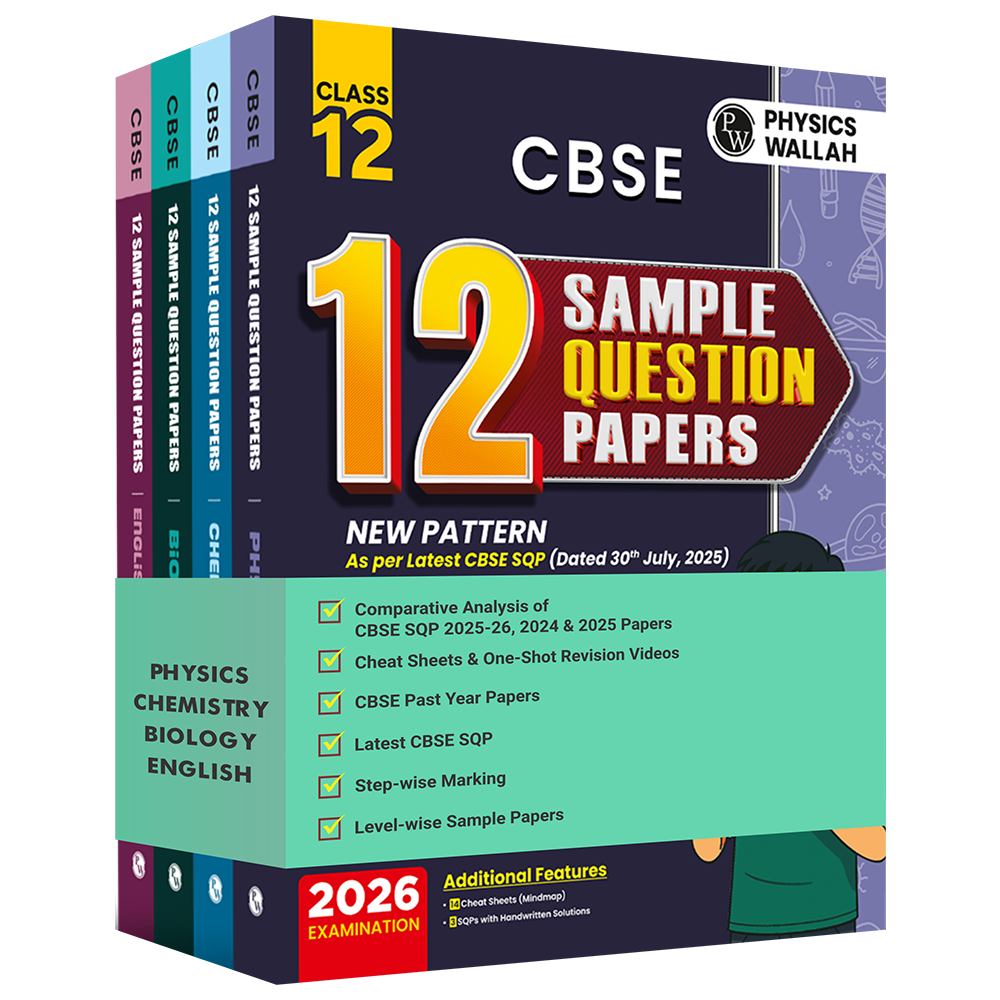
Recommended Books for Class 12 Board Exams:
- CBSE 15 Sample Question Papers Class 12 Chemistry
- CBSE 15 Sample Question Papers Class 12 PCME
- CBSE 15 Sample Question Papers Class 12 PCBE
- CBSE Class 12 Science Stream Combined 30 Sample Papers
Weightage of CBSE Class 12 Chemistry 2025-26 Chapter-Wise
In Chemistry, the theoretical part carries a weightage of 70 marks, while the practical part is responsible for the remaining 30 marks. The following table presents the CBSE Class 12 exam pattern for Chemistry chapters and the associated marking scheme. Check the table below for more information:
|
Chemistry Class 12 CBSE Chapter-wise Weightage |
|
|
Unit/Chapter |
Marks |
|
Solutions |
7 |
|
Electrochemistry |
9 |
|
Chemical Kinetics |
7 |
|
d- and f-Block Elements |
7 |
|
Coordination Compounds |
7 |
|
Haloalkanes and Haloarenes |
6 |
|
Alcohols, Phenols and Ethers |
6 |
|
Aldehydes, Ketones and Carboxylic Acids |
8 |
|
Amines |
6 |
|
Biomolecules |
7 |
|
Total |
70 |
CBSE Class 12 Chemistry 2023-24 Syllabus
The CBSE Board has published the revised CBSE Class 12 Chemistry Syllabus for the academic year 2023-24, specifically aimed at students in the science stream. The CBSE 12th Chemistry Syllabus for 2023-24 can be accessed on the official website @cbseacademic.nic.in.
It is imperative for Class 12 students preparing for the annual board exams to review the CBSE Class 12 Chemistry Syllabus for the 2023-24 session, as it offers insights into the types of questions that may appear in the exam. This comprehensive syllabus includes a breakdown of all the units, topics, and their respective weightage in terms of marks.
For the benefit of students, we have outlined the CBSE 12th Chemistry Syllabus for 2023-24, chapter by chapter. The CBSE Class 12 Chemistry Syllabus for 2023-24 serves as a valuable resource, aiding students in planning their study strategies. It assists them in identifying the topics that require greater focus to achieve higher marks.
Students are encouraged to thoroughly cover all the topics and chapters listed below well in advance of the main examinations, allowing ample time for effective revision. Check the table below for more details:
CBSE Class 12 Chemistry 2025-26 Syllabus
|
CBSE Class 12 Chemistry Syllabus 2025-26 Chapter-wise |
||
|---|---|---|
| Unit | Topic | Topics |
| 1 | Solid state | Classification Of Solids Based On Different Binding Forces- Molecular, Ionic, Covalent And Metallic Solids, Crystalline And Non-Crystalline Solids, Two Dimensional And Three Dimensional Crystal Lattice And Unit Cells, Packing Efficiency, Calculate Density Of Unit Cell, Packing Efficiency In Solid, Vacancies, Number Of Cells Per Unit In Cubic Unit Cell, etc. |
| 2 | Solution | Type of Solution, Expressing the Concentration of Solutions Formed from Solids in Liquids, Solubility of Gases in Liquids, Solid Solution, Atomic Number Property- Relative Pressure Of Vapor Pressure, Raoult’s Law. |
| 3 | Electrochemistry | Oxidation-Reduction Reactions, Specific And Molar Conductivity, Change In Conductivity Due To Change In Concentration, Conductivity In Electrolytic Solution, Kohlrausch’s Law, Galvanic Isolation And Its Laws, Dry Cell, Galvanic Cell, Relationship Between Gibb’s Free Energy And Change In EMF Of A Cell. Reaction Velocity- Average And Instantaneous, Factors Affecting Reaction Velocity- Concentration, Temperature, Catalyst, Order Of Reaction And Molecularity, Velocity Law And Specific Rate Constant, Integrated Velocity Equation And Half-Life. |
| 4 | d and f-block elements | Basic Introduction, Electronic Configuration, Characteristics And Availability Of Transition Metals, General Trend In Properties Of First Series Of Transition Metals, Metallic Properties, Oxidation State, Catalyst Properties, Preparation And Properties of K2Cr2O7 and KMnO4. Group 15 Elements- Basic Introduction, Electronic Configuration, Oxidation State, Availability, General Trend in Physical And Chemical Properties, Preparation Of Nitrogen, Properties And Applications, Preparation And Application Of Halides, etc. Group 16 Elements- Basic Introduction, Electronic Configuration, Oxidation State, Availability, General Trend in Physical & Chemical Properties, Preparation of Dioxygen, Properties & Applications, Preparation & Application of Sulphuric Acid, etc. Group 17 Elements- Basic Introduction, Electronic Configuration, Oxidation State, Availability, General Trend in Physical And Chemical Properties, Preparation Of Chlorine And Hydrochloric Acid, Properties And Applications. Group 18 Elements- Basic Introduction, Electronic Configuration, Oxidation State, Availability, General Trend in Physical And Chemical Properties, Application |
| 5 | Coordination Compounds | Introduction, Ligands, Coordination Number, Magnetic Properties Of Coordination Compound, IUPAC Nomenclature Rules Of Coordination Compounds, Bond, Werner Theory, VBT And CFT Structure And Stereoscopic Isomerism, Importance Of Co-Ordination Compound In Extraction And Qualitative Analysis Of Metals And In Biological System |
| 6 | Haloalkanes and Haloarenes | Haloalkane- Nomenclature, Nature of C-X Bond, Physical & Chemical Properties, Mechanism of Substitution Reactions, Polar Rotation Haloarene- Nature of C-X Bond, Substitution Reactions, Dichloromethane, Trichloromethane, Tetrachloromethane, Iodoform, Freons and DDT Usage and Effect On Environment |
| 7 | Alcohols, Phenols, and Ethers | Alcohol- Nomenclature, Method Of Preparation, Physical & Chemical Properties, Identification Of Primary, Secondary And Tertiary Alcohol, Dehydration Of Alcohol, Uses Of Methanol And Ethanol Phenol- Nomenclature, Method Of Preparation, Physical & Chemical Properties, Acidic Nature Of Phenol, Electron Substitution Reaction, Application Of Phenol Ether- Nomenclature, Method Of Preparation, Physical & Chemical Properties, Application |
| 8 | Aldehydes, Ketones, and Carboxylic Acids | Aldehyde & Ketone- Nomenclature, Nature of Carbonyl Group, Method of Preparation, Physical & Chemical Properties, Nucleophilic Addition Reactions of Aldehydes And Ketones, Aldehyde’s Alpha Hydrogen Activity, Application Carboxylic Acids- Nomenclature, Acidic Nature, Method of Preparation, Physical & Chemical Properties, Application |
| 9 | Amines (Organic Compounds containing Nitrogen) | Amines- Nomenclature, Classification, Structure, Method of Preparation, Physical & Chemical Properties, Identification of Primary, Secondary, and Tertiary Amines, and Cyanide and isocyanides. |
| 10 | Biomolecules | Carbohydrate- Classification (Aldose And Ketose), Monosaccharide (Glucose And Fructose), D-L Configuration, Oligosaccharide (Sucrose, Lactose, Maltose), Polysaccharide (Starch, Cellulose, Glycogen), Importance Protein- Primary Introduction Of Amino Acid, Peptide Bond, Polypeptide, Protein, Primary, Secondary, Tertiary And Quaternary Structure Of Protein, Deformation Of Proteins, Enzymes, Hormones Vitamin- Classification And Function Nucleic acid- DNA and RNA |
CBSE Class 12 Chemistry 2025-26 Practical Syllabus
Here is the practical syllabus for CBSE class 12 chemistry 2025-26:
|
CBSE Class 12 Chemistry Syllabus for Practical |
||
| S.No. | Practicals | |
| A. | Surface Chemisry | (a) Preparation of one lyophilic and one lyophobic sol Lyophilic sol - starch, egg albumin and gum Lyophobic sol - aluminium hydroxide, ferric hydroxide, arsenous sulphide. (b) Dialysis of sol-prepared in (a) above. (c) Study of the role of emulsifying agents in stabilizing the emulsion of different oils. |
| B. | Chemical Kinetics | (a) Effect of concentration and temperature on the rate of reaction between Sodium Thiosulphate and Hydrochloric acid. (b) Study of reaction rates of any one of the following: (i) Reaction of Iodide ion with Hydrogen Peroxide at room temperature using different concentrations of Iodide ions. (ii) Reaction between Potassium Iodate, (KIO3) and Sodium Sulphite: (Na2SO3) using starch solution as an indicator (clock reaction). |
| C. | Thermochemistry | Any one of the following experiments (a) Enthalpy of dissolution of Copper Sulphate or Potassium Nitrate. (b) Enthalpy of neutralization of strong acid (HCl) and strong base (NaOH). (c) Determination of enthalpy change during interaction (Hydrogen bond formation) between Acetone and Chloroform. |
| D. | Electrochemistry | Variation of cell potential in Zn/Zn2+|| Cu2+/Cu with change in concentration of electrolytes (CuSO4 or ZnSO4) at room temperature. |
| E. | Chromatography | (a) Separation of pigments from extracts of leaves and flowers by paper chromatography and determination of Rf values. (b) Separation of constituents present in an inorganic mixture containing two cations only (constituents having large differences in Rf values to be provided). |
| F. | Preparation of Inorganic Compounds | Preparation of double salt of Ferrous Ammonium Sulphate or Potash Alum. Preparation of Potassium Ferric Oxalate. |
| G. | Preparation of Organic Compounds | Preparation of any one of the following compounds i) Acetanilide ii) Di -benzalAcetone iii) p-Nitroacetanilide iv) Aniline yellow or 2 - Naphthol Aniline dye. |
| H. | Tests for the functional groups present in organic compounds: | Unsaturation, alcoholic, phenolic, aldehydic, ketonic, carboxylic and amino (Primary)groups. |
| I. | Characteristic tests of carbohydrates, fats and proteins in pure samples and their detection in given foodstuffs. | |
| J. | Determination of concentration/ molarity of KMnO4 solution by titrating it against a standard solution of | (a) Oxalic acid, (b) Ferrous Ammonium Sulphate (Students will be required to prepare standard solutions by weighing themselves). |
| K. | Qualitative analysis | Determination of one anion and one cation in a given salt: Cation: Pb2+, Cu2+ As3+, Aℓ3+ , Fe3+, Mn2+, Zn2+, Ni2+, Ca2+, Sr2+, Ba2+, Mg2+, NH4+ Anions: (CO3)2- , S2- , (SO3)2-, (NO2)- , (SO4)2- , Cℓ- , Br- , I- , (PO4)3- , (C2O4)2- , CH3COO- , NO3- |
Surface Chemistry
-
Creation of a lyophilic and a lyophobic sol:
-
Lyophilic sol examples include starch, egg albumin, and gum.
-
Lyophobic sol examples are aluminium hydroxide, ferric hydroxide, and arsenic sulphide.
-
Dialysis of the sols created.
-
Examination of the role of emulsifying agents in stabilising oil emulsions.
Chemical Kinetics
-
Investigation of how concentration and temperature impact the reaction rate between Sodium Thiosulfate and Hydrochloric acid.
-
Assessment of reaction rates for one of the following:
-
Iodide ion reaction with Hydrogen Peroxide at room temperature using varying Iodide ion concentrations.
-
Reaction between Potassium Iodate (KIO₃) and Sodium Sulphite (Na₂SO₃) using starch solution as an indicator (clock reaction).
Thermochemistry
-
Choice of one experiment from the following:
-
Determining the enthalpy of dissolution of Copper Sulphate or Potassium Nitrate.
-
Determining the enthalpy of neutralisation of hydrochloric acid (HCl) and sodium hydroxide (NaOH).
-
Determining the enthalpy change during the interaction (hydrogen bond formation) between Acetone and Chloroform.
Electrochemistry
-
Exploration of cell potential variation in Zn/Zn²⁺|| Cu²⁺/Cu with changes in the concentration of electrolytes (CuSO₄ or ZnSO₄) at room temperature.
Chromatography
-
Separation of pigments from leaf and flower extracts using paper chromatography and calculating Rf values.
-
Separation of constituents in an inorganic mixture containing two cations with substantial differences in Rf values.
Preparation of Inorganic Compounds
-
Preparation of a double salt of Ferrous Ammonium Sulphate or Potash Alum.
-
Preparation of Potassium Ferric Oxalate.
Preparation of Organic Compounds
-
Preparation of one of the following compounds:
-
Acetanilide.
-
Di-benzalAcetone.
-
p-Nitroacetanilide.
-
Aniline yellow.
-
2-Naphthol Aniline dye.
-
Testing for functional groups in organic compounds, including unsaturation, alcoholic, phenolic, aldehydic, ketonic, carboxylic, and amino (primary) groups.
-
Characteristic tests for carbohydrates, fats, and proteins in pure samples and detecting them in provided food items.
Determination of Concentration/Molarity
-
Determining the concentration/molarity of KMnO4 solution by titrating it against a standard solution of:
-
Oxalic acid.
-
Ferrous Ammonium Sulphate.
Qualitative Analysis
-
Identifying one cation and one anion in a given salt:
-
Cations – Pb²⁺, Cu²⁺, As³⁺, Al³⁺, Fe³⁺, Mn²⁺, Zn²⁺, Ni²⁺, Ca²⁺, Sr²⁺, Ba²⁺, Mg²⁺, NH⁴⁺.
-
Anions – (CO₃)²⁻, S²⁻, (SO₃)²⁻, (NO₂)⁻, (SO₄)²⁻, Cl⁻, Br⁻, I⁻, (PO₄)³⁻, (C₂O₄)²⁻, CH₃COO⁻, NO³⁻.
CBSE Class 12 Chemistry 2025-26 Project
-
Investigation of the presence of oxalate ions in guava fruit at various ripening stages.
-
Determination of casein content in different milk samples.
-
Preparation of soyabean milk and comparison with natural milk concerning curd formation and the impact of temperature.
-
Study of the effectiveness of Potassium Bisulfate as a food preservative under different conditions (temperature, concentration, time, etc.).
-
Investigation of starch digestion by salivary amylase and the effects of pH and temperature.
-
Comparative analysis of the fermentation rate of materials such as wheat flour, gram flour, potato juice, carrot juice, etc.
-
Extraction of essential oils from aniseed, carum, and cardamom.
-
Study of common food adulterants in fat, oil, butter, sugar, turmeric powder, chilli powder, and pepper.
CBSE Class 12 Chemistry 2025-26 Deleted Syllabus
The CBSE board has published the most recent syllabus for senior secondary students studying Chemistry, along with other Science stream subjects on their official academic website. In the aftermath of the pandemic, the syllabus has been updated for various subjects, with the intention of reverting to the traditional annual board examination format. Below, you will find the CBSE Class 12 Chemistry Revised Syllabus for the 2025-26 academic year, presented in a tabular format that lists the omitted topics unit by unit and chapter by chapter.
|
CBSE Class 12 Chemistry Deleted Syllabus 2025-26 |
||
| Chemistry Part 1 | ||
| Units | Page No. | Dropped Topics/Chapters |
| Unit 1: The Solid State | 1–34 | Full Chapter |
| Unit 5: Surface Chemistry | 123–148 | Full Chapter |
| Unit 6: General Principles and Processes of Isolation of Elements | 149–169 | Full Chapter |
| Unit 7: The p-Block Elements | 170–214 | Full Chapter |
| Chemistry Part 2 | ||
| Unit 15: Polymers | 433–446 | Full Chapter |
| Unit 16: Chemistry in Everyday Life | 447–463 | Full Chapter |
CBSE Class 12 Chemistry 2025-26 Sample Paper
CBSE Class 12 Chemistry sample papers serve as a valuable resource for students, offering them a preliminary understanding of the final examination. These chemistry questions, designed in line with the CBSE Class 12 Syllabus, encompass a range of difficulty levels, ensuring comprehensive coverage. Our subject matter experts have thoughtfully solved the Class 12 CBSE Chemistry Sample Question Paper with Solutions, making it easily comprehensible for students. Check the table below for more details:
CBSE Class 12 Chemistry 2023-24 Preparation Tips
Preparing for CBSE Class 12 Chemistry can be a challenging task, but with the right strategies and focus, you can excel in the subject. Here are some highly specific and relevant tips to help you prepare effectively for your CBSE Class 12 Chemistry exams:
-
Understand the Syllabus: Begin your preparation by thoroughly understanding the CBSE Class 12 Chemistry syllabus. This will give you a clear idea of what topics you need to cover.
-
Organise Your Study Material: Organise your textbooks, notes, and reference materials in a systematic manner. Ensure you have easy access to important formulas, diagrams, and reactions.
-
Master the Basics: Chemistry is built on fundamental concepts. Make sure you have a strong grasp of concepts like the periodic table, chemical bonding, stoichiometry, and atomic structure. These are the foundation of more complex topics.
-
Practice Regularly: Chemistry requires regular practice. Solve a wide variety of problems, especially numerical and chemical equations. This will help you become comfortable with the application of concepts.
-
Study In-Depth: Don't just memorise. Understand the underlying principles. For example, when studying organic chemistry, understand reaction mechanisms and how different functional groups interact.
-
Use Mnemonics and Visual Aids: Chemistry involves a lot of information, including chemical reactions, formulas, and nomenclature. Mnemonics and visual aids like charts and diagrams can help you remember complex information easily.
-
Balancing Chemical Equations: Practise balancing chemical equations until you can do it quickly and accurately. This skill is fundamental and comes up in many topics, including stoichiometry and chemical kinetics.
-
Chemical Nomenclature: Pay special attention to chemical nomenclature, which involves naming compounds and understanding their formulas. Practise this regularly to avoid confusion during exams.
-
Electrochemistry: Understand the concepts of electrochemistry thoroughly, including cell potential, electrolysis, and the Nernst equation. These are often challenging topics for students.
-
Spectroscopy and Analytical Chemistry: Be sure to practise problems related to spectroscopy, chromatography, and other analytical techniques. These are significant parts of the CBSE Class 12 Chemistry syllabus.
-
Environmental Chemistry: Environmental chemistry is a relevant and often overlooked topic. Study the concepts related to environmental pollution, greenhouse gases, and their impact on the environment.
-
Chemical Kinetics: This topic deals with reaction rates and mechanisms. Understand the factors affecting reaction rates and practice solving problems related to kinetics.
-
Reference Books: While NCERT textbooks are essential, you can also refer to supplementary textbooks like Pradeep's Chemistry, OP Tandon, and P. Bahadur for additional practice and explanations.
-
Previous Year Question Papers: Solve previous year question papers and sample papers to get a feel for the exam pattern. This will also help you identify important topics and trends.
Read More: CBSE Class 12 Chemistry Chapter-Wise PYQs
CBSE Class 12 Chemistry 2025-26 FAQs
Q1: What is the CBSE Class 12 Chemistry syllabus for 2025-26?
Ans: The CBSE Class 12 Chemistry syllabus for 2025-26 has 10 units and covers a wide range of topics, including solutions, electrochemistry, chemical kinetics, d- and f-block elements, coordination compounds, haloalkanes and haloarenes, alcohols, phenols and ethers, aldehydes, ketones and carboxylic acids, amines, and biomolecules.
Q2: What should I do if I am struggling in CBSE Class 12 Chemistry?
Ans: If you are struggling in CBSE Class 12 Chemistry, don't hesitate to seek help from your teacher, a tutor, or a classmate. You can also find many helpful resources online. The most important thing is to not give up and keep practising until you understand the concepts and can solve the problems.
Q3. What are the important tips for preparing for the CBSE Class 12 Chemistry exam?
Ans: Start early, revise regularly, understand concepts thoroughly, solve previous year question papers and sample papers, practice answering questions in the correct format, and take care of your health.
Q5. What are the passing marks for CBSE Class 12 Chemistry?
Ans: The passing marks for CBSE Class 12 Chemistry are 33% for each of the theory and practical exams. However, students are advised to aim for higher marks in order to secure good grades and college admissions.