NCERT Solutions for Class 12 Maths Chapter 5 Exercise 5.7 Continuity and Differentiability

Class 12 Maths Chapter 5 Exercise 5.7 – Continuity and Differentiability
Class 12 Maths Chapter 5, Continuity and Differentiability, is one of the most important chapters for board exams as well as competitive exams. Class 12 Maths Chapter 5 Ex 5.7 mainly focuses on testing a student’s understanding of continuity, differentiability, and different methods of differentiation. This exercise helps students apply concepts rather than just learning formulas.
In Ex 5.7 Class 12, students are asked to find derivatives of complex functions using rules like the chain rule, implicit differentiation, and logarithmic differentiation. Some questions also check whether a function is continuous and differentiable at a given point. Practising class 12 maths exercise 5.7 improves clarity in handling higher-order problems.
Exercise 5.7 Class 12 Maths is important because it builds a strong base for topics like applications of derivatives and integrals. Students who understand this exercise well often find later chapters easier. For students preparing for exams, exercise 5.7 class 12 solutions are very helpful. They provide clear, step-wise explanations following the NCERT marking scheme. Using ex 5.7 class 12 maths NCERT solutions helps students avoid common mistakes and write accurate answers in exams.
You can refer to class 12 maths exercise 5.7 solutions to revise key concepts before tests or pre-boards. These solutions explain each question in an easy manner, making them suitable for all learners. Overall, class 12 maths ch 5 ex 5.7 is essential for scoring well in mathematics and understanding calculus concepts deeply.
Check out: CBSE Class 12th Books
NCERT Solutions for Class 12 Maths Chapter 5 Exercise 5.7 Continuity and Differentiability
Check out the NCERT Solutions for Class 12 Maths Chapter 5 Exercise 5.7 Continuity and Differentiability below:-
Find the second order derivatives of the functions given in Exercises 1 to 5.
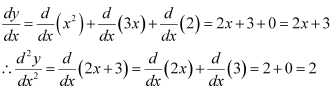
Question 1. x2 + 3x + 2
Solution :
Let y = x2 + 3x + 2
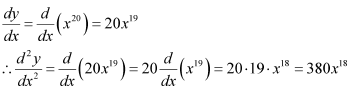
Question 2. x20
Solution :
Let x20
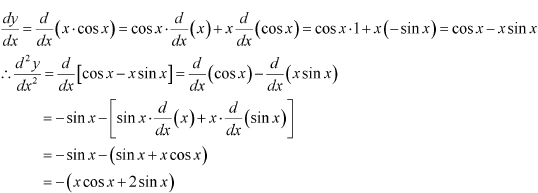
Question 3. x.cos x
Solution :
Let x. cos x
Check out: NCERT Solutions for Class 12 Maths Chapter 5 Exercise 5.1
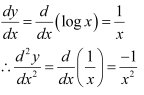
Question 4. log x
Solution :
Let log x
Check out: NCERT Solutions for Class 12 Maths Chapter 5 Exercise 5.2
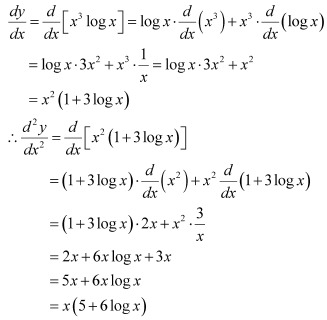
Question 5. x3 log x
Solution :
Let x3 log x
Find the second order derivatives of the functions given in Exercises 6 to 10.
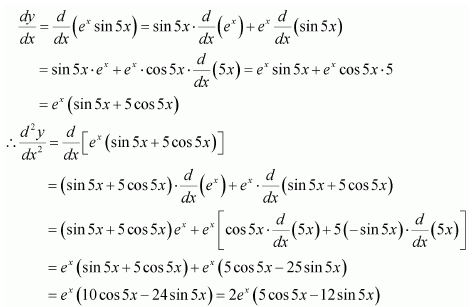
Question 6. ex sin 5x
Solution :
Let ex sin 5x
Check out: NCERT Solutions For Class 12 Maths Chapter 5 Exercise 5.5
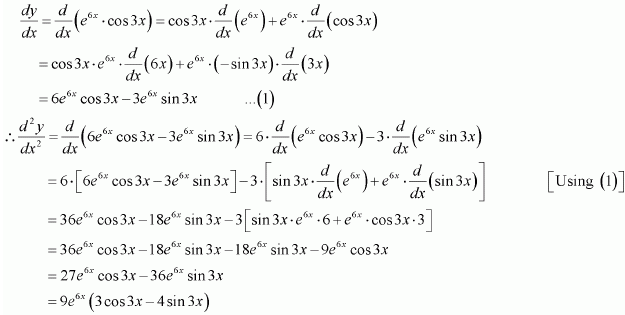
Question 7. e6x cos x
Solution :
Let e6x cos x
Check out: NCERT Solutions For Class 12 Maths Chapter 5 Exercise 5.6
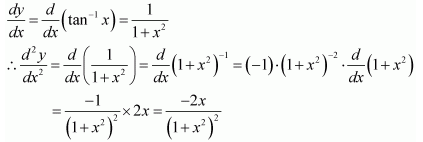
Question8. tan-1 x
Solution :
Let tan-1 x
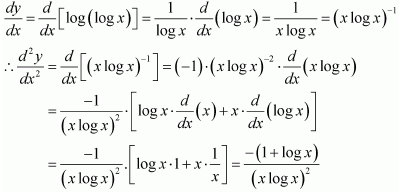
Question9. log (log x)
Solution :
Let log (log x)
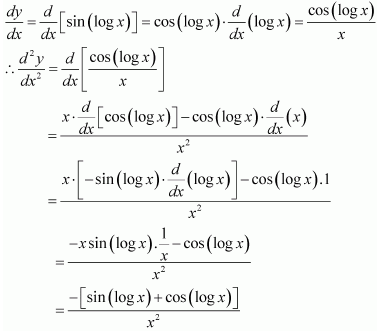
Question10. sin(log x)
Solution :
Let sin (log x)
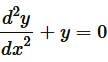
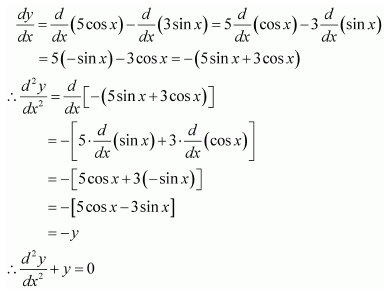
Question11. If y = 5 cos x – 3 sin x prove that
Solution :
Let y = 5 cos x – 3 sin x
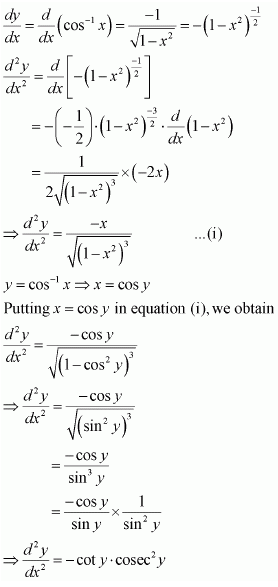
Question12. If y = cos-1 x Find 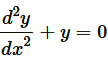
Solution :
Given: y = cos-1 x
Question13. If y = 3 cos (log x) + 4 sin (log x), show that x2y2 + xy1 + y = 0
Solution :
Given: y = 3 cos (log x) + 4 sin (log x)
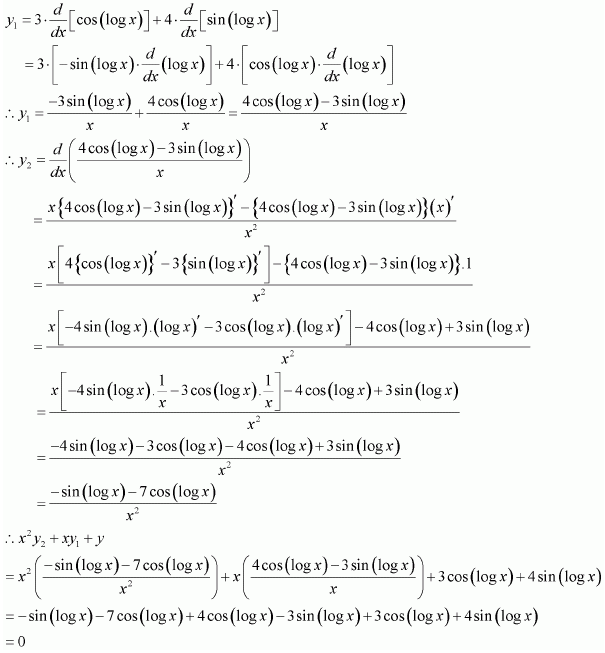
Hence proved.
Check out: Class 12th Sample Papers
Question14. If y = Aemx + Benx show that

Solution :
Given: y = Aemx + Benx
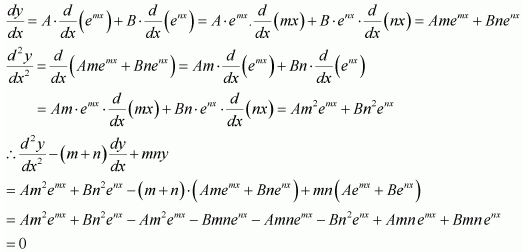
Hence proved.
Question15. If 500e7x + 600e-7x show that 
Solution :
Given: 500e7x + 600e-7x
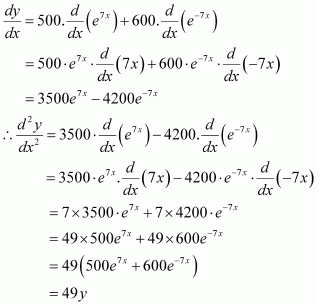
Hence proved.
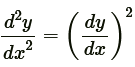
Question16. If ey (x + 1) = 1, show that
Solution :
Given: ey (x + 1) = 1

Taking log on both sides,

Differentiating this relationship with respect to x, we obtain
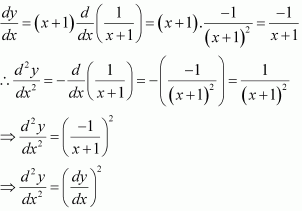
Hence proved.
Question17. If y = (tan-1 x)2 show that (x2 + 1)2y2 + 2(x2 + 1)y1 = 2
Solution :
Given: y = (tan-1 x)2
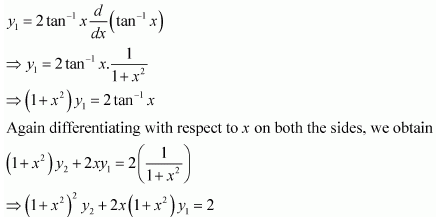
Hence proved.
Check out: Class 12th Question Banks
Class 12 Maths Chapter 5 Exercise 5.7 Continuity and Differentiability Summary
In Exercise 5.7, the focus is on advanced concepts of continuity and differentiability. Here’s a summary to help you understand the key points:
Key Concepts:
-
Continuity at a Point:
-
A function f(x)f(x)f(x) is continuous at x=cx = cx=c if limx→cf(x)=f(c)\lim_{{x \to c}} f(x) = f(c)limx→cf(x)=f(c).
-
This implies there are no breaks, jumps, or holes in the graph of the function at x=cx = cx=c.
-
Differentiability at a Point:
-
A function f(x)f(x)f(x) is differentiable at x=cx = cx=c if limh→0f(c+h)−f(c)h\lim_{{h \to 0}} \frac{f(c+h) - f(c)}{h}limh→0hf(c+h)−f(c) exists.
-
Differentiability implies continuity, but the reverse is not always true.
-
Chain Rule:
-
If y=f(u)y = f(u)y=f(u) and u=g(x)u = g(x)u=g(x), then dydx=dydu⋅dudx\frac{dy}{dx} = \frac{dy}{du} \cdot \frac{du}{dx}dxdy=dudy⋅dxdu.
-
This rule is essential for finding the derivative of composite functions.
-
Implicit Differentiation:
-
Used when the function is not explicitly solved for one variable in terms of the other.
-
For example, if xxx and yyy are related by an equation, differentiate both sides with respect to xxx and solve for dydx\frac{dy}{dx}dxdy.
-
Logarithmic Differentiation:
-
Useful for functions of the form y=[f(x)]g(x)y = [f(x)]^{g(x)}y=[f(x)]g(x).
-
Take the natural logarithm of both sides, then differentiate.
Class 12 Maths Chapter 5 Exercise 5.7 Continuity and Differentiability FAQs
-
What is the Intermediate Value Theorem?
Ans. The Intermediate Value Theorem states that if a function f(x)f(x)f(x) is continuous on the interval [a,b][a, b][a,b] and NNN is any number between f(a)f(a)f(a) and f(b)f(b)f(b), then there exists a point ccc in [a,b][a, b][a,b] such that f(c)=Nf(c) = Nf(c)=N.
-
What is Rolle’s Theorem?
Ans. Rolle’s Theorem states that if a function f(x)f(x)f(x) is continuous on [a,b][a, b][a,b], differentiable on (a,b)(a, b)(a,b), and f(a)=f(b)f(a) = f(b)f(a)=f(b), then there exists at least one point ccc in (a,b)(a, b)(a,b) where f′(c)=0f'(c) = 0f′(c)=0.
-
What is the Mean Value Theorem?
Ans. The Mean Value Theorem states that if a function f(x)f(x)f(x) is continuous on [a,b][a, b][a,b] and differentiable on (a,b)(a, b)(a,b), then there exists at least one point ccc in (a,b)(a, b)(a,b) such that f′(c)=f(b)−f(a)b−af'(c) = \frac{f(b) - f(a)}{b - a}f′(c)=b−af(b)−f(a).
-
How do you prove that a function is continuous at a point?
Ans. To prove that a function is continuous at a point x=cx = cx=c, show that f(c)f(c)f(c) is defined, limx→cf(x)\lim_{x \to c} f(x)limx→cf(x) exists, and limx→cf(x)=f(c)\lim_{x \to c} f(x) = f(c)limx→cf(x)=f(c).
-
How do you determine points of discontinuity?
Ans. To determine points of discontinuity, identify where the function fails to meet the criteria for continuity. Check for points where the function is not defined, where the limit does not exist, or where the limit does not equal the function’s value at that point.