CBSE Class 10 Science Notes Chapter 10 Light – Reflection and Refraction
CBSE Class 10 Science Chapter 10 covers one of the most important topics in Physics—Light: Reflection and Refraction. These light reflection and refraction class 10 notes are designed to help students understand every concept in a simple and clear way. Whether you are revising before exams or preparing chapter-wise, these notes will make learning easier.
Our class 10th light reflection and refraction notes follow the latest NCERT and CBSE syllabus. They explain key concepts like reflection of light class 10 notes, types of mirrors, image formation, rules of reflection, and real-life applications. Students will also learn what is refraction class 10, bending of light, refractive index, laws of refraction, and how lenses form images. These explanations are supported with diagrams and simple examples to remove doubts quickly.
These class 10 light reflection and refraction notes are created by subject experts to help students strengthen their understanding. Each topic is covered step by step so that learners can revise important formulas, definitions, and diagrams without confusion. Chapter 10 is important not only for board exams but also for higher classes. That is why our light reflection and refraction notes focus on conceptual learning rather than memorisation. Students will find these notes explained in a neat and structured manner.
By using these class 10 chapter 10 science notes, students can save time, revise effectively, and clear their fundamentals thoroughly. These NCERT-based notes make exam preparation smooth, organised, and stress-free, helping every learner achieve better results.
Check Out: CBSE Class 10 Books
CBSE Class 10 Science Notes Chapter 10
Light
One type of energy that gives us the ability to perceive things is light. Light originates from a source, reflects off of objects that our eyes detect, and is then processed by our brain to allow us to see. According to Maxwell's theory, waves made up of electric and magnetic fields travel at the speed of light. As a result, Maxwell postulated that electromagnetic waves carry light, indicating that light is a type of radiation.Nature of Light
Light behaves as a:- ray, e.g. reflection
- wave, e.g. interference and diffraction
- particle, e.g. photoelectric effect
Laws of Reflection
Light Incident on the Surface Separating Two Media
Light moves in one of two ways when it moves between media:- gets absorbed (absorption)
- bounces back (reflection)
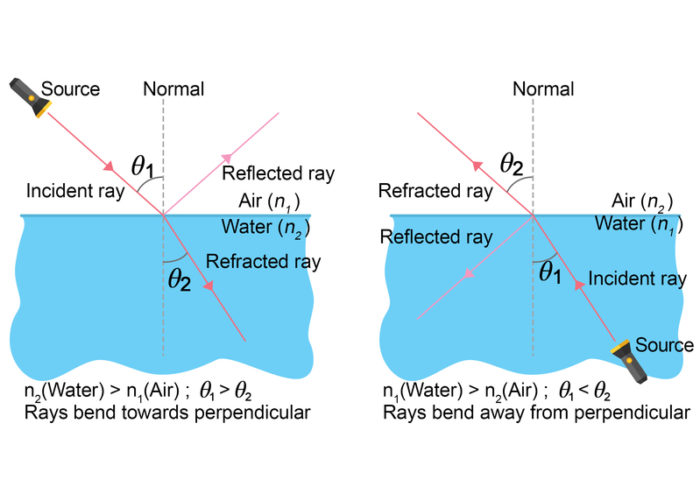
- passes through or bends (refraction)
Check Out: CBSE Class 10 Sample Papers
Characteristics of Light
The formula for the speed of light is c=λμ, where λ stands for wavelength and μ for frequency. The constant speed of light is 2.998×10⁸m/s, or around 3.0×10⁸m/s.Reflection of Light by Other Media
Regular light reflection results from a medium with a well-polished surface free of flaws. Take a plane mirror, for instance. Even yet, the surface still absorbs some light.Laws of Reflection
The incident ray, reflected ray and the normal all lie in the same plane. Angle of incidence = Angle of reflection [ ∠ i = ∠ r ]Fermat’s Principle
The least-time principle states that light always chooses the fastest route between any two points, even if it's not the shortest one. Fermat's principle of least time can be used to support the law of reflection [−i=−r] and the rectilinear propagation of light.Applications of Fermat’s Principle
Fermat's Principle allows us to make several observations that will be helpful as we go more into the field of geometric optics: Light beams in a homogenous medium are rectilinear. That is, light moves in a straight line through any medium where the index of refraction is constant. An angle of incidence and reflection on a surface are equal. The Law of Reflection is this.Example of Fermat’s Principle
One illustration of this phenomenon is Mirage. On occasion, we may perceive water on the route, but upon arrival, we find that it is dry. The light from the sky that is reflected on the road is what we see. Since it is colder higher up, the air is much hotter just over the road. Because hot air is thinner and expands faster than cool air, the speed of light decreases less.Image Formation by a Plane Mirror
A planar mirror always creates an erect, imaginary picture. Both the image and the object are equally spaced from the mirror.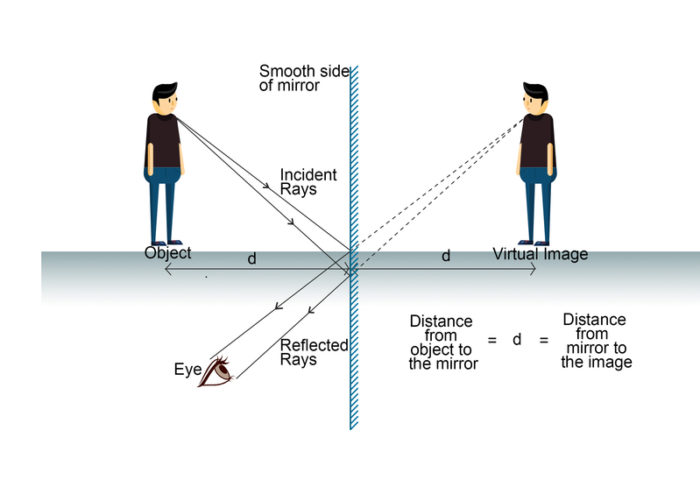
Characteristics of Images
Pictures can be virtual or actual, upright or upside down, and enlarged or smaller. The actual convergence of light beams creates a real image. An apparent convergence of light beams that are diverging is called a virtual picture. An image is said to be either inverted or upright depending on whether it is generated upside down. Magnified refers to a picture generated that is larger than the object. It is diminished if the produced picture is smaller than the object.Rules of Ray Diagram for Representation of Images Formed
When a ray strikes the concave spherical mirror while traveling through the center of curvature, it retraces its route. The focus or focal point is traversed by rays that are parallel to the primary axis.Image Formation by Spherical Mirrors
The ray diagrams for the special two rays can be used to find the image created for objects at different places. The concave mirror is shown in the following table.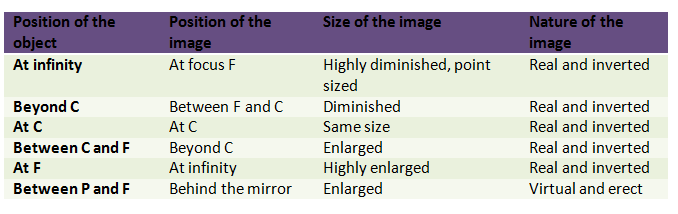


Mirror Formula and Magnification
| 1/v + 1/u = 1/f |
Sign Convention for Ray Diagram
The coordinate system's positive x and y axes represent distances, while the negative x and y axes represent distances. Remember that the pole (P) is the origin. In most cases, an object's height is measured as positive when it is above the principal axis, while an image's height is measured as negative when it is below the principal axis.Check Out: CBSE Class 10 Question Banks
Refraction Through a Glass Slab and Refractive Index
Refraction
Not always is the shortest path the fastest. Since light travels at the fastest possible speed, it bends when it passes through different materials. Refraction is the term used to describe the phenomena of light bending in a different medium.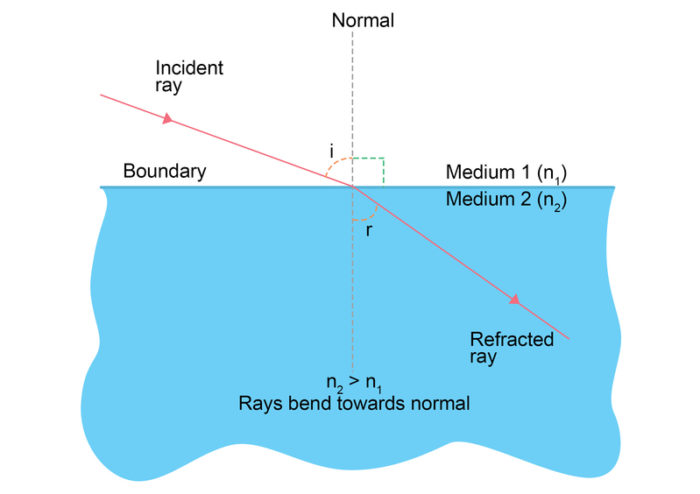
Laws of Refraction
At the point of incidence, the incident ray, refracted ray, and normal to the interface of two transparent media all lie in the same plane. For a given pair of media and a given colour of light, the ratio of the sines of the angles of incidence and refraction is constant. Snell's law of refraction is another name for this law.Refractive Index
The refractive index measures how much light bends when it passes through different materials. The ratio of the speeds in the two media determines this. The amount of bending increases with the ratio. In addition, it is the constant ratio between the sines of the angles of incidence and refraction for each given pair of media. It is indicated by: n = sin∠i/sin∠r = speed of light in medium 1/speed of light in medium2. The relative refractive index is the product of the speed of monochromatic light in the substance of interest and the speed of light in a vacuum. In mathematical notation, it is expressed as: n = c/v where v is the light's velocity within that specific medium, c is the light's velocity in a vacuum, and n is the medium's refractive index.Image Formation by Spherical Lenses
A convex lens's ability to generate images is displayed in the table below.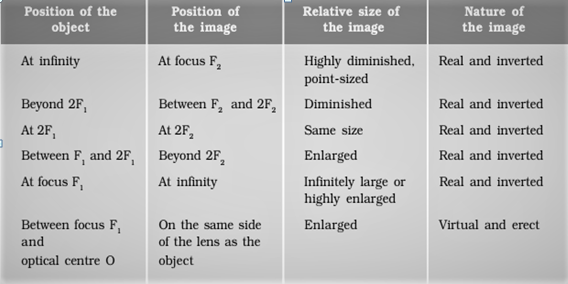
Sign Convention for Reflection by Spherical Mirror
The item is positioned with the mirror on the left. The mirror's pole is the starting point for all measurements of lengths parallel to the major axis. All distances measured along the X-axis and in the direction of the incident ray are considered positive, whereas all distances measured along the X-axis and in the opposite direction of the incident ray are considered negative. Measurements of distance above and perpendicular to the primary axis are interpreted as positive. Measurements taken below and perpendicular to the primary axis are interpreted as negative.
Power of a Lens
A lens's power is equal to 1/f (in metres), which is the reciprocal of its focal length. The dioptre (D) is the SI unit of power for a lens.Check Out: CBSE Class 10 Previous Year Papers
How to Use CBSE Class 10 Notes Effectively
-
Read the Chapter First: Begin by reading the complete chapter from your textbook. For example, in Science Chapter 10 (Light – Reflection and Refraction), understand their functions, importance, and challenges.
-
Use Notes for Quick Revision: After reading the chapter, go through the CBSE Class 10 notes. They simplify the concepts and highlight the main ideas clearly.
-
Focus on Important Points: Pay attention to key terms, definitions, and examples in the notes—such as different types of political parties or their role in democracy.
-
Practice with Questions: Solve textbook exercises and previous year questions while referring to PW CBSE Class 10 notes. This helps in better understanding and long-term memory.
-
Create Short Summaries: Write brief summaries in your own words based on the notes. For example, summarise the importance or functions of political parties in a few lines.
-
Revise Regularly: Read the notes frequently to keep the concepts fresh. Regular revision is helpful for all subjects, especially chapters with many facts like History or Science.
Read More: NCERT Solutions for Class 10 Science Chapter 10 Light Reflection and Refraction
CBSE Class 10 Science Notes Chapter 10 FAQs
1. What is covered in Chapter 10 of Class 10 Science?
Chapter 10 focuses on Reflection and Refraction of light. It explains laws of reflection, image formation by mirrors, refraction, refractive index, and how lenses form images.
2. What is the difference between reflection and refraction?
Reflection is when light bounces back from a surface.
Refraction is when light bends while passing from one medium to another, like air to water.
3. Why is refraction important in daily life?
Refraction helps us see clearly through glasses, microscopes, telescopes, and even the human eye. It is also responsible for effects like a pencil appearing bent in water.
4. What are real and virtual images in mirrors and lenses?
A real image is formed when light rays actually meet (seen on a screen).
A virtual image is formed when light rays only appear to meet (seen in mirrors).
5. Are formulas important in this chapter?
Yes. Formulas like magnification, refractive index, and mirror/lens formulas are frequently asked in exams. Understanding them makes numerical problems easier.