How to Practise Science Questions for Class 10 Board?

The board exams at the end of class 10 are the first big test in a student's academic career. You need to be ready from the beginning of the session if you want to get a high percentage, not just in the last few months. Physics, Chemistry, and Biology are three subjects that you need to know a lot about if you want to study science. A lot of students get the ideas, but many have trouble putting their responses in the right order according to the marking scheme. A good CBSE class 10 question bank science is just what you need right now. It helps you connect what you know about theory with how to use it on the test, so you'll never be startled by the questions.
Check Out: CBSE Class 10th Books
How to Choose the Right CBSE Class 10 Question Bank Science?
With the 2026 boards introducing a higher weightage for competency-based questions, your study material must be up-to-date. A standard question bank 2026 is designed to align with these latest changes. It ensures that you aren't just memorizing definitions but learning to apply Science to real-life scenarios.
For a subject like Science, your practise needs to be diverse. You need numerical practise for Physics (like Mirror and Lens formulas), equation-balancing for Chemistry, and diagram-labelling for Biology. A dedicated CBSE class 10 chapter wise question bank allows you to master one topic at a time before moving to the next.
Features of CBSE Class 10 Science Question Bank
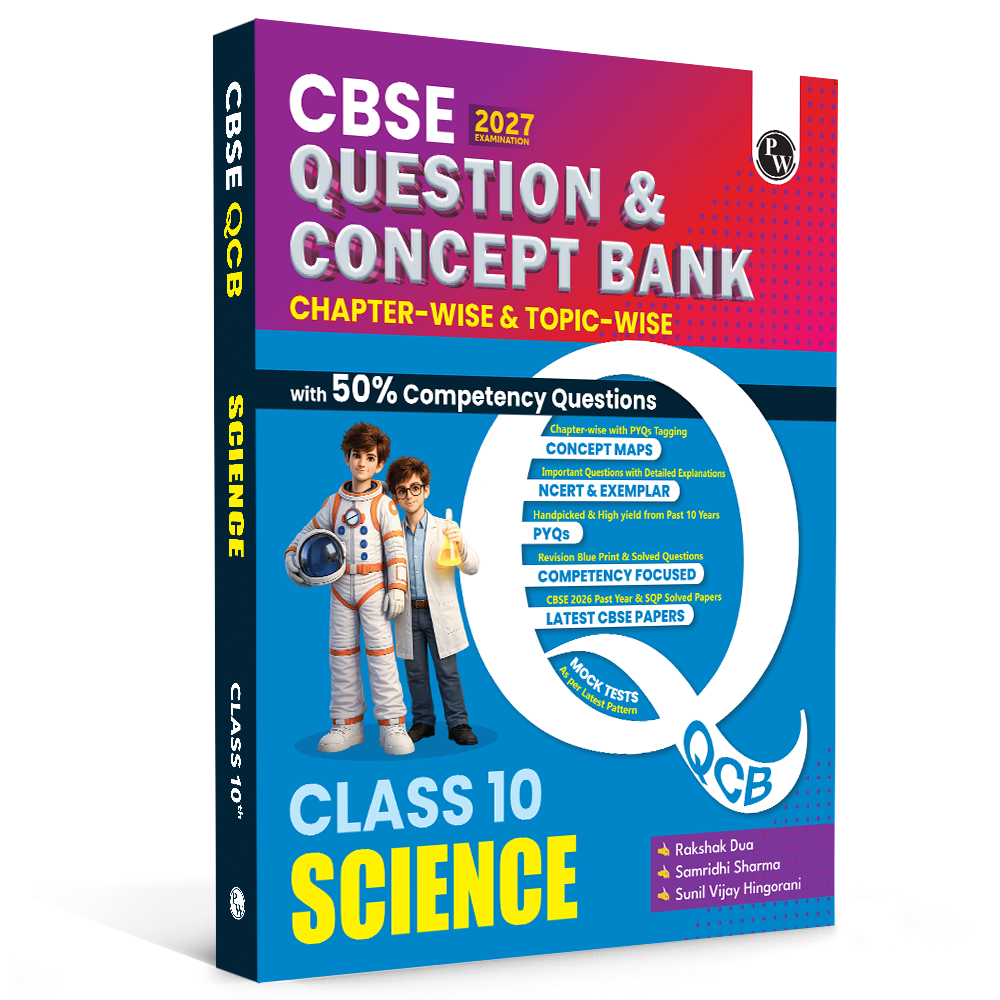
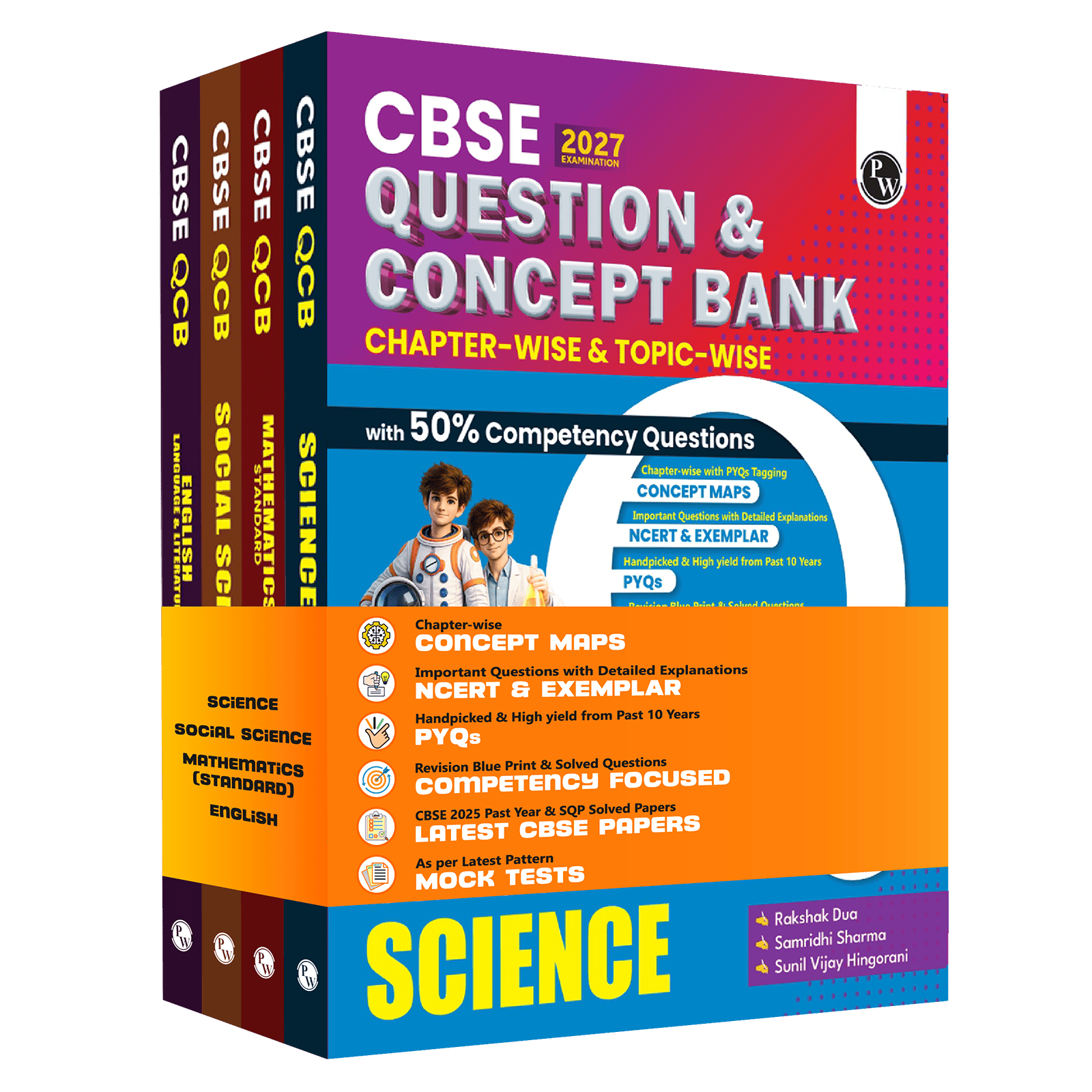
Physics Wallah has designed CBSE Class 10 Science question bank to act as a complete mentor. Based on the latest curriculum, here are the standout features:
|
Feature |
What it Offers |
|
Question-Answer Style Theory |
Concepts are explained in a Q&A format so you learn "how to write" while you study. |
|
Guru Gyan |
Expert tips and shortcuts shared by top teachers to solve tricky problems quickly. |
|
NCERT Integration |
Covers NCERT Intext, Exercise, and Exemplar questions in one place. |
|
Competency-Based Questions |
A significant portion of the book focuses on high-order thinking and case-study questions. |
|
Mind Maps |
13 detailed mind maps for quick visual revision of entire chapters. |
|
Special "Gem" Questions |
Handpicked high-probability, exam-focused questions |
|
Previous Year Questions |
Includes PYQs and sample papers to give real exam-level practise and improve accuracy |
How to Use a Question Bank to Practise Science?
Using a science question bank effectively requires a strategy. Here is how you can use the specific features of the bank to boost your score:
Practise Competency-Based Questions
The 2026 exam pattern emphasizes 50% competency-based questions. These aren't direct questions from the book. By practising these specifically from the CBSE Class 10 question bank, you learn to analyze diagrams and data-based scenarios, which are common in the Biology and Physics sections.
Revise Quickly with Mind Maps
Visual memory is stronger than rote learning. Before starting a practise session, look at the Chapter-wise Mind Maps. This helps you remember the link between different topics, such as how "Refraction" leads to "Atmospheric Phenomena."
Learn Tricks from Guru Gyan
In science, students regularly lose points for things like forgetting to put units in Physics problems or not balancing a chemical equation. The Guru Gyan sections act as a teacher's voice, reminding you of these common mistakes so you don't repeat them during the exam.
Why Use a CBSE Class 10 Question Bank for Board Exams
Textbooks like NCERT provide you the basics, but a question bank is like a specialized practise book. It changes the way you read from passive to active. Here is why you can't live without them:
-
Understand the Exam Pattern Better: The board exam isn't just about what you know, but how you answer. Question banks include MCQs, Assertion-Reasoning, and Case-Based questions that mirror the actual paper.
-
Revise Weak Chapters Easily: Instead of re-reading 200 pages, you can use a CBSE question bank class 10 to solve specific problems from your weakest chapters.
-
Learn How to Write Answers Properly: Most question banks provide topper-style answers, showing you exactly how many points to write for a 3-mark or 5-mark question.
-
Build Confidence with Regular Practise: Solving hundreds of questions throughout the year removes the "exam phobia" often associated with Science.
-
Use Along with NCERT for Better Results: While NCERT textbooks help you understand concepts, a science question bank focuses on application. Together, they create a balanced preparation strategy where you learn first and then practise effectively.
-
Practise with Previous Year Questions (PYQs): Many question banks include previous year questions (PYQs) and sample papers, helping you understand trends, frequently asked questions, and the actual exam pattern more clearly
Check Out: CBSE Class 10 Previous Year Papers
Time Management Tips Using CBSE Class 10 Question Bank Science
To finish your Science paper on time, you must practise with a clock. Here is a simple strategy to use your question bank for time management:
-
Solve 15 Questions Daily: Every evening, pick 15 questions from the CBSE class 10 chapter wise question bank. Set a timer for 30 minutes. This builds speed.
-
Give Full-Length Tests on Weekends: Use the sample papers included at the end of the question bank. Sit in a quiet room for 3 hours and solve a full paper to test your endurance.
-
Check and Improve Your Answers: Don't just check if the answer is right. Look at the step-by-step solutions provided in the question bank for class 10. If a 5-mark question took you 20 minutes, see how the model answer simplifies it into bullet points to save time.
-
Focus on Important Topics First: Use the "Most Probable Questions" section to focus your energy on topics like Electricity, Carbon Compounds, and Life Processes during the final weeks.
Read More: CBSE Class 10 Science Chapter Wise Weightage
Practise Science Questions for Class 10 Board FAQs
Is the NCERT textbook enough, or do I need a CBSE class 10 question bank science?
NCERT is the foundation, but a CBSE class 10 question bank science is necessary to understand the variety of questions—like Assertion-Reason and Case-studies—that are not extensively covered in NCERT but appear in boards.
When should I start using the CBSE class 10 question bank 2026?
You should start using it from the very first day of your session. As soon as you finish a chapter in school, solve the class 10 chapter wise question bank for that specific topic to solidify your understanding.
Does the question bank include past year questions (PYQs)?
Yes, the question bank includes previous year questions (PYQs), sample papers, and high-yield problems, making it a complete practise resource.
How do mind maps help in Science practise?
Mind maps in the question bank provide a one-page visual summary of the entire chapter. They are excellent for quick revision before a class test or the final board exam.
Are there solved sample papers in the CBSE class 10 question bank science?
Yes, the bank includes full-length solved sample papers designed according to the latest 2026 pattern to help you practise time management and exam simulation.