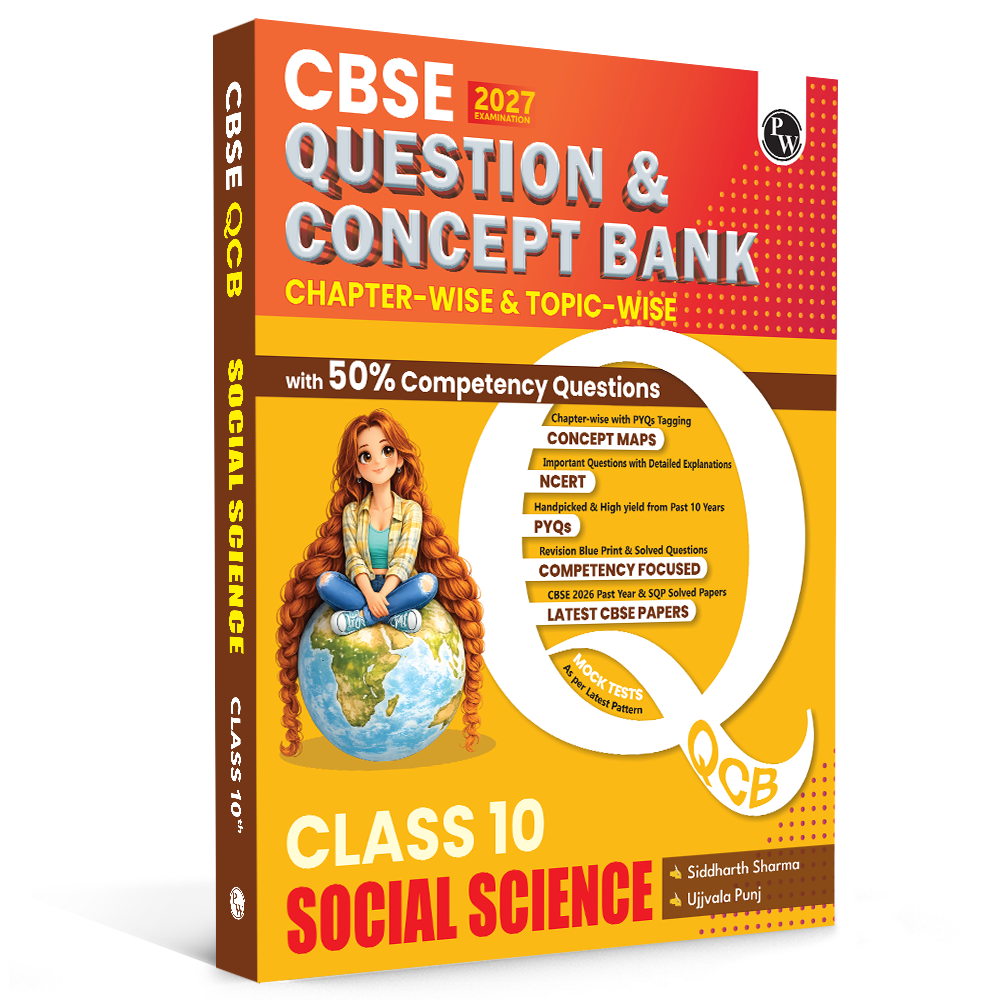
How to Memorise SST Easily Using CBSE Question Bank Class 10

For every student, class 10 is a very important year because it's the first time they take national board exams. To score well, you need to be prepared since the start of the session, especially in subjects like Social Science (SST). A lot of students have trouble learning SST since it has so many dates, complicated political ideas, and hard-to-read maps. It frequently feels like a never-ending race to remember things. A high-quality CBSE class 10 question bank sst is a game-changer here. Instead of getting lost in thick textbooks, these resources help you filter out the noise and focus on what actually appears in the exam, making the learning process far less daunting.
Check Out: CBSE Class 10th Books
Importance Of CBSE Class 10 Question Bank SST for Board Exams
Most students only use textbooks, yet textbooks are meant to teach ideas, not show you how to answer questions. Using a question bank bridges this gap. It transforms passive reading into active learning. When you see a historical event framed as a 5-mark question, your brain starts to categorise information logically rather than just trying to "remember everything."
Furthermore, the question bank provides a clear roadmap of the marks distribution. You begin to notice patterns—certain topics in "Print Culture" or "Manufacturing Industries" appear every year. By focusing on these through a sst question bank, you save hours of wasted effort and build the confidence needed to face the actual board paper.
How CBSE Class 10 Question Bank SST Helps You Finish the Syllabus?
Social Science is divided into four distinct parts: History, Geography, Political Science, and Economics. Each requires a different mental approach. A CBSE class 10 sst question bank organises these subjects into digestible chunks.
-
History: Focuses on chronological events. The question bank helps by providing "Short Answer" questions that act as timeline markers.
-
Geography: Deals with resources and maps. Here, the CBSE class 10 sst chapter wise question bank offers specific map-based queries that are easy to memorise.
-
Civics & Economics: These are logic-based. The question bank provides case-based questions that mirror the latest CBSE patterns.
By using the chapter wise question bank, you aren't just reading stories; you are preparing specific "answer blocks" that can be reproduced in the exam hall.
Key Features of the CBSE Class 10 Question Bank SST
These features are meant to follow the most recent NCERT syllabus and CBSE rules.
|
Feature |
Benefit for the Student |
|
Chapter-wise Summaries |
Quick recap of entire chapters in minutes before moving to questions. |
|
Solved Previous Year Questions |
Understand the exact phrasing required to score full marks. |
|
Assertion & Reason Questions |
Enhances critical thinking and prepares you for the new MCQ format. |
|
Mind Maps |
Visual aids that help in connecting complex historical events or economic cycles. |
|
Self-Assessment Tests |
Allows you to track your progress and identify weak areas early. |
|
Competency-Focused Blueprints |
Helps you understand exam pattern, marks distribution, and types of questions asked in boards so you can prepare more strategically. |
These features make sure that the CBSE sst question bank class 10 is more than just a bunch of questions; it's a full revision tool. The format is the same whether you're looking for a CBSE class 10 question bank, which helps you stick to a schedule.
How Question Bank Helps You Memorise SST Easily?
Memorising SST isn't about rote learning; it's about association. The CBSE class 10 sst chapter wise question bank facilitates this through several psychological triggers:
Break Big Chapters into Small Parts
Instead of facing a 20-page chapter on "Nationalism in Europe," the question bank breaks it into 15-20 key questions. Memorising 20 specific answers feels much more achievable than memorising a whole book. This "chunking" method is a proven way to improve memory retention.
Use Mind Maps to Remember Faster
The human brain processes visuals 60,000 times faster than text. The mind maps included in the question bank allow you to see the "Big Picture." When you can visualise how the "Civil Disobedience Movement" branched out into different social groups, you don't need to struggle to remember the details—they follow the logic of the map.
Test Yourself Regularly
The more you test yourself, the stronger your neural pathways become. By using the self-assessment sections of the question bank, you practise "Active Recall." This is far more effective than reading the same page five times.
Focus on Important Keywords
The solved answers in the CBSE sst question bank class 10 highlight essential keywords. In board exams, examiners look for these specific terms. By learning these keywords through the question bank, you ensure your answers meet the marking scheme criteria without having to write long, rambling paragraphs.
5. Understand Exam Pattern with Blueprints
The competency-focused blueprints guide you on how questions are structured, which chapters carry more weight, and how marks are distributed. This makes your preparation smarter, not just harder.
Right Way to Use CBSE Class 10 Question Bank SST
To get the most out of your question bank, follow these steps:
-
Read the Summary First: Never jump straight to questions. Read the chapter summary to get the context.
-
Start with MCQs: Start with the one-mark questions. They build your foundational knowledge.
-
Practise Map Work Weekly: Don't leave maps for the last month. Use the map section in your chapter wise question bank at least once a week.
-
Compare Answers: Write an answer to a 5-mark question, then compare it with the model answer in the CBSE class 10 question bank sst. Note what you missed.
If you are balancing multiple subjects, you might also use a CBSE question bank class 10 math to keep your problem-solving skills sharp while you dedicate specific hours to SST memorisation. Consistency across all subjects using a question bank is the secret to a high percentage.
Check Out: CBSE Class 10th Previous Year Papers
Common Mistakes to Avoid When Studying SST
Even with the best question bank, certain habits can hinder your progress. Avoiding these will make your study sessions much more productive:
-
Relying on Rote Learning: Do not try to memorise every word. Understand the "Why" and "How" behind historical and political events.
-
Ignoring the Marking Scheme: Students often write too much for 2-mark questions and too little for 5-mark ones. Stick to the word limits suggested in your question bank for class 10.
-
Skipping Maps and Diagrams: Many students ignore diagrams and flowcharts in Economics and Geography. These are easy scoring opportunities.
-
Starting Preparation Too Late: SST is too vast for last-minute cramming. Start using your sst question bank at least 5-6 months before the exams.
-
Ignoring Previous Year Questions (PYQs): CBSE often repeats themes. If you ignore the PYQ section in your question bank, you are missing out on predictable marks.
By integrating the sst chapter wise question bank into your daily routine and avoiding these common pitfalls, you turn SST from a "boring" subject into one of your highest-scoring areas.
Read More: CBSE Class 10 Social Science Notes PDF
Memorise SST Easily Using CBSE Question Bank Class 10 FAQs
Is the CBSE class 10 sst question bank enough for board exams?
Yes, it covers all the major concepts and gives you the practise you need for all types of questions when used with NCERT textbooks.
How does a chapter wise question bank help in revision?
It lets you focus on one chapter at a time, making sure you know the precise questions that are likely to be asked from that chapter before moving on.
Should I buy a question bank for class 10 for all subjects?
While SST requires it for content volume, subjects like Math benefit from a question bank for variety in numerical problems.
Can I rely solely on the sst question bank for map work?
A good question bank contains all the essential map locations prescribed by the CBSE syllabus, making it a very reliable resource for map practise.
How often should I practise from the CBSE class 10 question bank sst?
Ideally, you should use it daily or after finishing every chapter in school to reinforce what you have learned and test your memory.