Mistakes to Avoid While Using CBSE Previous Year Question Papers Class 10
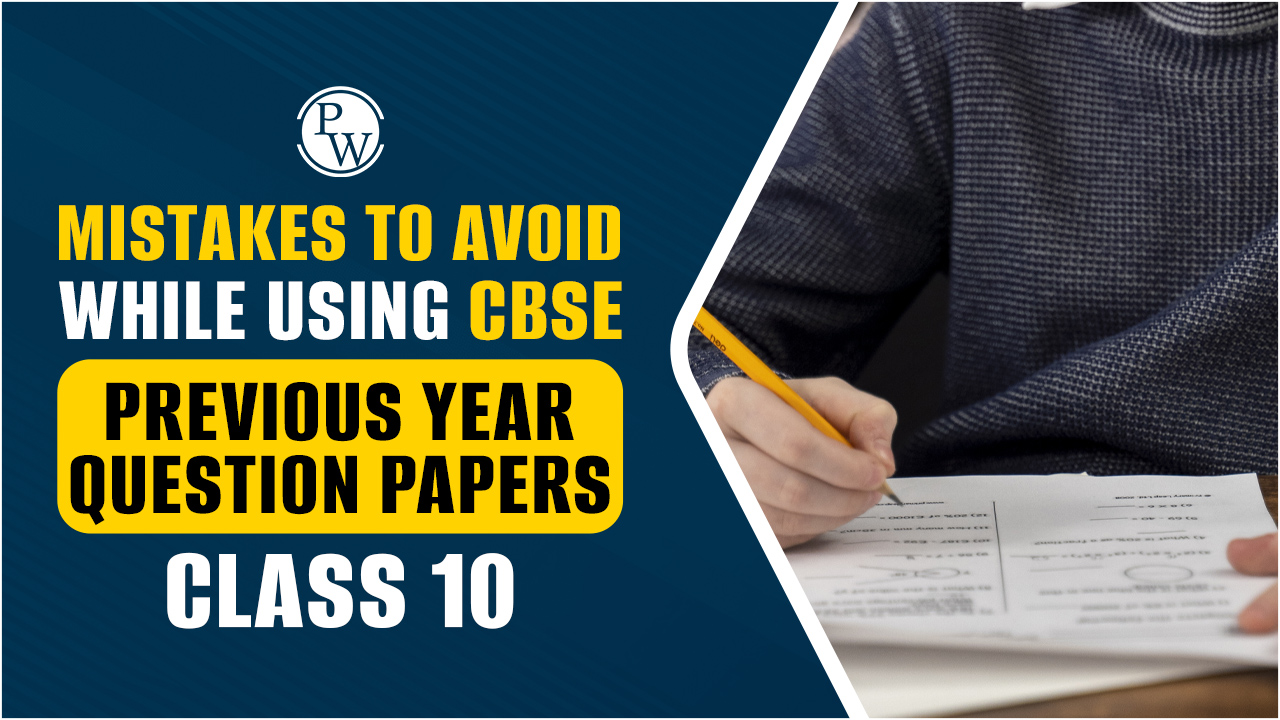
Mistakes to Avoid While Using CBSE Previous Year Question Papers Class 10:- Practising CBSE previous year question papers class 10 is one of the effective ways to prepare for board exams. These papers help students understand the exam pattern, question types, and marking scheme. However, many students make mistakes while solving them, which can impact their performance. Below are some common errors students should avoid while attempting CBSE PYQ class 10 for different subjects.
Mistakes to Avoid While Using CBSE PYQ Class 10
1. Ignoring Instructions in the Question Paper
Every previous year question paper in CBSE class 10 comes with important instructions regarding the exam format, marking scheme, and guidelines for answering. Some students skip reading these, leading to mistakes such as attempting unnecessary sections or missing out on mandatory ones.
For instance, in Mathematics, the paper is divided into multiple sections with different types of questions, MCQs, short answers, and long answers. If a student overlooks instructions, they might miss out on important details like whether steps carry marks in problem-solving. Similarly, in Science, instructions often mention whether diagrams are necessary, and ignoring them can lead to a loss of marks.
2. Poor Time Management
Time management is crucial while solving CBSE previous year question papers class 10 with solutions. Many students spend too much time on one section and then rush through the remaining part, leading to incomplete answers.
For example, in Social Science, students often spend excessive time writing long answers in History and then struggle to finish Geography and Political Science. A better approach is to divide time based on marks allotted to each section. In English, spending too much time on the Reading Section can leave less time for the Writing and Grammar sections, where structured answers are necessary.
3. Skipping Difficult Questions Instead of Attempting
Some students leave tough questions blank while solving class 10 previous year questions CBSE. Even if they don’t know the full answer, they should attempt it because CBSE awards partial marks for correct steps and explanations.
For example, in Mathematics, if a student can only solve part of a question on trigonometry or probability, they should write the formulas and attempt at least some calculations to earn partial marks. Similarly, in Science, even if they don’t recall the full explanation of a biological process, writing key points or drawing a labelled diagram can fetch marks.
4. Not Reviewing Answers Before Submission
Many students rush to finish CBSE PYQ class 10 without reviewing their answers. This can lead to careless mistakes in calculations, incorrect spelling in theoretical subjects, and missing key points in long answers.
In English, proofreading is essential to check for grammar errors in writing tasks like letters and essays. In Science, reviewing calculations in Physics and verifying chemical equations in Chemistry can prevent loss of marks.
5. Illegible Handwriting and Poor Presentation
Presentation matters when solving CBSE board previous year question papers class 10. If handwriting is difficult to read, examiners may struggle to understand the answer, leading to lower scores.
In subjects like Science and Geography, clear diagrams with proper labelling improve answer quality. For Social Science, neatly structured answers with subheadings (like "Causes," "Effects," and "Solutions") make it easier for examiners to evaluate.
6. Not Paying Attention to Choice-Based Questions
CBSE papers often have choice-based questions where students can select between two options. Many students either answer both questions (wasting time) or choose the harder one unknowingly.
For example, in English Literature, if given a choice between summarising a poem and analysing a character, students should pick the one they are more confident about. In Social Science, if given a choice between explaining the features of a historical movement and analysing its impact, selecting the one with more recallable points is a smarter strategy.
7. Forgetting to Write Correct Units in Numerical Answers
In subjects like Mathematics and Science, numerical problems require correct units (e.g., cm, m, kg, N, etc.). Students who forget to write units often lose marks.
For example, in a Physics problem on force, writing "10" instead of "10 N" (Newtons) makes the answer incomplete. Similarly, in Chemistry, if a question asks for molar mass and a student writes "18" instead of "18 g/mol," they may lose marks.
8. Misinterpreting Questions Due to Lack of Focus
Misunderstanding a question can lead to writing incorrect answers. Some students fail to identify keywords like "explain," "differentiate," or "justify."
For example, in Social Science, a question asking to "compare" two historical events requires a side-by-side comparison, not just a description. In Mathematics, if a question asks for the "range" of a function, some students mistakenly solve for "domain."
9. Not Labelling Diagrams Properly
Diagrams are crucial in subjects like Biology, Geography, and Physics. Many students either skip diagrams or forget to label them, leading to a loss of marks.
For instance, in Biology, a question on the digestive system should include a labelled diagram of the stomach and intestines. In Geography, climate maps should be drawn clearly, and in Physics, circuit diagrams should be properly labelled.
10. Ignoring Word Limits in Writing-Based Questions
CBSE provides word limits for certain answers, especially in English and Social Science. Writing too much can waste time, while writing too little may result in missing essential points.
For example, in English, a 120-word essay should be concise and focused, not exceeding 150 words. In History, a 5-mark question should be around 80-100 words, not an entire page.
11. Guessing Answers Without Logical Reasoning
While attempting CBSE previous year question papers class 10 with solutions, students sometimes guess answers randomly in Science and Mathematics. Guesswork without logic leads to incorrect answers, especially in multiple-choice questions.
For instance, in Chemistry, if a question asks about the oxidation state of an element, blindly picking an option instead of recalling periodic table trends can be risky. In Mathematics, guessing answers in probability questions without using formulas often results in mistakes.
12. Not Practising Regularly with CBSE PYQ Class 10
Some students solve only one or two CBSE board previous year question papers class 10, thinking it is enough. However, regular practice is essential for mastering different question patterns.
For example, in Mathematics, solving previous years’ questions on quadratic equations and coordinate geometry helps identify repeated concepts. In Science, practising Physics numerical problems from different years ensures better accuracy in calculations.
CBSE Previous Year Question Papers Class 10
Preparing for the CBSE Class 10 board exams can be challenging, but CBSE Clas 10 previous year question papers work as an excellent resource to gain confidence and performance. These papers help students understand the exam pattern, important topics, and marking scheme, making revision more effective. By solving CBSE PYQ class 10, students can familiarise themselves with frequently asked questions, improve time management, and reduce exam anxiety.
How to Prepare for CBSE Class 10 Exams While Avoiding Mistakes?
Preparing for CBSE board exams requires a well-planned approach to ensure accuracy and efficiency. Many students make avoidable mistakes that can lower their scores, even if they have studied well.
1. Understand the CBSE Syllabus and Exam Pattern
One of the most common mistakes students make is not studying according to the latest CBSE Class 10 syllabus. Each subject has a structured syllabus, and exam questions are based strictly on it.
-
Download the official CBSE syllabus from the CBSE website.
-
Identify important topics and weightage for each subject.
Check the exam pattern to understand the types of questions (MCQs, short answers, long answers). -
Focus more on high-weightage chapters but do not skip any topic.
2. Solve CBSE Previous Year Question Papers Class 10
Practising CBSE previous year question papers class 10 is crucial for understanding the exam pattern and time management. However, students often make the mistake of not analysing their mistakes after solving the paper.
3. Avoid Memorising Without Understanding Concepts
Many students rely only on rote learning instead of understanding the concepts, especially in subjects like Science and Mathematics. This can lead to confusion when the same topic is framed differently in the exam.
-
In Mathematics, understand formulas through solved examples instead of memorising them blindly.
-
In Science, focus on the "why" and "how" behind concepts instead of just definitions.
-
In Social Science, connect historical events logically rather than just remembering dates
4. Avoid Careless Mistakes in Numerical Questions
In subjects like Mathematics, Physics, and Chemistry, students often make errors due to:
-
Skipping steps in calculations.
-
Forgetting to write units in numerical answers.
-
Misreading the question (e.g., solving for the wrong variable).
Read More: CBSE Previous Year Question Papers Class 10 PDF with Solutions
CBSE Class 10 Previous Year Question Papers FAQs
1. Why is solving CBSE previous year question papers class 10 important?
Solving CBSE previous year question papers class 10 helps students understand the exam pattern, frequently asked questions, and marking scheme. It also improves time management and builds confidence for the actual exam.
2. Where can I find CBSE board previous year question papers class 10 with solutions?
CBSE official website, educational platforms, and reference books provide CBSE previous year question papers class 10 with solutions. These solutions help students learn the correct approach to answering questions.
3. How many years of CBSE PYQ class 10 should I solve?
Ideally, students should solve at least the last 5–10 years of CBSE PYQ class 10 to familiarise themselves with question trends and repeated topics.
4. How can I avoid mistakes while solving class 10 previous year question CBSE?
To avoid mistakes:
-
Read the question carefully before answering.
-
Manage time effectively.
-
Double-check calculations in Mathematics and Science.
-
Write answers in structured format in subjects like Social Science and English.
5. Should I attempt all questions in the CBSE exam?
Yes, students should attempt all questions, even if they are unsure. Writing relevant points can help fetch partial marks. However, avoid blind guessing in numerical-based subjects.