ACCA Syllabus 2026, All Levels Explained In Detail
ACCA Syllabus 2026 provides a complete roadmap for aspiring Chartered Certified Accountants by outlining all three qualification levels. These three levels of qualification include Applied Knowledge, Applied Skills, and Strategic Professional. This updated acca syllabus is set to match global industry standards to ensure learners build strong expertise in accounting, finance, taxation, audit, and business management. The ACCA exam syllabus equips candidates with practical skills and theoretical understanding, which are required for a successful international accounting career. The ACCA syllabus has a structured progression and 13 essential papers.
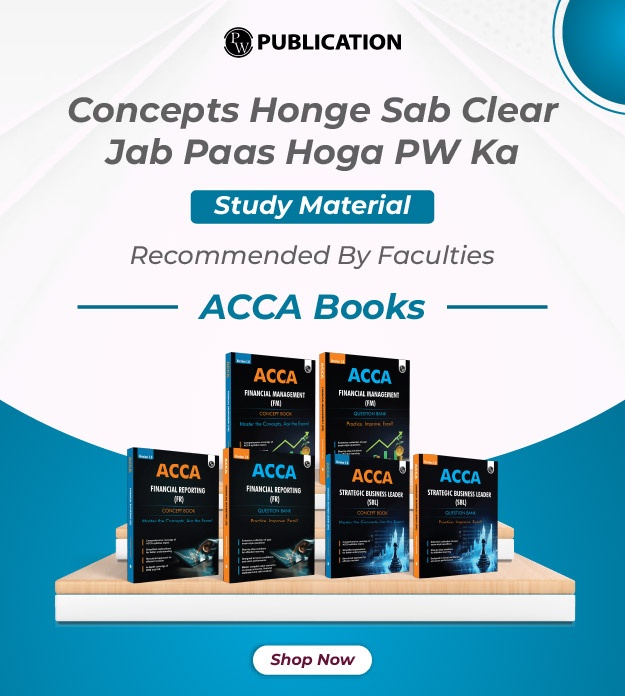
Check Out: ACCA Books
What is ACCA Syllabus?
The Association of Chartered Certified Accountants (ACCA) offers a globally recognized professional accounting qualification. ACCA was established in the year 1904. ACCA shapes accounting careers worldwide. This comprehensive qualification aligns with current industry standards. It ensures that professionals deliver transparent and accountable accounting and taxation services. The ACCA Syllabus 2026 provides a robust framework for finance professionals.
The ACCA qualification teaches vital skills. Candidates learn finance, accounting, taxation, and business management. It offers modules that are helpful to enhance skills as per modern professional demands. The course develops a foundation for a successful career. Students get comprehensive knowledge as they progress through the levels. This makes the ACCA an excellent choice for career advancement.
ACCA Syllabus Levels For 2026 Qualification
The ACCA course structured into three main levels. These levels cover a wide range of subjects. Here is the complete ACCA syllabus breakdown:
|
ACCA Syllabus Levels For 2026 Qualification |
|
|
Level |
Papers |
|
Applied Knowledge Level |
F1 – Business and Technology (BT) F2 – Management Accounting (MA) F3 – Financial Accounting (FA) |
|
Applied Skills Level |
F4 – Corporate and Business Law (LW) F5 – Performance Management (PM) F6 – Taxation (TX) F7 – Financial Reporting (FR) F8 – Assurance and Audit (AA) F9 – Financial Management (FM) |
|
Strategic Professional Level |
P1 – Strategic Business Leader (SBL) P2 – Strategic Business Reporting (SBR) P4 – Advanced Financial Management (AFM) P5 – Advanced Performance Management (APM) P6 – Advanced Taxation (ATX) |
Check out: ACCA Applied Skill Level Study Pack (CA Inter Combo Set of 10 Modules)
Core Concepts of ACCA Syllabus 2026
ACCA Syllabus 2026 is built on foundational accounting and financial principles. It guides global business reporting and decision-making. These core concepts help learners to understand how financial information is recorded, interpreted, and applied in real-world scenarios. A strong command over these fundamentals is important for progressing through ACCA levels and professional roles.
Key Laws, Theorems, and Relations
Understanding the foundational laws and principles of accounting is important for mastering ACCA concepts. These rules ensure consistency, transparency, and accuracy in financial reporting across global businesses.
The following important principles form the backbone of modern accounting practices.
Double-Entry Principle: Every financial transaction has equal and opposite effects in at least two accounts. This maintains the accounting equation.
Going Concern Assumption: Financial statements assume the business will operate indefinitely. This affects asset valuation.
Accrual Basis Accounting: Revenues and expenses are recognised when earned or incurred. This happens regardless of cash flow.
Prudence Concept: Financial statements should be prepared cautiously. This avoids overstating assets or income.
Agency Theory: Explains relationships between principals (owners) and agents (managers). Addresses potential conflicts of interest.
Short conceptual notes
These brief conceptual notes offer a quick understanding of the core disciplines within the ACCA framework. Each concept plays an important role in shaping financial transparency, decision-making, and overall business governance. Reviewing these fundamentals helps build a solid base for advanced ACCA topics.
-
Financial Reporting involves preparing statements for external use.
-
Management Accounting provides internal financial data for decisions.
-
Taxation covers rules for various national tax systems.
-
Audit and Assurance verifies financial statement accuracy.
-
Corporate Governance ensures ethical company management.
-
Performance Management measures and improves business effectiveness.
Check Out: ACCA Exemption Support Combo Skills + Professional Complete Set of 18 Modules
ACCA Syllabus 2026 Key Terms and Definitions
To understand the ACCA pathway clearly, it is essential to be familiar with the core terminology which is used in the syllabus. These major terms define exam levels, major subjects, and foundational concepts that guide a journey from beginner to professional qualification. Mastering these definitions helps build clarity and confidence while studying.
-
ACCA: Association of Chartered Certified Accountants. A global professional body.
-
Chartered Certified Accountant: A professional qualification awarded by ACCA.
-
Applied Knowledge Level: The initial stage of the ACCA exams.
-
Applied Skills Level: The second stage, building on foundational knowledge.
-
Strategic Professional Level: The final, advanced stage focusing on application.
-
Financial Accounting: System for recording and reporting financial transactions.
-
Management Accounting: Provides information for internal planning and control.
-
Business and Technology: Examines the business environment and technology's role.
-
Corporate Law: Legal framework governing business entities.
-
Taxation: The process of levying taxes on income and capital.
-
Financial Reporting: Official disclosure of financial information.
-
Audit and Assurance: Independent review of financial records.
-
Financial Management: Efficient use and management of money.
-
Strategic Business Leader: An exam paper focusing on strategic leadership.
-
Syllabus: The outline or plan for a course of study.
ACCA Exam Pattern
The ACCA exam pattern is structured into three distinct levels, each covering various subjects tailored to build a candidate's expertise in accounting and finance. These levels are Applied Knowledge Level, Applied Skills Level, Strategic Professional Level
The table below for ACCA Exam Pattern 2025 help you understand the structure:
|
ACCA Exam Pattern |
||||
|
Level |
Number of Papers |
Subjects |
Exam Duration |
Format |
|
Applied Knowledge |
3 |
Business and Technology (BT), Management Accounting (MA), and Financial Accounting (FA) |
2 hours |
Objective (MCQ-based) |
|
Applied Skills |
6 |
Corporate and Business Law (LW), Performance Management (PM), Taxation (TX), Financial Reporting (FR), Audit and Assurance (AA) and Financial Management (FM) |
3 hours |
Objective + Written (Mix of MCQs and essays) |
|
Strategic Professional |
4 (2 Essentials, 2 Options) |
Strategic Business Leader (SBL), Strategic Business Reporting (SBR) Optional: Advanced Financial Management (AFM), Advanced Performance Management (APM), Advanced Taxation (ATX), and Advanced Audit and Assurance (AAA) |
3-4 hours |
Written (Case studies, essays, professional reports) |
Read More: ACCA Full Form: Eligibility, Benefits, and Preparation Books
ACCA Syllabus 2026 FAQs
What is covered in the ACCA syllabus?
The ACCA syllabus includes subjects like financial accounting, management accounting, taxation, audit, and business law.
How many papers are in the ACCA syllabus?
The ACCA syllabus consists of 13 exams across three levels: Applied Knowledge, Applied Skills, and Strategic Professional.
Is the ACCA syllabus updated regularly?
Yes, the ACCA syllabus is reviewed and updated annually to align with global accounting standards and industry needs.