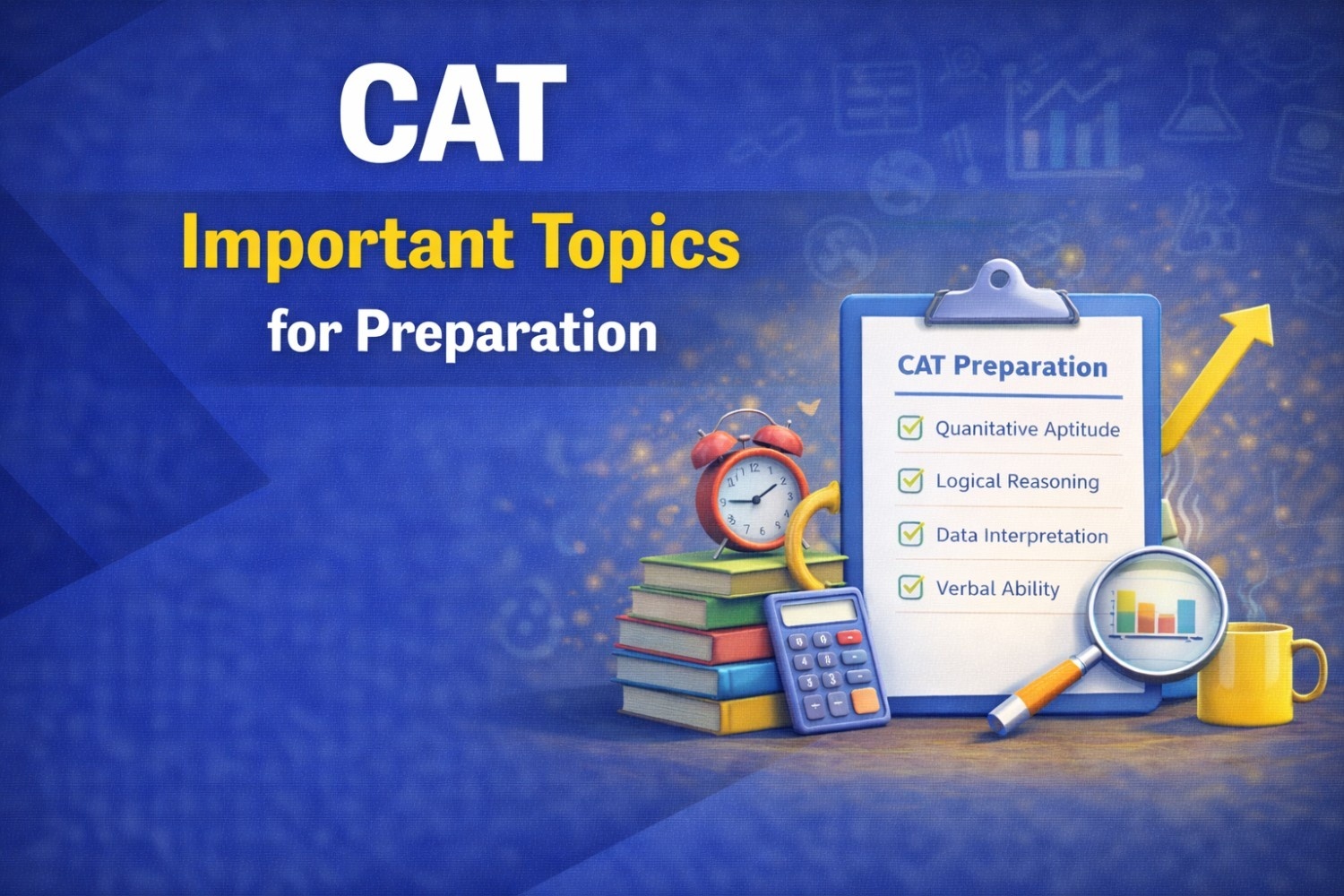
CAT Important Topics for Preparation 2026: Section-wise Key Areas
To do well on the CAT 2026, students need to focus on the most significant topics in each of the three areas. Arithmetic and Algebra are the most important subjects in Quantitative Aptitude (QA). In DILR, focus on Sets, Caselets, and Arrangements. In VARC, Reading Comprehension remains the primary focus. Mastering these important chapters for cat is the difference between a 90th and a 99th percentile.
The Common Admission Test (CAT) is not a test of how much you know, but how well you apply what you know under pressure. With over 3 lakh aspirants competing for a few thousand seats in the IIMs and other top B-schools, your strategy must be surgical. You cannot afford to study everything with the same intensity. Instead, you must identify the cat exam important topics that consistently appear year after year.
We look at years of paper patterns at PW Store to give you a defined plan. This guide goes over the most important cat subjects, one area at a time, so you may study in a way that is both effective and focused on getting results.
Check Out: MBA Books
CAT Quantitative Aptitude (QA) Important Topics
The QA section often feels overwhelming due to the vast syllabus. However, the data from the last five years shows that nearly 70% of the paper comes from just two modules: Arithmetic and Algebra.
A. Arithmetic (The Foundation)
Arithmetic is the most critical among cat quantitative aptitude important topics. It usually accounts for 8–10 questions out of 22.
-
Percentages, Profit & Loss, and Discount: Expect questions about percentages, profit and loss, and discounts that are both straightforward and based on real-life situations.
-
Ratio & Proportion, Mixtures & Alligations: These ideas are commonly mixed with other subjects.
-
Time, Speed & Distance (TSD): Concentrate on relative speed, circular tracks, and boats.
-
Time & Work: Pipes and cisterns are two common subtopics.
B. Algebra (The Differentiator)
If Arithmetic gets you into a good college, Algebra gets you into an IIM. It is a high-yield area among cat qa important topics.
-
Linear and Quadratic Equations: For linear and quadratic equations, you need to know how to find roots and coefficients.
-
Inequalities and Modulus: These come up a lot in "TITA" (Type In The Answer) questions.
-
Functions and Graphs: Functions and graphs are important for understanding complicated relationships.
-
Logarithms, Surds, and Indices: Often provide the "easy" marks in this section.
C. Geometry & Mensuration
-
Triangles and Circles: Focus on properties and theorems.
-
Coordinate Geometry: Basic formulas and slope-related questions.
-
Mensuration 2D & 3D: Area and volume of solids.
D. Number System & Modern Math
-
Number System: Even if there aren't as many questions, ideas like the Remainder Theorem and Unit Digits are still important.
-
Modern Math: Concentrate on Permutations and Combinations (P&C) and Probability.
Check Out: CAT Quantitative Aptitude 2000+ Practice Questions
Important DILR Topics for CAT
Data Interpretation and Logical Reasoning (DILR) is often the most unpredictable section. There is no fixed "syllabus," but there are important dilr topics for cat that form the basis of almost every set.
A. Data Interpretation (DI)
-
Tables and Caselets: These are the most common formats.
-
Line, Bar, and Pie Charts: Learn to handle multiple charts in a single set.
-
Missing Data Tables: A favorite for the 99th percentile difficulty level.
B. Logical Reasoning (LR)
-
Linear and Circular Arrangements: The bread and butter of LR.
-
Games and Tournaments: High weightage in recent CAT papers.
-
Venn Diagrams (Set Theory): Specifically, 3-circle and 4-circle diagrams.
-
Selection and Sequencing: Logical groupings based on constraints.
Check Out: CAT Logical Reasoning & Data Interpretation 800+ Practice Questions
CAT VARC Important Topics
Verbal Ability and Reading Comprehension (VARC) is 70% Reading Comprehension. Your ability to comprehend, infer, and summarize is what matters most.
A. Reading Comprehension (RC)
-
Themes: Practice reading passages in Philosophy, Sociology, Technology, Economics, and Literature.
-
Question Types: Concentrate on "Main Idea," "Author's Tone," and "Inference-based" questions.
B. Verbal Ability (VA)
-
Para Jumbles (TITA): Putting sentences in order to make a clear paragraph.
-
Para Summary: Picking the best summary of a brief text.
-
Odd One Out: Find the sentence that doesn't fit in with the rest of the sentences.
Check Out: CAT Verbal Ability & Reading Comprehension 1000+ Practice Questions
Weightage Analysis: CAT Exam Important Topics
Let’s understand the important topics and their weightage in CAT exam.
|
Section |
High Weightage (70%+) |
Moderate Weightage (20%+) |
Low Weightage (<10%) |
|
QA |
Arithmetic, Algebra |
Geometry, Number System |
Trigonometry, Modern Math |
|
DILR |
Arrangements, Caselets, Games |
Venn Diagrams, Graphs |
Cubes, Calendars, Clocks |
|
VARC |
Reading Comprehension |
Para Jumbles, Summary |
Grammar, Vocabulary* |
Month-wise Preparation Strategy for CAT Exam
To master these important chapters for cat, follow this timeline:
Phase 1: Concept Building (March - June)
Concentrate on the essentials of Algebra and Arithmetic. To improve your reading stamina, work on at least two RC paragraphs per day. Know how simple LR setups work.
Phase 2: Application & Topic Tests (July - August)
Go to CAT QA to learn about vital subjects like Geometry and Modern Maths. To get better at "set selection," which is the most important ability in DILR, start taking sectional tests.
Phase 3: Mock Exams & Revision (September - November)
Take full-length mocks. Use the PW Store mock series to analyze your performance in cat important topics. Analyze why you missed a question—was it a lack of conceptual clarity or a calculation error?
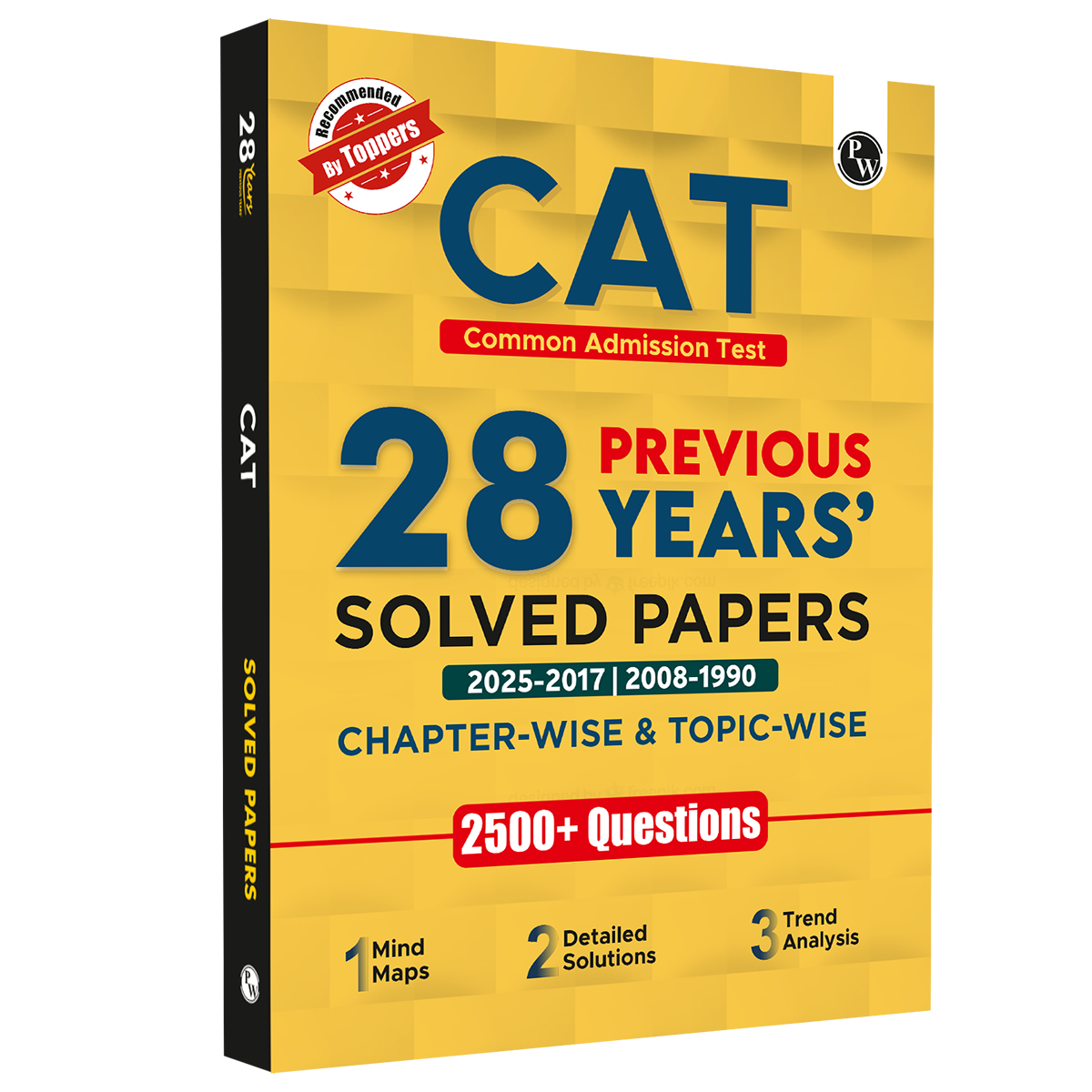
Check Out: CAT 28 Years Chapterwise & Topicwise Previous Years Solved Papers
How to Use "Set Selection" in DILR
In DILR, you don't need to solve all 20 questions. If you solve 2 full sets (10 questions) with 100% accuracy, you are already looking at a 98+ percentile.
-
The 5-Minute Rule: Spend the first 5 minutes scanning all sets.
-
Identify the Familiar: Look for important dilr topics for cat you have practiced, like Venn Diagrams or Arrangements.
-
Avoid the "Rabbit Hole": If a set isn't cracking after 8 minutes, leave it.
Common Pitfalls in CAT Preparation
-
Ignoring the Calculator: CAT provides an on-screen calculator. Practice using it to avoid manual errors in cat quantitative aptitude important topics.
-
Reading without Retaining: In VARC, if you have to read a paragraph thrice, you aren't focused. Practice active reading.
-
Falling for "Tough" Questions: Every question carries equal marks. Don't waste 10 minutes on a hard Geometry problem when an easy Arithmetic one is waiting.
Conclusion
To do well on CAT 2026, you need to work smart, not hard. By focusing on very important subjects like Arithmetic, Algebra, and Set Theory, you can be confident that your efforts are going toward the areas with the highest ROI (Return on Investment). Use the study aids and practice tests from the PW Store to help you do better on these important cat chapters.
Remember that the goal is not to answer every question, but to answer the right ones. Start your journey today and don't stop. You will be able to reach the three magic letters: IIM.
Read More: CAT Exam Syllabus for 2026 Exam
CAT Important Topics for Preparation FAQs
1. Which is the most important section in CAT?
All three sections are equally important due to "Sectional Cut-offs." Even if you score 99.9 in QA, you won't get an IIM call if you fail to clear the VARC cut-off.
2. Is the Number System still among the cat important topics?
The number of direct questions has reduced, but the concepts (like divisibility and remainders) are frequently used within Algebra and Arithmetic problems.
3. How many questions should I attempt in QA?
For a 99th percentile, aiming for 12–14 correct questions with high accuracy is usually sufficient, depending on the difficulty level.
4. What are the cat qa important topics for a non-engineer?
Focus heavily on Arithmetic. It is less formula-heavy and more logic-driven, making it the best area for non-engineers to score.
5. How do I improve in RCs?
Read diverse articles from The Guardian, Aeon, and The New York Times. This prepares you for the varied themes CAT examiners prefer.