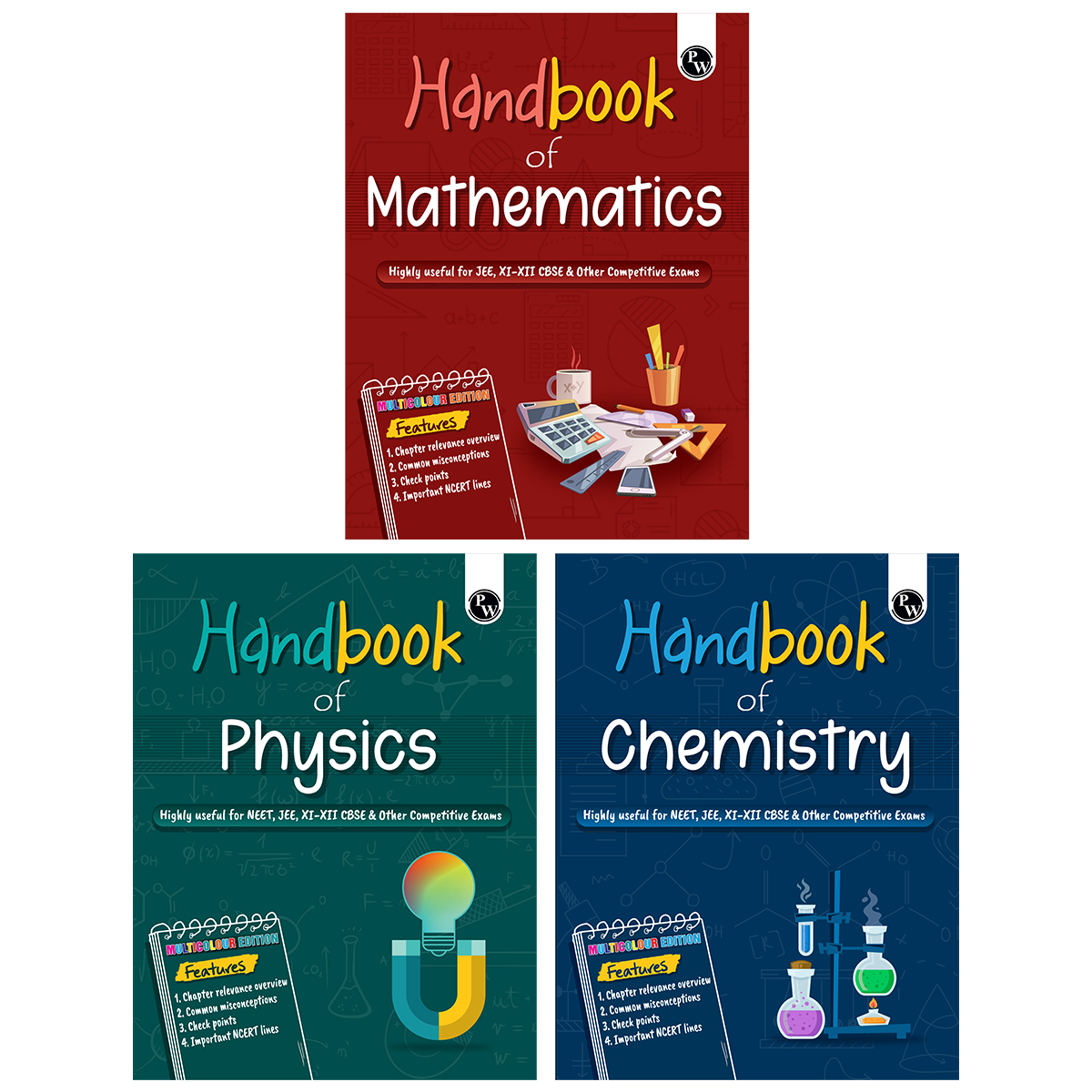
High-Scoring Chemistry Topics to Revise with PW Handbook
To crack JEE Chemistry, one needs to strike a strategic balance between understanding the concepts and quick recall of formulae. With such a huge syllabus consisting of Physical, Organic, and Inorganic sections, focusing on the high-yield chapters can increase your percentile by a large margin. The article discusses the important topics in chemistry that score high marks and how a well-organised JEE chemistry handbook can help you revise faster.
Importance of the JEE Chemistry Handbook
During the final phases of JEE preparation, flipping through massive textbooks becomes impractical. A dedicated handbook acts as a condensed repository of vital information, helping you optimize your study hours.
Quick Formula and Equation Recall
Numerical applications are very important in Physical Chemistry. A good chemistry handbook will contain all the important formulas in one place. From the Nernst equation to thermodynamic equations. This saves time for intense study sessions as you don’t have to scroll through many notebooks.
Consolidated Reactions and Reagents
In Organic Chemistry, it is necessary to have a complete knowledge of the mechanisms and the functions of reagents. A well-organised reference lets you quickly confirm electrophilic additions, reduction mechanisms or named reactions. This structured layout ensures you don’t confuse similar-looking pathways during exams.
Fast Inorganic Fact Checking
Inorganic Chemistry has a number of trends, exceptional behaviours and colour indicators. A short reference enables fast daily scanning of periodic properties and coordination compounds, which is necessary for the transfer of this factual data from short-term to long-term memory.
What Physical Chemistry Topics Are Covered in a JEE Chemistry Handbook?
Physical Chemistry demands a strong grip on mathematical applications and core concepts. Direct formula-based questions are common, making comprehensive formula revision absolutely essential. To make revision more effective, students can also use JEE Revision Books, which provide concise theory, important formulas, key concepts, and chapter-wise revision notes. Combining structured revision with regular problem-solving helps strengthen conceptual clarity, improve calculation speed, and boost performance in JEE Main and JEE Advanced.
|
Chapter Topic |
Core Areas to Focus On |
Expected Weightage (Approximate) |
|
Electrochemistry |
Nernst Equation, Kohlrausch's Law, Faraday's Laws |
Around 4% to 6% |
|
Chemical Kinetics |
Order of Reactions, Arrhenius Equation, Half-life |
Estimated 3% to 5% |
|
Thermodynamics |
Entropy Change, Gibbs Free Energy, Enthalpy |
Around 4% to 5% |
|
Solutions |
Raoult's Law, Colligative Properties, van 't Hoff Factor |
Approximately 3% to 4% |
-
Create Value-Added Sheets: Jot down the limiting conditions for specific formulas, such as ideal gas behavior vs. real gas corrections.
-
Focus on Units: Ensure you verify standard SI units for universal constants like the gas constant ($R$) and Faraday's constant ($F$).
-
Track Equilibrium Exceptions: Pay close attention to simultaneous equilibrium calculations and solubility product variations in buffer solutions
What Organic Chemistry Topics Are Covered in a JEE Chemistry Handbook?
Organic Chemistry can be highly rewarding if you understand the underlying electronic effects. Questions are typically interconnected, often combining multiple concepts and reaction mechanisms from different chapters. To strengthen your preparation, study with JEE Books that provide comprehensive theory, reaction mechanisms, concept-building exercises, and chapter-wise practice. Combining detailed conceptual learning with regular problem-solving helps improve reaction analysis, strengthen conceptual clarity, and boost performance in both JEE Main and JEE Advanced.
1. Hydrocarbons and Named Reactions
This forms the foundational base of organic transformations. Focus heavily on mechanisms like electrophilic aromatic substitution in benzene and free radical halogenation of alkanes. Keep a compiled list of key named reactions, including the Wurtz reaction, Friedel-Crafts alkylation, and Ozonlysis mechanisms.
2. Aldehydes, Ketones, and Carboxylic Acids
This is arguably the most critical segment of JEE Organic Chemistry. Questions frequently revolve around nucleophilic addition reactions. Ensure you thoroughly revise the Aldol Condensation, Cannizzaro Reaction, and Clemmensen Reduction using your chemistry quick notes.
3. General Organic Chemistry (GOC)
You cannot solve advanced problems without mastering GOC. Spend time revising stability orders of reaction intermediates like carbocations, carbanions, and free radicals. Understand the absolute applications of inductive, mesomeric, and hyperconjugation effects.
What Inorganic Chemistry Topics Are Covered in a JEE Chemistry Handbook?
Inorganic Chemistry is often a major differentiator in scoring. It takes the least amount of time to solve in the exam hall, giving you extra minutes for complex physics or math problems.
Coordination Compounds
This chapter is highly scoring and conceptually deep. Focus extensively on:
-
Isomerism: Both structural and stereoisomerism types.
-
Valence Bond Theory (VBT): Predicting hybridization and magnetic moments.
-
Crystal Field Theory (CFT): Calculating Crystal Field Stabilization Energy (CFSE) for octahedral and tetrahedral complexes.
Chemical Bonding and Molecular Structure
This serves as the backbone of all chemistry. Master the VSEPR theory to predict molecular shapes and geometries accurately. Ensure you can draw Molecular Orbital (MO) diagrams swiftly to determine bond orders and magnetic behaviors of homonuclear diatomic molecules.
The SP-Block Elements
While extensive, focus your revision on trends in periodic properties, structures of oxoacids of phosphorus and sulfur, and properties of noble gases. Daily reading of these sections helps retain anomalous behaviors.
How to Use the JEE Chemistry Handbook Effectively?
Simply owning a reference guide is not enough; you must integrate it systematically into your daily routine to see a tangible impact on your performance. After revising each chapter from the handbook, reinforce your understanding by solving questions from the PW JEE Main PYQ Combo Set of 3 Books. Practising authentic previous year questions immediately after revision helps strengthen concepts, familiarise you with recurring question patterns, improve accuracy, and build confidence for the JEE Main examination.
1. Daily Micro-Revision Sessions
Dedicate around 15 to 20 minutes every morning to scanning formulas and exceptional periodic trends. Consistent exposure reinforces memory retention far better than occasional marathon cramming sessions.
2. Post-Mock Test Analysis
Whenever you get a question wrong during a practice test due to a forgotten formula or missed reaction condition, immediately open your JEE chemistry handbook and highlight that specific section. This turns the handbook into a personalized diagnostic log.
3. Last-Minute Active Recall
In the final weeks leading up to the examination, use the handbook for active recall. Cover the right side of a reaction pathway or a formula sheet, look at the topic heading, and try to sketch out the entire mechanism or equation from memory.
How to Plan Your Revision Time with a JEE Chemistry Handbook?
Balancing the three branches of chemistry requires a structured approach. Do not over-index on one section while neglecting the others.
-
Physical Chemistry (35% of time): Focus primarily on solving diverse numerical problems and memorizing core formulas.
-
Organic Chemistry (35% of time): Spend time tracking structural transformations, reagent functions, and multi-step synthesis pathways.
-
Inorganic Chemistry (30% of time): Dedicate this time to active retention, structure visualization, and trend analysis.
Read More: Previous Year Question Papers of JEE Mains
JEE Chemistry Handbook FAQs
Which is the most scoring section in JEE Chemistry?
Inorganic Chemistry is generally considered the fastest scoring section because questions are direct and factual. However, Organic Chemistry yields high marks if your fundamental concepts of reaction mechanisms are completely clear.
How often should I practice formula revision for Physical Chemistry?
It is recommended to conduct a thorough formula revision at least twice a week. Using condensed reference sheets or a dedicated handbook makes this process swift, taking less than 30 minutes per session.
Can I clear JEE Chemistry by only studying high scoring chemistry topics?
While high-scoring topics help maximize your marks efficiently, it is safest to have a basic understanding of the entire syllabus. JEE often mixes concepts from multiple chapters into a single advanced-level question.
Why is a chemistry handbook better than standard textbooks during revision?
Standard textbooks contain extensive theoretical explanations meant for initial learning. A handbook filters out the narrative fluff, presenting only the core formulas, reactions, and tables needed for rapid preparation.