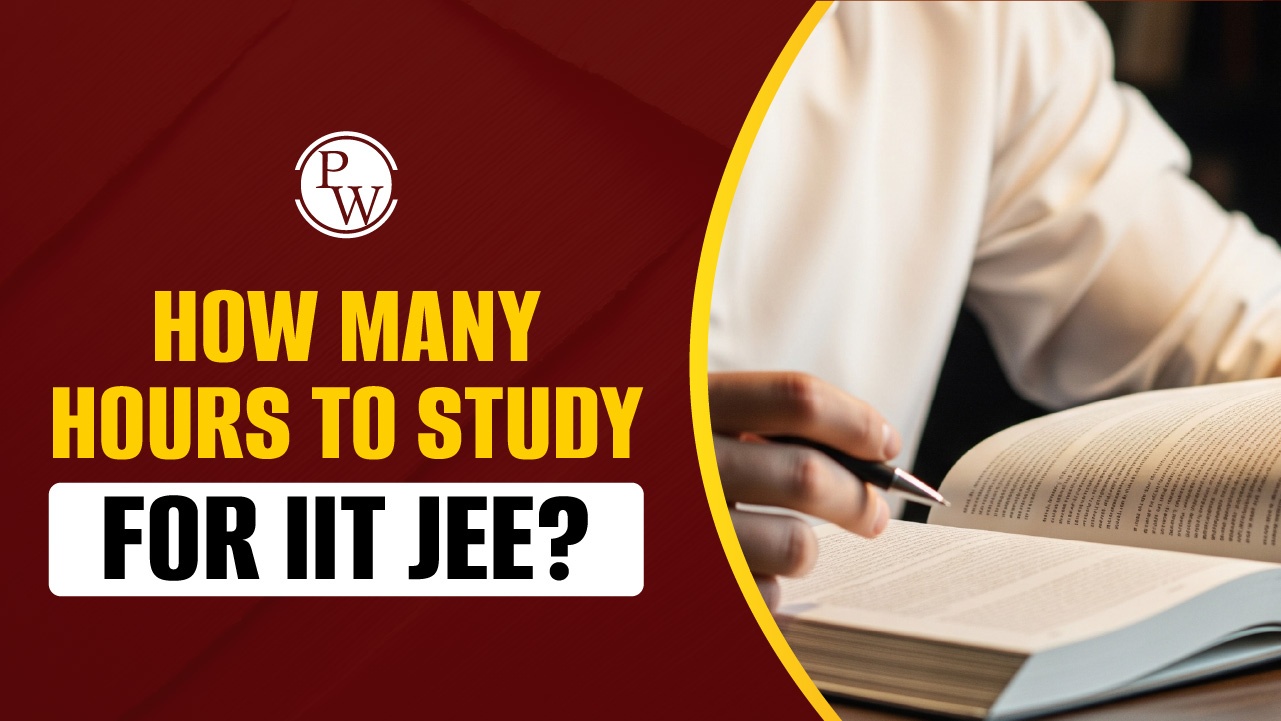
How Many Hours to Study for IIT JEE?
How Many Hours to Study for IIT JEE: The Joint Entrance Examination, or JEE, is one of the toughest exams in India. It is held in two stages. First comes JEE Main, which takes place twice a year, usually in January and April. If you clear the JEE Main, you have the opportunity to take the JEE Advanced, which is held only once a year. These exams decide admission into top engineering colleges like NITs, IIITs, and the IITs.
Both exams cover Physics, Chemistry, and Mathematics. JEE Main focuses more on basic concepts and problem-solving, while JEE Advanced is tougher with tricky and detailed questions. Students get three attempts for JEE Main in two years, and two attempts for JEE Advanced in consecutive years.
Now the big question students ask is, How many hours do I need to study for JEE? Most students who are preparing seriously study about 8 to 10 hours daily. Near the exam, some stretch to 12 hours. If you look at how many hours IIT toppers study, many follow a routine of 10 to 12 hours every day, but the key is not only long hours but also smart planning. They divide time between coaching, revision, solving doubts, and practice papers. Along with maintaining a disciplined schedule, using well-structured IIT JEE Books can help students organize learning, strengthen concepts, and improve consistency throughout preparation. So, check how to manage time for a good score from here.
IIT JEE Exam Overview
The IIT JEE is the national-level exam for admission to top engineering colleges in India. It has two stages: JEE Main and JEE Advanced. Both focus on Physics, Chemistry, and Mathematics, but their exam pattern and levels of difficulty are different. Here is the complete overview:-
|
IIT JEE Exam Overview |
|
|
Details |
Information |
|
JEE Exam Pattern |
|
|
Subjects Covered |
|
|
Attempts Allowed |
|
|
Frequency |
|
|
Purpose |
|
|
JEE Selection Process |
1. JEE Main: Appear for the exam and qualify with the required cut-off. 2. JEE Advanced: Write both papers after qualifying Main. 3. Counselling: JoSAA counselling for admission in IITs, NITs, IIITs, GFTIs. |
JEE Previous Year Papers help students understand the real exam pattern, difficulty level, and frequently asked concepts across subjects. Regular practice improves problem-solving speed, accuracy, and confidence for the final examination.
How Many Hours to Study for IIT JEE?
If you are in Class 11 or Class 12 and planning for IIT JEE, you already know that your school exams and board exams are equally important. The good thing is that the JEE syllabus is mostly from Class 11 and 12 NCERT books. This means when you study for school, you also prepare for JEE side by side.
The real focus should be on strengthening Physics, Chemistry, and Maths basics from the NCERT. If you are in Class 11, it is a good time to start because you get two full years to build concepts. If you are in Class 12, you have already gone through the basics, so now it is time to revise, practice, and solve more questions. So here is a simple IIT JEE study timetable for students of Class 11 and 12 who want to balance school studies along with JEE preparation. This is for students who are thinking about how many hours to study for JEE mains or for advanced.
|
How Many Hours to Study for IIT JEE? |
|
|
IIT JEE Time Table |
Study Plan |
|
Morning (5:30 am – 7:30 am) |
A fresh mind is ideal for problem-solving. Focus on Maths or Physics numericals. |
|
School Hours |
Pay attention in class because the NCERT is the base. Revise important formulas during free periods. |
|
Afternoon (After School, 2:00 pm – 5:00 pm) |
Revise the topics taught in school. Read the NCERT chapters of Physics, Chemistry, and Maths. |
|
Evening (6:00 pm – 9:00 pm) |
Practice JEE questions. If in Class 11, spend about 4–5 hours daily (how many hours to study for IIT in Class 11). If in Class 12, increase it to 6–7 hours daily, including revision and mock tests. |
|
Night (9:30 pm – 11:00 pm) |
Revise what you studied throughout the day. Keep 30 minutes for the NCERT theory and 1 hour for PYQs. |
|
Weekly |
Solve at least one JEE mock test or JEE Mains PYQ paper to track progress. |
How Many Hours Should a Dropper Study for JEE?
Many students take a drop year after Class 12 to focus fully on JEE preparation. The advantage is that you don’t have school exams to balance, so you get more time for self-study and practice. The common question is, how many hours should a dropper study for JEE? On average, droppers should aim for 8 to 10 hours of focused study every day. This time should be divided between learning concepts, solving problems, revising, and attempting mock tests. What matters most is consistency and not wasting the extra time you have.
For practice, the right resources make all the difference. NCERT is a must, but along with that, you should have standard books for JEE mains for each subject. Also, solving from a good JEE Main previous year question paper book or a complete JEE PYQ book is very important.
|
JEE Dropper Time Table |
|
|
Time of the Day |
Study Plan |
|
Morning (6:00 am – 9:00 am) |
Revise strong topics and solve questions from Physics or Maths. |
|
Late Morning (10:00 am – 1:00 pm) |
Study new chapters from Chemistry or revise NCERT concepts. |
|
Afternoon (2:00 pm – 5:00 pm) |
Practice questions from books for JEE Mains and focus on weak areas. |
|
Evening (6:00 pm – 9:00 pm) |
Solve sets from a JEE main previous year question paper book or JEE PYQ book. Analyse mistakes carefully. |
|
Night (9:30 pm – 11:00 pm) |
Quick revision, formula notes, or short topic recaps. |
|
Weekly |
Take at least 2 full mock tests and spend time analysing them. |
IIT JEE Study Materials 2026
One important part of IIT JEE 2026 preparation is solving previous year papers. A JEE Mains PYQ book is very useful because it helps you understand the type of questions that actually appear in the exam. Practicing PYQs regularly improves conceptual clarity, increases familiarity with exam patterns, and strengthens time management skills during mock sessions.
Previous year papers also help students identify frequently repeated concepts and understand the level of application expected in Physics, Chemistry, and Mathematics. Instead of studying randomly, aspirants can focus on important chapters and improve question-selection strategies during the actual examination. Solving papers in a timed environment further develops speed, accuracy, and confidence.
For students targeting stronger performance in both JEE Main and JEE Advanced, using structured study resources along with PYQ practice creates a more balanced preparation approach. Consistent revision, chapter-wise problem solving, and mock analysis can significantly improve overall readiness and help students track their progress throughout the preparation journey. PW has introduced dedicated IIT JEE books and JEE Advanced PYQ resources for 2026 preparation to support focused and exam-oriented learning.
How to Prepare for IIT JEE 2026 Exam?
Preparing for the IIT JEE needs planning and steady effort. Many students keep asking How Many Hours to study for IIT JEE? The truth is, there is no single fixed answer. It depends on whether you are in Class 11, Class 12, or even a dropper. But one thing is common: you need to follow a timetable, revise regularly, and solve questions from the right sources. Below are simple preparation tips with a subject-wise focus and study habits that will help in JEE 2026.
1. Understand the JEE Exam Pattern
Before wondering How Many Hours to study for IIT JEE, You need to know how the exam is structured. The JEE exam pattern is divided into JEE Main and JEE Advanced. JEE Main is the first step, and only those who qualify can appear for JEE Advanced. Knowing the exam pattern will help you plan your study routine in the right way.
-
JEE Main is held twice a year and has questions from Physics, Chemistry, and Maths.
-
After clearing JEE Main, you can sit for JEE Advanced.
-
Both exams are based on problem-solving skills and speed.
2. Complete Your NCERT Books First
Your NCERT books from Class 11 and 12 are the base of your preparation. If you are clear with the NCERT, then moving to other JEE books becomes easier. Most of the JEE Main questions are connected with NCERT concepts, so you should not skip them.
-
Start with the NCERT for Class 11 and Class 12 Physics, Chemistry, and Maths.
-
Revise the solved examples and back questions properly.
-
Once NCERT is strong, you can move to other JEE books for practice.
3. Focus on Note-Making
Making your own notes will save time later when you revise. Notes help you recall formulas, reactions, and shortcuts without going back to the whole chapter again. Keep them short and clear so you can go through them quickly before tests.
-
Write down key formulas, reactions, and definitions in a separate notebook.
-
Highlight tricky points that you usually forget.
-
Keep a formula sheet ready for last-minute revision.
4. Give More Attention to Important JEE Topics
Not all topics carry the same weight in JEE. Some chapters are asked more frequently, and you should spend extra time on them. If you manage your study hours well and cover these topics properly, it can make a big difference in your score. So, along with How Many Hours to Study for IIT JEE, knowing what and where to focus more is equally important.
|
Important Topics for JEE 2026 |
|
|
Subject |
Important Topics |
|
Physics |
Laws of Motion, Work Energy, Power, Thermodynamics, Waves, Current Electricity, Modern Physics |
|
Chemistry |
Mole Concept, Chemical Bonding, Coordination Compounds, Thermodynamics, Electrochemistry, Organic Reactions |
|
Maths |
Quadratic Equations, Sequences & Series, Calculus, Probability, 3D Geometry, Vectors, Trigonometry |
5. Practise PYQs and Attempt Mock Tests
After you complete the chapters, start solving previous year papers. A JEE main previous year question paper book or a JEE pyq book will help you understand the type of questions that come. Along with this, giving mock tests is important to check your speed and accuracy.
-
Solve the JEE Mains PYQ book every weekend.
-
Attempt full-length mocks to build exam stamina.
-
Review your mistakes and learn how to avoid them next time.
6. Identify Weak Areas and Work on Them
No one is perfect in all chapters. You may be good in Physics but weak in Organic Chemistry, or you may struggle with Maths. Identifying weak areas early will give you enough time to improve them.
-
Note down which chapters you make the maximum mistakes.
-
Take extra time on those areas during weekends.
-
Revise and practise those weak topics regularly.
7. Don’t Skip Revision
Revision is the most important part of your IIT JEE preparation. Even if you study long hours, if you don’t revise, you may forget what you have studied. A small part of every day should be kept only for revision.
-
Revise formulas and reactions daily before sleeping.
-
Once a week, revise the whole week’s chapters.
-
Keep short notes and formula sheets handy for quick revision.
Read More: JEE Syllabus 2026 And Exam Pattern
Study for IIT JEE FAQs
1. How many hours to study for IIT JEE every day?
Most students study for 6 to 8 hours daily. If you are in Class 11, you can start with 4 to 5 hours and slowly increase. Droppers usually give more time, around 8 to 10 hours.
2. How many hours should a dropper study for JEE?
A dropper should aim for 8 to 10 focused hours daily. It is not just about hours, but about covering the NCERT, practising questions, and attempting the JEE mains PYQ book regularly.
3. Do I need to complete the NCERT before other JEE books?
Yes, NCERT is the base. Once NCERT is clear, you can move to other JEE books for extra practice and problem-solving.
4. Which are the important topics for JEE 2026?
Important topics include Thermodynamics, Electrochemistry, Calculus, Probability, Modern Physics, and Organic Reactions. These topics usually carry more weight.
5. How useful is the JEE Main previous year question paper book?
Very useful. They help you understand the question style, chapter weightage, and time management.