Inorganic Chemistry for JEE Exam: Chapters and Important Topics
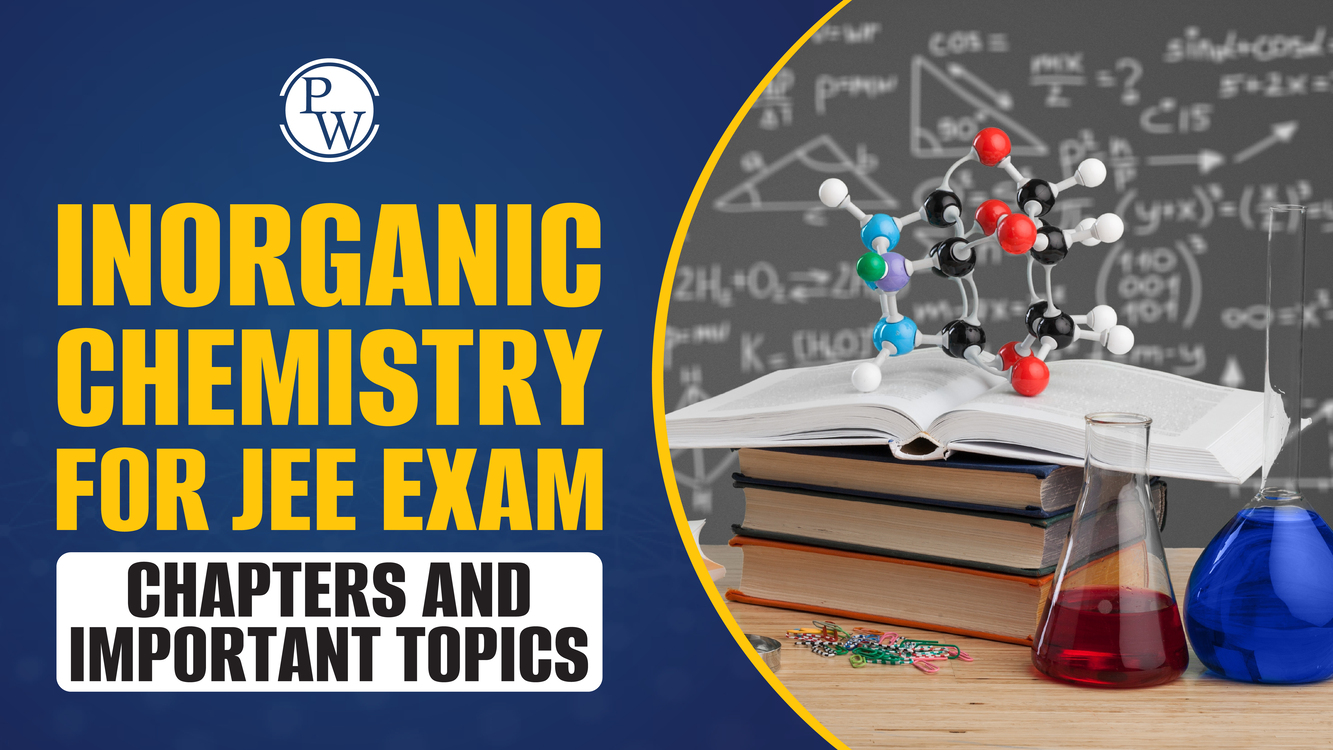
Inorganic Chemistry is an important section in the Joint Entrance Examination. JEE is for students who wish to get admission into top engineering colleges like IITs, NITs, IIITs, etc., to pursue higher education. Chemistry is one of the three main subjects in JEE, and Inorganic Chemistry carries a good weightage of marks in it. Many times, questions from the Inorganic Chemistry JEE syllabus are direct and can be solved easily.
That’s why knowing the IIT JEE Chemistry important topics from the inorganic part can really help you score better. Scoring in this section will be easier if you know what to study and how to study. Learning the right topics saves time and helps you focus on concepts that actually get asked in the exam. So, keep reading to explore the key topics and chapters along with tips to cover the Inorganic Chemistry JEE syllabus effectively.
Check Out: IIT JEE Books
What is Inorganic Chemistry for JEE?
Inorganic Chemistry for JEE is the part of Chemistry that focuses on elements and compounds. It covers concepts like metals, nonmetals, and how they react with each other. Even some simple carbon compounds like carbon dioxide (CO₂) and carbon monoxide (CO) are included here. The Inorganic Chemistry JEE syllabus is more about learning facts and remembering concepts than solving numerical problems.
For the upcoming exams, the JEE inorganic chemistry syllabus includes topics like periodic properties, chemical bonding, redox reactions, and the chemistry of s, p, d, and f block elements. Most questions from inorganic chemistry JEE are fact-based, not tough. If you focus on the important chapters, this part can help you gain marks without too much time or stress.
IIT JEE Chemistry Important Topics
Chemistry in the IIT JEE exam is divided into three main parts: Physical, Organic, and Inorganic. Each of these has some important topics, questions from which are asked almost every year. That's why knowing these IIT JEE Chemistry important topics is vital, as it helps you prepare smartly and use time effectively during revision.
Check out some of the IIT JEE Chemistry important topics you must include in your study plan here:
-
Chemical Bonding
-
Atomic Structure
-
Chemical Thermodynamics
-
Chemical Equilibrium
-
Electrochemistry
-
Solutions and Colligative Properties
-
Redox Reactions
-
Chemical Kinetics
-
Organic Chemistry Basics (like Nomenclature and Isomerism)
-
Hydrocarbons
-
d- and f-Block Elements
-
Coordination Compounds
-
Periodic Properties, among others.
These are some of the high-scoring IIT JEE Chemistry important topics. Many questions come directly from these chapters in both JEE Mains and Advanced. Let's now look at the complete Inorganic Chemistry JEE syllabus and see which chapters you should study in detail to score well.
Check Out: JEE Question Banks
Inorganic Chemistry JEE Syllabus: Important Chapters and Topics
Inorganic Chemistry JEE syllabus covers chapters from both Class 11 and Class 12. It includes the properties, trends, and reactions of different elements in the periodic table. While some important chapters from the JEE inorganic chemistry syllabus focus on understanding, others need the learning of facts. Find out all the important chapters and topics under them that you need to study from Inorganic Chemistry for JEE Exam below:
|
Inorganic Chemistry for JEE Exam |
|
|
Important Chapter |
Key Topics Covered |
|
Classification of Elements and Periodicity in Properties |
Periodic table, periodic trends (atomic size, ionization energy, electronegativity) |
|
Chemical Bonding and Molecular Structure |
Ionic, covalent, and metallic bonds, VSEPR theory, VBT, MOT, molecular geometry |
|
Coordination Compounds |
Ligands, central atom, naming rules, CFT, applications in biology and industry |
|
p-Block Elements (Group 13 & 14) |
Properties and uses of boron, aluminum, carbon, silicon, etc. |
|
p-Block Elements (Group 15 to 18) |
Nitrogen, oxygen, halogens, noble gases, trends, reactions, and everyday uses |
|
d-Block Elements |
Transition metals, oxidation states, colored compounds, and catalytic behavior |
|
f-Block Elements |
Lanthanides and actinides, magnetic and radioactive properties, applications |
|
Hydrogen |
Position in periodic table, properties, hydrides, uses in industry |
|
The s-Block Element |
Group 1 and 2 elements, their reactions, compounds, and trends |
|
Metallurgy |
Extraction of metals, refining methods, and basic principles |
|
Qualitative Analysis |
Tests for detecting basic anions and cations |
Inorganic Chemistry JEE Topic-Wise Weightage
-
Coordination Compounds carry around 5% weightage in the JEE exam.
-
S-block elements also have a 5% weightage.
-
P-block elements similarly contribute about 5%.
-
Periodic Classification of Elements has a slightly lower weightage of 3%.
-
Principles and Processes of Extraction of Elements carry 2% weightage.
-
Transition Elements also hold a 2% weightage.
-
Polymers contribute around 2% to the Inorganic Chemistry section.
Tips to Study Inorganic Chemistry for JEE Exam
Inorganic Chemistry is one of the easiest scoring parts in JEE if you know how to study it properly. Like Physics and Mathematics, you don’t need to solve tough problems in inorganic chemistry. Because most questions are based on facts, trends, and memory. That’s why many students use this section to balance their overall marks. Here are some effective tips that can help you prepare the Inorganic Chemistry JEE syllabus well:
Understand vs. Learn Topics
-
In the JEE Inorganic Chemistry syllabus, some topics are based on logic, and some need memory.
-
Topics like the Periodic Table, Chemical Bonding, and Coordination Compounds are understanding-based.
-
On the other hand, topics like s-block, p-block, d-block, and Qualitative Analysis are memory-based.
-
So, start with the understanding chapters first. Then go to the memory-based ones.
Focus on Periodic Table Trends
-
The periodic table is the basis of many chapters.
-
Try to learn the trends like atomic size, ionization energy, and electronegativity.
-
Also, note the exceptions. These are generally asked in JEE exams.
-
If you understand the logic behind the trends, it becomes easy to remember other chapters too.
Clear Your Concepts in Chemical Bonding
-
The chemical bonding chapter of Inorganic Chemistry for the JEE Exam is full of basic concepts.
-
Understand VSEPR theory, hybridization, and Molecular Orbital Theory (MOT).
-
Practice how to draw structures and predicting shapes.
-
Also, learn about dipole moment and hydrogen bonding clearly. Because questions from these simple concepts are generally asked.
Don’t Skip Coordination Compounds
-
This chapter is very important for both JEE Mains and Advanced.
-
Learn naming rules, electronic configuration, types of ligands, and bonding theories like CFT.
-
Keep a list of important complexes and their colours.
-
This topic has both logic and memory parts, so study it in parts.
Give Time to Metallurgy and Qualitative Analysis
-
The Metallurgy and Qualitative Analysis chapters are full of facts.
-
Learn the names of ores, methods of extraction, and important reactions.
-
In Qualitative Analysis, remember tests and colour changes.
-
It may be tough to remember all the concepts at first, but regular revision helps a lot.
Use Trend Tricks to Remember Properties
-
Try to link different topics with periodic trends.
-
For example, the solubility of salts, the reactivity of metals, and the colour of ions often follow a pattern.
-
Once you know the pattern, it becomes easier to guess or recall the correct answer.
Solve JEE Previous Year Questions
-
Practicing JEE previous year question papers from the last 10 years can help you understand the exam pattern and type of questions asked from the Inorganic Chemistry JEE syllabus.
-
You’ll also know which inorganic chemistry topics are repeated more often
-
It builds your confidence, too.
Check out the JEE Chemistry PYQ Books that cover all 144 shifts of JEE Main PYQs and offer 2500+ Advanced-level questions with mock tests to strengthen your preparation here:
|
JEE Preparation Books |
|
|
JEE Main 7 Years (2019 - 2025) Chemistry PYQ All 144 Shifts |
|
|
Absolute for JEE Advanced Chemistry 2500+ Questions |
|
|
48 Years JEE Advanced Physics, Chemistry, Mathematics Combo |
|
Make a Reactions Notebook
-
Keep a small notebook for important reactions.
-
Write down key reactions, properties, and exceptions.
-
Use this for daily revision, especially before the exam.
-
This will save you time and make last-minute revisions easier.
Use Colour Coding for Memory
-
In Qualitative Analysis, colours are hard to remember.
-
You can use coloured pens to match the ink with the compound colour.
-
This helps create a picture in your mind and makes it easier to recall during the exam.
Inorganic Chemistry Book for JEE
Inorganic Chemistry is very important for both the JEE Main and Advanced exams. Many aspirants find inorganic chemistry easy to score, once they understand the concepts. But because the theory part is vast and full of facts, remembering everything becomes tough without the right study material. That’s why having a reliable Inorganic Chemistry Book for JEE makes all the difference.
JEE Handwritten Notes for Inorganic Chemistry by PW is one such book made specially for JEE aspirants like you. It brings together complete theory and previous year questions (PYQs) in one place. This way, you don’t need to switch between your notes and question banks again and again. Here’s what makes this book even more helpful:
-
Complete Theory + PYQs: You get detailed theory for every inorganic chemistry chapter, along with JEE Main and Advanced PYQs right below each topic.
-
Jwala Concept by Om Sir: Learn through Om Pandey Sir’s special teaching method that explains tough topics in a very simple and engaging way.
-
Multicoloured Handwritten Notes: The notes are handwritten in different colours, which helps you remember key points better.
-
Easy to Understand: The book explains the Inorganic Chemistry syllabus for JEE in easy-to-understand language.
-
Creative Concept Presentation: Visual charts and clear formatting help you understand and revise faster.
-
NCERT Simplified: All NCERT-based theory is broken down into short and simple explanations.
-
PYQs with Each Topic: Each topic comes with previous year questions, so you can practice right after learning.
Read More: Physical Chemistry for JEE Exam: Chapters and Important Topics
Inorganic Chemistry for JEE Exam FAQs
Q.1. Is inorganic chemistry for JEE important?
Ans. Yes, inorganic chemistry is very important for both JEE Main and Advanced. It usually carries around 30–35% of the total marks in the chemistry section. So, if you study it well, you can improve your score easily.
Q.2. What is inorganic chemistry?
Ans. Inorganic chemistry is the branch of chemistry that deals with the study of elements and compounds that are not based on carbon. It includes topics like the periodic table, bonding, coordination compounds, and more.
Q.3. What Inorganic Chemistry JEE syllabus chapters should I prepare?
Ans. Some important Inorganic Chemistry chapters are Modern periodic law, the periodic table, s-, p-, d-, and f-block elements, and trends like atomic size, ionization energy, electron gain, valency, and oxidation states.
Q.4. Can I skip inorganic chemistry while preparing for JEE?
Ans. Inorganic chemistry for JEE alone carries around 30 to 35% of the chemistry marks in JEE Main, and many questions are direct and comparatively easy to answer. So, studying it properly can actually help you score well.
Q.5. How to cover the JEE inorganic chemistry syllabus on time?
Ans. Start with the NCERT and read each chapter carefully. Make short notes, revise regularly, and solve PYQs after each topic. Using handwritten notes can help you finish the syllabus faster and remember better.
![JEE Advanced EaJEE Handwritten Notes For Inorganic Chemistry By Om Pandey | Chapterwise and Topicwise Questions | Complete JEE Main & Advanced Syllabus | Handpicked PYQs [Paperback] Om Pandey](https://static.pw.live/7ad2ddc0-3b23-4e89-bce9-64275f276aa2.png)