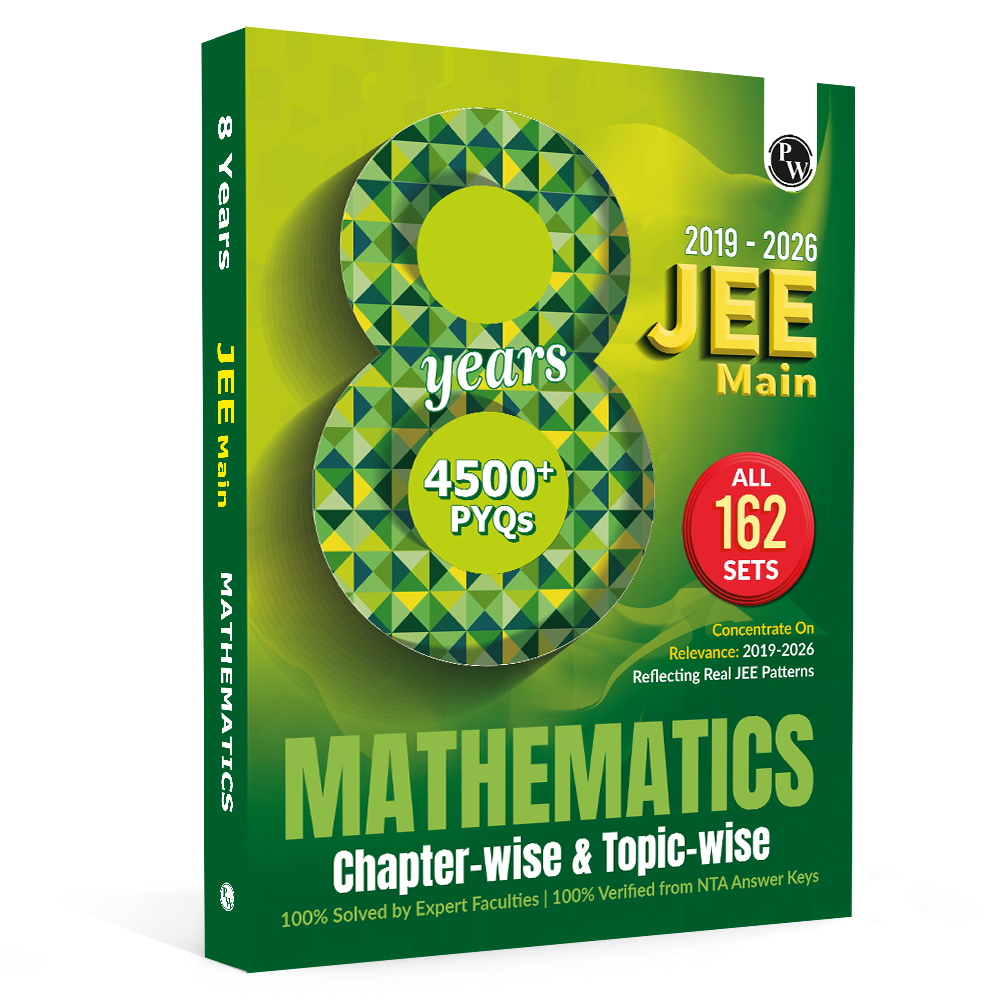
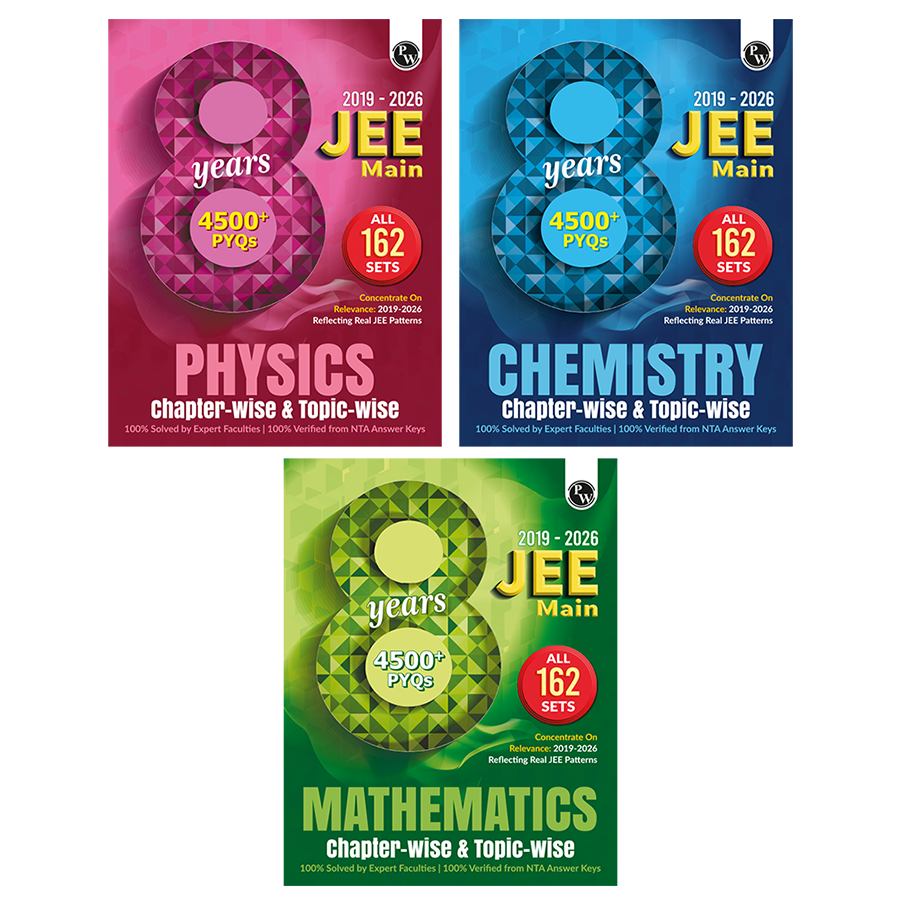
What does the 8 Years JEE Maths PYQ book cover and how is it organised
Preparing for engineering entrance exams requires a clear roadmap, especially when tackling the complex numericals and theorems of mathematics. Many aspirants struggle to find relevant practice questions that match the exact difficulty level of recent computer-based tests.
Studying outdated question formats often leads to poor time management and confusion during the actual exam. To solve this problem, selecting a structured question bank is essential. The 8 Years Book is a comprehensive guide specifically engineered to streamline your JEE Main Maths PYQ practice.
What is JEE Main Maths PYQ?
The preparation book is a specialized resource compiled for engineering aspirants who want to master the mathematical section of the entrance test. It filters out old, irrelevant question formats and focuses entirely on the modern era of computer-based testing. This allows students to align their preparation strategy with what external testing agencies actually ask in the examination hall.
The manual acts as a strategic diagnostic tool to help you understand question framing, option traps, and the core concepts that carry the maximum weightage. By practicing from this compiled guide, you build the required exam stamina and critical thinking skills without wasting hours on redundant materials.
Features of the JEE Main Maths PYQ Book
The manual is built around specific features designed to enhance self-study and minimize dependence on external doubt-clearing platforms. Combining such structured resources with JEE Previous Year Papers further strengthens preparation by helping students understand actual exam trends, improve application skills, and practice concepts independently.
|
Feature of the Book |
Benefit for Engineering Aspirants |
|
Year-wise distribution |
Helps track the evolving difficulty and shifting nature of the test. |
|
Topicwise division |
Allows you to focus on one specific mathematical strength at a time. |
|
Verified Answers |
Eliminates confusion or stress caused by errors found in unofficial answer keys. |
|
Smart Weightage Analysis |
Highlights high-priority chapters so you can plan your study hours strategically. |
Which Years are Covered in JEE Main Maths PYQ?
This resource provides an extensive collection of real examination papers, ensuring that you do not need to hunt for separate shift-wise PDFs online. It encompasses the transformative phase of the engineering entrance exam, making your practice highly accurate and efficient.
-
Timeline Focus: The guide covers all previous year questions from the year 2019 to the year 2026.
-
Total Shift Papers: It includes approximately 162 complete sets of previous papers across all morning and evening sessions.
-
Question Volume: Aspirants get access to around 4500+ authentic questions to solve and master.
-
Format Readiness: The collection features both Multiple Choice Questions (MCQs) and Numerical Value Questions to balance your section-wise practice.
How are the Questions Organized in JEE Main Maths PYQ?
A massive pool of 4500+ problems can easily become overwhelming if it is not cataloged correctly. This guide resolves that issue by abandoning simple chronological listing in favour of a student-friendly structural breakdown.
Chapterwise Categorisation
The complete syllabus is split cleanly into distinct individual chapters. This allows you to finish a topic from your main textbook or class notes and immediately jump into the corresponding chapter of the JEE Main Maths PYQ book. It ensures you validate your conceptual understanding before moving to the next segment.
Topicwise Segregation
Within every single chapter, the questions are further divided based on sub-topics and specific core themes. For instance, if you are studying Matrices and Determinants, you can isolate problems that solely deal with the properties of adjoints or Cramer’s Rule. This granular division lets you identify your exact problem areas and fix weak links immediately.
This structured approach makes JEE Main PYQ practice more efficient by helping students revise systematically, strengthen concepts, and build confidence through targeted problem-solving.
High Weightage Chapters in JEE Main Maths PYQ
The layout of the book helps you easily recognise high-yield areas where NTA regularly maintains a high question density. You can structure your revision by dividing the chapters into high-priority zones based on the historical trends present in the text.
-
Matrices and Determinants: These chapters are relatively simple to grasp and consistently provide around two questions per shift.
-
Sequence and Series: Focuses heavily on arithmetic and Geometric Progressions. The maths JEE main PYQ collection demonstrates how these are frequently blended with other calculus topics.
-
Vector Algebra and 3D Geometry: These areas carry a very high point weightage, and practicing them assists in visualising complex spatial arrangements.
-
Sets, Relations, and Functions: Essential baseline topics that establish the logic required for solving advanced Calculus problems.
-
Quadratic Equations: A highly recurring theme in the maths PYQ JEE mains section, where the roots of equations are interconnected with trigonometry or coordinate geometry.
How to Use the JEE Main Maths PYQ Book Effectively?
To transform this collection of papers into a high percentile score, you must follow a disciplined execution plan rather than solving questions randomly. Combining this approach with well-structured JEE Books helps build strong concepts, improve revision efficiency, and create a balanced preparation strategy for consistent performance improvement.
-
Concept Consolidation: Spend around two hours reviewing the core formulas and short notes of a chapter before opening the practice book. Do not get stuck on lengthy derivations during this phase.
-
Immediate Topic-wise Solving: Right after finishing your theory review, solve the specific sub-topic questions from the math JEE PYQ archive to lock in the logic.
-
Analyze the Detailed Explanations: Do not just look at the final answer. Read through the step-by-step breakdown to learn the exact step logic and shortcuts. NTA frequently repeats the underlying mathematical logic while simply altering the numerical values.
-
Time-Bound Practice Runs: Once you develop a comfort level with the formulas, solve the PYQ of maths JEE mains in a strictly timed setting using a stopwatch to mirror actual test conditions.
Tips for Using JEE Main Maths PYQ
Relying on questions from fifteen or twenty years ago can misguide your preparation because the pattern has evolved significantly. The JEE_math_PYQ trends from the last 8 years represent the era of online computer-based tests, which demand faster calculation speeds and a different approach to numerical grid entries.
By focusing your attention on these 162 sets, you ensure that every single minute of your study session is spent on relevant, contemporary question styles. This keeps your critical thinking sharp and fully aligned with the expectations of the paper setters.
Read More: JEE Main Previous Year Question Papers, Download PDF
JEE Main Maths PYQ FAQs
How many years of previous papers are included in this book?
The book contains all the official questions from the last 8 years, specifically covering the sets from the year 2019 to the year 2026. This encompasses approximately 162 shift papers in total.
Are the questions organized chronologically or by topic?
The questions are organized using a dual-layered structure. They are first divided chapterwise and then further sorted into topicwise sub-sections, allowing students to practice specific concepts right after learning them.
Does this resource contain step-by-step solutions for the math problems?
Yes, the book features comprehensive, error-free, detailed explanations for all 4500+ questions. These solutions focus on conceptual clarity and explain the logical reasoning behind each step.
Are both multiple-choice and numerical questions covered?
Yes, it covers all question formats introduced in recent years, including standard Multiple Choice Questions (MCQs) and Numerical Value Questions to ensure complete exam readiness.
How does the weightage analysis feature help in preparation?
The smart weightage analysis highlights high-priority chapters and recurring question trends, allowing candidates to prioritize high-yield topics and optimize their revision schedule.