Which JEE Maths Chapters have the Most Questions Across 8 Years
Preparing for a highly competitive engineering entrance test requires an analytical study plan. Many students spend countless hours solving entire textbooks without realising that certain chapters consistently dominate the exam. If you are struggling to manage your revision timeline, tracking question trends from past papers is the ultimate solution.
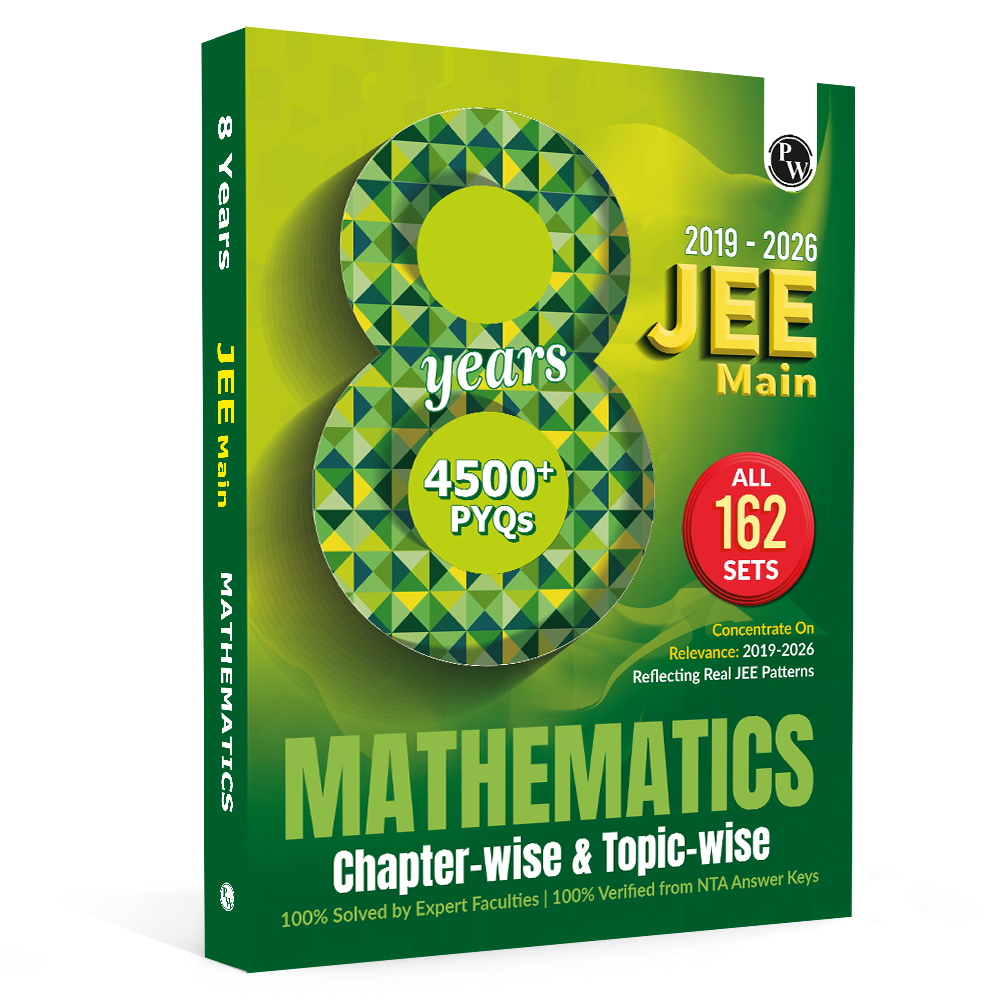
Utilizing a structured JEE Main Maths PYQ resource helps you separate high-yield topics from low-priority ones, ensuring your effort yields the maximum possible score.
Importance of JEE Main Maths PYQ
Sometimes, looking at the trends from the previous year can be misleading because there are sudden shifts in paper patterns. But eight years is a fair perspective, eliminating short-term anomalies.
Analyzing data across multiple years offers several clear advantages:
-
Identifies Consistent Core Patterns: You can spot chapters that examiners never skip, regardless of variations in paper sets.
-
Familiarity with Question Variety: It exposes you to multiple question formats, including single-correct options and numerical value-based entries.
-
Balances Syllabus Depth: You can easily gauge whether a massive chapter is worth your time or if a shorter topic provides a better return on effort.
-
Develops Time Management: Solving extensive past questions trains your mind to identify lengthy calculation traps that you might want to skip or attempt later.
What are the High Weightage Chapters in JEE Main Maths PYQ?
Based on previous trend data, it is estimated that a small selection of units makes up approximately 45% to 50% of the entire Mathematics section. So get these chapters down first. Your chances of clear categorization and scoring improve dramatically. To validate these trends and understand real question distribution, regularly solving JEE Previous Year Papers can help you identify recurring concepts and prioritize your preparation more effectively.
Three-Dimensional Geometry and Vector Algebra
These two topics are generally studied together and stand out as the highest-yielding chapters in the entire syllabus. Over the last eight years, they have consistently contributed around 3 to 4 questions in every single shift paper.
-
Key Focus Areas: Scalar triple products, vector equations of lines, shortest distance between two skew lines, and intersection of lines and planes.
-
Why Prioritize It: The problems are highly structured. Once you visualize the directional cosines and vector positions, reaching the final answer involves standard algebraic steps.
Matrices and Determinants
This unit is highly favored by paper setters due to its application-based nature. It frequently provides around 2 to 3 questions per session, often serving as a scoring area for systematic students.
-
Key Focus Areas: Properties of determinants, adjoint and inverse matrices, and solving systems of linear equations using Cramer’s Rule.
-
Why Prioritize It: The concepts are straightforward, and practicing with a JEE Main Maths PYQ compilation ensures you pick up the exact step-saving properties that cut down manual calculation times.
Sequences and Series
Algebra contains several broad topics, but this specific chapter yields around 2 questions per shift with remarkable consistency.
-
Key Focus Areas: Arithmetic and Geometric Progressions (AP and GP), sigma notations for the sum of series, and Arithmetico-Geometric Progressions.
-
Why Prioritize It: The questions usually rely on standard formulas, meaning structured practice directly translates into quick marks during the actual test.
How is the Distribution of Questions in JEE Main Maths PYQ?
To help you plan your preparation effectively, the table below provides an approximate breakdown of the percentage weightage and average question frequency. This comprehensive overview is based on analysis of the last eight years of papers. For deeper pattern recognition and targeted revision, practicing JEE Main PYQs alongside this analysis can help you understand chapter importance and improve exam readiness.
|
Mathematics Unit / Chapter |
Approximate Weightage (%) |
Average Questions Per Shift |
|
Three-Dimensional Geometry |
Around 7.3% |
2 to 3 Questions |
|
Sequences and Series |
Around 5.7% |
1 to 2 Questions |
|
Limit, Continuity, and Differentiability |
Around 5.5% |
1 to 2 Questions |
|
Definite Integration |
Around 5.1% |
1 to 2 Questions |
|
Binomial Theorem |
Around 5.0% |
1 Question |
|
Complex Numbers |
Around 4.7% |
1 Question |
|
Vector Algebra |
Around 4.7% |
1 to 2 Questions |
|
Application of Derivatives |
Around 4.7% |
1 Question |
|
Differential Equations |
Around 4.1% |
1 Question |
|
Matrices and Determinants |
Around 4.0% |
1 to 2 Questions |
|
Permutations and Combinations |
Around 3.6% |
1 Question |
|
Coordinate Geometry (Circles & Conics) |
Around 7.5% |
2 to 3 Questions |
|
Probability and Statistics |
Around 6.1% |
1 to 2 Questions |
Integral and Differential Calculus Weightage in JEE Main Maths PYQ
Calculus forms the operational backbone of the entire examination paper. While individual chapters might seem moderate in weightage, the entire block taken together dictates a huge portion of your final percentile.
Integral Calculus
Definite integration combined with differential equations regularly supplies around 2 to 3 questions per session.
-
Definite Integration: Focus heavily on the properties of definite integrals, estimation techniques, and Leibniz's rule for differentiation under the integral sign.
-
Differential Equations: Prioritize linear differential equations and variable separable forms, which appear in nearly every shift.
Differential Calculus
This segment tests your fundamental analytical skills. The question format often mixes multiple concepts from different sub-topics.
-
Limits and Continuity: Questions regularly involve evaluating forms like $0/0$ or $1^\infty$, where L'Hopital's Rule or expansion series save time.
-
Application of Derivatives: Maxima, minima, and tangent-normal conditions are highly recurring themes that demand clear geometric visualization.
How to Use JEE Main Maths PYQ Effectively?
Simply owning a collection of questions will not guarantee an improved rank. You must approach your practice systematically to get the best out of your study sessions. Resources such as the JEE Maths Handwritten Notes Class 11 can support concept revision and make it easier to connect theory with question practice.
Using a strategic framework transforms your preparation style:
-
Start with Chapter-Wise Segregation: Do not jump directly into full-length papers. Solve a Maths JEE main PYQ collection chapter by chapter immediately after finishing the corresponding theoretical concepts.
-
Analyze Under Timed Conditions: Set a timer when working through a maths PYQ JEE mains collection. Mathematics papers have become increasingly calculation-heavy, making speed an absolute necessity.
-
Deconstruct Step-by-Step Solutions: When you hit a roadblock, do not just glance at the final answer. Study the underlying methodology to understand why a specific identity or trick was used.
-
Maintain a Mistakes Logbook: Note down every math JEE PYQ question where you committed a silly calculation error or conceptual mistake. Review this logbook before your weekly mock tests.
Tips for Coordinate Geometry and Algebra in JEE Main Maths PYQ
Coordinate geometry is highly formula-driven, while algebra tests your logical reasoning capabilities. Balancing your preparation across both areas ensures stable performance across different paper sets.
Master the Conic Sections
Chapters like straight lines, circles, parabolas, ellipses, and hyperbolas collectively form a major chunk of the question pool.
-
Practicing a dedicated maths JEE mains PYQ series highlights that standard tangent conditions are repeated across different variations.
-
Memorizing the parametric forms of coordinates helps in simplifying complex geometrical intersections significantly.
Tackle Complex Numbers and Binomial Theorem
These chapters are occasionally perceived as difficult, but they offer highly predictable question types.
-
Complex Numbers: Focus on the geometry of complex variables, De Moivre's theorem, and cube roots of unity.
-
Binomial Theorem: General terms, remainder problems, and binomial coefficient series are the most frequent question formats. Working on a regular PYQ of maths JEE mains schedule ensures these predictable formats become easy scoring opportunities.
Read More: JEE Mains 2026 Syllabus
JEE Main Maths PYQ FAQs
Which chapter has the highest weightage in the past eight years of papers?
Three-Dimensional Geometry combined with Vector Algebra has consistently registered the highest weightage. Together, they contribute approximately 3 to 4 questions per shift, making them an absolute priority for every engineering aspirant.
Are questions directly repeated from previous years in the mathematics paper?
Direct numerical repetitions are exceptionally rare. However, the core mathematical concepts, structural layouts, and application styles are heavily recycled. Mastering the past paper formats allows you to easily identify the underlying logic of new problems.
Should I practice past questions chapter-wise or year-wise?
You should initially practice chapter-wise to cement your conceptual grip on individual topics. As the final months of your preparation approach, switch over to solving full year-wise mock tests in a strict three-hour window to improve your stamina and time management.
How has the difficulty level of the mathematics section changed recently?
Analysis indicates that the mathematics section has become progressively lengthier and more calculation-intensive. This trend makes systematic practice with recent papers crucial for developing the speed and selection skills needed to skip lengthy questions.
Can I score a high percentile by preparing only high-weightage chapters?
Focusing entirely on high-weightage chapters can help you clear the sectional cut-off and achieve a respectable score. However, securing a top-tier rank requires a balanced attempt where you also cover basic concepts of moderate topics to solve easy questions from those chapters.