List of Landforms Name in English for kids
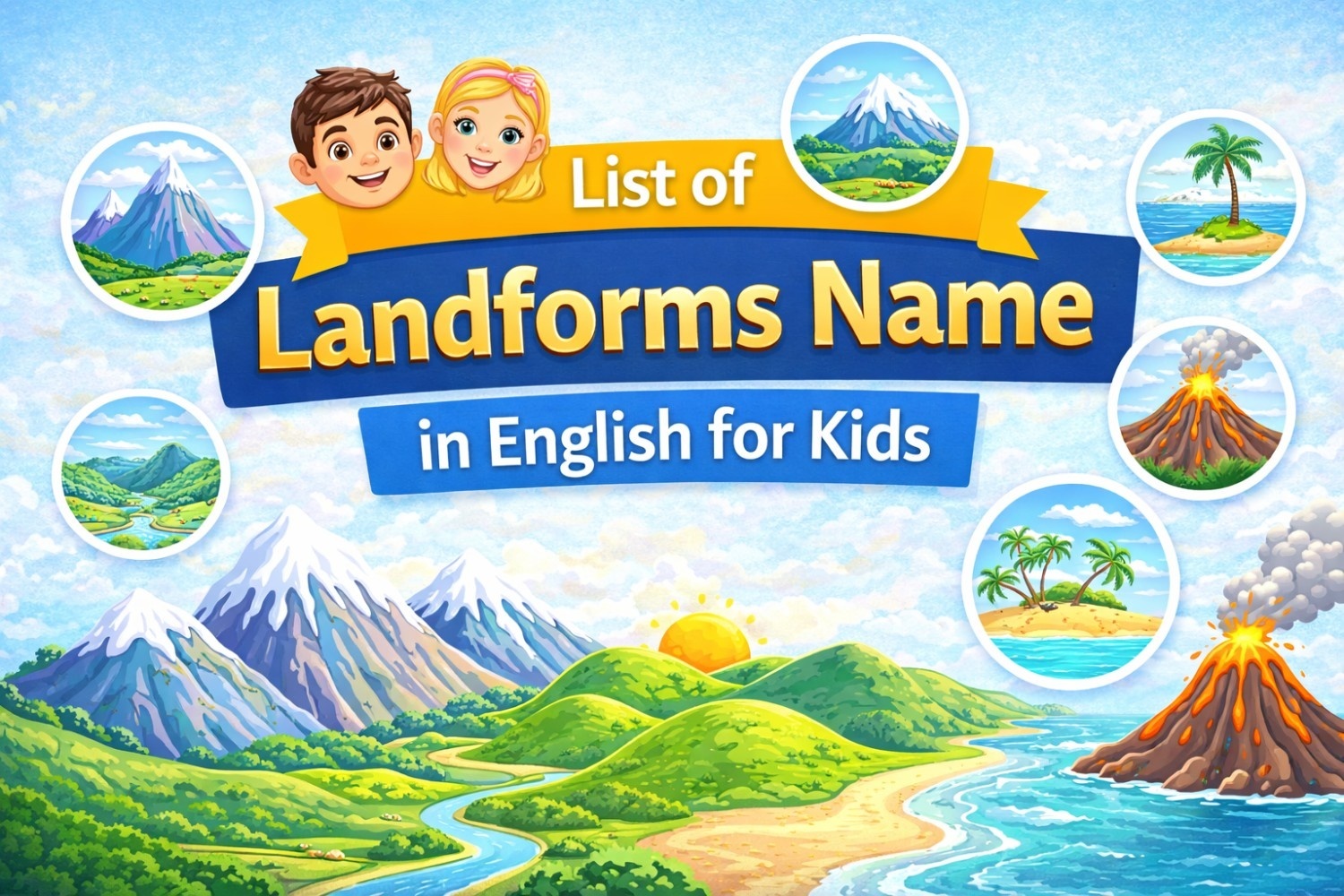
Discover the different shapes of the Earth's surface! This guide shares a landform name list, including mountains, valleys, and plains, helping students identify how our planet’s natural features are formed and where they are found.
The Earth isn't just a flat ball; it is covered in incredible shapes called landforms. If you have ever wondered why some places have high snowy peaks while others are flat and grassy, you are looking for a landforms name to describe them. Understanding these features helps us learn how our planet works.
Check Out: PW Kids' Books
Why Do Landform Names Matter?
When we talk about landforms, we are referring to a natural feature found on the Earth's surface. These shapes are created over millions of years by forces like water, wind, and the movement of the ground beneath our feet. Learning the landforms name list for students is the first step in geography. It helps us understand where animals live, why certain plants grow in specific spots, and how people build their homes.
From the highest mountains to the deepest oceans, every name of the landform represents a unique part of our world’s physical map.
Major Landforms on the Earth
Earth has four major landforms of the earth that define most of the landscape. These are the big categories that every student should know.
1. Mountains
Mountains are the tallest features on Earth. They rise high above the surrounding land and usually have steep sides and sharp peaks. Most mountains are formed when the Earth’s plates collide and push the ground upwards.
-
Fact: The top of a mountain is called a peak or summit.
-
Climate: It is usually much colder at the top of a mountain than at the bottom.
2. Plains
Plains are large, flat areas of land with very few hills. They are often found along coasts or in the middle of continents. Because the land is flat and the soil is often rich, plains are the best places for farming.
-
Usage: Most of the food we eat is grown on plains.
-
Visibility: You can see for a very long distance on a plain because there are no obstructions.
3. Plateaus
A plateau is like a mountain with its top cut off. It is a large, flat area that is raised high above the land around it. People often call them "tablelands" because they look like giant tables.
-
Formation: They can be formed by thinning glaciers or erupting volcanoes.
4. Hills
Hills are similar to mountains but much smaller and less steep. They are usually covered in grass and are easier to climb.
|
Landform Type |
Height |
Appearance |
|
Mountain |
Very High |
Steep, pointed peaks |
|
Hill |
Medium |
Rounded, gentle slopes |
|
Plateau |
High |
Flat top, steep sides |
|
Plain |
Low |
Very flat and wide |
Check Out: Kids Activity Books
Desert Landforms Names
Deserts are dry areas that receive very little rain. However, they are shaped mostly by wind and sand.
-
Sand Dunes: These are giant hills of sand moved by the wind. They can "travel" as the wind blows sand from one side to the other.
-
Oasis: A tiny area in the desert where there is water and plants. It acts like a little island of life in the middle of the dry sand.
-
Mesa: A flat-topped hill with steep sides, very common in dry regions.
Learning these different types of landforms helps kids imagine what it would be like to travel across the Sahara or the Gobi desert.
Water Landforms Name
Water also creates unique shapes on our planet. While some landforms are made of rock and soil, water landforms are defined by how water flows or sits on the land.
Oceans and Seas
Oceans are the largest bodies of salt water on Earth, covering more than 70% of the planet. Seas are also salt water but are smaller and usually partly surrounded by land.
Rivers and Lakes
Rivers are flowing bodies of fresh water that usually start in mountains and flow down to the sea. Lakes are large bodies of water that are completely surrounded by land. Unlike rivers, the water in a lake does not flow in a specific direction.
Islands and Peninsulas
-
Island: A piece of land completely surrounded by water on all sides.
-
Peninsula: A piece of land that is surrounded by water on three sides but connected to a larger landmass on the fourth side. Think of Florida or Italy!
Coastal Areas Landforms Name
Where the land meets the sea, the waves create a specific landform for different features.
-
Valleys: These are low areas between mountains or hills. They are often "U" or "V" shaped and usually have a river running through them.
-
Canyons: A canyon is a very deep valley with extremely steep sides, often carved out by a river over millions of years (like the Grand Canyon).
-
Delta: This is a fan-shaped piece of land at the mouth of a river where it meets the ocean. It is made of sand and mud dropped by the river.
Check Out: Kids Reading Books
Why We Study Landforms and Their Definitions
Landforms for kids learning play an important role in the history of our planet. For example, seeing a valley shaped like a "U" tells us that a giant glacier (a moving river of ice) once sat there.
Every landform we use describes a part of the Earth’s "skin". By knowing these names, students can better understand maps and the world they see outside their windows. Whether you live near a "Hill" or a "Plain", you are part of a vast geographic system.
Landforms Name Explanation in Simple Language
Below is a summarised table of major landforms, along with their key features and examples:
|
Landform Name |
Primary Characteristic |
Example |
|
Mountain |
Tallest landform with a peak |
Mount Everest |
|
Valley |
Low land between hills |
Nile Valley |
|
Island |
Land surrounded by water |
Sri Lanka |
|
Desert |
Dry land with little rain |
Sahara |
|
Peninsula |
Land with water on 3 sides |
India (Southern part) |
Read More: Fruits Name in English for Kids
Landforms Name in English FAQs
What is the most common landform name for flat land?
The most common name for wide, flat land is a plain. These areas are great for farming because the ground is level and the soil is usually very healthy for crops.
How are landforms created?
They are created by nature! Some are made by "internal forces" like earthquakes and volcanoes pushing land up. Others are made by "external forces" like rain, wind, and ice wearing land away.
What is the difference between a mountain and a hill?
While both are raised areas, a mountain is much taller (usually over 600 metres) and has a jagged peak. A hill is shorter and has a more rounded top.
Can you give some water landforms examples?
Yes! Common examples include rivers, lakes, oceans, and gulfs. An island is also often grouped here because its shape is defined by the water surrounding it.
Which landform describes land surrounded by water on three sides?
A peninsula is the correct term for land that has water on three of its sides but remains attached to a larger piece of mainland.