Learn More and Less Concept for Kids
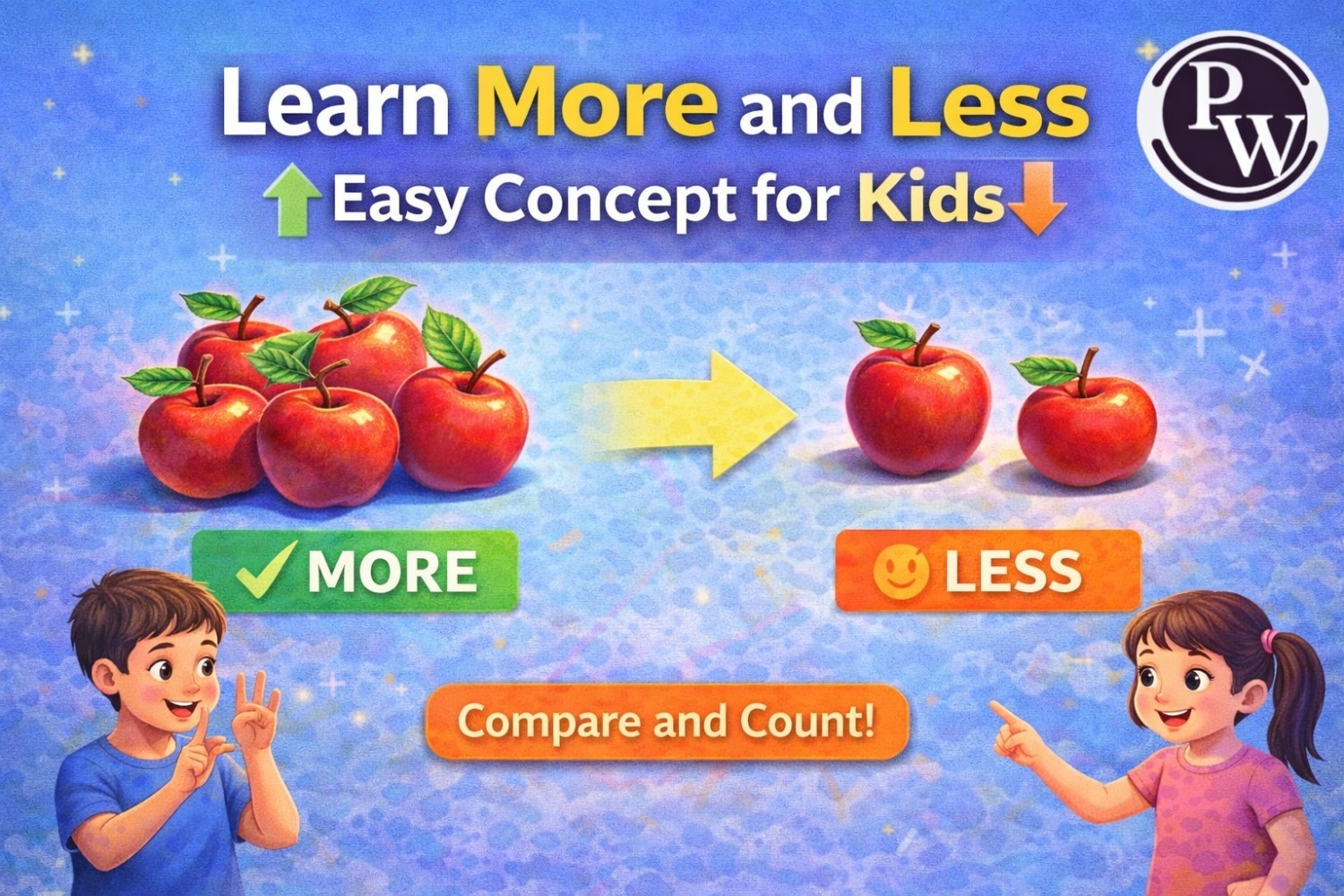
The more and less concept is a fundamental mathematical skill that helps young children compare quantities of different objects. By identifying which group has a larger amount and which contains fewer items, kids develop early number sense. This vital part of learning sets the stage for future addition, subtraction, and logical reasoning in daily life.
Check Out: PW Kids' Books
Teaching the More and Less Concept
Understanding quantity doesn't happen overnight for a child. You can start by using physical objects they love, like cereal or toy cars. When kids see two piles of items, they begin to notice the visual difference in size. This hands-on approach makes the more and less concept for kids feel like a fun game rather than a strict lesson.
Using Visual Aids Effectively
Visuals are your best friend when teaching this.
-
More and less concept pictures help bridge the gap between physical objects and abstract numbers.
-
Show images of two jars: one filled with marbles and one with only three.
-
Ask your student, "Which jar looks crowded?"
-
This builds the vocabulary needed to describe amounts accurately.
Comparing Groups of Objects
-
The "Pile" Method: Create two uneven piles of building blocks.
-
The "Line" Method: Line up stickers in two rows of different lengths.
-
The "Snack" Method: Give one plate more crackers than the other and let them choose.
Check Out: Kids Reading Books
More and Less Concept Pictures
Pictures provide a static reference that kids can analyze at their own pace. When you use more and less concept pictures, you remove the distraction of moving toys. It forces the brain to focus on the quantity shown on the page. We find that high-contrast images work best for toddlers who are just starting out.
What to Look for in Images
-
Clear Differences: Don’t use groups of 9 and 10; try 2 and 10 instead.
-
Familiar Items: Use pictures of apples, balls, or animals.
-
Simple Layouts: Keep the background white so the objects stand out clearly.
Interactive Picture Activities
-
Circle the More: Have the child draw a big circle around the larger group.
-
Cross the Less: Use an 'X' to mark the group that has fewer items.
-
Coloring Tasks: Ask them to color only the side that has "more" blocks.
More and Less Concept Worksheet
A well-designed more and less concept worksheet is a great way to track progress. It moves the student from "guessing" by sight to actually "verifying" by counting. Worksheets provide a structured environment where a child can practice the same skill repeatedly until it sticks. You can find these easily in the PW Store Kids Kits.
Essential Worksheet Components
|
Feature |
Purpose |
|
Side-by-Side Boxes |
Allows direct comparison of two groups. |
|
Counting Circles |
Helps kids keep track of items they have already counted. |
|
Vocabulary Labels |
Reinforces the words "More" and "Less" in written form. |
Best Practices for Paper Practice
Don't rush through the pages. Let the child count each item aloud. Using their finger to point at each object on the more and less concept worksheet prevents them from skipping numbers. If they get stuck, go back to physical toys for a moment to rebuild their confidence.
Check out: Kids Writing & Pattern Books
More and Less Concept Lesson Plan
Creating a more and less concept lesson plan ensures you cover all the bases. A good plan starts with a "hook" to get them excited, followed by an activity, and ends with a quick check. We want to move from concrete objects to pictorial representations and finally to abstract symbols like the "greater than" sign later on.
Step-by-Step Lesson Flow
-
Introduction (5 Mins): Show two bags of candy; ask which one they want.
-
Guided Practice (10 Mins): Use the more and less concept for kids by sorting buttons into groups.
-
Independent Work (10 Mins): Hand out a simple worksheet with clear pictures.
-
Closing (5 Mins): Have the kids point to things in the room that are "more" or "less."
Essential Lesson Goals
-
Identify the group with a larger quantity.
-
Identify the group with a smaller quantity.
-
Use the words "more" and "less" correctly in a sentence.
-
Compare two groups up to the number ten.
At the end of the day, the more and less concept is about building a "number sense" that lasts a lifetime. It isn't just about math; it is about making choices and understanding the world.
Tips for Daily Reinforcement
-
Grocery Shopping: Ask which bag of apples has more.
-
Tidying Up: See who can pick up more toys in one minute.
-
Story Time: Count the characters on different pages of a book.
-
Bath Time: Compare the number of bubbles or floating ducks.
Why This Concept Matters
-
It is the foundation for basic arithmetic.
-
It helps with logical thinking and estimation skills.
-
It teaches kids how to distribute items fairly among friends.
-
It boosts confidence when they start formal schooling.
Making It Stick
Keep your sessions short and sweet. Young kids have short attention spans, so five minutes of focused play is better than thirty minutes of forced sitting. Always praise the effort, even if they miscount. Use "Let's count again together" instead of saying "You are wrong." This supportive tone makes learning feel safe.
Transitioning to Numbers
Once they are experts at looking at more and less concept pictures, start adding digits. Put the number "5" next to five stars and "2" next to two stars. This helps them realize that the symbol "5" actually represents a specific amount. It’s a huge "aha!" moment for any young learner.
Using the PW Store Kids Kits
For parents who want a ready-to-go solution, these kits offer curated materials. They include the more and less concept worksheet sets and colorful cards that make the more and less concept for kids easier to teach. You don't have to spend hours drawing your own pictures when these resources are at your fingertips.
Read More: Fruits Name in English for Kids
More and Less Concept for Kids FAQs
What is the more and less concept?
It is a basic math skill where children compare two groups of objects to see which has a higher or lower quantity.
At what age should kids learn more and less?
Most children begin to understand this between ages 2 and 4, usually starting with visual comparisons before moving to counting.
How do you explain 'less' to a preschooler?
Use the word "fewer" or explain it as the pile that "doesn't have as many" items. Visual aids are the best way to show this.
Can I use household items for this lesson?
Yes! Spoons, socks, fruit, and even pebbles from the garden are perfect tools for teaching the more and less concept.
Why do kids struggle with this concept?
Sometimes they get confused if the objects are different sizes. For example, three big balls might look like "more" than five tiny marbles. Focus on the count, not the size!