List of National Leaders Name of India
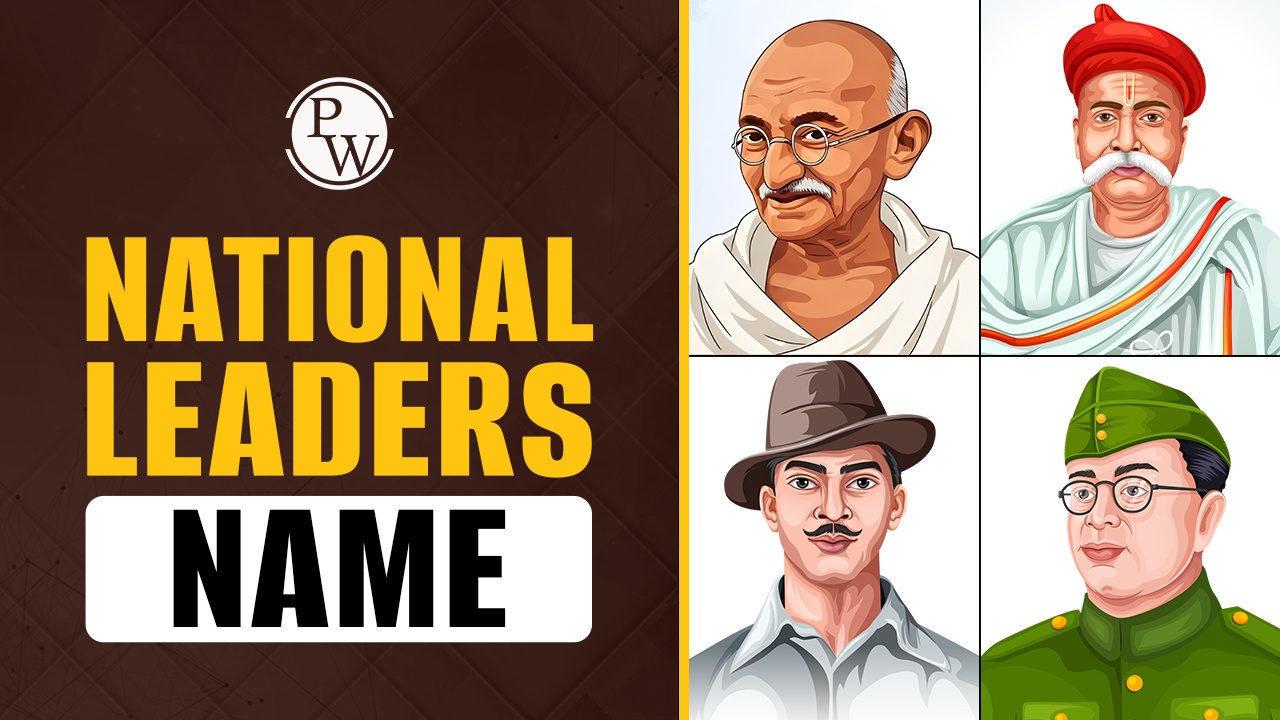
National Leaders Name
During the British rule in India, many brave leaders worked hard to free the country from foreign control. These national leaders inspired people from all parts of India to come together and fight for independence. The struggle for freedom began long ago, with one of the first major events being the Revolt of 1857, remembered as the First War of Independence.
Over time, several movements took place to protest against British rule. The Non-Cooperation Movement in 1920 encouraged Indians to boycott British goods and institutions. In 1930, the Civil Disobedience Movement, led by Mahatma Gandhi, showed the power of peaceful protests, marches, and refusing to obey unfair laws. The Quit India Movement in 1942 demanded an immediate end to British rule.
Many famous freedom fighters of India, including female freedom fighters of India, played a crucial role in these struggles. Their courage and sacrifices inspired millions of people to join the fight for independence. Finally, India gained freedom on 15th August 1947. Remembering the lives and contributions of these national leaders is very important, and thus, it is one of the most important topics when it comes to competitive exams. Go through the provided article here to get the National Leaders Name and learn about their contribution to free our India.
Check Out: PW Kids' Books
Used BLOG100 for Science Activity Kits and BLOG50 for Kids’ Books. Grab your PW Store discount today!
Famous Freedom Fighters of India
Here is the list of the greatest freedom fighters of India:-
|
Famous Freedom Fighters of India |
|||
|
Mahatma Gandhi |
Jawaharlal Nehru |
Subhas Chandra Bose |
Sardar Vallabhbhai Patel |
|
Bhagat Singh |
Bal Gangadhar Tilak |
Lala Lajpat Rai |
Chandra Shekhar Azad |
|
Rani Lakshmibai |
Sarojini Naidu |
Annie Besant |
Kasturba Gandhi |
|
Aruna Asaf Ali |
Rajendra Prasad |
Maulana Abul Kalam Azad |
Bipin Chandra Pal |
|
Gopal Krishna Gokhale |
Khan Abdul Ghaffar Khan |
Madan Mohan Malaviya |
Vinayak Damodar Savarkar |
|
Lal Bahadur Shastri |
Motilal Nehru |
C. Rajagopalachari |
Subramania Bharati |
|
Satyendra Nath Bose |
P. C. Joshi |
Jamnalal Bajaj |
Dadabhai Naoroji |
|
Lala Hansraj |
Veer Savarkar |
Alluri Sitarama Raju |
K. Kamaraj |
|
Khudiram Bose |
Durgabai Deshmukh |
Begum Rokeya |
Meera Benarji |
|
Chandrasekhar Azad (younger) |
Uma Devi |
Rukhmabai |
Mangal Pandey |
Check Out: Kids Activity Books
Freedom Fighters of India Female
1. Rani Lakshmibai
Rani Lakshmibai, the Queen of Jhansi, was one of the bravest female freedom fighters of India. She led her army during the Revolt of 1857 and became a symbol of courage and resistance against the British. Her leadership continues to inspire people even today.
-
She fought bravely in the 1857 Revolt, leading her soldiers against the British army.
-
Rani Lakshmibai became a symbol of bravery and patriotism, motivating many to join the independence struggle.
-
She showed that women could also take part in battles for the nation’s freedom.
2. Sarojini Naidu
Sarojini Naidu, known as the “Nightingale of India,” was a poet and a powerful national leader. She played an important role in India’s freedom movement and inspired many with her speeches and writings.
-
Sarojini Naidu actively participated in the Non-Cooperation Movement led by Mahatma Gandhi.
-
She worked to encourage women to join the freedom struggle across India.
-
Naidu became the first female President of the Indian National Congress, showing women’s leadership.
3. Annie Besant
Annie Besant was a British-born social reformer and a strong supporter of India’s freedom. She worked to educate people about self-rule and organised campaigns for independence.
-
Annie Besant launched the Home Rule Movement, demanding self-government for India.
-
She inspired Indians to participate actively in politics and fight for their rights.
-
Besant also worked to promote education and social reforms throughout India.
4. Kasturba Gandhi
Kasturba Gandhi, wife of Mahatma Gandhi, was a dedicated freedom fighter who supported non-violent protests. She worked alongside Gandhi to improve the lives of Indians and fight against British rule.
-
Kasturba Gandhi participated in the Salt March and Non-Cooperation Movement.
-
She helped mobilise women to join peaceful protests against the British.
-
Kasturba devoted her life to serving people and supporting India’s independence.
Check Out: Kids Reading Books
10 Freedom Fighters of India
1. Mahatma Gandhi
Mahatma Gandhi was born on 2 October 1869 in Porbandar, Gujarat. He grew up learning the values of truth and non-violence, which later became the foundation of his leadership in India’s independence movement. Gandhi dedicated his entire life to peaceful protests and fighting British colonial laws. He was assassinated on 30 January 1948 in New Delhi.
-
In 1920, Gandhi led the Non-Cooperation Movement, urging Indians to boycott British schools, courts, and products.
-
He organised the Salt March in 1930, walking over 240 miles to protest the British salt monopoly.
-
During the Quit India Movement in 1942, Gandhi called for mass protests demanding an immediate end to British rule.
2. Jawaharlal Nehru
Jawaharlal Nehru was born on 14 November 1889 in Allahabad, India. From a young age, he was deeply interested in politics and India’s freedom struggle. Nehru worked closely with Gandhi to lead the Indian National Congress and later became the first Prime Minister of independent India. He passed away on 27 May 1964 in New Delhi after dedicating decades to nation-building.
-
Nehru played a key role in the Civil Disobedience Movement, participating in protests and organising strikes.
-
In 1942, he was imprisoned during the Quit India Movement for actively opposing British rule.
3. Sardar Vallabhbhai Patel
Sardar Vallabhbhai Patel was born on 31 October 1875 in Nadiad, Gujarat. Known as the “Iron Man of India,” he was a skilled lawyer and determined leader who worked to unify the country. Patel played a crucial role in integrating over 500 princely states into India. He died on 15 December 1950 in Bombay (now Mumbai), leaving behind a legacy of discipline and national unity.
-
Patel led the integration of princely states into India after independence, using diplomacy and strategic planning.
-
He played an important role in the Quit India Movement of 1942, motivating citizens to resist British authority.
4. B.R. Ambedkar
B.R. Ambedkar was born on 14 April 1891 in Mhow, Madhya Pradesh. Facing social discrimination from childhood, he became a champion of equality and social justice. Ambedkar dedicated his life to uplifting marginalised communities and ensuring legal and social rights for all. He passed away on 6 December 1956 in Delhi, remembered as the principal architect of the Indian Constitution.
-
Ambedkar was the chief architect of the Indian Constitution, framing laws to protect equality and social justice.
-
He fought against untouchability and caste-based discrimination, campaigning for Dalit rights.
5. Subhas Chandra Bose
Subhas Chandra Bose was born on 23 January 1897 in Cuttack, Odisha. He was a fearless leader who believed that India’s independence could be achieved through direct action. Bose formed the Indian National Army to fight the British during World War II. He reportedly died in a plane crash on 18 August 1945 in Taiwan, though some accounts of his death remain debated.
-
Bose established the Indian National Army (INA) to militarily fight the British in Southeast Asia.
-
He gave the famous slogan, “Give me blood, and I will give you freedom,” to inspire revolutionaries.
6. Rani Lakshmibai
Rani Lakshmibai was born on 19 November 1828 in Varanasi. She became the Queen of Jhansi and one of India’s most courageous female leaders. During the Revolt of 1857, she led her troops against the British, becoming a symbol of bravery and resistance. She died on 18 June 1858 in battle while defending Jhansi, leaving a legacy of heroism.
-
She fought valiantly in the 1857 Revolt, leading her soldiers directly into combat against British forces.
-
Rani Lakshmibai defended Jhansi fort when the British tried to capture the state, showing strategic skill in battle.
7. Bhagat Singh
Bhagat Singh was born on 28 September 1907 in Banga, Punjab. From a young age, he was inspired to fight British colonial rule through revolutionary activities. Singh became a symbol of courage for youth across India. He was executed on 23 March 1931 at the age of 23, sacrificing his life for the nation.
-
Bhagat Singh took part in the Lahore Conspiracy Case, challenging British authority through bold revolutionary acts.
-
He was involved in the shooting of British officer John Saunders, protesting against the Simon Commission.
8. Lal Bahadur Shastri
Lal Bahadur Shastri was born on 2 October 1904 in Mughalsarai, Uttar Pradesh. He played an important role in India’s independence movement and later became the country’s second Prime Minister. Shastri was known for his honesty, humility, and dedication to public service. He died on 11 January 1966 in Tashkent after signing a peace agreement following the India-Pakistan war.
-
Shastri participated in the Non-Cooperation and Civil Disobedience Movements, supporting Gandhi’s campaigns.
-
He coined the slogan “Jai Jawan Jai Kisan” to motivate soldiers and farmers during challenging times.
9. Dr. Rajendra Prasad
Dr Rajendra Prasad was born on 3 December 1884 in Ziradei, Bihar. He was a scholar, a lawyer, and a committed freedom fighter. Prasad played a key role in India’s independence and became the first President of India, helping establish democratic institutions. He passed away on 28 February 1963 in Patna, leaving a legacy of dedication and integrity.
-
Prasad actively took part in the Non-Cooperation and Quit India Movements, often facing imprisonment.
-
He was elected as the first President of independent India, guiding the country’s democratic foundation.
10. Chandra Shekhar Azad
Chandra Shekhar Azad was born on 23 July 1906 in Bhavra, Madhya Pradesh. From an early age, he was determined to fight British colonial rule through revolutionary activities. Azad remained committed to India’s independence until he died in a police encounter on 27 February 1931 in Alfred Park, Allahabad, refusing to be captured alive.
-
He organised and led revolutionary groups like the Hindustan Socialist Republican Association to challenge British authority.
-
Azad was involved in the Kakori Train Robbery, raising funds for revolutionary activities.
Read More: 100+ General Knowledge Question and Answer for Kids
Educational Kids Books
Educational kids books play an important role in developing reading habits, language skills, and general knowledge from an early age. Well-designed books make learning enjoyable through colorful illustrations, engaging activities, and age-appropriate content. The Library Set of 10 Books introduces children to a variety of stories and learning concepts that help build curiosity and imagination. The 555 English Learning Activity Book supports vocabulary development, grammar practice, and language learning through interactive exercises. For children who are expanding their word knowledge, the Kids First 1200 Words Pictionary makes learning new words easy and fun with visual examples. Together, these books create a strong foundation for lifelong learning and academic growth.
National Leaders Name FAQs
1. Who are the 10 great leaders of India?
The 10 great leaders of India include Mahatma Gandhi, Jawaharlal Nehru, Sardar Vallabhbhai Patel, B.R. Ambedkar, Subhas Chandra Bose, Rani Lakshmibai, Bhagat Singh, Lal Bahadur Shastri, Dr. Rajendra Prasad, and Chandra Shekhar Azad.
2. Why are they called national leaders?
These leaders are called national leaders because they inspired people across India, led movements against British rule, and made significant contributions to the country’s freedom and unity.
3. Who are the famous freedom fighters of India?
Famous freedom fighters of India include Mahatma Gandhi, Bhagat Singh, Subhas Chandra Bose, Rani Lakshmibai, Sarojini Naidu, and many others.
4. Who is the greatest national leader?
Mahatma Gandhi is often considered the greatest national leader of India. Born on 2 October 1869, he led the freedom struggle through non-violence and civil disobedience, inspiring millions to oppose British rule peacefully.
5. Who was Subhas Chandra Bose,Ś and what did he do?
Subhas Chandra Bose was a revolutionary leader who formed the Indian National Army (INA) and fought the British during World War II. His slogan, “Give me blood, and I will give you freedom,” inspired many to join the fight for independence.