Learn Planet Names in Solar System for Kids
Understanding the planet names is the first step in becoming a little astronomer. The primary challenge for young learners is often memorising the names without getting confused by their order or specific characteristics. This article is designed to solve that problem. We will go from the hot sun to the cold borders of our neighbourhood, making sure that every kid can name all planets.
Check Out: PW Kids' Books
What Is the Solar System?
Before we go into the names of the planets, we should talk about where they live. The Sun is the centre of the solar system, which is made up of planets, moons, asteroids, and comets that all move around it.
What Is a Planet?
A planet is a big, spherical thing in space that moves in a set course around the Sun. Unlike stars, planets do not produce their own light—they shine because they reflect the Sun’s light.
To make it simple for kids, a planet must:
-
Orbit the Sun
-
Be round in shape
-
Have enough gravity to clear its path of smaller objects
This simple understanding helps children clearly identify what counts as planets in the solar system and what does not.
Check Out: Kids Activity Books
Planet Names in Solar System
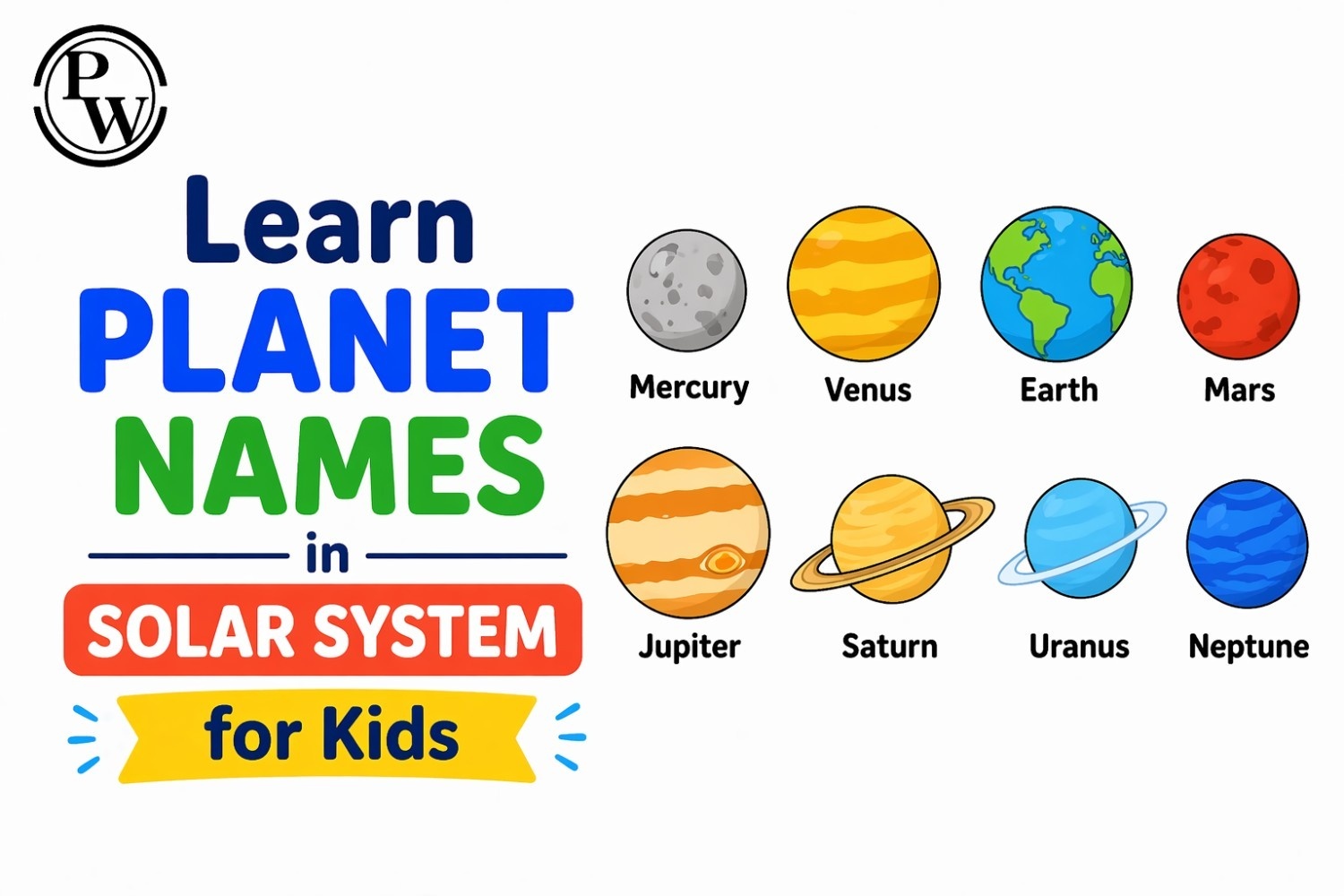
To make learning easy, we usually list the names in order based on how close they are to the Sun. This helps kids visualise the "map" of space. Here are the eight main planets that scientists recognise today:
-
Mercury (Closest to the Sun)
-
Venus
-
Earth
-
Mars
-
Jupiter
-
Saturn
-
Uranus
-
Neptune (Farthest from the Sun)
Many people also include Pluto as the ninth member, though it is now classified as a "dwarf planet." When people search for the 9 planets' names, they are usually including Pluto in their list.
Every world in our sky has its own personality. Let’s look at the details of these fascinating places to help children connect with the names of the planets.
Mercury
Mercury is the smallest of all the planets we study. Because it is so close to the Sun, it zips around its orbit very quickly. It is a rocky world with no air to breathe and is covered in craters, looking very much like our Moon.
Venus
Venus is often called Earth’s sister because they are similar in size. Venus, on the other hand, is much hotter! Because it has dense clouds that retain heat, it is the hottest planet. You can often see it in the evening sky without a telescope since it shines so brightly.
Earth
This is the most well-known name for a planet. It is the only planet that has life and liquid water. It sits at just the right distance from the Sun, not too hot and not too cold.
Mars
Mars is famous for its reddish colour, which comes from rusty iron in its soil. Scientists are very interested in Mars because it has frozen water and giant volcanoes. It is one of the most popular planets for kids to learn about because of the many robotic rovers exploring its surface.
Jupiter
Jupiter is the biggest of all the planets. It is made of gas and has a famous "Great Red Spot," which is a huge storm that has been going on for hundreds of years.
Saturn
When kids look at pictures of planets, Saturn always catches their eye. People know it for its gorgeous, dazzling rings composed of ice and rock. Saturn's rings are the most noticeable and beautiful of all the planets' rings.
Uranus
It's really cold on Uranus. Uranus is different from the other planets because it spins on its side. The gases in its atmosphere give it a beautiful blue-green hue.
Neptune
Neptune is the major planet that is farthest from the Sun. It is a very windy, dark, and cold environment. It looks like a beautiful, bright blue marble in space.
Pluto
For a long time, Pluto was part of the standard list of planets. In 2006, scientists decided it was too small to be a full planet and called it a dwarf planet. However, it remains a favourite for kids learning about the edges of our solar system.
Check Out: Kids Reading Books
Planet Names Chart with Key Features
This table makes it easy to see the names of the planets and what makes each one special:
|
Planet Name |
Type |
Key Feature |
|
Mercury |
Terrestrial |
Smallest and closest to the Sun |
|
Venus |
Terrestrial |
Hottest planet with thick clouds |
|
Earth |
Terrestrial |
Only planet known to support life |
|
Mars |
Terrestrial |
Known as the Red Planet |
|
Jupiter |
Gas Giant |
Largest planet in the solar system |
|
Saturn |
Gas Giant |
Famous for its large, icy rings |
|
Uranus |
Ice Giant |
Spins on its side |
|
Neptune |
Ice Giant |
Farthest planet from the Sun |
Inner and Outer Planet Names in the Solar System
Scientists put the names into two primary groups to make learning even easier:
Inner Planets (Rocky Planets)
These planets are the nearest to the Sun:
-
Mercury
-
Venus
-
Earth
-
Mars
You could (theoretically!) stand on rocky planets because they have solid surfaces.
Outer Planets (Giant Planets)
These are farther from the Sun:
-
Jupiter
-
Saturn
-
Uranus
-
Neptune
They are a lot bigger and largely formed of ice or gas. You cannot stand on them like Earth.
This grouping helps children better understand how the entire planet group is organised.
Check out: Kids Writing & Pattern Books
Planet Names Comparison
Learning becomes easier when kids compare things. Here are some fun comparisons:
-
Biggest Planet: Jupiter
-
Smallest Planet: Mercury
-
Hottest Planet: Venus
-
Coldest Planet: Uranus
-
Closest to the Sun: Mercury
-
Farthest from the Sun: Neptune
These comparisons help children quickly remember important facts about each planet in the solar system.
Trick to Remember Planet Names in Order
Memorising the names in order can be tricky. A great way to help kids is by using a "mnemonic" or a memory sentence. Here is a popular one:
"My Very Educated Mother Just Served Us Noodles"
-
My - Mercury
-
Very - Venus
-
Educated - Earth
-
Mother - Mars
-
Just - Jupiter
-
Served - Saturn
-
Us - Uranus
-
Noodles - Neptune
If you want to include the 9 planets' names, you can add "Pizza" at the end for Pluto!
Fun Activities to Learn Planet Names
Learning the names of the planets can be even more exciting with activities! Here are some fun ideas:
-
Draw the Solar System: Ask kids to draw and colour each planet.
-
Planet Flashcards: Create cards with names and pictures of the planets.
-
Memory Game: Mix planet cards and match names with images.
-
Space Quiz Time: Ask simple questions like “Which is the biggest planet?”
-
Make a Model: Use clay or paper to build the solar system.
These activities make learning the all name of planet more interactive and enjoyable.
Fun Facts About Planet Names in the Solar System
To keep kids engaged, share these "wow" facts while practising the names:
-
A day on Venus is longer than a year on Venus!
-
Jupiter has 95 known moons.
-
Mars has the tallest volcano in the entire solar system, called Olympus Mons.
-
You cannot walk on Saturn or Jupiter because they don't have a solid surface; they are made mostly of gas.
Read More: Rainbow Colours Names in English for Kids
Planet Names in Solar System FAQs
What are the 8 names of planets in order?
The eight planets in order, starting from the Sun, are Mercury, Venus, Earth, Mars, Jupiter, Saturn, Uranus, and Neptune.
Is Pluto still one of the 9 planets name?
While many people grew up learning the 9 planets name, scientists now classify Pluto as a dwarf planet. However, it is still an important part of our solar system studies.
Which is the biggest planet name in solar system?
The biggest planet is Jupiter. It is a gas giant so large that it could hold over 1,300 Earths inside it.
Why is Mars called the Red Planet?
Mars is one of the most recognisable names because of its colour. It is called the Red Planet because its surface is covered in iron oxide, which is the same stuff that makes old bikes go rusty.
Can we see all the planets from Earth?
You can see five of the planet with just your eyes: Mercury, Venus, Mars, Jupiter, and Saturn. To see Uranus and Neptune, you usually need a telescope.