Roman Numerals 1 to 10 | Roman Numbers 1 to 10 Chart
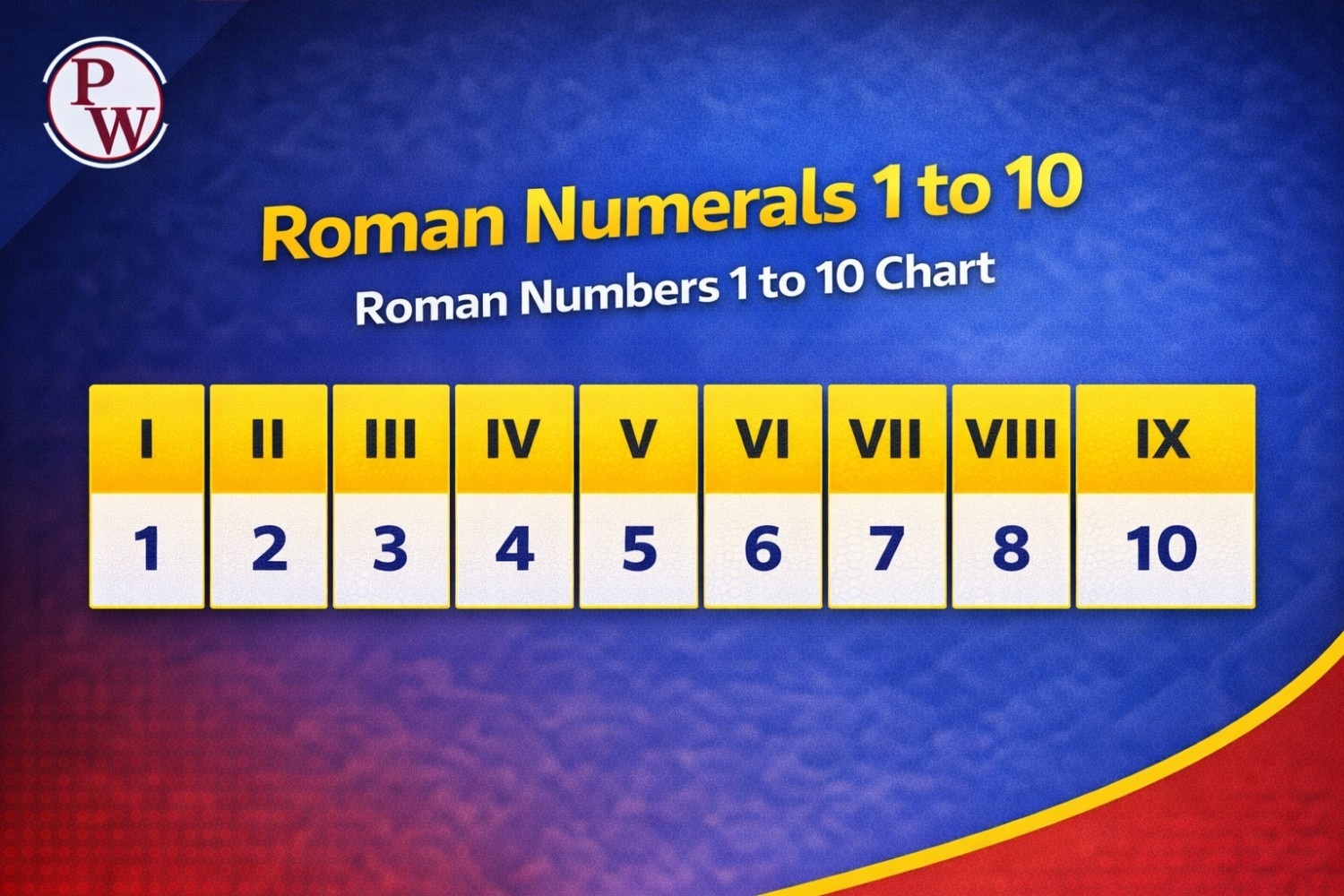
Learning Roman numerals 1 to 10 is the foundation of a system that was used across Europe for centuries and still appears today on clock faces, book chapters, and monuments. A lot of students have trouble figuring out why some letters come before or after others. This article makes the whole procedure easier by breaking it down into simple steps, giving you a clear 1 to 10 Roman number breakdown, important guidelines, and a useful chart to make sure you never get confused again.
Check Out: PW Kids' Books
What is the Roman Numeral System?
The Roman numeral system is an old technique to write numbers using letters from the Latin alphabet. This system doesn't use place value like our modern one does (units, tens, hundreds). Instead, it adds and subtracts certain symbols. You only need to know three letters to learn Roman counting 1 to 10: I, V, and X.
-
I represent the number 1.
-
V represents the number 5.
-
X represents the number 10.
We can make one to 10 Roman numerals by putting these three symbols together in different orders.
Roman Numerals 1 to 10 Chart
Visual learners typically find it simpler to understand numbers when they are shown in a list with a clear organization. Here is the whole list of Roman numerals 1 to ten. You can see how the symbols change as the number becomes bigger.
|
Hindu-Arabic Number |
Roman Numeral |
|
1 |
I |
|
2 |
II |
|
3 |
III |
|
4 |
IV |
|
5 |
V |
|
6 |
VI |
|
7 |
VII |
|
8 |
VIII |
|
9 |
IX |
|
10 |
X |
Check Out: Kids Activity Books
Rules for Roman Numerals 1 to 10
Writing Roman numerals isn't just about memorising a list; it involves following a specific set of mathematical logic. There are two primary rules you must keep in mind to avoid common mistakes.
1. The Rule of Addition
When a symbol of a smaller value is placed after a symbol of a larger value, we add them together. This is the simplest way to build numbers.
-
To get 2, we write II (1 + 1).
-
To get 3, we write III (1 + 1 + 1).
-
To get 6, we write VI (5 + 1).
-
To get 7, we write VII (5 + 1 + 1).
-
To get 8, we write VIII (5 + 1 + 1 + 1).
2. The Rule of Subtraction
This is where many students get tripped up. When a symbol of a smaller value is placed before a symbol of a larger value, you subtract the smaller from the larger. This rule makes sure that a symbol can never be used more than three times in a row.
-
We write IV instead of IIII for 4. This means that 5 minus 1 = 4.
-
We write IX instead of VIIII for 9. This means that 10 minus 1 is 9.
Students should memorise all the principles for using Roman numerals to prevent getting mixed up:
-
A sign can only be used three times (III = 3, but not IIII).
-
The letters V, L, and D never show up more than once.
-
You can only subtract in certain situations:
-
I can only be taken away from V and X (IV, IX).
-
Putting a smaller number in front of a bigger number implies taking it away.
-
Putting a smaller number after a bigger number signifies adding.
These guidelines guarantee that Roman numerals are always the same and easy to read.
Roman Numerals 1 to 10 Pattern
You don't have to memorise Roman numerals from 1 to 10; you can learn them by looking at patterns:
-
1 to 3: Repetition of I → I, II, III
-
4: Subtraction → IV (5 − 1)
-
5: New base symbol → V
-
6 to 8: Addition with V → VI, VII, VIII
-
9: Subtraction → IX (10 − 1)
-
10: New symbol → X
This pattern makes it easier to remember numbers without rote learning.
Check Out: Kids Reading Books
How to Write Roman Numerals 1 to 10?
Let’s look at the step-by-step formation for every 1 to 10 in Roman representation so you can see the logic in action.
-
Number 1: Represented by the single letter I.
-
Number 2: Formed by repeating the symbol for 1 twice: II.
-
Number 3: Formed by repeating the symbol for 1 three times: III.
-
Number 4: Since we cannot use "I" four times, we subtract 1 from 5: IV.
-
Number 5: Represented by the single letter V.
-
Number 6: Formed by adding 1 to 5: VI.
-
Number 7: Formed by adding 2 to 5: VII.
-
Number 8: Formed by adding 3 to 5: VIII.
-
Number 9: Since we cannot add four "I"s after 5, we subtract 1 from 10: IX.
-
Number 10: Represented by the single letter X.
Common Mistakes in Roman Numerals 1 to 10
Even though Roman counting seems straightforward, there are a few errors that pop up frequently in student assignments:
-
Over-repeating Symbols: Never use the letter "I" four times in a row. For example, writing IIII for 4 is incorrect in standard modern Roman numerals; use IV instead.
-
Incorrect Subtraction: You can only subtract "I" from "V" or "X". You cannot subtract "I" from larger numbers like "C" or "L" directly.
-
Confusing IV and VI: Remember, if the "I" comes first, you subtract (IV = 4). If the "V" comes first, you add (VI = 6).
Roman Numerals 1 to 10 Practise Question
Practising regularly helps students understand Roman numerals quickly. Try solving these:
Convert Numbers to Roman Numerals
-
2 = ___
-
4 = ___
-
7 = ___
-
9 = ___
-
10 = ___
Convert Roman Numerals to Numbers
-
VI = ___
-
IX = ___
-
III = ___
-
VIII = ___
-
V = ___
Answers
Numbers → Roman: II, IV, VII, IX, X
Roman → Numbers: 6, 9, 3, 8, 5
Check out: Kids Writing & Pattern Books
Importance of Roman Numerals 1 to 10
You might be wondering why we still study this old system. Roman numerals from 1 to 10 show up in a lot of real-life situations besides maths class:
-
Analogue clocks: These symbols are used by many old-fashioned watches to show the time.
-
Book Volumes: Authors commonly use Roman numerals for the start of a chapter or the preface.
-
Historical Dates: This technique is often used to show the year a building or monument was built.
-
Sports Events: These numbers are often used to show which edition of the games is taking place at major worldwide events.
When you learn the foundations of Roman numerals, you give yourself the tools you need to understand even bigger numbers, such as the ones used for years (like MMXXIV for 2024).
Read More: Number Names 1 to 100
Roman Numerals 1 to 10 FAQs
How do you write 4 in Roman numerals?
A1: The number 4 is written as IV. This follows the subtraction rule where 1 (I) is taken away from 5 (V).
What is the symbol for 10 in the 1 10 Roman number sequence?
A2: The symbol for 10 is X. It is one of the three primary symbols used to form all numbers in the 1 to 10 in Roman list.
Can I write the number 8 as IIX?
A3: No, that is incorrect. Following the Roman numeral system, the number 8 is written as VIII, which means 5 + 3.
Why is the one to ten Roman numeral system called non-positional?
A4: Unlike our modern system where "1" can mean 1, 10, or 100 depending on its place, Roman symbols like "V" always represent 5, regardless of where they are placed.
What are the primary symbols for Roman numerals 1 to ten?
A5: The three primary symbols you need to know for this range are I (1), V (5), and X (10).