NDA Syllabus 2026 with Subject-wise Topics

There are two parts to the NDA syllabus 2026: Mathematics (300 points) and the General Ability Test (600 marks). You need to know 11th and 12th grade material and be up to speed on current events in order to pass these tests. After that, you will have to take the SSB Interview to see how you are as a person.
The National Defence Academy (NDA) is still the right place for young people who want to be officers in the Indian Armed Forces. The first and most important thing you need to do to pass this tough test is to comprehend the NDA syllabus. The UPSC gives the exam twice a year, and it assesses not just what you know but also how quickly and accurately you can do it. The competition will be tougher than ever in 2026, so it's important to have a disciplined study strategy. Knowing how much each topic is worth will help you focus your energy where it matters most, whether you are utilising NDA modules to study on your own or are in the NDA shaurya 1.0 2026 program.
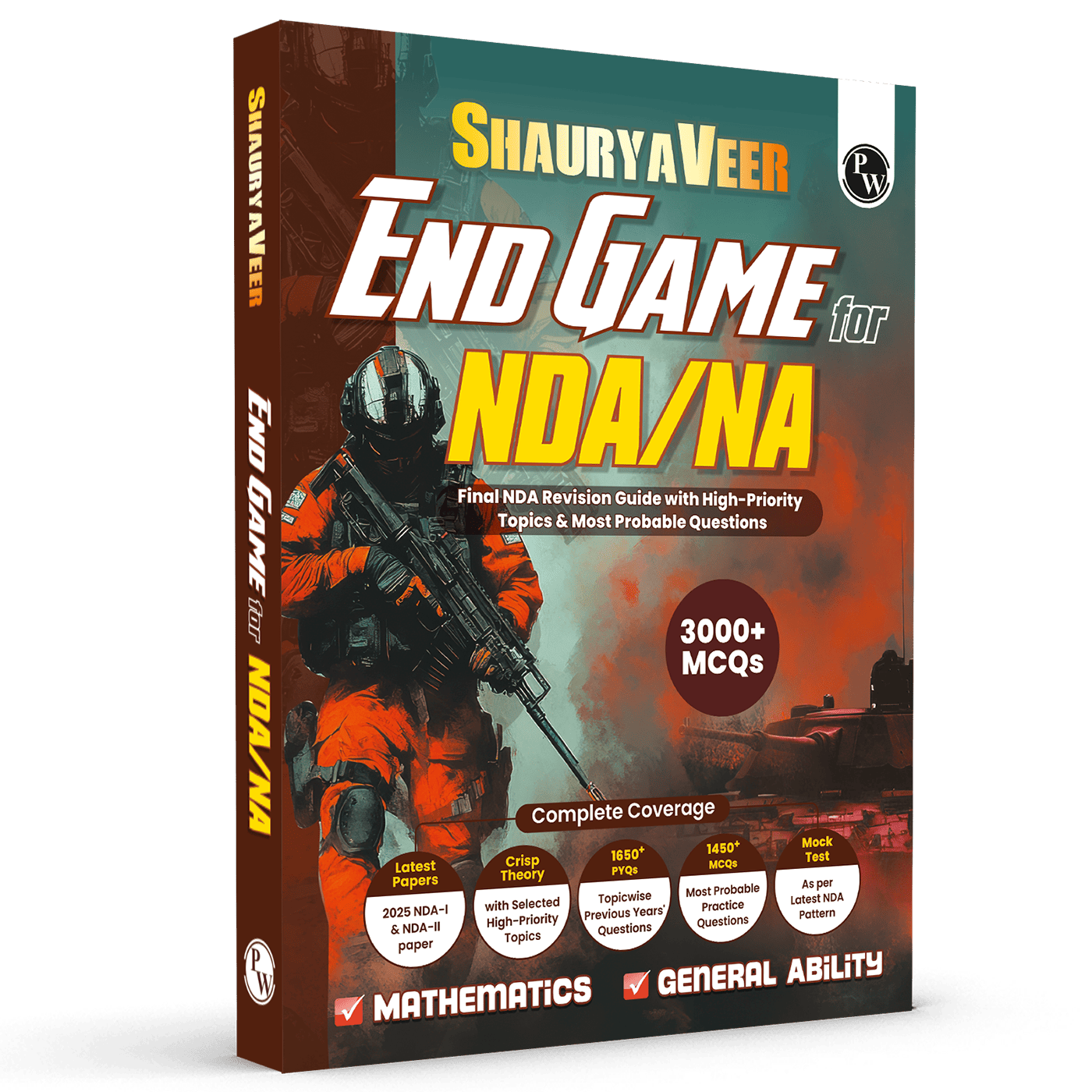
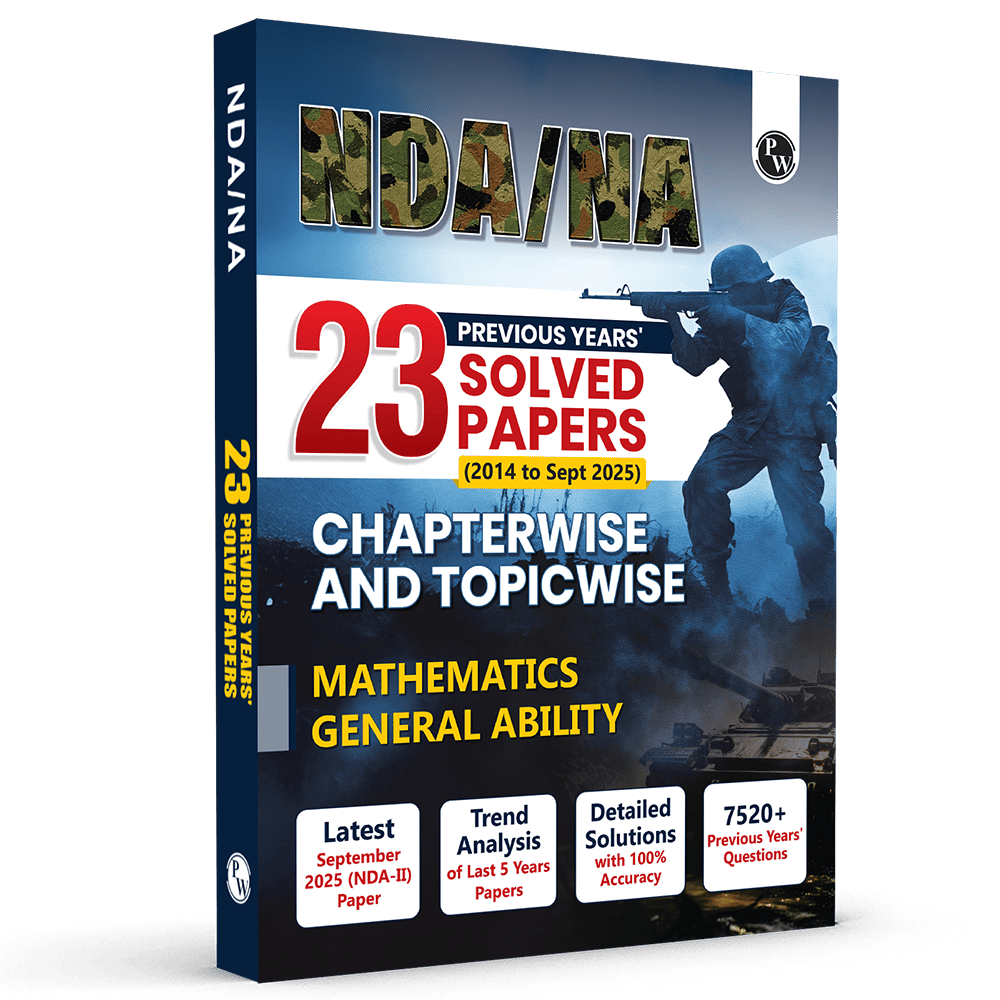
Check Out: NDA Books
NDA Exam Pattern 2026
The written exam is divided into two distinct papers. Candidates must clear the cutoff in both papers to qualify for the SSB Interview.
|
NDA Exam Pattern 2026 for Maths & GAT |
||
|
Subject |
Mathematics |
General Ability Test |
|
Total Number of Questions |
120 |
150 |
|
Maximum Marks |
300 |
600 |
|
Marks for Correct Answer |
2.5 mark |
4 mark |
|
Marks for Incorrect Answer |
-0.83 mark |
-1.33 mark |
|
Duration |
2.5 hours |
2.5 hours |
|
NDA Exam Pattern 2026 for SSB Test/Interview |
||
|
Subject |
Total |
|
|
SSB Test/Interview |
900 |
|
Check Out: NDA/Defence Books
Subject-wise NDA Syllabus Breakdown
Let’s have a subject-wise NDA Syllabus breakdown to understand each subjects in detail.
1. Mathematics (Paper I)
This paper is based on the curriculum for grades 10 and 12. If you use NDA modules pw, you'll see that these topics are made easier by using high-yield shortcuts.
-
Algebra: Sets, Venn diagrams, complex numbers, quadratic equations, and progressions are all parts of algebra.
-
Trigonometry: Identities, triangle properties, and inverse trigonometric functions.
-
Calculus: Limits, continuity, and differential and integral calculus.
-
Matrices & Determinants: Types of matrices, adjoint, and inverse are all examples of matrices and determinants.
-
Statistics & Probability: Mean, median, mode, and probability distributions are all parts of statistics and probability.
|
NDA Syllabus 2026 for Mathematics |
|
|
Subject |
UPSC NDA Maths Syllabus 2026 |
|
NDA Syllabus for Algebra |
Concept of set, operations on sets, Venn diagrams. De Morgan laws, Cartesian product, relation, equivalence relation. Representation of real numbers on a line. Complex numbers—basic properties, modulus, argument, cube roots of unity. Binary system of numbers. Conversion of a number in decimal system to binary system and vice-versa. Arithmetic, Geometric, and Harmonic progressions. Quadratic equations with real coefficients. Solution of linear inequations of two variables by graphs. Permutation and Combination. Binomial theorem and its applications. Logarithms and their applications. |
|
NDA Syllabus for Matrices and Determinants |
Types of matrices, operations on matrices. Determinant of a matrix, basic properties of determinants. Adjoint and inverse of a square matrix, Applications-Solution of a system of linear equations in two or three unknowns by Cramer’s rule and by Matrix Method. |
|
NDA Syllabus for Trigonometry |
Angles and their measures in degrees and radians. Trigonometrical ratios. Trigonometric identities Sum and difference formulae. Multiple and Sub-multiple angles. Inverse trigonometric functions. Applications-Height and distance, properties of triangles. |
|
NDA Syllabus for Analytical Geometry of Two and Three Dimension |
Rectangular Cartesian Coordinate system. Distance formula. Equation of a line in various forms. The angle between two lines. Distance of a point from a line. Equation of a circle in standard and general form. Standard forms of parabola, ellipse, and hyperbola. Eccentricity and axis of a conic. Point in a three-dimensional space, the distance between two points. Direction Cosines and direction ratios. Equation two points. Direction Cosines and direction ratios. Equation of a plane and a line in various forms. The angle between two lines and the angle between two planes. Equation of a sphere. |
|
NDA Syllabus for Differential Calculus |
Concept of a real-valued function–domain, range, and graph of a function. Composite functions, one-to-one, onto, and inverse functions. The notion of limit, Standard limits—examples. Continuity of functions—examples, algebraic operations on continuous functions. Derivative of function at a point, geometrical and physical interpretation of a derivative—applications. Derivatives of sum, product, and quotient of functions, derivative of a function concerning another function, derivative of a composite function. Second-order derivatives. Increasing and decreasing functions. Application of derivatives in problems of maxima and minima |
|
NDA Syllabus for Integral Calculus and Differential Equations |
Integration as inverse of differentiation, integration by substitution and by parts, standard integrals involving algebraic expressions, trigonometric, exponential, and hyperbolic functions. Evaluation of definite integrals—determination of areas of plane regions bounded by curves—applications. Definition of order and degree of a differential equation, formation of a differential equation by examples. A general and particular solution of differential equations, solution of the first order, and first-degree differential equations of various types—examples. Application in problems of growth and decay |
|
NDA Syllabus for Vector Algebra |
Vectors in two and three dimensions, magnitude, and direction of a vector. Unit and null vectors, addition of vectors, scalar multiplication of a vector, scalar product or dot product of two vectors. Vector product or cross product of two vectors. Application work done by a force and moment of a force and in geometrical problems |
|
NDA Syllabus for Statistics and Probability |
Statistics Classification of data, Frequency distribution, cumulative frequency distribution—examples. Graphical representation—Histogram, Pie Chart, frequency polygon— examples. Measures of Central tendency—Mean, median, and mode. Variance and standard deviation—determination and comparison. Correlation and regression. Probability Random experiment, outcomes, associated sample space, mutually exclusive and exhaustive events, impossible and certain events. Union and Intersection of events. Complementary, elementary, and composite events. Definition of probability—classical and statistical—examples. Elementary theorems on probability—simple problems. Conditional probability, Bayes’ theorem—simple problems. Random variable as function on a sample space. Binomial distribution, examples of random experiments giving rise to Binominal distribution |
2. General Ability Test (Paper II)
There are two elements to the GAT: English and General Knowledge.
Part A: English (200 Marks)
Concentrates on grammar, vocabulary, and understanding.
-
Topics: Finding mistakes, synonyms and antonyms, idioms and phrases, and making sentences better.
Part B: General Knowledge (400 Marks)
This part is rather big, hence the NDA modules list needs to be split up into different subjects:
-
Physics: Electricity, Optics, Work, Power, and Energy; Laws of Motion.
-
Chemistry: Acids and Bases, Elements and Compounds, and Changes in Matter.
-
General Science: The basics of biology, the human body, including food and nutrition.
-
History & Geography: The Indian Freedom Movement, the Earth's Crust, Climate, and Resources.
-
Current Affairs: Big events that happen in the US and around the world.
|
NDA GAT Syllabus 2026 |
|
|
Subject |
NDA Important Topics |
|
NDA Syllabus for English |
|
|
NDA Syllabus for Physics |
|
|
NDA Syllabus for Chemistry |
|
|
NDA Syllabus for General Science |
|
|
NDA Syllabus for History, Freedom Movement, etc. |
|
|
NDA Syllabus for Geography |
|
|
NDA Syllabus for Current Events |
|
Check Out: UPSC CAPF AC 15 Previous Year Solved Papers l & ll
NDA Syllabus 2026 in Hindi
संघ लोक सेवा आयोग (UPSC) हर वर्ष NDA 1 और NDA 2 परीक्षा के लिए आधिकारिक नोटिफिकेशन के साथ NDA सिलेबस 2026 जारी करता है। नेशनल डिफेंस अकादमी (NDA) परीक्षा की तैयारी कर रहे सभी उम्मीदवारों को NDA परीक्षा सिलेबस को ध्यानपूर्वक पढ़ना चाहिए, ताकि वे लिखित परीक्षा में पूछे जाने वाले विषयों और टॉपिक्स को अच्छे से समझ सकें।
NDA सिलेबस को दो मुख्य भागों में विभाजित किया गया है, गणित (Mathematics) और सामान्य योग्यता परीक्षण (General Ability Test - GAT)। परीक्षा में केवल ऑब्जेक्टिव प्रकार (Objective Type) के प्रश्न पूछे जाते हैं। परीक्षा में सफल होने के लिए उम्मीदवारों को NDA परीक्षा पैटर्न और मार्किंग स्कीम की भी जानकारी होनी चाहिए, जिससे वे प्रश्न पत्र के प्रारूप और प्रत्येक सेक्शन के वेटेज को समझ सकें।
इस लेख में हमने NDA सिलेबस 2026 की पूरी जानकारी हिंदी और अंग्रेजी में उपलब्ध कराई है, जिसमें परीक्षा पैटर्न, मार्किंग स्कीम, और NDA की तैयारी के लिए बेहतरीन किताबों की सूची भी शामिल है।
Shaurya Batch: Your Path to Success
The pw shaurya batch is made for students who want help preparing for the NDA exam. It covers everything from the basics to the more difficult parts.
-
NDA Shaurya 1.0 2026: This group has live classes, recorded classes, and special sessions to answer questions.
-
NDA Modules: Students can examine a full list of NDA modules, which includes theory, practice problems, and papers from previous years.
-
NDA Modules PDF: The NDA modules pdf format offers high-quality study resources that are easy to look at on the go.
Read More: NDA Eligibility Criteria 2026, Age Limit, Qualification
NDA Preparation Strategy for 2026
Follow these pw shaurya batch approved tips to learn the syllabus:
-
NCERT is Foundation: Start with Class 11 and 12 NCERT books for Maths and Science.
-
Daily Current Affairs: To stay up to date with the GAT section, read the news every day.
-
Mock Tests: Before the real thing, take at least 10 to 15 full-length mock tests to get better at managing your time.
-
Revision: Use the NDA modules that are available every weekend to go on formulas and shortcuts..
NDA Books for All Subjects
|
NDA Books |
|
UPSC NDA/NA National Defence Academy & Naval Academy 10 Previous Year Solved Papers (PYQs) |
NDA Syllabus FAQs
1. Is there negative marking in the NDA 2026 exam?
Yes, there is a penalty for wrong answers. For every incorrect response, 0.33 of the marks assigned to that question will be deducted.
2. Can I clear the NDA exam without coaching?
Yes, it is doable if you study hard on your own. Using tools like the NDA modules list and practicing with the NDA modules pdf will help you become ready in the right way.
3. What is the benefit of the nda shaurya 1.0 2026 batch?
The batch has a set schedule, qualified teachers for each subject, and regular tests, which helps you stay on track, which is important for passing the NDA syllabus.
4. How much time is needed to cover the entire nda syllabus?
Most of the time, 6 to 8 months of focused study is enough to cover the material and go over it several times.
5. What is the age restriction for the NDA 1 in 2026?
Most of the time, aspirants need to be between 16.5 and 19.5 years old. The UPSC notice will state specifically when people who want to take the NDA 1 2026 exam must have been born (typically between July 2, 2007, and July 1, 2010).