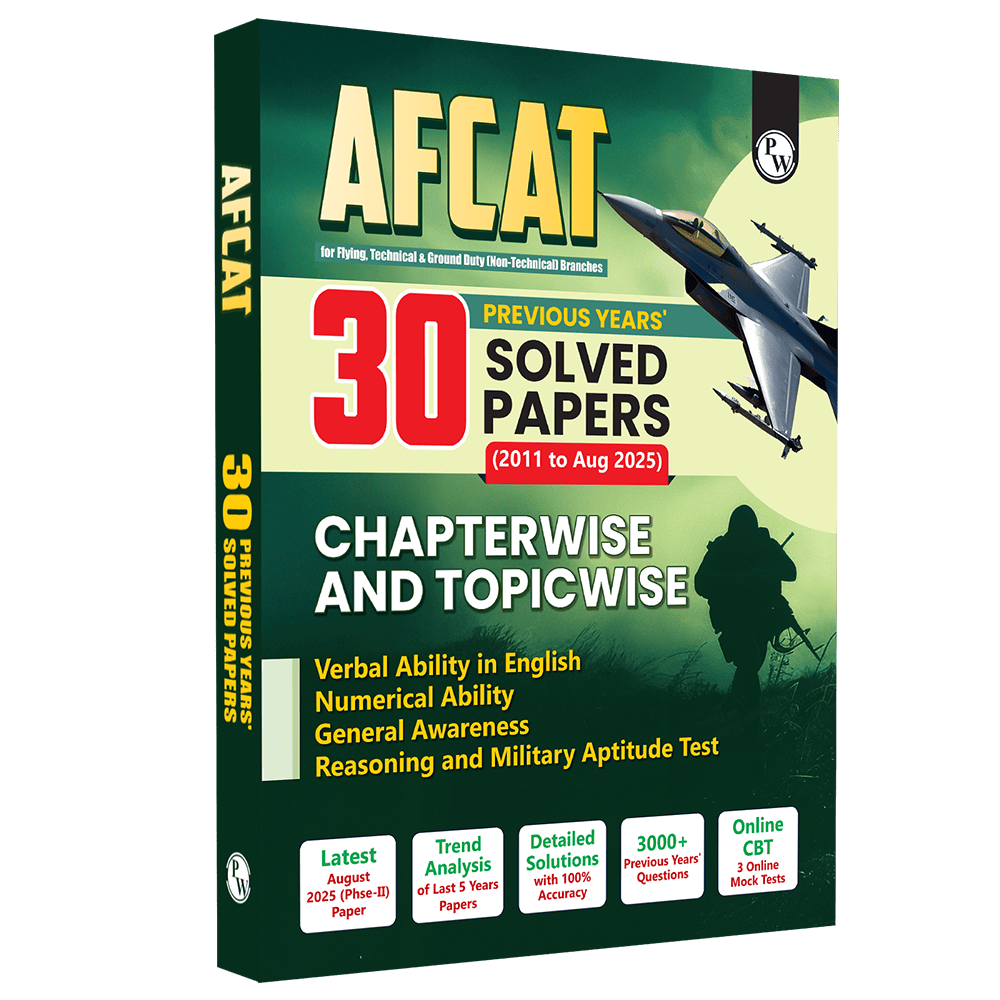
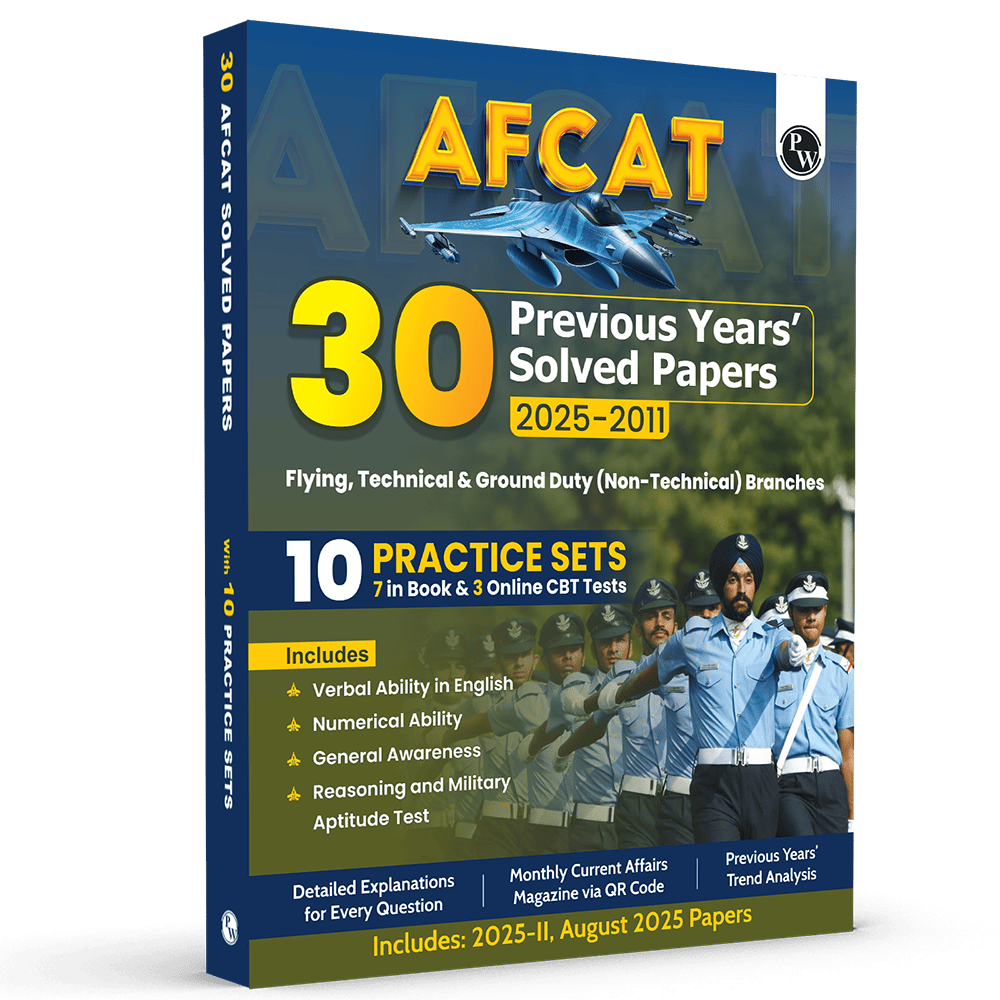
What is AFCAT Exam? Complete Guide for Beginners

The AFCAT exam is a national-level competitive test conducted by the Indian Air Force (IAF) to select Class-1 Gazetted Officers for Flying and Ground Duty branches. Held twice a year, it assesses candidates on their numerical ability, verbal aptitude, reasoning, and general awareness. Passing the AFCAT exam is the first step toward a prestigious career in the Indian sky.
Check Out: PW NDA/Defence Books
Understanding the AFCAT Exam Pattern
For beginners, the AFCAT exam pattern is the most critical starting point. The test is a Computer-Based Test (CBT) conducted entirely in English. You have 120 minutes to solve 100 questions, which means speed is just as vital as accuracy.
-
Total Questions: 100 Multiple Choice Questions (MCQs).
-
Marking Scheme: +3 for every correct answer; -1 for every wrong answer.
-
Total Marks: 300 marks.
-
Negative Marking: Strict penalty for incorrect responses; 0 marks for unattempted questions.
|
Section |
No. of Questions |
Marks |
|
General Awareness |
20-25 |
60-75 |
|
Verbal Ability in English |
25-30 |
75-90 |
|
Numerical Ability |
15-20 |
45-60 |
|
Reasoning & Military Aptitude |
25-30 |
75-90 |
Check Out: AFCAT Books
Master the AFCAT Exam Pattern
For beginners, the AFCAT exam pattern is the most critical starting point. The test is a Computer-Based Test (CBT) conducted entirely in English. You have 120 minutes to solve 100 questions, which means speed is just as vital as accuracy.
-
Total Questions: 100 Multiple Choice Questions (MCQs).
-
Marking Scheme: +3 for every correct answer; -1 for every wrong answer.
-
Total Marks: 300 marks.
-
Negative Marking: Strict penalty for incorrect responses; 0 marks for unattempted questions.
Navigating the AFCAT Exam Syllabus
The syllabus for the AFCAT exam is designed to test your "Officer Like Qualities" (OLQs). Unlike other exams, the math section focuses on 10th-standard arithmetic rather than advanced calculus, making it accessible for non-engineering students.
-
General Awareness: Focus on Indian History, Geography, Defence News, and Current Affairs.
-
English Section: Includes Cloze tests, Idioms, Synonyms, and Error Detection.
-
Numerical Ability: Master Time & Work, Profit & Loss, and Decimal Fractions.
-
Reasoning: Spatial ability and verbal/non-verbal reasoning are high-scoring areas.
Whether you are looking at the AFCAT exam date 2025 archives for practice or preparing for 2026, consistent mock tests are your best bet to beat the clock.
Strategy for Success in AFCAT 2026
Success boils down to how you manage your time during the 2-hour window. Since there is no sectional timing, you can switch between sections. Most toppers recommend finishing General Awareness first, then moving to English, and leaving Math and Reasoning for the end.
-
Practice Daily: Solve at least 20 reasoning and 15 math questions every morning.
-
Vocab Building: Note down five new words daily to ace the English section.
-
Current Affairs: Read the last six months of news before your AFCAT exam date.
-
Mock Tests: Aim for at least 15-20 full-length tests to build exam stamina.
Crucial AFCAT Exam Date 2026 Details
Staying updated with the AFCAT exam date 2026 ensures you don't miss the narrow application window. The Indian Air Force typically follows a fixed cycle, releasing notifications in December and June each year. For the upcoming cycle, the official AFCAT exam date To be Released.
-
AFCAT 1 2026 Notification: Released on November 10, 2025.
-
AFCAT 1 2026 Exam Date: To be Released
-
Admit Card Release: To be Released
-
AFCAT 2 2026 Cycle: Notification likely in May 2026, with the exam in August.
Planning around the AFCAT exam date 2026 helps you divide your syllabus into manageable 30-day sprints. If you missed the current cycle, you should keep an eye on the AFCAT exam date for the second half of the year to start your preparation early.
Check Out: 30 AFCAT Chapterwise & Topicwise Previous Years Solved Papers
Eligibility for Beginners and AFCAT Exam Date 2025
Many students often confuse the AFCAT exam date 2025 cycles with the 2026 requirements. If you were eligible during the AFCAT exam date 2025, you likely still fit the criteria for 2026, provided you stay within the age brackets. The selection process remains consistent across years, moving from a written test to the AFSB interview and medical rounds.
-
Age (Flying Branch): 20 to 24 years at the time of course commencement.
-
Age (Ground Duty): 20 to 26 years for both Technical and Non-Technical roles.
-
Education: Minimum 50% marks each in Physics and Math at 10+2 level, and a graduation degree with 60% aggregate.
-
Marital Status: Must be unmarried at the time of starting the training course.
Whether you are looking at the AFCAT exam date 2025 archives for practice or preparing for the next attempt, understanding these basics is vital. For technical candidates, an additional Engineering Knowledge Test (EKT) is conducted, which adds 45 minutes to the total AFCAT exam duration.
Read More: AFCAT Previous Year Question Paper with Solution
AFCAT Exam FAQs
1- How many times is the AFCAT exam held?
It is held twice a year, usually in February and August.
2- Is there an interview after the written AFCAT exam?
Yes, successful candidates must clear the 5-day Air Force Selection Board (AFSB) interview.
3- What is the minimum height for females in AFCAT?
The minimum height is 162.5 cm for Flying Branch and 152 cm for Ground Duty roles.
4- Can final-year students apply for the AFCAT exam?
Yes, final-year graduation students can apply if they don't have backlogs.
5- Is EKT compulsory for everyone?
No, the Engineering Knowledge Test (EKT) is only for candidates applying for Technical Branches.