How PW Chemistry Modules Help in Understanding Chemical Reactions
Chemistry is too abstract for many pupils, which makes it hard for them to understand. PW chemistry modules, on the other hand, are made to fix this by reducing down complicated processes into easy-to-understand steps that help you remember what you've learned and do well on tests.
Why Are PW Chemistry Modules Important for Learning Reactions?
It's not enough to just memorise chemical formulas; you also need to understand how atoms move around. These NEET modules give you a clear path to follow, starting with simple atomic interactions and ending with complicated organic transformations. Students can stop learning by heart by employing these tools.
The modules talk about why each reaction happens. The material is stacked to help you feel more confident, whether it's a displacement reaction in Class 10 or a nucleophilic substitution in Class 12. Each chapter has a map that shows the learner what the reagents, conditions, and products are for each chemical transition.
Breakdown of PW Chemistry Modules for NEET Preparation
The stakes are enormous for people who want to be doctors. The PW modules are carefully put together to match the most recent test formats. Chemical reactions are the main focus of both the organic and inorganic chemistry parts of the NEET test.
|
Feature |
Benefit for Students |
|
Concept Maps |
Quick visual summary of all interconnected reactions. |
|
Solved Examples |
Step-by-step logic for balancing and predicting products. |
|
Topic-wise MCQs |
Immediate testing of reaction mechanisms. |
|
Previous Year Questions |
Understanding the weightage of specific chemical changes. |
Using modules for NEET ensures that you are not just reading text but practising the exact types of questions that appear in the entrance test. This practical approach is what sets these books apart from standard school textbooks.
Step-by-Step Learning with Arjuna NEET Module
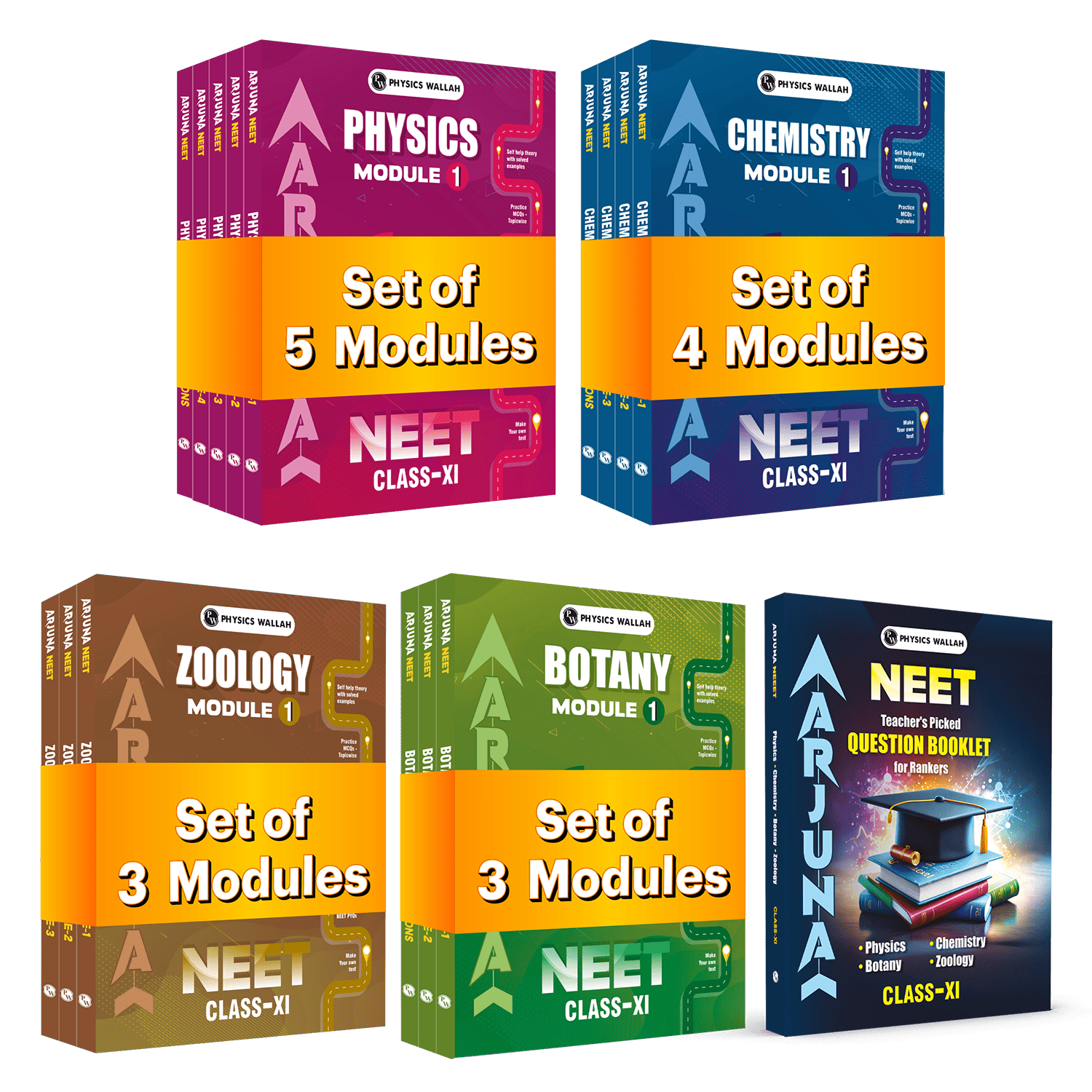
If you are starting your journey in Class 11, the Arjuna NEET module is your primary companion. This stage is crucial because it introduces the fundamental laws of chemical combinations and stoichiometry.
The class 11 students focus heavily on physical chemistry reactions. At this point, it is very important to understand the mole concept and redox reactions. The Arjuna series gives us:
-
Simplified Definitions: No jargon, just clear explanations.
-
Visual Illustrations: Diagrams showing electron transfer in reactions.
-
Graded Exercises: Start with simple Level 1 questions to keep motivation high.
The Arjuna NEET 2026 module has new material that is up to current with the NTA syllabus, so you can be sure that your preparation is still useful.
Advanced Reaction Mechanisms in Lakshya NEET Module
Reactions become much more complicated as you move up to Class 12. The Lakshya NEET module covers a lot of ground in organic chemistry, where knowing how things work is the only way to do well.
The class 12 modules NEET aspirants rely on help in:
-
Mechanism Visualisation: Detailed arrows showing the movement of electrons.
-
Named Reactions: A dedicated section for reactions like Reimer-Tiemann or Kolbe’s reaction.
-
Functional Group Analysis: How different groups react under various catalysts.
By using these modules, Class 12 students can categorise reactions into types, making it easier to recall them during the high-pressure environment of the NEET exam.
Effective Preparation with Yakeen NEET Module 2026
Dropper students or those in their final revision phase need a different strategy. The Yakeen NEET module 2026 is built for speed and accuracy. It focuses on the most frequent chemical reactions that appear in competitive exams.
This model provides "shortcut tricks" to predict the major product of a reaction without drawing the entire mechanism. This saves precious seconds during the exam. Furthermore, it includes exhaustive practice sets that cover:
-
Acid-base neutralisation reactions.
-
Complex formation in coordination compounds.
-
Polymerisation and Biomolecules.
How to Use PW Chemistry Modules Effectively
To get the most out of your PW modules for chemistry, you should follow a specific study pattern. Chemistry is a subject of revision.
-
Read the Theory: Start with the concise theory provided at the beginning of each unit.
-
Follow the solved problems: Don't skip these; they show you the "method" of thinking.
-
Self-Testing: Attempt the exercise questions without looking at the hints.
-
Review Mistakes: Use the detailed solutions provided in the PW modules to understand where your logic failed.
This cycle of learning ensures that chemical reactions become a strength rather than a weakness.
Check Out: NEET Test series
How Do PW Chemistry Modules Visuals Help You Remember Better?
One of the biggest hurdles in chemistry is the "invisible" nature of atoms. These modules use high-quality 3D-style diagrams to represent molecular structures. When you can see how a molecule looks, it becomes much easier to understand why it reacts in a certain way.
For example, the PW modules show the transition states of reactions. This helps kids learn how energy changes. You don't only read that a process is exothermic; you also see the energy profile graphic, which helps you remember the idea.
How to Solve Reaction Numericals Using PW Chemistry Modules?
Physical chemistry reactions involve a lot of calculations. The modules offer a dedicated section for numerical practice. From calculating the enthalpy of a reaction to determining the rate of a chemical change, the modules provide plenty of practice.
The PW modules for chemistry ensure that you are comfortable with:
-
Stoichiometric Calculations: Determining the amount of reactants needed.
-
Equilibrium Constants: Predicting the direction of a reversible reaction.
-
Electrochemistry: Understanding the redox reactions occurring in a cell.
Read More: Benefits of Solving PW NEET Modules for 2026 Exam
PW Chemistry Modules FAQs
Which book is best for learning reaction mechanisms?
The PW chemistry modules are highly recommended, as they break down complex mechanisms into simple, logical steps suitable for both board exams and NEET.
Are the Arjuna modules enough for Class 11 reactions?
Yes, the NEET modules class 11 (Arjuna series) cover the entire NCERT syllabus while adding the depth required for competitive entrance exams.
Does the Yakeen series cover organic chemistry well?
The Yakeen series is great for organic chemistry since it gives you short notes on specific reactions and reagent functions that are very important for quick review.
How do PW modules help in balancing equations?
Inside the module, you will find specific rules and "hit and trial" alternatives that make balancing even the most complex redox reactions straightforward.
Can I rely solely on PW modules for chemistry?
While NCERT is the base, PW modules provide the necessary edge with extra practice questions and previous-year trends that textbooks often lack.