Most Repeated Questions in NEET Exam

NEET repeated questions refer to the high-yield topics and specific MCQ formats that consistently reappear in the National Eligibility cum Entrance Test. By analyzing previous year question papers, students identify recurring concepts in Biology, Physics, and Chemistry, allowing them to focus on themes like Human Physiology and Mechanics that frequently dictate the overall difficulty and scoring potential of the exam.
Check Out: PW NEET Books
Important NEET Topics for 2026
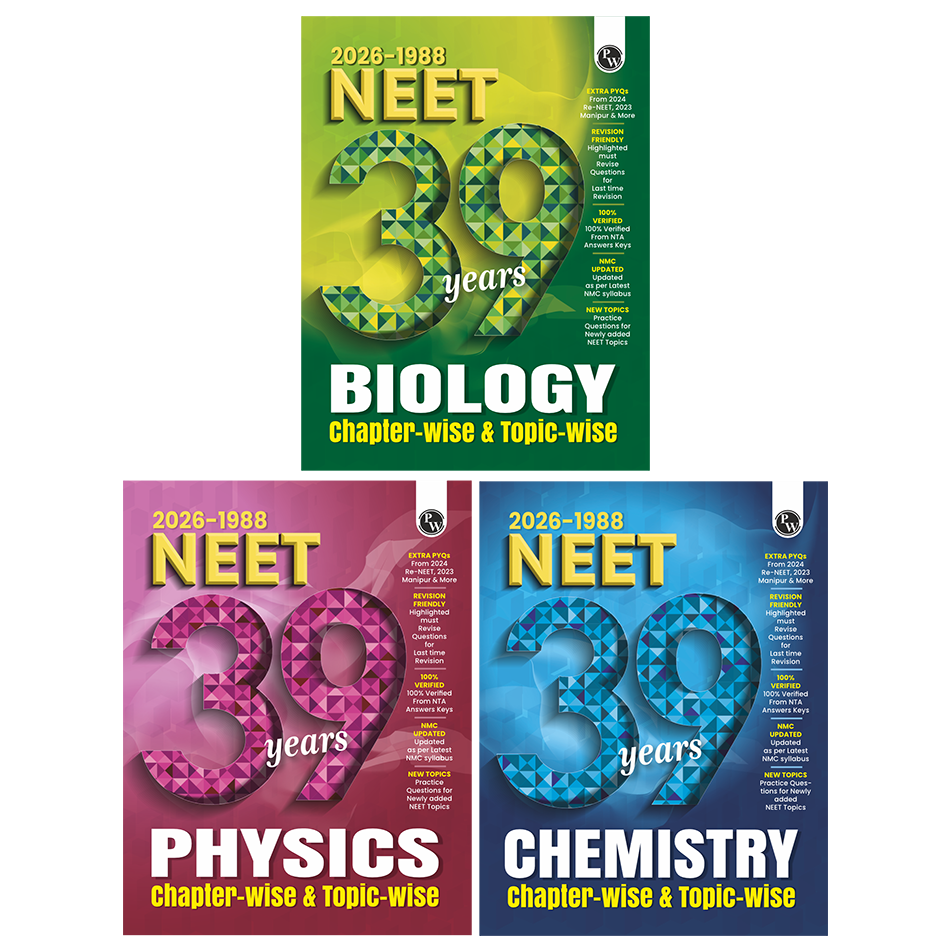
To pass the National Eligibility cum Entrance Test (NEET), you need to do more than simply study hard. You also need to know which ideas the National Testing Agency (NTA) thinks are most important. About 60% to 70% of the article is conceptually the same every year. The basic ideas stay the same, even if the actual numbers or words vary. Using a neet repeated questions with answers might help students find these "do-or-die" chapters early in their study cycle. For comprehensive practice, students can also refer to the 39 Years NEET PYQ book, which contains extensive previous year questions across Physics, Chemistry, and Biology, helping aspirants recognize important patterns and focus on topics that frequently appear in the NEET examination.
Most Repeated Questions in Biology
Biology makes up half of the questions on the NEET test. Based on past statistics, the most repeated questions in NEET biology come from direct NCERT lines. Experts say that pupils who know these subjects well can get more than 330 points.
1. Human Physiology
This unit always has the most questions. Important areas are:
-
Digestion and Absorption:Concentrate on enzymes, their origins, and nutrient absorption.
-
Breathing and Exchange of Gases: Questions often repeat on tidal volume, oxygen dissociation curves, and transport mechanisms.
-
Body Fluids and Circulation: Understand the ECG, double circulation, and the structure of the human heart.
2. Genetics and Evolution
This is a high-yield unit where neet repeated questions in biology are extremely common.
-
Mendelian Inheritance: Monohybrid and dihybrid crosses, as well as test crosses, appear almost every year.
-
Genetic Disorders: Conditions like Sickle-cell anemia, Down’s syndrome, and Klinefelter's syndrome are frequently tested.
-
Evolution: Pay attention to Darwin's theory, the Hardy-Weinberg equilibrium, and homologous organs.
3. Biotechnology
The questions in this unit are generally very technical and repeat a lot:
-
Tools of Recombinant DNA Technology: Restriction enzymes, such as PstI in plasmid pBR322, and their recognition sites are tools of recombinant DNA technology.
-
Uses: In particular, making insulin and the use of Bt cotton.
Specifically, the production of insulin and the role of Bt cotton.
|
Biology Unit |
Important Repeated Concepts |
Average Weightage |
|
Ecology |
Food chains, Pyramids, Biodiversity |
16% |
|
Genetics |
Mendel's Laws, Lac Operon, DNA |
18% |
|
Plant Physiology |
Photosynthesis, Nitrogen Cycle |
14% |
Check Out: NEET Previous Year Papers
Most Repeated Questions of Physics in NEET
Physics is often regarded as the most challenging section due to its numerical nature. However, the most repeated questions of physics in neet follow a formulaic pattern.
1. Mechanics
Mechanics forms the foundation of NEET Physics.
-
Laws of Motion: Pulleys, friction on inclined planes, and Newton’s second and third laws are staples.
-
Work, Energy, and Power: The work-energy theorem and power calculations are high-frequency topics.
-
Rotational Motion: Moment of inertia for rings, discs, and solid spheres is a recurring concept.
2. Electrodynamics
This unit is critical for students aiming for a high rank.
-
Current Electricity: Ohm’s law, Kirchhoff’s laws, and the Wheatstone bridge circuit are frequently asked.
-
Electrostatics: Coulomb’s law and the energy stored in capacitors are key.
3. Modern Physics
This is the most scoring area as questions are often direct.
-
Photoelectric Effect: Graphs and Einstein’s photoelectric equation.
-
Atoms and Nuclei: Bohr’s model, nuclear fission, and binding energy per nucleon.
Check Out: NEET Test series 2026
Most Repeated Questions of Chemistry in NEET
Chemistry in NEET is divided into Physical, Organic, and Inorganic sections. Students often look for a neet repeated questions to practice the complex reactions and numericals found here.
1. Physical Chemistry
-
Mole Concept: Empirical and molecular formulas, and limiting reagents.
-
Thermodynamics: Spontaneity (ΔG), enthalpy (ΔH), and the first law of thermodynamics.
-
Chemical Kinetics: Order of reaction and half-life calculations for first-order reactions.
2. Organic Chemistry
This section focuses heavily on mechanisms and named reactions.
-
General Organic Chemistry (GOC): Resonance, inductive effect, and stability of intermediates.
-
Named Reactions: Aldol condensation, Cannizzaro reaction, and Wurtz reaction.
-
Biomolecules: Carbohydrates, proteins, and vitamins are sources of direct theoretical questions.
3. Inorganic Chemistry
-
Chemical Bonding: VSEPR theory, hybridization, and molecular shapes.
-
Coordination Compounds: IUPAC naming and isomerism.
-
Periodic Table: Trends in atomic radii, ionization enthalpy, and electronegativity.
NEET most repeated questions help students understand which topics are asked again and again in the exam. Practising these questions regularly can improve speed, accuracy, and confidence. For easy revision of important concepts, students can use the PCB Med Easy Handwritten Notes Combo Book, which offers short and simple notes for Physics, Chemistry, and Biology.
How to Effectively Use PYQs for Success
To maximize the benefit of neet repeated questions, students should follow a systematic approach:
-
Chapter-wise Practice: Don't just solve full papers. Focus on one chapter at a time to identify the specific sub-topics that the NTA favors.
-
NCERT Linkage: For Biology and Inorganic Chemistry, find the exact page in the NCERT where the repeated question originated.
-
Simulate Exam Conditions: Use a timer when solving neet repeated questions with answers to improve speed and accuracy.
-
Error Log: Maintain a notebook of questions you consistently get wrong, even if they are from high-frequency topics.
Read More: Study Material for NEET Exam 2025 in Hindi
Most Repeated Questions in NEET Exam FAQs
Q1: How many questions on the NEET test are the same as others?
It's not common for questions to be exactly the same as in prior years, although roughly 10 to 15 may be fairly similar. But about 60–70% of the questions are conceptually repeated, which means that the logic employed to answer them is the same as in previous papers.
Q2: Is it enough to solve PYQs to get a score of 600 or more on the NEET?
Answering questions from previous years is a big part of it, but it's not the only thing you need to do. It must be done with a lot of reading of NCERT books and practice exams to make sure that everything is covered and that time is used better.
Q3: Which subject has the most direct repeats?
Biology typically has the highest number of direct or near-direct repetitions because the questions are strictly bound to the NCERT textbook. Chemistry, particularly Inorganic, also sees many repeated theoretical questions.
Q4: Where can I find a free PDF copy of neet questions and answers that have been asked before?
Many educational websites offer free resources, but for serious students, structured books from the PW Store are frequently better because they have curated, error-free, and verified lists with full solutions.
Q5: Should I only read the "Do or Die" chapters?
No. You should focus on chapters with a lot of weight, such Human Physiology and Mechanics, to get a basic score. However, to get a top rank, you need to read the whole syllabus because the NTA can change the weightage a little bit from year to year.