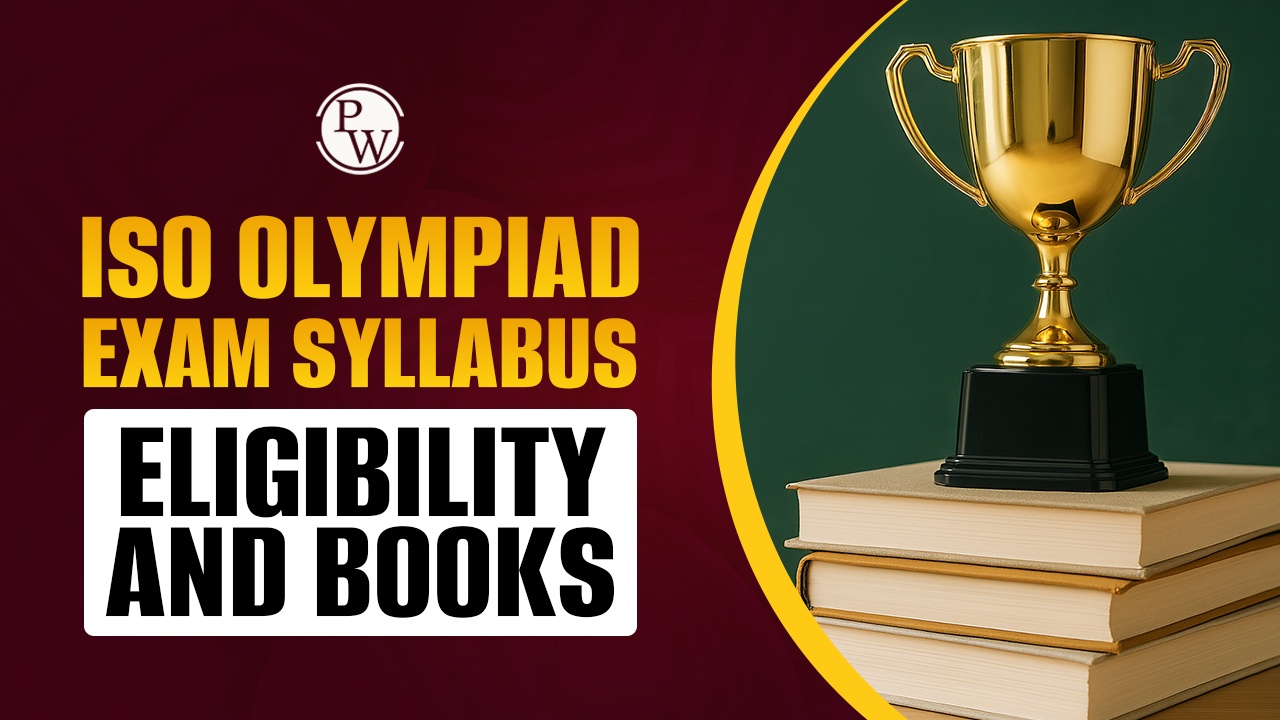
ISO Olympiad Exam Syllabus, Eligibility and Books
ISO Olympiad Syllabus
The ISO Olympiad is a popular science exam that helps students test their knowledge and build confidence for future competitive exams. It is not just an extra academic activity but also a great way to improve problem-solving and thinking skills. The ISO Olympiad Exam Syllabus mostly includes topics that students already study in their school science books.
The syllabus is based on Physics, Chemistry, and Biology, the three main parts of Science. So, students can easily prepare for it along with their school syllabus. The exam helps them revise what they have already learned and understand science in a deeper and more practical way.
To help students in their preparation, PW is providing ISO Olympiad books for Classes 3 to 12. These books include chapter-wise notes, practice questions, and sample papers that help students prepare well and gain the maximum benefit from their study time.
Check Out: Olympiad Books
ISO Olympiad Exam Syllabus
Check out the full and detailed class-wise ISO Olympiad Exam Syllabus from the provided table:-
|
Class |
ISO Olympiad Science Syllabus |
|
Class 1 |
Living and non-living things, parts of plants and animals, human body parts, air, water, food, sense organs, day and night |
|
Class 2 |
Plants and animals, food and shelter, water and air, cleanliness, sense organs, the environment around us, and types of soil |
|
Class 3 |
Parts of plants, animals and their eating habits, materials and their uses, weather and seasons, measurement, light and shadow |
|
Class 4 |
Living organisms and habitats, food and nutrition, force, motion and energy, environment, matter and its states, air and water |
|
Class 5 |
Life processes, growth in plants and animals, materials and their properties, Earth and its resources, natural phenomena, environment and conservation |
|
Class 6 |
Food and its components, materials and their separation, living organisms, environment, light and motion, natural resources and their uses |
|
Class 7 |
Nutrition and respiration, reproduction in plants, heat and temperature, motion and force, materials and changes, environment and pollution |
|
Class 8 |
Crop production and management, synthetic materials, cell structure and function, reproduction, force and pressure, sound, pollution and its control |
|
Class 9 |
Matter and its nature, motion and laws of motion, structure of the atom, diversity in living organisms, work and energy, natural resources and environment |
|
Class 10 |
Chemical reactions and equations, life processes, control and coordination, heredity and evolution, electricity and magnetism, sources of energy, environment and sustainable development |
Check Out: Olympiad NSEB Class 12 Advanced Biology Book
ISO Olympiad Book
The PW ISO Olympiad Book is a great study partner for students preparing for the International Science Olympiad. It’s made for Classes 3 to 12 and helps students understand science in a simple and interesting way.
It comes with concept maps that explain tough topics through easy diagrams and visuals. Each chapter includes important Olympiad concepts that are often seen in the exam. There are also topic-wise solved examples that show how to solve different types of questions step by step. To make learning even stronger, the book includes Achievers MCQs to test your understanding and previous year Olympiad questions so you can practise real exam-style problems.
|
ISO Olympiad Book |
|
|
ISO Olympiad Book For Class 3 |
|
|
ISO Olympiad Book For Class 4 |
|
|
ISO Olympiad Book For Class 5 |
|
|
ISO Olympiad Book For Class 6 |
|
|
ISO Olympiad Book For Class 7 |
|
|
ISO Olympiad Book For Class 11 |
|
|
ISO Olympiad Book For Class 12 |
|
How To Prepare for International Science Olympiad?
Students who wish to take part in the International Science Olympiad can begin their preparation early. The first step is to understand the ISO exam eligibility and the International Science Olympiad syllabus for their class. Check out the details here:-
1. Understand the ISO Olympiad Syllabus
Before you start your preparation, make sure you know what to study. The ISO Olympiad syllabus is mostly based on your school curriculum. However, the level of questions is higher, so you need to understand the concepts deeply rather than memorising them. The syllabus is divided into three main parts: Physics, Chemistry, and Biology.
-
Physics: Covers topics like motion, force, light, work, energy, and electricity.
-
Chemistry: Includes concepts of matter, atoms, elements, compounds, and reactions.
-
Biology: Focuses on life processes, the human body, plants, and the environment.
2. Complete the School Syllabus First
Your school syllabus forms the base of the Olympiad preparation. Since most of the questions in the Science Olympiad syllabus are inspired by NCERT concepts, you should first master what you study in school.
-
Once you finish your school syllabus properly, you will find the Olympiad questions much easier to understand.
-
Pay attention to examples, side notes, and blue boxes in your NCERT book.
-
Revise each topic two to three times for better understanding.
3. Make Short Notes for Revision
Note-making is one of the most useful habits while preparing for the International Science Olympiad. Writing down important points helps you remember better and saves time during revision.
-
Your notes should include formulas, diagrams, and key terms from each chapter.
-
Write in short and clear sentences.
-
Highlight important terms using coloured pens.
-
Keep one notebook only for Olympiad preparation.
4. Use the PW ISO Olympiad Book for Practice
Once you are done with your syllabus and notes, start practising from reliable study material like the PW ISO Olympiad Book. It is specially created to help students from Class 3 to 12 prepare smartly for the Olympiad. The book includes important features that make it easy to study and practise.
-
Concept Maps: These help you understand difficult science topics through simple diagrams and visual aids.
-
Olympiad-Specific Concepts: The book covers all the topics that are often asked in Olympiad exams, so you can focus on what really matters.
-
Topic-wise Solved Examples: You can go through solved questions for every topic to learn how to approach different types of questions.
-
Achievers MCQs: These are designed for students who want to challenge themselves with high-level questions.
-
Olympiad PYQs: The book also includes previous year questions to help you understand the question pattern.
-
This book is a good choice for anyone who wants to practise properly without missing any topic.
5. Solve Sample Papers and Previous Year Papers
After finishing your syllabus and practising from the ISO Olympiad book, start solving sample papers. This helps you understand the pattern of the paper and improves your time management.
Solving CBSE class 10 sst sample paper or Olympiad sample papers gives you an idea of the type of questions that can be asked. It also shows your weak areas so that you can improve them.
-
Improves speed and accuracy.
-
Helps in understanding question patterns.
-
Builds confidence for the final exam.
-
You can also solve the International Olympiad of Science syllabus-based questions and analyse your performance regularly.
6. Focus on Time Management and Regular Revision
Time management is very important while preparing for the Olympiad. You should set a routine that allows you to cover all subjects without stress. Along with studying new topics, keep revising the old ones regularly.
-
Make a weekly plan and stick to it.
-
Divide your time between reading theory and solving questions.
-
Revise for at least 30 minutes every day.
-
Remember, regular practice and revision are the keys to success in the International Science Olympiad.
7. Take Small Tests to Check Your Progress
Once you are confident with your preparation, take small tests on each topic. This helps you know which areas you need to improve. The PW ISO Olympiad Book also includes self-assessment questions that allow you to test yourself.
-
Attempt one test every week.
-
Check your mistakes and revise the related topics again.
-
Try to complete the test in the given time to build exam speed.
8. Stay Curious and Keep Learning
Science is a subject that grows with curiosity. When preparing for the International Science Olympiad, try to understand how things work in real life. Watch small science experiments or educational videos to make learning more interesting.
-
Learn with interest, not pressure.
-
Take short breaks while studying.
-
Discuss science topics with friends or teachers.
Read More: NSEB Previous Year Question Papers with Solutions PDF
International Science Olympiad (ISO) FAQs
1. Who can appear for the International Science Olympiad (ISO)?
Students from Classes 1 to 12 who are studying in recognised schools can participate in the ISO exam.
2. What is the ISO Olympiad syllabus based on?
The ISO Olympiad syllabus is mainly based on the NCERT or school syllabus, with slightly advanced questions.
3. What subjects are covered in the International Science Olympiad syllabus?
The syllabus includes Physics, Chemistry, and Biology, based on the class level of the student.
4. What is the ISO exam eligibility?
Any student from Class 1 to 12 is eligible to take part in the ISO Olympiad exam.
5. Are there any books available for ISO Olympiad preparation?
Yes, the PW ISO Olympiad Book is available for Classes 3 to 12, covering all important topics and previous year questions.