NSEJS Syllabus 2025 And Exam Pattern

NSEJS Syllabus 2025 and Exam Pattern are very important for every student who is preparing for the upcoming National Standard Examination in Junior Science. NSEJS is the first step for students in India who want to appear for the International Junior Science Olympiad (IJSO). NSEJS is for students of classes 9th and 10th and is conducted by the Indian Association of Physics Teachers (IAPT).
As the exam is national-level and highly competitive, thousands of students will appear from across the country. To perform well, knowing the NSEJS 2025 syllabus and exam pattern is the first step. The NSEJS exam syllabus includes Physics, Chemistry, Biology, and Mathematics, covering topics from the school level but asked in a more challenging way.
By following the NSEJS syllabus, you can make a robust study plan, focus on important chapters, and practice in the right direction. So, keep reading to know the exam pattern and detailed syllabus of NSEJS 2025.
Check Out: Olympiads Books
NSEJS Syllabus 2025 Overview
NSEJS Syllabus 2025 is important to cover for students of Classes 9 and 10 who want to take part in the National Standard Examination in Junior Science. This exam tests how well students understand Science at a deeper level.
The NSEJS 2025 exam will be held on Sunday, November 23, 2025, and the registration process will close on September 14, 2025. Since the competition is tough and the number of participants is expected to be high, knowing the complete NSEJS exam syllabus becomes even more crucial.
As per the official syllabus of NSEJS 2025, there are mainly topics from Physics, Chemistry, Biology, and Mathematics, which are based on the CBSE Class 9 and Class 10 curriculum. While the concepts come from school-level Science, the questions are asked in a challenging way to test your concepts, applications, and logical thinking skills.
Detailed Syllabus of NSEJS 2025
To boost your exam preparation, check the detailed syllabus of the NSEJS 2025 examination covering topics from Physics, Chemistry, Maths, and Biology here.
|
NSEJS Syllabus 2025 |
|
|
Topics |
Description |
|
Matter - Nature and Behaviour |
Definition of matter: solid, liquid, and gas; shape, volume, density; change of state (melting, freezing, evaporation, condensation, sublimation). Elements, compounds, mixtures; heterogeneous and homogeneous mixtures; colloids, suspensions, solutions, concentration, separation of components. Atoms and molecules, law of constant proportions, atomic and molecular masses, mole concept. Structure of atoms: electrons, protons, neutrons; valency, chemical formula, isotopes, and isobars. |
|
Chemical Substances - Nature and Behaviour |
Chemical reactions and equations (balanced equations, types of reactions). Acids, bases, salts; properties, examples, uses; pH scale and importance; common compounds like sodium hydroxide, baking soda, washing soda, bleaching powder, Plaster of Paris. Metals and non-metals: properties, reactivity series, ionic compounds, metallurgy, corrosion. Carbon compounds: bonding, homologous series, nomenclature, saturated vs unsaturated hydrocarbons, important reactions, ethanol and ethanoic acid, soaps and detergents. Periodic classification of elements: early attempts, Mendeleev’s periodic table, modern periodic table, properties and trends. |
|
Organization in the Living World |
Cell as the basic unit of life; prokaryotic and eukaryotic cells, cell structure, and organelles. Tissues in plants and animals. Biological diversity: classification of plants (Bacteria, Thallophyta, Bryophyta, Pteridophyta, Gymnosperms, Angiosperms) and animals (non-chordates to phyla, chordates to classes). Health and diseases: infectious and non-infectious diseases, causes, prevention, microbial diseases, principles of treatment, vaccination (Pulse Polio programme). |
|
Life Processes |
Nutrition, respiration, transport, and excretion in plants and animals. Control and coordination: tropic movements, plant hormones, nervous system, reflex action, animal hormones. Reproduction in plants and animals; reproductive health. Heredity and evolution: Mendel’s laws, inheritance of traits, sex determination, and evolution basics. |
|
Motion, Force, and Work |
Motion: distance, displacement, velocity, acceleration, graphs, equations of motion, uniform circular motion. Newton’s laws of motion, inertia, momentum, force, acceleration, and conservation of momentum. Gravitation, universal law, acceleration due to gravity, mass and weight, free fall. Floatation: thrust, pressure, Archimedes’ principle, buoyancy, relative density. |
|
Effects of Current |
Electric current, potential difference, Ohm’s law, resistance, series and parallel combinations, heating effect, applications, electric power. Magnetic effects: field due to current, solenoid, Fleming’s rules, motor, generator, electromagnetic induction, AC and DC, domestic circuits. |
|
Light |
Reflection of light by mirrors, the mirror formula, and magnification. Refraction, refractive index, lenses, lens formula, power of lens. Human eye and defects of vision. Prism, dispersion, scattering, and applications in daily life. |
|
Our Environment |
Physical resources: air, water, soil; their role and pollution. Ozone layer depletion. Biogeochemical cycles: water, oxygen, carbon, nitrogen. |
|
Natural Resources |
Energy sources: conventional (fossil fuels) and non-conventional (solar, wind, biogas, hydro, nuclear). Renewable vs non-renewable sources. Management of resources: forests, wildlife, coal, petroleum, water conservation, dams, harvesting, and sustainable use. |
|
Food Production |
Plant and animal breeding for quality, fertilizers, manures, pest protection, and organic farming. |
|
Mathematics |
Polynomials, linear equations, quadratic equations, number systems, triangles, trigonometry, circles, surface areas and volumes, statistics. |
The NSEJS 2025 syllabus is not only about learning chapters from books. It mainly checks how well you understand concepts, how you use reasoning, and how you connect ideas from Physics, Chemistry, Biology, and Maths. This makes the exam a test of thinking and problem-solving skills. Let’s now check the NSEJS exam pattern to understand how the paper is designed.
Check Out: Class 12th Olympiad
NSEJS Exam Pattern 2025
NSEJS Exam Pattern helps you understand how the paper will be set. Knowing the pattern makes your NSEJS preparation smarter, as you can practice according to the number of questions, the marking scheme, and the time limit. NSEJS is designed to test not just your memory but also logical thinking, problem-solving, and scientific understanding of topics from classes 9th and 10th.
The NSEJS exam is held offline and includes only multiple-choice questions. All students who take it must answer 60 questions in 2 hours. The paper has a total of 216 marks and is given in both English and Hindi. Here is the detailed NSEJS exam pattern:
|
NSEJS Exam Pattern 2025 |
|
|
Particulars |
Details |
|
Total Questions |
60 questions in the paper |
|
Total Marks |
216 marks |
|
Exam Duration |
2 hours (120 minutes) |
|
Mode of Exam |
Offline exam using OMR sheets |
|
Question Type |
Multiple Choice Questions (MCQs) |
|
Sections |
Section A: 48 questions with one correct answer: +3 for correct, -1 for wrong. Section B: 12 questions with multiple correct answers: +6 only if all correct options are chosen and no wrong options are marked |
Check Out: Class 11th Olympiads
How to Make NSEJS Preparation More Exam-Focused
After knowing the NSEJS syllabus 2025 and exam pattern, you should also know how to prepare in a focused way. Here are some tips to boost your NSEJS preparations:
-
Make a Study Plan: First, make a timetable to complete the NSEJS 2025 syllabus at least one month before the exam. Allocate time for revision and practice.
-
Use NCERT Textbooks: Focus on the NCERT books to understand basic concepts. Most NSEJS questions are based on them.
-
Practice Previous Year Papers: Solve NSEJS previous year questions to know the important topics, exam pattern, and time management.
-
Give Extra Time To Your Weak Areas: Identify topics where you are weak and give them extra attention.
-
Take Short Notes: Make short notes of formulas, definitions, and important points for quick revision before the exam.
-
Practice Mock Tests: Take online or offline mock tests to improve speed and accuracy under exam conditions.
-
Time Yourself While Practicing: Solve questions within set time limits as per the NSEJS exam pattern to build exam stamina and avoid last-minute stress.
-
Take Guidance: Sometimes discussing tricky questions with friends, teachers, or mentors helps in better understanding and remembering concepts.
-
Stay Updated: Read about updated science-related news or discoveries to improve general knowledge questions.
-
Revise Regularly: Keep revising important concepts, formulas, and definitions from the NSEJS exam syllabus regularly.
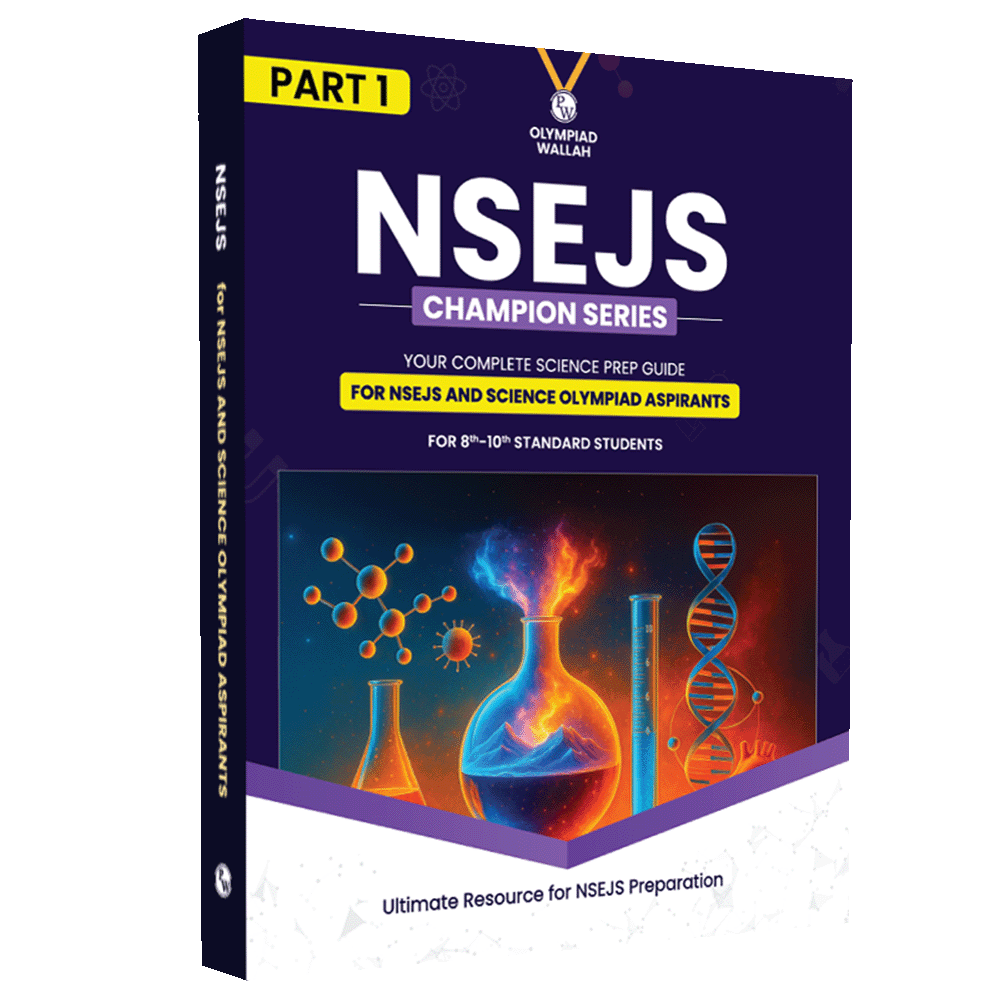
NSEJS Preparation Book by PW
For students preparing for the highly competitive NSEJS exam, having the right study material can help a lot. PW offers the NSEJS Book for Classes 8–10, designed to help you understand key concepts and build confidence step-by-step in problem-solving. This NSEJS Preparation Book by PW is especially helpful for students aiming for NSEJS, INJSO, and IJSO exams. Here's why you should invest in this book:
-
Practice Questions: It includes Olympiad-level science questions that give hands-on practice for NSEJS and other science competitions.
-
Concept-Based Learning with PYQs: The book combines core theory with previous year NSEJS questions to help you focus on important topics and exam patterns.
-
Progressive Difficulty: Topics are arranged from basic to advanced levels, making it easier for students in Classes 8 to 10 to learn.
-
Olympiad-Aligned Content: All content is aligned with the NSEJS, INJSO, and IJSO syllabus and exam trends, making sure you only study what is relevant.
-
Analytical Skill Focus: The book encourages logical thinking and analytical skills, which are important for solving challenging Olympiad questions.
Using this NSEJS Champion Series for Class 8–10 by PW as part of your NSEJS preparation helps you study in an organized way and strengthen your understanding of key Science concepts.
Read More: NSEJS Previous Year Papers with Solutions
NSEJS Syllabus 2025FAQs
Q1. What does the NSEJS Syllabus 2025 cover?
Ans. The NSEJS Syllabus 2025 covers Physics, Chemistry, Biology, and Mathematics. It is based on CBSE Class 9 and 10 science topics, but the questions test a deeper understanding and reasoning.
Q2. How many questions are asked in NSEJS?
Ans. As per the NSEJS exam pattern, it has a total of 60 questions, carrying a total of 216 marks.
Q3. How to complete the NSEJS 2025 syllabus in one month?
Ans. To complete the NSEJS 2025 syllabus in just one month, focus on important chapters from Class 9 and 10 science. Make a timetable, revise topics daily, and practice previous year papers to improve speed and accuracy.
Q4. Is there any negative marking in the NSEJS exam?
Ans. Yes, as per the NSEJS exam pattern, there is negative marking. For single-correct questions, 1 mark is deducted for every wrong answer. For multiple-choice questions, marks are given only if all correct options are marked without any wrong answers.
Q5. Can I skip Biology during NSEJS preparation?
Ans. No, you should not skip Biology. It is a core subject in NSEJS. Skipping it can lower your overall score. Therefore, focus on all subjects to score good marks.