RRB Group D Reasoning Practice Questions with Solutions

RRB Group D reasoning practice questions are essential study materials designed to help candidates master the General Intelligence and Reasoning section of the Railway Recruitment Board Group D exam. This section typically consists of 30 questions that assess a candidate’s logical thinking, pattern recognition, and analytical skills through various verbal and non-verbal reasoning problems
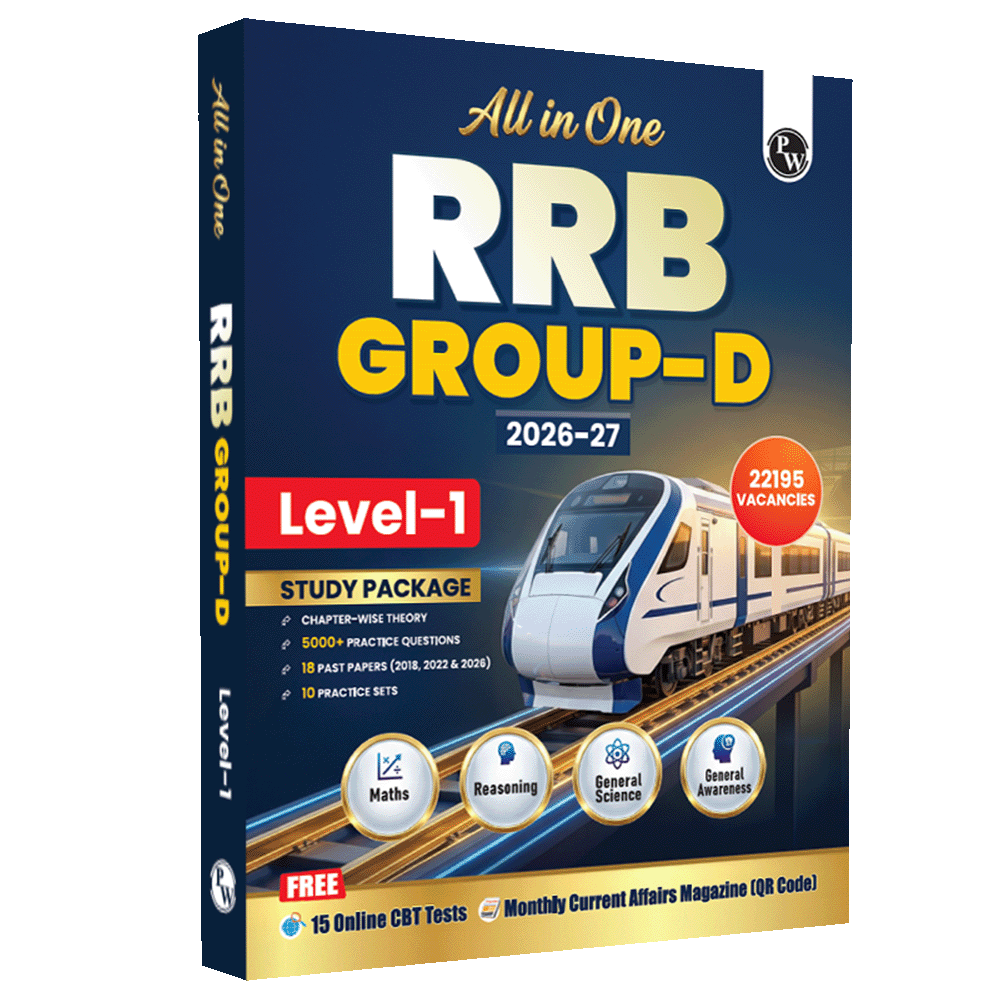
Check Out: PW RRB Books!
Why "Logical" Practice Beats Rote Memorization
You can't "learn" reasoning from a textbook the way you learn History. It’s a skill, like riding a bike. Most candidates fail not because the questions are hard, but because they panic when they see a new pattern. Using an RRB Group D reasoning practice questions pdf is great for offline study, but you need to focus on why an answer is correct, not just what it is.
The Topics That Actually Matter
Railway exams have a "favorite" set of topics. If you're short on time, double down on these:
-
The Big Three: Coding-Decoding, Analogies, and Series. These are fast and usually make up 30-40% of the section.
-
The Time-Suckers: Seating Arrangements and Puzzles. These are worth more marks but can trap you if you aren't careful.
-
The Logic Tests: Syllogism and Venn Diagrams. This is where most students make "silly" mistakes.
Whether you are looking for RRB Group D reasoning practice questions in hindi or English, the logic remains the same. You are looking for the "hidden rule" the examiner has buried in the question.
Hand-Picked Practice Questions (With Human Logic)
Forget the generic examples. Here is how you should actually approach RRB Group D exam reasoning questions during the heat of the exam.
1. The "Quick-Fire" Analogy
Question: Architect : Building :: Sculptor : ?
-
How to think: An architect creates a building. What does a sculptor create? A statue.
-
Answer: Statue.
2. The Coding "Rank" Trick
Question: In a code, TIGER is written as SUHDS. How is HORSE written?
-
How to think: Look at the first letters. T is 20, S is 19 (T-1). I is 9, U is 21 (too far!). Let's try again. T to S (-1), I to H (-1), G to H (+1)... no. Let's look at the letters again. T-S, I-J, G-F... If you see a -1/+1 pattern, follow it carefully.
-
Answer: GNSDR (Each letter is shifted back by one: H-1=G, O-1=N, R-1=Q... wait, check the pattern!).
-
Real Tip: Always write the A-Z ranks (1-26) on your rough sheet the moment the exam starts.
3. The "No-Fail" Syllogism
Question: * Statement 1: All Rain are Clouds.
-
Statement 2: Some Clouds are Water.
-
Conclusion: Is "Some Water is Rain" definitely true?
-
How to think: Use a Venn Diagram. Draw a circle for Rain inside a circle for Clouds. Now, draw a Water circle overlapping "Some" of the Cloud circle. Does the Water circle have to touch the Rain circle? No. It might, but it’s not certain.
-
Answer: Conclusion does not follow.
30 RRB Group D Level 1 Previous Years Papers to practise authentic exam questions, understand the latest exam pattern, and analyse frequently asked topics. With detailed solutions and extensive previous year practice, this book helps improve speed, accuracy, time management, and overall confidence for the RRB Group D Level 1 examination.
The Psychology of the "Second Pass" in Reasoning
One of the very human things that you could be doing in the RRB Group D reasoning practice questions portion is getting "stuck" on the same problem. Your brain gets caught up in a cycle where it keeps spotting the same same faulty pattern again and again. It is at such times that the "Second Pass" technique is going to be your BFF. When it comes to spotting the logic behind the seating order pattern or the complex number series, if you do not get the hang of it in the first 45 seconds, then you absolutely cannot wait to get past the easier questions. By the time you get around to the second pass, your brain would have "reset" the problem, and that is exactly when you realize what the trick was the first time around. This is going to prove to be very useful in the context of RRB Group D reasoning practice questions that come in Hindi.
Furthermore, don't ignore the importance of "Physical Logic." When practicing with an RRB Group D reasoning practice questions pdf, physically draw the directions, the family trees, and the Venn diagrams. Relying solely on mental imagery increases the "cognitive load" on your brain, leading to fatigue in the final 30 minutes of the exam. By offloading that information onto your rough sheet, you keep your mind clear for the high-level analysis needed to solve the trickiest RRB Group D exam reasoning questions and secure your place on the final merit list.
All in One RRB Group D PYQs for comprehensive preparation with chapter-wise previous year solved papers, detailed explanations, and exam-oriented practice. This book helps candidates understand question trends, strengthen concepts, improve speed and accuracy, and prepare confidently for the RRB Group D Level 1 examination.
3 Tactics to Finish the Reasoning Section in 20 Minutes
1. Skip the "Ego" Questions
If a Number Series doesn't click in 15 seconds, skip it. It’s easy to get offended by a math puzzle and waste 3 minutes trying to prove you're smart. Don't do it. Mark it for review and move on.
2. The Venn Diagram Rule
For RRB Group D reasoning practice questions, never solve Syllogisms or "Statement-Conclusion" in your head. Your brain will take shortcuts that lead to errors. Spend 5 seconds drawing the circles. It’s the only way to be 100% sure.
Read More: RRB Group D Exam Preparation Tips and Strategy
RRB Group D Reasoning Practice Questions FAQs
-
Is the Reasoning section harder than Math in RRB Group D?
Actually, it’s usually easier to score in, but harder to manage time-wise. Puzzles can be "traps" that eat up your clock. -
Where can I find a reliable RRB Group D reasoning practice questions pdf?
You can also find comprehensive guides and SSC/Railway books at the PW Store that break down the 2026 patterns. -
What is the most common mistake in Coding-Decoding?
Mixing up the "forward" and "backward" ranks. For example, thinking 'W' is 22 when it's actually 23. Memorize "EJOTY" (5, 10, 15, 20, 25) to stay on track. -
How do I solve Blood Relation questions without getting confused? Always draw a family tree. Use a '+' for males, a '-' for females, and a double line '==' for married couples. It turns a confusing paragraph into a simple map.
-
How much time should I give to each reasoning question?
Aim for an average of 40-45 seconds. Some (like analogies) take 10 seconds; others (like seating arrangements) might take 2 minutes. It all balances out.