RRB NTPC GK Questions for Exam Preparation
RRB NTPC GK Questions
RRB NTPC GK questions are asked with the aim to check how much you know about the world around you and how aware you are of important events. They also carry significant weightage of marks in the Railway Recruitment Board Non-Technical Popular Categories (RRB NTPC) exam. The RRB NTPC exam is held to select candidates for different non-technical posts in Indian Railways, both at the graduate and undergraduate levels.
The general knowledge questions for RRB NTPC are asked from many topics, like current affairs, general science, Indian history, geography, economy, Indian politics, and culture. This section in the exam also includes questions on static GK, such as national parks, monuments, important days, and festivals. Covering RRB NTPC GK questions effectively helps you understand the question types, improves your accuracy, and boost your confidence for the final exam.
Moreover, as per the RRB NTPC exam pattern, 40 RRB NTPC GK questions are asked in the CBT 1 exam, and 50 questions are asked in the CBT 2 exam. Since this section carries more marks compared to others, studying it deeply can help you score well easily. So, keep reading to explore general awareness questions for RRB NTPC and smart tips to prepare for this section effectively.
Check Out: RRB Books
RRB NTPC General Awareness Syllabus
Before you start solving RRB NTPC GK questions, it’s important to first understand what topics you need to study. Knowing the RRB NTPC syllabus for GK helps you focus on those topics that are needed to score well. Check the detailed RRB NTPC General Awareness Syllabus 2025 for the CBT 1 and CBT 2 exams here:
|
RRB NTPC General Awareness Syllabus |
||
|
Section |
Subjects |
Topics |
RRB NTPC Static GK Syllabus |
History |
Indian history, major dynasties, independence movement, and important events. |
|
Geography |
Physical geography, Indian rivers, mountains, and climate. |
|
|
Indian Polity |
Constitution of India, fundamental rights, government policies, and important articles. |
|
|
Economy |
Basic economic terms, Indian economy, budget, and financial institutions. |
|
|
Art & Culture |
Indian classical dance, music, literature, and important cultural events. |
|
|
Sports |
Major national and international sports events, awards, and winners. |
|
|
Books & Authors |
Famous books, their authors, and literary awards. |
|
RRB NTPC Current Affairs Syllabus |
National Events |
Major government schemes, political updates, and policy changes. |
|
International Events |
Global summits, agreements, and important international affairs. |
|
|
Awards & Honors |
Nobel Prize, Bharat Ratna, Padma Awards, and other recognitions. |
|
|
Science & Technology |
Recent scientific discoveries, space missions, and technological advancements. |
|
|
Government Schemes |
Important welfare schemes, PM initiatives, and economic reforms. |
|
|
Important Days |
National and international important days and their significance. |
|
|
Defense & Security |
Military exercises, defense deals, and important appointments. |
|
RRB NTPC General Science Syllabus |
Physics |
Basic laws, motion, electricity, magnetism, and optics. |
|
Chemistry |
Elements, compounds, reactions, and everyday chemistry. |
|
|
Biology |
Human body, nutrition, diseases, and plant sciences. |
|
General Knowledge Questions for RRB NTPC
Now that you know the syllabus, find the general knowledge questions for RRB NTPC here. Learning these questions will help you understand what types of topics are asked in the exam. General awareness for RRB NTPC is not just about memorising facts but about how well you understand different subjects like history, geography, polity, science, economy, and current events.
General Awareness Questions for RRB NTPC
Ques. 1. Who was the first Muslim President of the Indian National Congress?
(A) Abu Kalam Azad
(B) Badruddin Tyabji
(C) Nawab Syed Muhammad Bahadur
(D) Dada Bhai Naoroji
Ques. 2. Who led the Indian National Congress at its first annual session?
(A) Surendra Nath Banerjee
(B) Dadabhai Naoroji
(C) WC Banerjee
(D) AO Hume
Ques. 3. Who among the following are the moderate leaders?
(A) Dadabhai Naoroji
(B) W.C.Banerjee
(C) R.C.Dutt
(D) All of the above
Ques. 4. Who founded the Indian National Congress?
(A) A.O. Hume
(B) Dadabhai Naoroji
(C) Surendranath Banerjee
(D) Dinshaw Wacha
Ques. 5. The first session of the Indian National Congress was held in __ Bombay under the Presidentship of Womesh Chandra Banerjee.
(A) December, 1885
(B) November, 1906
(C) January, 1884(D) October, 1882
Ques. 6. The first session of the Indian National Congress was held at
(A) Bombay
(B) Madras
(C) Calcutta
(D) Surat
Ques. 7. Which trio of leaders had extremist outlooks and were known as Lal-Bal-Pal?
(A) Mahatma Gandhi, Jawaharlal Nehru, Subhas Chandra Bose
(B) Bal Gangadhar Tilak, Lala Lajpat Rai, Bipin Chandra Pal
(C) Dadabhai Naoroji, Gopal Krishna Gokhale, Surendranath Banerjee
(D) Rajagopalachari, Motilal Nehru, Vallabhbhai Patel
Ques. 8. Who among the following was the prominent leader of the Moderate Phase of the Indian National Congress?
(A) Mahatma Gandhi
(B) Bal Gangadhar Tilak
(C) Gopal Krishna Gokhale
(D) Jawaharlal Nehru
Ques. 9. What were the main objectives of the extremist phase of the Indian National Congress?
(A) Gradual political reforms and constitutional methods
(B) Collaboration with the British government
(C) Immediate self-rule and complete independence
(D) Preservation of British colonial rule
Ques. 10. With which of the following institutions is the name of Madan Mohan Malaviya associated?
(A) Banaras Hindu University
(B) Muhammadan Anglo-Oriental College
(C) Fort William College
(D) Hindu College
Ques. 11. Self-Government or 'Swaraj' as the ultimate goal of the Indian National Congress-this declaration was made by Dadabhai Naoroji in which of the following sessions of the INC?
(A) Bombay
(B) Calcutta
(C) Madras
(D) Bankipur 56
Ques.12. Which of the following parties supported the move for partition of Bengal?
(A) Gadar Party
(B) Forward Bloc
(C) All India Muslim League
(D) Communist party of India
Ques.13. The Swadeshi Movement during the Indian freedom struggle encouraged Indians to:
(A) Boycott foreign goods
(B) Promote communal harmony
(C) Support British rule
(D) Embrace the Western culture
Ques.14. The Swadeshi Movement was closely associated with which other movement in India?
(A) Champaran Movement
(B) Civil Disobedience Movement
(C) Non-Cooperation Movement
(D) Quit India Movement
Ques.15. The method used by the extremists to achieve independence was?
(A) Swadeshi method
(B) Boycott method
(C) Both A and B
(D) None of the above methods
Ques.16. When was India's capital shifted from Calcutta to Delhi?
(A) 1911
(B) 1905
(C) 1910
(D) 1912
Ques.17. In the Lahore conspiracy case, which leaders were held guilty?
(A) Bhagat Singh
(B) Sukhdev
(C) Rajguru
(D) All of the above
If you want to find and practice more such RRB NTPC GK questions, solving previous year papers can really help. They give you a clear idea of the real exam pattern and the kind of questions that are usually asked. You can check out PW's RRB NTPC 28 Previous Year Solved Papers that cover both CBT 1 and CBT 2 exams. These are available in both English and Hindi mediums, so you can pick the one you’re most comfortable with and start practicing right away.
Benefits of Prioritising RRB NTPC GK Questions During Exam Prep
Though you may feel that the RRB NTPC General Awareness syllabus is vast, this section can actually help you score very well if you prepare it smartly. You just need to read the question, recall the correct fact, and mark the answer. Here are some reasons why you should focus more on general knowledge questions for RRB NTPC during exam prep:
-
They are theoretical in nature: Most general knowledge questions for RRB NTPC are based on facts and concepts from subjects like history, geography, science, and current affairs. You only need to remember key information.
-
No calculations needed: These questions from general awareness for RRB do not involve formulas or lengthy steps, so you can answer them quickly and save time for other sections.
-
Simple and direct questions: The general awareness for RRB NTPC section mostly covers straightforward questions that test your basic understanding, not advanced-level knowledge.
-
High number of questions: Since 40 questions are asked in CBT 1 and 50 in CBT 2, it gives you a good opportunity to score more marks easily.
-
Less time-consuming: You can complete this section quickly, which helps manage time better during the exam.
Check Out: Half Yearly Current Affairs Book
General Awareness for RRB NTPC Preparation Tips
General Awareness for RRB NTPC is one of the most scoring sections because it doesn’t need long calculations or high-level problem-solving skills. All it needs is regular study, revision, and awareness of current events.
With the right study plan, you can easily improve your score in the general awareness for RRB section. Here are some effective tips that will help you prepare well for the upcoming RRB NTPC GK questions:
1. Stay Updated with Current Affairs
Current affairs cover a large part of the general awareness questions for RRB NTPC. Questions are asked about the latest national and international events, government schemes, sports, awards, and important days.
-
So, read newspapers like The Hindu and The Indian Express, or any of your choice, daily.
-
Watch short daily news analysis videos to understand important updates in less time.
-
Use monthly current affairs magazines or PDFs to revise important topics.
-
Maintain a small notebook to note important dates, new schemes, and major appointments for quick revision.
2. Focus on Static General Awareness for RRB NTPC
Static GK covers facts that do not change, such as history, geography, polity, and economy. These are asked very frequently in RRB NTPC GK questions.
-
Make short notes on topics like the Indian freedom movement, major rivers, national parks, and important articles of the Indian Constitution.
-
Revise on a regular basis so that these facts stay fresh in your mind till the exam.
-
Use easy memory tricks or short stories to remember facts related to history, geography, or government policies.
3. Solve RRB NTPC Previous Year Papers
Solving RRB NTPC previous year papers is one of the best ways to understand what kind of questions are asked.
-
Practice at least 5–10 years old question papers to see which topics are repeated.
-
Give extra attention to general science, polity, and current affairs because these are often asked.
-
After solving each paper, check your mistakes and reread those topics carefully.
4. Attempt Mock Tests Regularly
Mock tests help you check your speed, accuracy, and understanding of the general awareness for RRB NTPC section.
-
Try to take at least one mock test every day or every alternate day.
-
After each test, check your wrong answers and note down the topics you need to revise again.
-
You can also practice with daily GK quizzes available on PW’s platform to build your knowledge step by step.
5. Revise Consistently Every Week
Revision is very important if you want to remember what you've learnt, such as facts and details. Without it, you may forget or get confused between events and dates.
-
Make small, easy-to-read notes for last-minute preparation.
-
Set one day every week just for revision. On that day, revise history, geography, science, polity, and economy topics.
-
Use flashcards or short lists to quickly recall important names, events, and years.
6. Use Reliable RRB NTPC Books
Using the right set of RRB books is very important for effective preparation. Choose study resources that explain concepts clearly and provide sufficient practice questions. A good book helps you cover both static General Knowledge and Current Affairs in a structured and easy-to-understand manner.
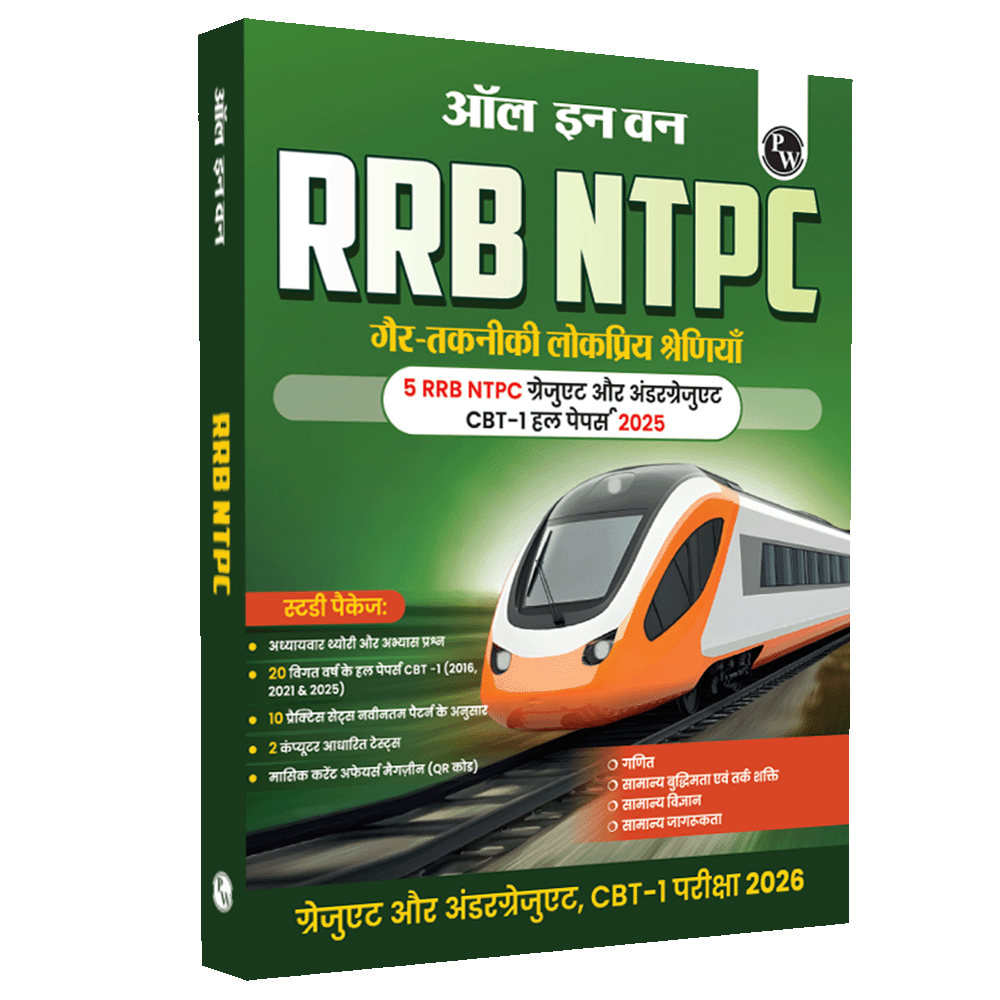
Candidates can prepare with RRB NTPC Undergraduate Level CBT-1 2026 for comprehensive exam-oriented practice and strengthen their understanding of the latest question patterns. Hindi-medium aspirants can also benefit from 45 Years-wise RRB NTPC Solved Papers (Hindi Edition), which provides extensive previous year questions with detailed solutions for better conceptual clarity and revision.
Practising with these resources regularly helps you understand the actual exam pattern, improve accuracy, and become familiar with the types of RRB NTPC GK questions asked in the examination.
RRB NTPC GK Questions for Exam Preparation FAQs
Q.1. What is the syllabus of the General Awareness for RRB NTPC?
Ans. The General Awareness in RRB NTPC covers topics like Indian History, Geography, Polity, Economy, Science, and Current Affairs. It checks how well you know what is happening in the country and the world.
Q.2. From which topics are RRB NTPC GK questions asked?
Ans. RRB NTPC GK questions are mostly asked from static topics and daily events. You will find questions from the Indian freedom struggle, the constitution, geography, famous books and authors, government schemes, awards, and sports.
Q.3. How to prepare general knowledge questions for RRB NTPC?
Ans. To prepare effectively for General Awareness for RRB NTPC, start by reading newspapers daily and revising important topics from history, geography, and science. Solve previous year papers and take small quizzes to check your learning.
Q.4. What is the weightage of General Awareness questions in RRB NTPC?
Ans. The General Awareness section carries questions worth 40 marks, which is high compared to other sections. Since most of the questions are direct and short, you can score well here without spending much time.
Q.5. Can I skip General Awareness for RRB NTPC?
Ans. Skipping General Awareness for RRB NTPC is not a good idea. General Awareness is scoring because it does not need calculations or long solving steps. With regular reading and revision, you can easily answer these questions and improve your total marks.