3 Marks CBSE Class 10 Science Questions
Preparing for the CBSE Class 10 Science 2026 exam becomes easier when students understand the types of questions commonly asked, especially 3-mark questions. These CBSE Class 10 Science questions are important because they test both understanding and explanation skills. They usually require short, structured answers along with diagrams, examples, or chemical equations. By practising these questions, students can strengthen conceptual clarity and improve their overall score in the board exam.
Three mark questions often come from chapters like Chemical Reactions and Equations, Acids, Bases and Salts, Metals and Non-metals, Life Processes, Control and Coordination, Electricity, Magnetic Effects of Electric Current, and Heredity and Evolution. Questions may involve differentiating concepts, writing balanced chemical equations, explaining processes, or drawing labelled diagrams.
To answer 3 mark CBSE Class 10 science questions effectively, students must write clear, concise answers with proper keywords. Where applicable, always add equations, diagrams, or flow charts to fetch full marks. Referring to NCERT Class 10 Science, sample papers, previous year questions, and CBSE Class 10 revision notes helps students understand the answer presentation expected by examiners.
Regular practice of important 3 mark CBSE Class 10 science questions helps students revise faster, improve accuracy, and build confidence for the board exam. With a focused approach, the 3-mark section can become a high-scoring part of the CBSE Class 10 Science 2026 examination.
Check Out: CBSE Class 10 Books
Important 3 Marks CBSE Class 10 Science Questions
Question 1
(i) While electrolysing water before passing the current some drops of an acid are added. Why? Name the gases liberated at cathode and anode. Write the relationship between the volume of gas collected at anode and the volume of gas collected at cathode.
(ii) What is observed when silver chloride is exposed to sunlight? Give the type of reaction involved.
Question 2
Decomposition reactions require energy either in the form of heat or light or electricity for breaking down the reactants. Write one equation each for decomposition reactions where energy is supplied in the form of heat, light and electricity.
Question 3
Select (i) combination reaction, (ii) decomposition reaction and (iii) displacement reaction from the following chemical equations:
(i) ZnCO₃(s) → ZnO(s) + CO₂(g)
(ii) Pb(s) + CuCl₂(aq) → PbCl₂(aq) + Cu(s)
(iii) NaBr(aq) + AgNO₃(aq) → AgBr(s) + NaNO₃(aq)
(iv) H₂(g) + Cl₂(g) → 2HCl(g)
(v) Fe₂O₃ + 2Al → Al₂O₃ + 2Fe
(vi) 3H₂(g) + N₂(g) → 2NH₃(g)
(vii) CaCO₃(s) —Heat→ CaO(s) + CO₂(g)
Question 4 How is a double displacement reaction different from a displacement reaction? Explain giving example in the form of balanced chemical equations.
Question 5
(A) Common salt is an important raw material for various chemicals of daily use. State in brief the method of preparation of
(i) Sodium hydroxide, and
(ii) Sodium hydrogen carbonate from common salt.
Write balanced chemical equations of the reactions that occur.
OR
(B) Design an experimental set-up to demonstrate that
"Alcohol and glucose contain hydrogen but are not categorised as acids".
Also give the reason to justify this fact.
Question 6
(A) Enlist any two nitrogenous waste products removed from the blood of the human kidney.
(B) Name the capillary cluster formed by the branch of renal artery in the Bowman’s capsule.
(C) Depict in the form of a flow chart the path of the urine formed in each kidney until it is finally passed out through the urethra.
Question 7
A pure pea plant having round (R), yellow (Y) seeds is crossed with another pure pea plant having wrinkled (r), green (y) seeds. Subsequently F₁ progeny is self-pollinated to obtain F₂ progeny.
(A) What do the seeds of F₁ generation look like?
(B) Give the possible combinations of traits in seeds of F₂ generation. Also give their ratio.
(C) State the reason of obtaining seeds of new combination of traits in F₂ generation.
Question 8
(A) Draw a labelled diagram to show the pattern of magnetic field lines on a horizontal white board due to a straight current carrying conductor passing perpendicular through its centre. If the direction of current in the conductor is vertically downwards, mark the direction of
(i) current, and
(ii) magnetic field lines.
How Sample Papers Simplify Class 10 3-Mark Practice
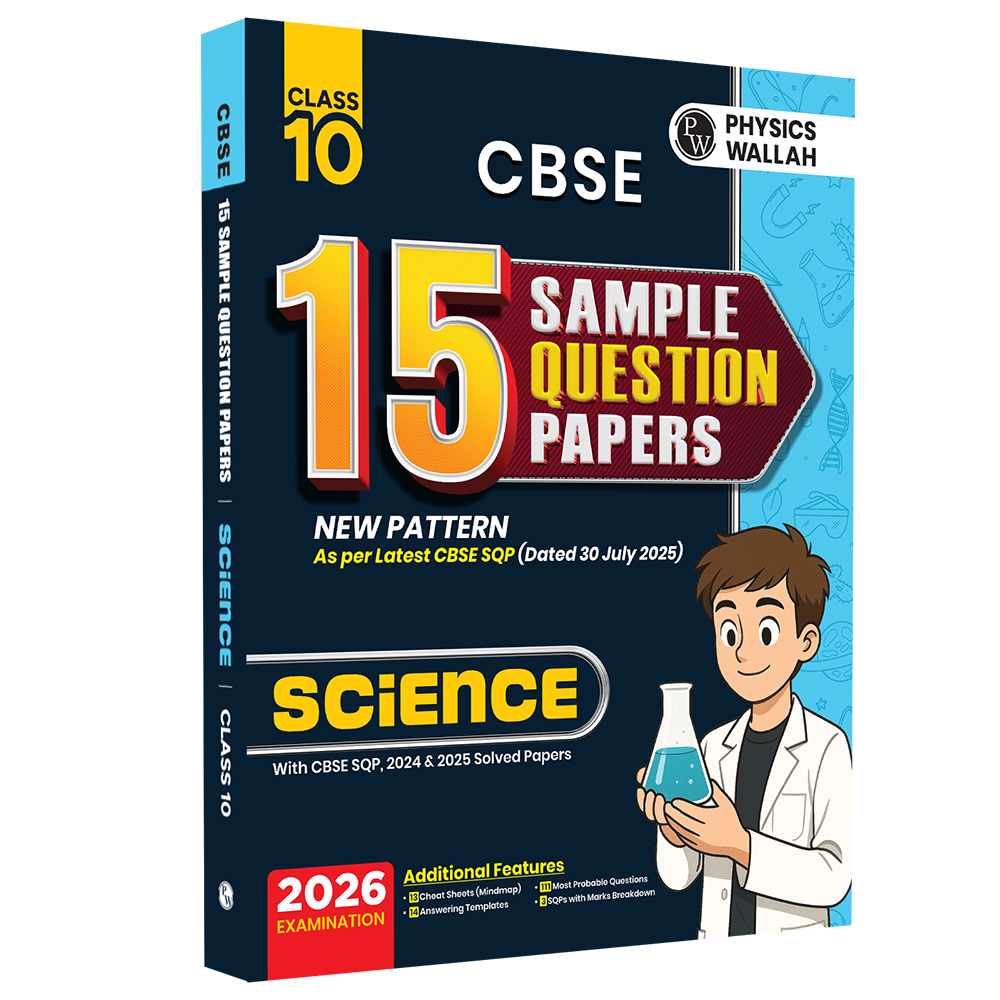
CBSE Class 10 sample papers make practicing 3-mark Science questions much easier by showing students the exact structure and style expected in the board exam. They guide students on how much explanation is needed, what key points must be included, and how to stay within the ideal answer length. By solving these sample papers regularly, students learn to organise their thoughts, write clear and focused responses, and manage time better. CBSE Class 10 sample papers also highlight important and frequently asked topics, helping students revise smarter. With consistent practice, students become more confident and improve their accuracy in 3-mark questions.
|
PW CBSE Sample Papers Class 10 2025-26 |
|
|
Products Links |
PDFs Link |
3 Marks CBSE Class 10 Science Questions FAQs
1. Why are 3-mark questions important in the CBSE Class 10 Science exam?
3-mark questions carry significant weight and test conceptual understanding, reasoning, and diagram-based explanations. With proper practice, students can easily score full marks in this section.
2. Which chapters usually have more 3-mark questions?
Chapters like Chemical Reactions and Equations, Acids, Bases and Salts, Life Processes, Electricity, Magnetic Effects of Electric Current, and Heredity and Evolution commonly include 3-mark questions.
3. How should students prepare for 3-mark Science questions?
Students should understand concepts deeply, practise NCERT questions, solve sample papers, and write short, structured answers with relevant diagrams or equations.
4. Do diagrams help in scoring full marks in 3-mark questions?
Yes. Adding a neat, labelled diagram improves clarity and presentation, helping students score maximum marks, especially in Biology and Physics chapters.
5. Where can students find good practice questions for this section?
Students can refer to NCERT textbooks, CBSE sample papers, previous year board papers, and Class 10 Science revision notes for reliable and exam-based 3-mark questions.