CBSE Class 11 Biology Notes Chapter 4 Animal Kingdom
Class 11 Biology Chapter 4 focuses on the Animal Kingdom, one of the most interesting topics in biology. These animal kingdom class 11 notes help students understand the huge variety of animals found on Earth and the scientific method used to classify them. Since animals differ in structure, behaviour, and body design, scientists use a systematic method to group them based on common features. These features include their body shape, body organization, presence or absence of a backbone, type of body cavity, symmetry, and how their organs function.
The chapter starts with the basic idea of classification. Instead of studying each animal individually, scientists divide them into groups called phyla. This makes it easier to understand similarities and differences among animals. Class 11 biology animal kingdom notes explain how animals are arranged from simple to complex forms. For example, sponges are the simplest animals because they do not have true tissues or organs. As we move to higher groups like arthropods, molluscs, and chordates, the structure becomes more advanced, which is clearly highlighted in class 11 animal kingdom notes.
One of the most important divisions in the Animal Kingdom is whether an animal has a backbone (vertebrates) or not (invertebrates). Vertebrates include fish, amphibians, reptiles, birds, and mammals. These animals have a well-developed organ system and complex body structure. In contrast, invertebrates like sponges, cnidarians, worms, insects, and starfish have simpler body designs.
This chapter also helps students understand how animals evolved over time. As we move from lower groups to higher ones, we see a gradual increase in body complexity, specialization of organs, and better survival abilities. By studying the Animal Kingdom through class 11 notes, students get a clear idea of how diverse life forms are and how each group is unique. These concepts are well supported by animal kingdom NCERT notes.
Overall, Chapter 4 provides a strong foundation for learning zoology in higher classes by explaining the characteristics and classification of animals in a simple and organized way. These class 11 biology chapter 4 animal kingdom notes make revision easier for students.
Check Out: Class 11th Books
CBSE Class 11 Biology Chapter 4 Notes
Animal Kingdom
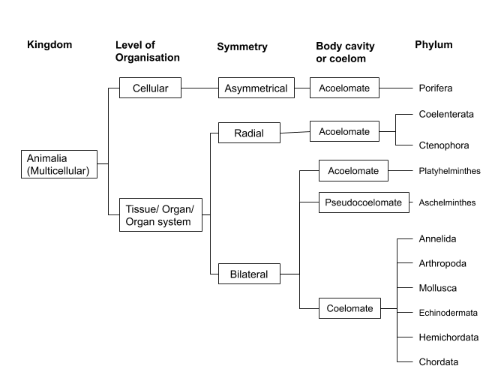
Animals are sorted out based on some key basic traits such as how their cells are arranged, the symmetry of their bodies, and if they have a coelom or not.
- Cellular level of organization: This is the simplest level, where cells are loosely put together, seen in creatures like sponges.
- Tissue level of organization: Cells doing the same job form tissues, seen in animals like coelenterates.
- Organ level of organization: Tissues group up to form organs that do specific jobs, like in flatworms.
- Organ system level of organization: Here, a bunch of organs work together for a particular function, seen in animals like annelids and arthropods.
Then there's how their circulatory system works:
- Open circulatory system: Blood is pumped out of the heart directly to the cells and tissues.
- Closed circulatory system: Blood moves around in a network of tubes like arteries, veins, and capillaries.
Animals are also categorized based on their body structure:
- Diploblastic: The embryo has two layers, like sponges and cnidarians.
- Triploblastic: The embryo has three layers, with mesoderm between the outer and inner layers, seen in animals from flatworms to chordates.
Then there's symmetry:
- Asymmetrical: No symmetry, like in sponges.
- Radial symmetry: The body can be split into equal halves by any plane passing through the center, seen in animals like jellyfish.
- Bilateral symmetry: The body can be split into equal left and right halves, seen in animals like worms and insects.
Some creatures, like echinoderms, show both radial and bilateral symmetry at different points in their lives. The space between the body wall and gut wall, lined by mesoderm, is called the coelom. Animals can be:
- Acoelomates: No body cavity, like flatworms.
- Pseudocoelomates: Their body cavity is filled with scattered pouches of mesoderm, like roundworms.
- Coelomates: They have a proper body cavity, seen in animals from segmented worms to vertebrates.
And finally, some animals, like earthworms, have bodies made up of repeating segments. Creatures with a notochord are called chordates, while those without are called non-chordates, spanning from sponges to echinoderms.
Classification of Animals
Check Out: Class 11th Question Banks
Classification of the Animal Kingdom based on common fundamental features
Phylum – Porifera (Sponges)
- Found in the ocean, asymmetrical shape, and cellular level of organization.
- They take in food, exchange gases, and excrete waste through water flow.
- Water enters through pores and exits through an opening called osculum.
- The inner cavity, spongocoel, is lined with collar cells or choanocytes.
- They have a skeleton made of spongin fibers or spicules.
- Sponges can reproduce both asexually and sexually, and they're hermaphrodites.
Phylum – Coelenterata (Cnidaria)
- Aquatic animals, either stationary or free-swimming, with tissue-level organization and radial symmetry.
- They have a central digestive cavity with a single opening surrounded by sensory tentacles.
- Special cells called cnidoblasts on tentacles contain stinging structures called nematocysts.
- Digestion is both inside and outside the body.
- Some have a hard skeleton made of calcium carbonate.
- They exist in two forms: polyps (sessile) and medusae (free-swimming).
- Some undergo alternation of generations, producing offspring asexually and sexually.
Phylum – Ctenophora (Comb jellies)
- Marine animals with tissue-level organization, radial symmetry, and no body cavity.
- They have eight rows of cilia-covered comb plates for locomotion.
- Digestion happens both inside and outside their bodies.
- Some species can produce light (bioluminescence).
- They can reproduce both sexually and externally, and they're hermaphrodites.
Phylum – Platyhelminthes (Flatworms)
- Mostly parasitic worms with flattened bodies, bilateral symmetry, and no body cavity.
- Parasites have hooks and suckers for attachment.
- They have flame cells for osmoregulation and excretion.
- Flatworms are hermaphrodites and can regenerate.
- Reproduction is both internal and through larval stages.
Phylum – Aschelminthes
- These are either free-living or parasitic, found in water or on land.
- They have round bodies, bilateral symmetry, and a pseudocoelom.
- Their digestive system is complete with a muscular pharynx.
- They reproduce sexually, with females usually longer than males.
- Examples include Ascaris (roundworm), Wuchereria (Filarial worm), and Ancylostoma (hookworm).
Phylum – Annelida
- These creatures have bilateral symmetry, a true coelom, and segmented bodies.
- Longitudinal and circular muscles aid in movement.
- They have closed circulatory systems and nephridia for waste removal.
- Reproduction is usually sexual, with some species being hermaphrodites.
- Examples are Pheretima (earthworm), Nereis, and Hirudinaria (bloodsucking leech).
Phylum – Arthropoda
- This is the largest phylum, containing insects.
- They have bilateral symmetry, a true coelom, and jointed legs.
- Their bodies are covered by a hard exoskeleton made of chitin.
- Respiration occurs through various methods like trachea, gills, or book lungs.
- They have open circulatory systems and compound or simple eyes.
- Examples include economically important species like Bombyx (silkworm) and disease vectors like mosquitoes.
Phylum – Mollusca
- These animals have bilateral symmetry, a true coelom, and a shell.
- They have distinct body parts like a head, foot, and visceral hump.
- Respiration and waste removal happen through feather-like gills.
- They have a rasping organ called a radula for feeding.
- Reproduction is usually sexual, with indirect development.
- Examples include Pila (apple snail), Octopus, and Pearl oyster.
Phylum – Echinodermata
- Adults show radial symmetry, while larvae have bilateral symmetry.
- They have a true coelom and an endoskeleton made of calcareous ossicles.
- Echinoderms have a unique water vascular system for various functions.
- Reproduction is usually sexual with indirect development.
- Examples include Asterias (starfish), Ophiura (brittle star), and Echinus (sea urchin).
Phylum – Hemichordata
- They have features similar to both chordates and invertebrates.
- They possess a structure called a stomochord resembling a notochord.
- Hemichordates have bilateral symmetry and a coelom.
- They reproduce sexually, with indirect development.
- Examples include Balanoglossus and Saccoglossus.
Phylum – Chordata
- Chordates are characterized by a hollow nerve cord, notochord, and gill slits.
- They have bilateral symmetry, a true coelom, and a closed circulatory system.
- Chordata is divided into three subphyla: Urochordata, Cephalochordata, and Vertebrata.
- Vertebrata is further divided into Agnatha (jawless) and Gnathostomata (jawed), which includes Pisces and Tetrapoda.
- Examples include various fish species, amphibians, reptiles, birds, and mammals.
Class I – Cyclostomata (Circular Mouthed Fishes)
- These fishes have a circular and sucking mouth without jaws.
- They are ectoparasites on other fishes.
- Cyclostomes have 6-15 pairs of gill slits, with no scales or fins.
- They have a cartilaginous vertebral column and closed circulation.
- Examples include Petromyzon (Lamprey) and Myxine (Hagfish).
Class II – Chondrichthyes (Cartilaginous fishes)
- These fishes have a cartilaginous endoskeleton and their mouth is on the ventral side.
- They lack operculum covering the gills.
- Chondrichthyes have placoid scales on their skin.
- They maintain buoyancy by constant swimming as they lack air bladders.
- Examples include Scoliodon (Dogfish), Trygon (Stingray), and Carcharodon (Great white shark).
Class III – Osteichthyes (Bony fishes)
- These fishes have a streamlined body with a bony endoskeleton.
- They possess cycloid scales on their skin.
- Osteichthyes have a two-chambered heart and an air bladder for buoyancy.
- Examples include marine species like Hippocampus (Sea horse) and freshwater species like Labeo (Rohu).
Following these classes, we have the Super Class Tetrapoda, which includes four classes:
Class IV – Amphibia
- Amphibians can live both in water and on land.
- They typically have moist skin and lay eggs in water.
- Examples include frogs, salamanders, and limbless salamanders like Ichtthyophis.
Class V – Reptilia
- Reptiles are mostly terrestrial and have dry, cornified skin with scales or scutes.
- They lay eggs on land and have internal fertilization.
- Examples include crocodiles, alligators, chameleons, and snakes like Naja and Viper.
Class VI – Aves
- Birds have feathers for flying and their forelimbs are modified into wings.
- They have dry skin with oil glands and pneumatic bones for flight.
- Birds lay eggs with hard shells and exhibit internal fertilization.
- Examples include crows, pigeons, parrots, and flightless birds like ostriches.
Class VII – Mammalia
- Mammals are mostly terrestrial but some can fly or live in water.
- They have skin covered in hair or fur and mammary glands to feed their young.
- Mammals have a four-chambered heart and are warm-blooded.
- They give birth to live young and exhibit internal fertilization.
- Examples include kangaroos, cats, lions, and marine mammals like dolphins.
Read More: CBSE Class 11 Important Topics - Subject Wise
How to Use CBSE Class 11 Notes
-
Read Chapter Thoroughly
Begin by reading the entire chapter from your NCERT Class 11 textbook. For example, if you are studying Chapter 4 (Animal Kingdom), make sure you understand the main ideas such as internal energy, entropy, classification of animals, body organization, and types of processes. -
Use Notes for Better Understanding
After completing the textbook reading, go through your CBSE Class 11 notes. These class 11 biology chapter animal kingdom notes help you revise concepts like types of symmetry in animals or levels of body organisation. -
Highlight Key Points
While studying the animal kingdom notes, underline or highlight essential terms such as enthalpy, entropy, coelom, vertebrates, invertebrates etc. -
Prepare Short Self-Notes
Once you finish reading the chapter and notes, make your own short summaries. For example, write brief points like “types of animal phyla,” “differences between chordates and non-chordates,” etc. -
Focus on Understanding Concepts
Instead of memorising definitions, try to understand how and why concepts work. -
Revise Frequently
Keep revising your Class 11 notes regularly. Revisiting topics like entropy, animal classification, or internal energy along with your animal kingdom NCERT notes will keep the concepts fresh.
Books for Class 11
Using good class 11 books makes your study time more useful. Instead of reading the same chapters again and again, you can test what you actually know. Find the books link on the table
|
Book Name |
Link |
|
CBSE Question Bank Class 11 Biology |
|
|
CBSE Question Bank Class 11 Combo Set of 4 Books |
|
|
CBSE Class 11 Chapterwise 20 Most Probable |
|
|
CBSE Class 11 Formula Handbook For 2026 Exams |
CBSE Class 11 Biology Notes Chapter 4 FAQs
What is the Animal Kingdom in Class 11 Biology?
The Animal Kingdom includes all animals on Earth. In Class 11 Biology, it teaches how animals are grouped based on body structure, backbone, symmetry, body cavity, and organ systems. These are covered in this animal kingdom class 11 notes.
Why is classification important in the Animal Kingdom?
Classification helps us study animals easily by grouping similar organisms. Instead of learning every species separately, we learn their common features through phyla and classes.
How should I prepare for Biology Class 11 Chapter 4 Animal Kingdom?
Start with NCERT and read each phylum carefully. Understand key terms like symmetry, coelom, segmentation, and body organisation. Then revise your class 11 biology chapter 4 animal kingdom notes and practise PYQs, Question Bank to build clarity.
Is NCERT enough for Class 11 Biology Animal Kingdom?
Yes, NCERT is the most important source for this chapter. It covers all phyla and examples required for exams. For extra practice, revise your animal kingdom NCERT notes, PYQs, Question Bank.