CBSE Class 11 Biology Notes Chapter 7 Structural Organisation in Animals
These CBSE Class 11 Biology Chapter 7 notes are designed to help students clearly understand the topic Structural Organisation in Animals. This chapter is an important part of the syllabus and is useful for both school exams and competitive exams. Our structural organisation in animals class 11 notes follow the latest CBSE guidelines and present the concepts in simple, easy-to-learn language.
These class 11 biology chapter 7 notes explain how animals are made up of different tissues, organs, and organ systems. Students learn about epithelial, connective, muscular, and nervous tissues, which form the basic structure of all animals. The notes also explain the anatomy of important organisms like earthworms, cockroaches, and frogs. With the help of diagrams and clear explanations, these structural organisation in animals notes make it easier for students to remember important points.
Our biology notes for class 11 chapter 7 provide detailed explanations of each topic, including tissue types, functions, and their locations in animals. These notes also highlight important exam questions, helping students prepare better. The language is simple, ensuring that even difficult concepts become easy to understand.
Students looking for class 11 structural organisation in animals notes or chapter 7 biology class 11 notes will find this resource extremely helpful. Each section is well-organised, making revision quicker and more effective. These class 11 bio ch 7 notes also include key terms and summary points so that students can quickly revise before exams.
Whether you are preparing for a class test, final exams, or competitive exams, these biology class 11 chapter 7 notes offer everything you need in one place. These ch 7 biology class 11 notes ensure that students build a strong foundation in animal anatomy and structural organisation, boosting both confidence and performance.
Check Out: Class 11th Books
CBSE Class 11 Biology Notes Chapter 7 Structural Organisation in Animals
Animal Tissues
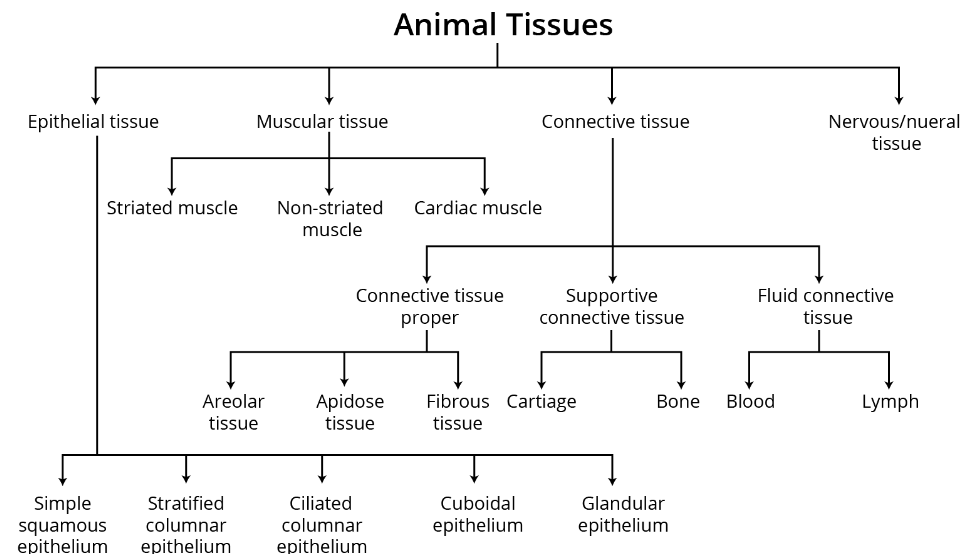 Since cells have different structures depending on their functions, tissues can be broadly classified into the following categories:
Epithelial tissue : These tissues have a surface facing a free space and are tightly packed with very little space between cells. There are two types:
- Simple epithelium: A single layer of cells that line body cavities, ducts, and tubes. They come in three types based on cell shape: squamous, cuboidal, and columnar.
- Compound epithelium: Consists of two or more layers and protects the skin.
Connective tissue : These tissues support and connect other tissues and organs in the body. They include soft connective tissue, cartilage, bone, adipose tissue, and blood. Connective tissues provide strength, elasticity, and flexibility to the body. They can be classified into loose connective tissue (like aerolar and adipose tissues), dense connective tissue, and specialized connective tissue.
Muscular tissue : Muscles are made up of long, tube-shaped fibers arranged in parallel. They are composed of fine fibrils called myofibrils and are responsible for body movements. There are three types:
- Skeletal muscles: Bundled muscle fibers closely attached to skeletal bones.
- Smooth muscles: Involuntary muscles with narrow, spindle-shaped cells that line internal organs like blood vessels and the digestive system.
- Cardiac muscles: Involuntary muscle tissue found in the heart.
Neural tissue : Neurons, or nerve cells, are the building blocks of the nervous system. They are excitable cells that make up the neural system, providing support and protection.
Structural Organization of Earthworm
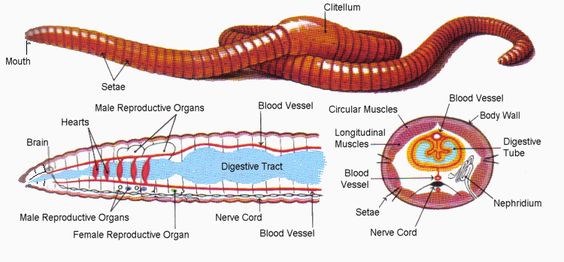 It's a reddish-brown terrestrial invertebrate that lives in moist sand's upper layer and is identified by its worm casting fecal deposits.
Morphology : The earthworm's long cylindrical body is divided into over a hundred similar segments called metamers. It has a dorsal blood vessel and genital openings on the ventral surface. The mouth and prostomium, serving as a mouth cover, are at the anterior end. Segments 14-16 have a prominent glandular band called the clitellum. There are four pairs of spermathecal apertures and single female and male genital pores on specific segments. Each body segment has rows of S-shaped setae for locomotion.
Anatomy : The body wall has a non-cellular cuticle, epidermis, two muscle layers, and a coelomic epithelium. The straight alimentary canal includes a buccal cavity, pharynx, esophagus, gizzard, stomach, intestine, and anus. The closed circulatory system comprises blood vessels, capillaries, and a heart. Respiratory exchange happens through the moist skin, and excretion occurs via nephridia. The nervous system includes ganglia and sensory organs sensitive to light, touch, and chemical stimuli.
Reproduction : Earthworms are hermaphrodites with testes, ovaries, and accessory glands. Spermathecae store sperm, while ovaries connect to oviducts leading to female genital pores. Mutual exchange of sperm occurs during mating, facilitated by gonadal openings. Clitellum glands produce cocoons where fertilization, ova development, and embryonic growth occur. Cocoons release baby worms after three weeks.
Benefits : Earthworms aerate soil, promoting root growth and soil fertility, aiding vermicomposting, and serving as fishing bait.
Check Out: Class 11th Question Banks
Structural Organization of Cockroach
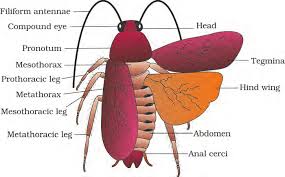 The structural organization of a cockroach, like that of many other insects, is well-adapted for its survival in diverse environments. Cockroaches belong to the class Insecta and the order Blattodea. They are known for their resilience and adaptability, thriving in various habitats worldwide.
External Anatomy:
- Body Segmentation: A cockroach's body is divided into three main parts: head, thorax, and abdomen. These segments are covered by a hard exoskeleton made of chitin, providing protection and support.
- Head: The head houses the sensory organs, mouthparts, and compound eyes. Cockroaches have a pair of long, flexible antennae that serve as sensory organs for touch, smell, and taste.
- Thorax: The thorax contains three pairs of jointed legs, which are adapted for running and climbing. Each leg consists of segments with specialized structures for locomotion.
- Abdomen: The abdomen is the largest segment of the cockroach's body. It contains vital organs such as the digestive, reproductive, and excretory systems.
Internal Anatomy:
- Digestive System: Cockroaches have a complete digestive system with mouthparts adapted for chewing. Food is ingested through the mouth and passes through the esophagus into the crop and gizzard for storage and grinding, respectively. Digestion primarily occurs in the midgut, where nutrients are absorbed, and undigested material passes into the hindgut for excretion.
- Respiratory System: Cockroaches breathe through a system of air-filled tubes called tracheae. These tubes deliver oxygen directly to cells throughout the body, allowing for efficient gas exchange. Spiracles, small openings along the cockroach's body, regulate the flow of air into the tracheal system.
- Circulatory System: Cockroaches have an open circulatory system consisting of a dorsal vessel and a series of sinuses. Hemolymph, the insect equivalent of blood, circulates freely within the body cavity, transporting nutrients, hormones, and waste products.
- Nervous System: Cockroaches have a well-developed nervous system consisting of a brain, ventral nerve cord, and ganglia. Sensory receptors located on the antennae, legs, and body surface detect environmental stimuli and transmit signals to the central nervous system for processing.
- Reproductive System: Cockroaches reproduce sexually, with males and females typically exhibiting distinct reproductive organs. Males have reproductive structures called testes, while females have ovaries. Fertilization occurs internally, and females produce egg cases called oothecae, which contain multiple eggs.
- Excretory System: Waste products are eliminated through a network of tubules known as Malpighian tubules. These tubules remove nitrogenous waste and excess ions from the hemolymph, which are then excreted as uric acid.
Behavioral Adaptations:
- Nocturnal Habits: Cockroaches are primarily nocturnal, seeking shelter during the day and becoming active at night to forage for food.
- Omnivorous Diet: Cockroaches are opportunistic feeders, consuming a wide range of organic matter, including decaying plant material, fungi, and even dead insects.
- Agile Locomotion: Cockroaches are fast runners and adept climbers, enabling them to navigate various terrains and escape predators.
- Thigmotaxis: Cockroaches exhibit thigmotactic behavior, preferring confined spaces and surfaces in contact with their bodies, which provides a sense of security.
Structural Organization of Amphibia -Frog
The structural organization of amphibians, like frogs, reveals fascinating adaptations that allow them to thrive in both aquatic and terrestrial environments. Let's explore the anatomy of a frog, focusing on its various systems and structures:
Integumentary System :
- Frogs have a smooth and moist skin covered in mucus, which helps them stay hydrated and facilitates gas exchange through cutaneous respiration.
- Their skin is permeable, allowing them to absorb water and oxygen directly from their surroundings.
- Specialized skin glands secrete toxins that provide defense against predators.
Skeletal System :
- The skeletal system provides support and protection to the frog's body.
- It includes a vertebral column, skull, limbs, and rib cage.
- The absence of ribs in the abdominal region allows for the expansion of the body during breathing.
Muscular System :
- Frogs have well-developed muscles that enable various movements such as jumping, swimming, and catching prey.
- Muscles attached to the bones of the limbs facilitate locomotion, while muscles in the abdomen aid in breathing.
Digestive System :
- The digestive system of a frog consists of organs involved in ingestion, digestion, absorption, and elimination.
- Food is ingested through the mouth and passes through the esophagus into the stomach.
- The stomach secretes gastric juices to break down food, which then moves into the small intestine for further digestion and absorption of nutrients.
- Undigested material exits through the cloaca, a common chamber for waste elimination and reproductive functions.
Respiratory System :
- Frogs exhibit both cutaneous and pulmonary respiration.
- Cutaneous respiration occurs through the skin, allowing for gas exchange with the environment, particularly in water.
- Pulmonary respiration involves breathing through the lungs, which are located in the upper part of the trunk and connected to the buccal cavity.
Circulatory System :
- Frogs have a closed circulatory system with a three-chambered heart (two atria and one ventricle).
- Blood is pumped from the heart to the rest of the body through arteries and returns to the heart via veins.
- The circulatory system facilitates the transport of oxygen, nutrients, and waste products throughout the body.
Excretory System :
- The excretory system removes metabolic waste products from the body, maintaining internal balance.
- Frogs have paired kidneys that filter waste from the blood and excrete it as urine.
- Urine is transported from the kidneys to the cloaca through ureters and expelled from the body along with feces.
Nervous System :
- The nervous system coordinates sensory input, motor responses, and higher cognitive functions.
- It consists of the brain, spinal cord, and peripheral nerves.
- Sense organs such as eyes, ears, and tactile receptors provide information about the environment.
Reproductive System :
Frogs have intricately structured reproductive systems that ensure successful reproduction. Let's delve into the details of their reproductive anatomy and life cycle:
Male Reproductive System:
- Male frogs possess a pair of yellowish ovoid testes, which are responsible for producing sperm.
- These testes attach to the upper part of the kidney via a structure called the mesorchium, which is a double fold of the peritoneum, the serous membrane lining the abdominal cavity.
- From the testes, 10-12 vasa efferentia originate and carry sperm. They enter the kidneys from the side and exit through Bidder's canal.
- Bidder's canal is a passage found inside the kidney that receives sperm from the vasa efferentia. It connects to the urinogenital duct and eventually enters the cloaca.
Female Reproductive System:
- The female reproductive system comprises two ovaries located near the kidneys.
- Unlike in mammals, the ovaries and kidneys in frogs have no direct functional relationship.
- Each ovary is connected to the cloaca via an oviduct, a tube responsible for transporting eggs from the ovary to the cloaca. The oviduct opens independently into the cloaca.
- A mature female frog can lay between 2500 and 3000 eggs at a time.
- Fertilization in frogs is external, meaning it occurs outside the female's body and takes place in water.
Life Cycle:
- The life cycle of a frog exhibits complete metamorphosis, which includes distinct stages: egg, tadpole (larval stage), metamorphosis, and adult frog.
- Eggs are laid by the female frog in water, typically in clusters or gelatinous masses.
- After fertilization, the eggs hatch into tadpoles, aquatic larvae with gills and a tail for swimming.
- Tadpoles undergo metamorphosis, during which they gradually develop lungs, lose their gills, and grow legs.
- Eventually, the tadpole metamorphoses into an adult frog, equipped for life both on land and in water.
Ecological Importance:
Frogs play a crucial role in ecosystems as they consume insects and pests, helping to control their populations and protect crops.
Check Out: CBSE Question Bank Class 11 Biology
Benefits of CBSE Class 11 Biology Notes Chapter 7
-
Easy Understanding: The structural organisation in animals class 11 notes explain tissues, organs, and systems in simple language, making the chapter easy to understand.
-
Quick Revision: These class 11 biology chapter 7 notes provide a clear summary of all important topics, helping students revise faster before exams.
-
Better Concept Clarity: These notes include diagrams and simplified explanations, improving clarity of complex concepts.
-
Improved Memory: With neatly structured points and visuals, the biology notes for class 11 chapter 7 help students remember definitions and functions for a longer time.
-
Exam-Focused Content: These notes highlight important questions and key terms that often appear in exams.
-
Time-Saving: Instead of reading the full textbook again, these notes allow students to quickly revise all essential parts.
Read More: CBSE Class 11 Biology Notes Chapter 8 Cell The Unit of Life
CBSE Class 11 Biology Notes Chapter 7 FAQs
1. What is the main topic of Class 11 Biology Chapter 7?
Class 11 Biology Chapter 7 focuses on the Structural Organisation in Animals, which includes animal tissues, organs, and the anatomy of organisms like earthworms, cockroaches, and frogs.
2. Why are Structural Organisation in Animals Class 11 notes important?
These notes help students understand complex concepts in a simple way, making revision easier and improving exam performance.
3. Which topics are covered in Class 11 Structural Organisation in Animals notes?
The notes include different types of animal tissues—epithelial, connective, muscular, and nervous—along with organ systems and detailed examples of animal anatomy.
4. Are these Class 11 Biology Chapter 7 notes useful for competitive exams?
Yes, the notes are helpful for entrance exams because they cover core concepts and definitions that are frequently asked.
5. How can I revise Chapter 7 Biology Class 11 effectively?
You can revise by reading the summary points, practicing diagrams, reviewing tissue types, and solving previous year questions related to this chapter.