CBSE Class 11 Chemistry Notes Chapter 7 Equilibrium
Chapter 7 of Class 11 Chemistry focuses on Chemical Equilibrium, an important concept that helps students understand how reactions behave after a certain point. Chemical equilibrium is the stage in a reaction where the concentrations of reactants and products stop changing. This does not mean the reaction has stopped. Instead, the rate of the forward reaction becomes equal to the rate of the backward reaction. Because both reactions continue at the same speed, the overall composition remains constant.
These equilibrium chemistry class 11 notes help students understand these concepts in a simple way.
Understanding equilibrium is important because it forms the base for advanced chemistry topics in Class 11 and Class 12. Concepts like acids and bases, solubility, ionic equilibrium, and many industrial processes depend on the principles of equilibrium. Once students understand how reactions reach balance, it becomes easier to solve numerical problems and predict outcomes of chemical processes. This is why equilibrium notes are very helpful for Class 11 students.
The CBSE Class 11 Chemistry Notes for Chapter 7 give a clear explanation of ideas like dynamic equilibrium, equilibrium constants, factors affecting equilibrium, and Le Chatelier’s Principle. With these class 11 chemistry chapter 7 notes, students can understand how changes in temperature, pressure, or concentration affect the state of equilibrium.
Students who want quick revision can download the Class 11 Chemistry Chapter 7 Notes PDF. These chemistry notes for class 11 chapter 7 are useful for exam preparation, practising numerical questions, and understanding definitions easily.
Check Out: Class 11th Books
CBSE Class 11 Chemistry Notes Chapter 7
An essential component of chemical and biological processes is chemical equilibrium. When a liquid evaporates in a closed container, some of the vapour phase's liquid molecules impact the liquid surface and stay in the liquid phase, while molecules with comparatively higher kinetic energy leave the liquid surface into the vapour phase. Because of an equilibrium where the number of molecules leaving the liquid equals the number returning to the liquid from the vapour, it results in a constant vapour pressure. At this point, the system has attained a condition of equilibrium. The rate of evaporation and the rate of condensation are so identical at equilibrium. It could be shown as The double arrow above shows that both directions of the procedure are being carried out at the same time. The term "equilibrium mixture" refers to the mixture of reactants and products in the equilibrium state.
Equilibrium in the Physical Process
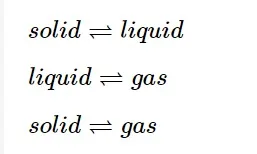
The most important and familiar example is the phase transformation process. Eg.
Solid-liquid Equilibrium
The ice and water are in equilibrium at a specific temperature and pressure. The temperature at which the liquid and solid phases of any pure substance are in equilibrium under atmospheric pressure is known as the substance's normal melting or freezing point. When the system reaches dynamic equilibrium, it will behave as follows:
- Simultaneously, the opposite processes take place
- The process proceeds at an identical pace, maintaining a steady volume of water and ice.
Check Out: Class 11th Question Banks
Liquid-vapour equilibrium
The number of water molecules from the gaseous state into the liquid state increases until the equilibrium is reached. i.e rate of evaporation = rate of condensation The pressure at which water molecules stay constant at a specific temperature is known as the equilibrium water pressure, and it rises as the temperature does. Liquid evaporation is dependent upon,
-
The nature of the liquid
-
The amount of liquid
-
The applied temperature
For instance, at 100C and atmospheric pressure (1.031 bar), water and water vapour are in equilibrium in a closed vessel. Accordingly, the temperature at which liquid and vapours are in equilibrium is referred to as the normal boiling point for any pure liquid at one atmospheric pressure (1.0301 bar).
Solid-vapour Equilibrium
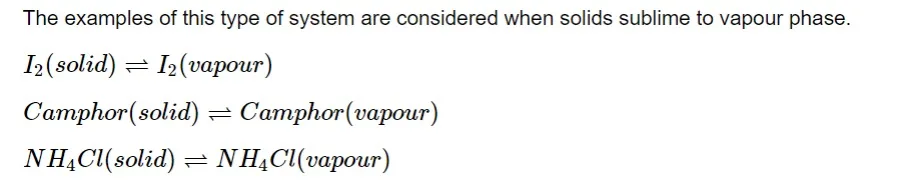
General Characteristics of Equilibrium Involving Physical Processes
The system in equilibrium for which the physical processes previously outlined have the following qualities in common:
- Only closed systems can achieve equilibrium at a given temperature.
- In steady conditions, the system is dynamic if the rates of the opposing processes are equal.
- Every measurable property in a system stays the same.
- In the case of a physical process, equilibrium is defined as the constant value of one of its parameters.
Equilibrium in Chemical Processes
Chemical reactions, in contrast to physical systems, also reach a state of equilibrium. Both forward and reverse motion are possible for such chemical processes. When the rate of forward reaction equals the rate of backward reaction, there is a dynamic chemical equilibrium.
Check Out: PW School Books
Dynamic Nature of Chemical Equilibrium
This dynamic nature of chemical equilibrium can be explained by the synthesis of ammonia by Haber’s process. This process starts with definite amounts of 𝑁2 𝑎𝑛𝑑𝐻2 and carries out a reaction when equilibrium is attained at a particular temperature. At equilibrium the concentrations of N 2 a n d N H 3 𝑁2 𝑎𝑛𝑑𝑁𝐻3 are constant.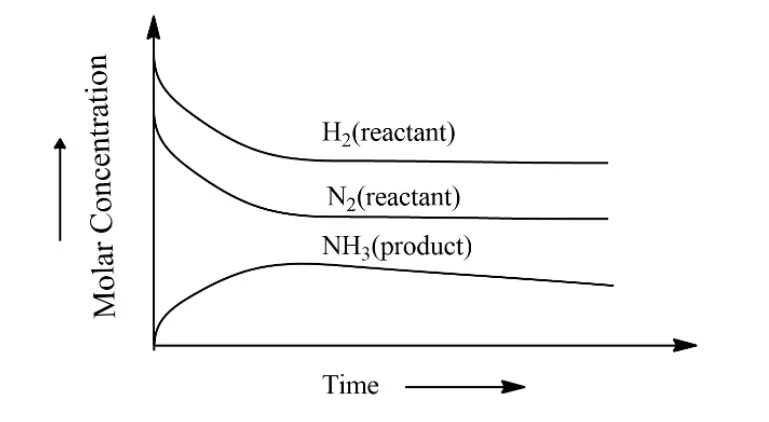
Characteristics of Chemical Equilibrium
At equilibrium, the concentrations of all the reactants and products are constant. At equilibrium, the rates of forward and backward reactions are equal, indicating that equilibrium is dynamic. Only chemical equilibrium can be established if none of the products are permitted to escape or separate as solids.
Equilibrium Constant:
An equilibrium mixture is a mixture of reactants and products in the equilibrium state.
Consider a general reversible reaction,
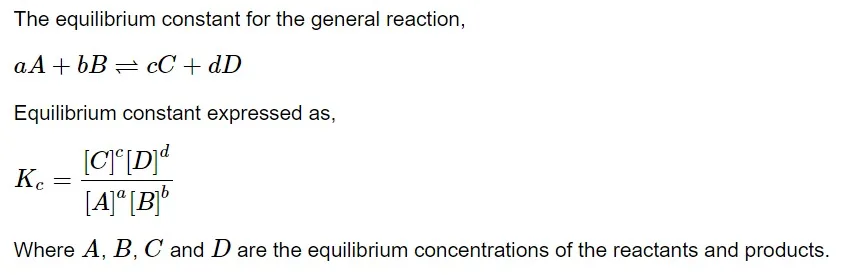
Characteristics of Equilibrium Constant
The value of the equilibrium constant for a given reaction is always constant; it is not affected by the starting reactant concentrations or the direction in which the equilibrium approached. Instead, it solely depends on the reaction's temperature. When the reaction is reversed, the equilibrium constant's value is inverted.
Le Chatelier’s Principle
This principle aids in choosing the appropriate course of action and in qualitatively predicting how conditions will change to affect equilibrium. It says that "a system will change in such a manner as to reduce or counteract the effect of the change if any of the factors that determine the equilibrium conditions of a system change." Any physical or chemical equilibrium system can benefit from this idea.
Read More: CBSE Class 11 Syllabus for All Subjects
Books for Class 11
Using good class 11 books makes your study time more useful. Instead of reading the same chapters again and again, you can test what you actually know. Find the books link on the table
|
Book Name |
Link |
|
CBSE Question Bank Class 11 Chemistry |
|
|
CBSE Question Bank Class 11 Combo Set of 4 Books |
|
|
CBSE Class 11 Chapterwise 20 Most Probable |
|
|
CBSE Class 11 Formula Handbook For 2026 Exams |
How to Use CBSE Class 11 Chemistry Notes Chapter 7
1. Read Full Chapter First
Start by reading the entire NCERT chapter on Equilibrium. Understand concepts like dynamic equilibrium, reversible reactions, equilibrium constant (Kc, Kp), and Le Chatelier’s Principle.
2. Go Through Notes Carefully
After reading the textbook, use these class 11 equilibrium notes to revise concepts, formulas, and rules like the relationship between Kc and Kp.
3. Highlight Important Points
Underline key terms such as reaction quotient (Qc), equilibrium constant, reversible reactions, and factors affecting equilibrium. This makes revision faster.
4. Make Short Notes
Prepare small points like “Kc formula,” “Kp = Kc(RT)Δn,” or “Effect of temperature on equilibrium.” These help during last-minute revision.
5. Focus on Understanding
Equilibrium is a concept-based chapter. Try to understand how the system adjusts to stress and why equilibrium is dynamic instead of memorising everything.
6. Revise Regularly
Keep revising your equilibrium chemistry class 11 notes frequently. Revise topics like Le Chatelier’s Principle, Kp–Kc relation, and the ICE table method.
FAQs on Class 11 Chemistry Chapter 7 Equilibrium
1. What is equilibrium in chemistry?
Equilibrium is the state in a reversible reaction where the forward and backward reactions occur at the same rate, so the concentrations of reactants and products remain constant.
2. What is the difference between physical and chemical equilibrium?
-
Physical equilibrium: Involves changes in physical states (liquid ↔ vapour).
-
Chemical equilibrium: Involves reversible chemical reactions (A + B ↔ C + D).
3. How should I prepare for Chemistry Class 11 Chapter 7?
Start with NCERT, understand concepts like equilibrium constant, reversible reactions, and Le Chatelier’s Principle. Revise equilibrium class 11 notes and practise numerical questions from sample papers or PYQs.
4. Is NCERT enough for Class 11 Chemistry Equilibrium?
Yes, NCERT covers all main concepts. But for better practice, solve PYQs, use equilibrium chemistry class 11 notes, and practise extra numerical questions to strengthen understanding.