CBSE Class 11 Physics Notes Chapter 2 Units and Measurement & Basic Mathematics
The class 11 physics chapter 2 notes guide is here to help you learn how we use numbers in Physics. This chapter is the start for everything else. It starts with how we measure things like how long an object is or how much time has passed. Having strong class 11 physics chapter 2 notes pdf is a big part of getting high marks in your tests. Without units and measurements, we wouldn't know the difference between a small bag of sugar and a giant bag! In this guide, we will look at units, how to check math rules, and how to avoid mistakes when measuring.
|
Topic |
What it Tells Us |
Why it Matters |
|
SI Units |
World rules |
7 main units and 2 for corners (angles) |
|
Dimensions |
The "type" of a unit |
Helps check if a math rule is right |
|
Errors |
Mistakes in measuring |
How small mistakes add up |
|
Basic Math |
Calculus and Vectors |
The tools used to solve motion problems |
Check Out: Class 11th Books
CBSE Class 11 Physics Notes Chapter 2
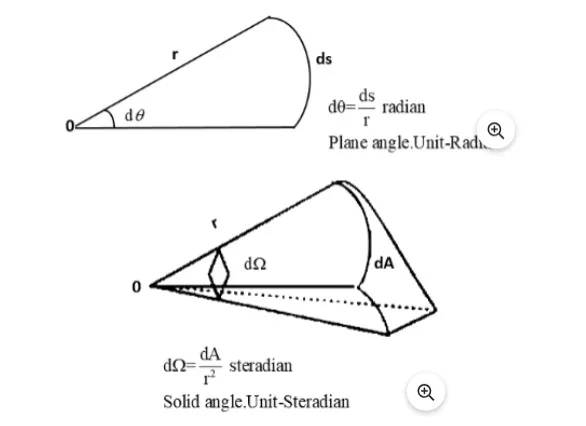
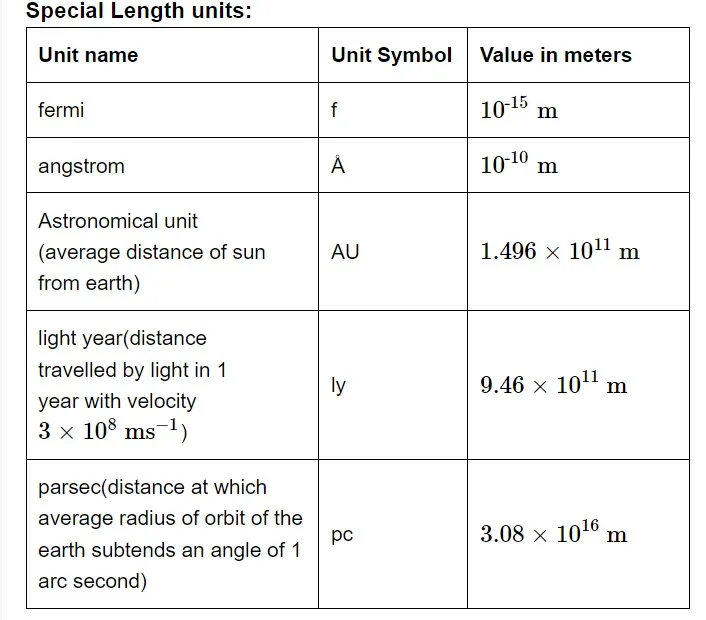
An internationally recognised standard for measuring amounts is referred to as a unit. A measurement of a numerical quantity in a particular unit has been included. For base quantities (mass, length, etc.), the units are known as Fundamental unitfs. The units that result from the combining of basic units are called derived units. A System of Units is made up of both Fundamental and Derived units. Système Internationale d'Unites, or SI (International System of Units) as it is known in French, is a definition of a globally recognised system of units. It was created and suggested by the General Conference on Weights and Measures in 1971. The list of seven base units that SI mentioned is displayed in the table below. Accompanying it are two components. The two units for angles are radians, or rad, for plane angles, and steradians, or sr, for solid angles. These two have no dimensions.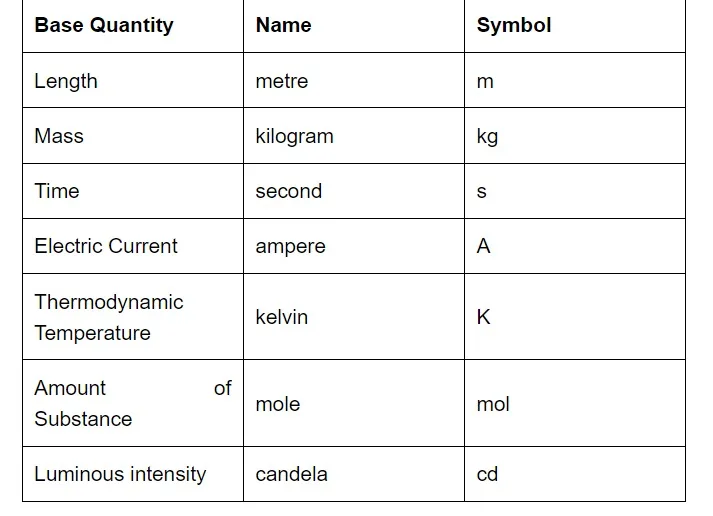
Parallax Method-Measurement of large distances
The angle or semi-angle of inclination between two lines of sight is used to compute parallax, which is the displacement or difference in the apparent position of a body observed along those two lines. The distance between the two points of view is referred to as the foundation.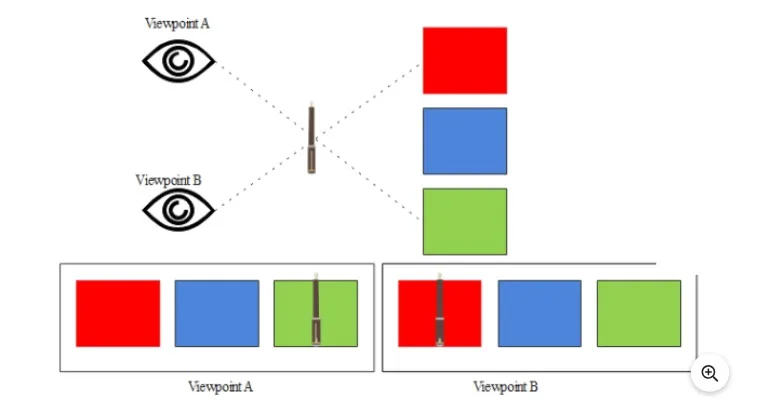
Calculating the distance of a planet using parallax method
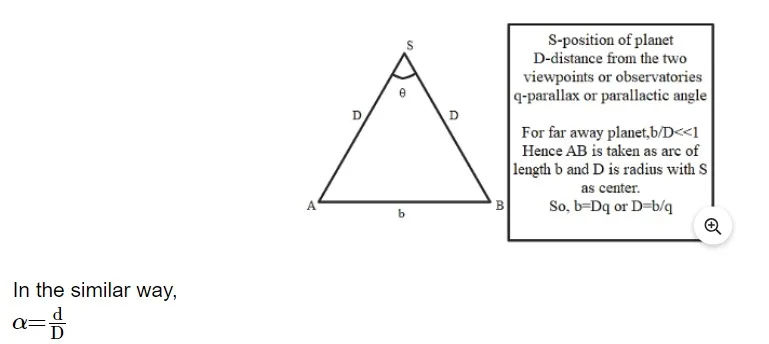 where d is the planet's diameter and α is the planet's angular size (the angle subtended by d at Earth). When viewing two diametrically opposed points on the planet, the angle between the telescope's direction and the points is represented by α.
Measuring very small distances
Electron microscopes will be used to measure lengths as small as a molecule. Among them will be electron beams that are subject to magnetic and electric fields. The resolution of electron microscopes will be 0.6 Angstroms, or Å. When we employ tunnelling microscopy, which is a technique used to resolve atoms and molecules, we may estimate the size of molecules. estimating the Oleic acid molecule's size. Oleic acid has a large molecular size of around 10−9 m, resulting in a soapy liquid state. The steps listed below are utilised to ascertain a molecule's size: Next, sprinkle lycopodium powder over a trough's water's surface while retaining one drop of the aforesaid solution. The oleic acid in the solution will spread across the water in the form of a circular molecule thick layer. Use the computations below to get the diameter of the circular film above.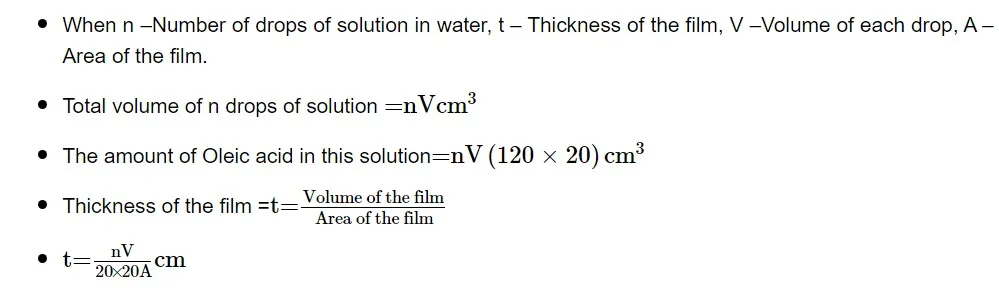
Combinations of Errors
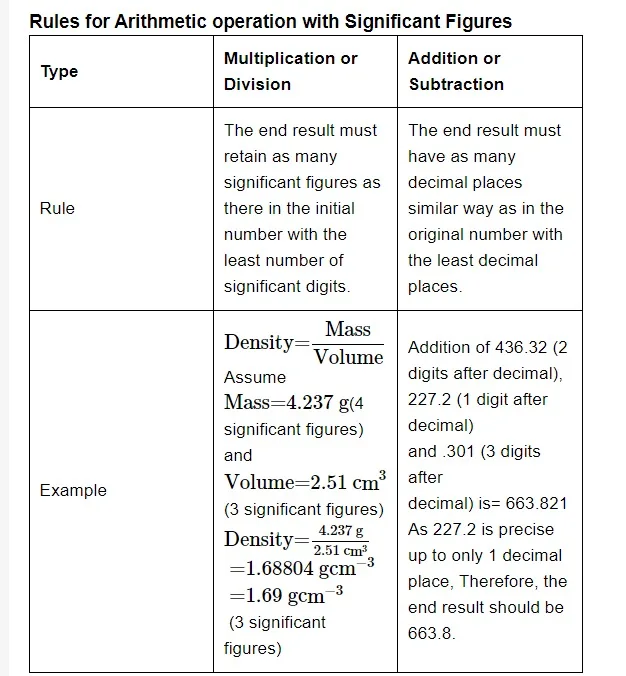
The sum of the mistakes in the two values will be helpful in identifying and forecasting the errors in the resultant amount when a quantity depends on two or more other quantities. There are several ways to go about this. Think about two quantities. The values of A and B are A ±ΔA and B ± ΔB. Assume that Z is the outcome and that the error ΔZ results from the combination of A and B.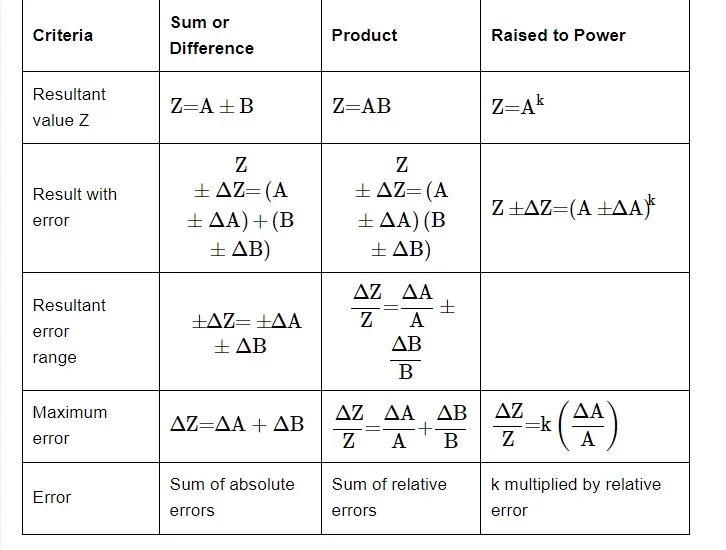
Significant Figures
Each measurement yields an output in the form of a number with both certain and uncertain digits. Significant digits or significant figures are defined as reliable digits appended to the first uncertain digit. This illustrates how measurement precision varies with the least number of measuring instruments utilised. A pendulum with an oscillation period of 1.62 seconds can be used as an example. In this case, 1 and 6 will be dependable, whereas 2 is not sure. Therefore, there will be three significant figures in the measured value.
Rules for the determination of number of significant figures
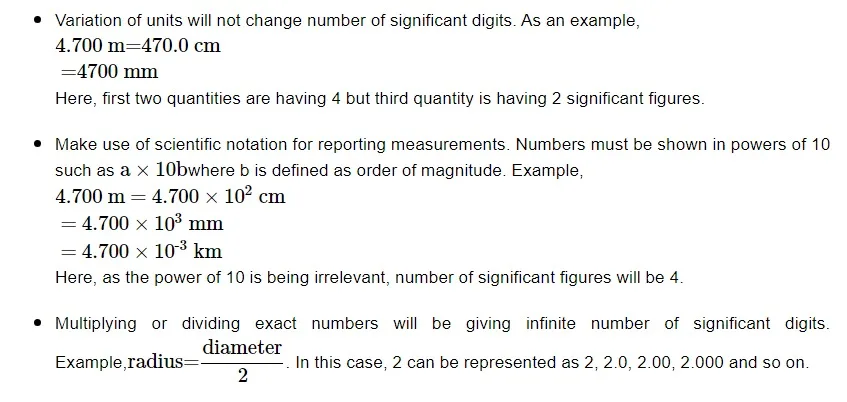
Every digit that is not zero will be important. Every zero in between two non-zero digits will have significance regardless of the decimal place. For values less than 1, zeroes are not regarded as important when they come before or after non-zero digits and the decimal. If there is a zero before the decimal place for these numbers, it will never matter. If a number has no decimal places, the trailing zeros have no significance. When a number has a decimal place, the trailing zeros are important.
Cautions for removing ambiguities in calculating number of significant figures
Check Out: Class 11th Question Banks
Learn Class 11 Physics Chapter 2 Notes
Getting ready for your Physics test is easy when you follow a simple plan. In this chapter, you will learn how to write numbers carefully and how to use math to show how things move. You will also see how to find mistakes when you use a ruler or a clock. If you practice these class 11 physics chapter 2 notes steps, you will find it easy to solve the first few parts of your book. This chapter gives you the "tools" for the rest of Physics.
Units and Ways to Measure
Everything in Physics is measured. In your class 11 physics chapter 2 notes in pdf, you will learn about the SI System. This is the standard way scientists use units around the world. Imagine if one scientist used "feet" and another used "meters"—their answers would never match!
-
Main vs Made-up Units: Main units (like mass and length) stand alone. There are only 7 of them. Made-up (derived) units (like speed or force) are built by putting main units together.
-
Corners (Angles): There are two extra units for corners that don't fit in the main list: the Radian (for flat corners on a page) and the Steradian (for solid corners like the tip of an ice cream cone).
-
Measuring Far and Near: To see how far a star is, we use the Parallax Method. This is like holding your thumb in front of your face and closing one eye at a time. To see tiny things like a molecule, we use special microscopes.
Finding the Type (Dimensions) and Important Numbers
Dimensions are like the "type" of a unit. This is a big part of class 11 physics chapter 2 notes pdf motion in a straight line. It helps us make sure we aren't adding apples to oranges.
-
Writing Types: We use letters like [M] for mass, [L] for length, and [T] for time. For example, Speed is [LT⁻¹] because it is length divided by time.
-
Checking Rules: You can check if a math rule is right by seeing if the letters on both sides match. This is called the Principle of Homogeneity. If one side of a rule says [L] and the other says [T], the rule is wrong!
-
Important Numbers (Significant Figures): This tells us which numbers we can trust. Rules to remember: (1) All numbers that are not zero are important. (2) Zeros in the middle of other numbers are important. (3) Zeros at the end with a dot (decimal) are important. Zeros at the very start are never important!
Mistakes (Errors)
No measurement is perfect. Your class 11 physics chapter 2 notes will help you understand "mistakes." Even with the best ruler, there is always a tiny gap.
-
Accuracy: This is how close you are to the real answer. If the real length is 5 cm and you get 4.9 cm, you are very accurate.
-
Precision: This is how close your measurements are to each other. If you measure something three times and get 4.1, 4.1, and 4.1, you are very precise (even if the real answer is 5!).
[Image showing the difference between high accuracy/low precision and high precision/low accuracy on a target] -
Types of Mistakes: Some mistakes happen by chance, and some happen because a ruler is broken. When you add or subtract numbers, the mistakes always add up to be bigger. When you multiply, the percentage mistakes add up.
Easy Math for Physics
To understand class 11 physics chapter 2 notes motion in a straight line, you need some math help. Physics uses math as a secret code to explain the world.
-
Calculus: One part helps us find how fast something changes at one specific second (Differentiation). Another part helps us add up many small bits to find the total distance or work (Integration).
-
Angles (Trig): Knowing how to use sin and cos helps us break a diagonal push into a straight push and an upward push.
-
Arrows (Vectors): A vector is a number with a direction, like "3 steps to the right." We use special rules, like the Triangle Law, to add these arrows together. You can't just add them like normal numbers!
Check Out: CBSE Class 11 Chapterwise 20 Most Probable Questions
Friendly Advice for Your Physics Test
When you solve problems, always look at your units first. If the weight is in grams but the rule needs kilograms, your answer will be wrong! Change everything to the main SI units first. Keeping a small list of the "type" letters (dimensions) will help you remember them fast.
Writing Good Answers
Always start by writing down the "type" letters for each part of the rule. This shows the teacher you know what you are doing. For example, if you are asked about a swinging weight (pendulum), write the letters for length [L] and gravity [LT⁻²] before you start your calculation. This "check" can save you from big mistakes.
Using Your Time Well
Don't stay stuck on a hard math part. Practice class 11 physics chapter 2 notes at home with a clock. Try to solve "percentage mistake" problems many times because they are on every test. Remember: zeros at the start of a decimal number (like 0.002) do NOT count as important. Check your numbers carefully!
Read More: NCERT Solutions for Class 11 Physics Chapter-2
FAQs on Class 11 Physics Chapter 2
-
What are the 7 main SI units?
They are Meter (length), Kilogram (mass), Second (time), Ampere (electricity), Kelvin (heat), Mole (amount), and Candela (light brightness). -
Can a rule be right with letters but wrong with numbers?
Yes. The letters might match, but you might forget a number like 1/2 or 2 \pi. The letters only check the "type" of the unit, not the numbers. -
What is the Radian for?
It is the unit used to measure flat corners (plane angles). It is much better than "degrees" for high-level Physics. -
How do you find the mistake when multiplying?
You don't add the mistakes directly. You add up the percentage mistakes of the two numbers to find the total mistake. -
How many marks do I get from this chapter?
It is usually worth 3 to 5 marks, but you need it to solve every other chapter in Physics. It is the most important "tool" chapter!