CBSE Class 12 Biology Notes Chapter 2 Sexual Reproduction in Flowering Plants
Understand Class 12 Biology Chapter 2 notes step by step, from microsporogenesis to seed development in flowering plants. This guide simplifies tricky concepts to make your board and medical exam preparation easier.
For many biology students, the second chapter of the biology syllabus proves to be a challenge due to its intricate microscopic details and botanical terminology. Visualising the transition from a tiny pollen grain to a complex embryo sac can be overwhelming, especially when trying to remember the distinct ploidy levels of various tissues. Many learners struggle to differentiate between types of pollination or fail to grasp the unique mechanism of triple fusion.
Class 12 Biology Chapter 2 notes are a helpful study guide. They explain the life cycle of flowering plants in small steps, making it easier to understand what happens before and after fertilisation and do well in school exams or NEET.
Check out: CBSE Class 12th Books
CBSE Class 12 Biology Notes Chapter 2
Sexual Reproduction in Flowering Plants
The process by which male and female gametes from two parents combine to generate new creatures is known as sexual reproduction.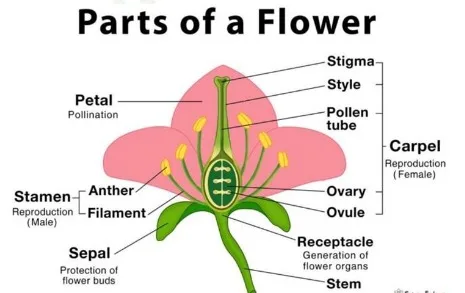 •
•• There are two types of sporophores: megasporophylls (carpel) and sporophylls (stamen). An ovary with an ovule, a style, and a stigma is called a carpel.
• Filament, anther, and connective stamens are the three different kinds. • There are three types of stamen: filament, anther, and connective.
i) Pre-fertilization
ii) Double fertilization
iii) Post-fertilization
Pre-Fertilization: Structure and Events
The following pre-fertilization events can be studied:
i) Pollen grain formation
ii) Embryo sac formation
iii) Pollination
iv) Pollen pistil interaction
Pollen Grain Formation
Male reproductive unit (Stamen)
The male reproductive unit of an angiosperm is called a stamen. It is made up of a filament and an anther. Each lobe of the bilobed anther contains four pollen sacs, called microsporangia. • Every pollen sac contains several pollen grains. The four corners of a dithecous anther house the four pollen sacs.
• Dithecous anther: An anther with two lobes joined by the connective tissue, which is not sporangious.
Four cell layers make up the other wall. • Through slits, another dehiscence releases pollen grains.
Microsporogenesis
The process by which microspores develop and differentiate is known as microsporogenesis. PMCs experience meiosis. Each forms a tetrahedral tetrad. • Cytokinesis may occur simultaneously or sequentially. • There are five different varieties of tetrads: T-shaped, linear, isobilateral, decussate, and tetrahedral. Tetrahedral shapes are the most prevalent.
Pollen Grain
There are various shapes and sizes of pollen grains.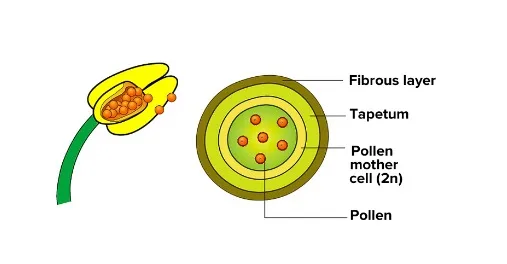 • Its diameter ranges from 25 to 30 meters, and it is usually round. • The haploid, unicellular body of the pollen particle has a single nucleus. Its outer wall is composed of two layers. • There are two layers to the wall or sporoderm. • Quite a thick layer covers the outside. We call it the exine. It has a thin inner wall known as the intine and is made of sporopollenin. It is made of cellulose and pectose.
Pollen allergy
Severe allergies are caused by pollen grains. In addition to common respiratory conditions including bronchitis and asthma, it also causes fever. Parthenium hysterophorus, or carrot grass, is a significant source of allergens. It damages the body's interior organs as well. It came to India via wheat that was imported.
Pollination
The movement of pollen grains from the anther to the stigma of the flower is known as pollination. • There are two distinct types of pollination: cross-pollination and self-pollination. • The movement of pollen grains from anthers to stigmas of the same flower or various flowers on the same plant is referred to as self-pollination. Self-pollinating flowers share genetic similarities. There are two types of self-pollination: geitonogamy and autogamy.
1. Autogamy: The transfer of pollen grains from a flower's anther to stigma. It is favored due to the following modifications:
a) Chasmogamous
• When pollination agents come into contact with the flower's mature anther and stigma. In Lilac, the stigma is situated just below the anthers.
b) The cleistogamy
• The only process available is self-pollination because the blooms stay closed. Among them are Commelina benghalensis, Lathyrus, and Pisum. • The stigma and anthers of bisexual flowers mature well before the bud opens. Therefore, in plants like wheat and peas, self-pollination takes place in the bud stage. 2. The transfer of pollen grains from one bloom's anther to the stigma of another flower belonging to the same or a genetically related plant is known as geitonogamy. The following lists the advantages of self-pollination. • It maintains the purity of the race. • The plant does not have to generate a lot of pollen grains. • It guarantees the yield of seeds. • Unwanted recessive characteristics are eliminated through self-pollination.
Cross-Pollination
• The movement of pollen grains from one plant's anther to the stigma of another plant, either of the same species or a different one, is its definition. Another name for it is allogamy. • In xenogamy, pollination takes place between two genetically and environmentally different plant blooms.
Advantages of Cross-Pollination
Genetic recombination brought about by cross-pollination results in progeny differences. • Cross-pollination increases the progeny's capacity for environmental adaptation. • The defective character of the race disappears and is replaced with a superior one.
Disadvantages of Cross-Pollination
Pollen grains need to be produced in vast quantities by plants. • It's possible that the excellent character will be spoilt. • The chance element is always present since there is an outside agency engaged.
Significance of Pollination
Fertilisation and hence the generation of seeds and fruit depend on pollination. • It encourages ovarian development. • It causes hybrid seeds to be produced. • The fruits and seeds are also nutrient-dense.
Double Fertilization
The process by which male and female gametes combine to produce the zygote is known as fertilization. • Eventually, the zygote will develop into an embryo. The pollen tube releases two male gametes into the embryo sac. One male gamete unites with the egg to generate the diploid zygote. We refer to this process as generative fertilization or syngamy. The two polar nuclei are joined by the second male gamete. As a result, a triploid main endosperm nucleus forms. Triple fusion, or vegetative fertilization, is the term used to describe this process.
Formation of Seed and Fruit
- A matured or fertilized ovary is referred to as fruit.
- The ovary wall forms the fleshy or dry fruit wall known as the pericarp.
- The three layers of fleshy fruit, or pericarp, are called epicarp, mesocarp, and endocarp.
- The ovarian wall gives rise to the fruit covering.
- • It's a fleshy or dry fruit portion that gives the seed nourishment and a protective layer.
Importance of Seeds
Success in evolution: Seed has undergone evolution. It protects the embryo. • Enough nutritional reserves are present in seeds to sustain the developing embryo. • Seeds may disperse and propagate their species, as well as colonize and inhabit new places. • Seeds have a large range of variants due to sexual reproduction, which helps them adapt to a variety of settings. • Agriculture was created by the germination and sowing of human seeds, and this led to the development of knowledge, technology, and civilization.
Check out: Class 12th Question Banks
Class 12 Biology Notes Chapter 2
This chapter explains how flowering plants reproduce, from pollen formation to seed and fruit development, in easy-to-understand steps
The Structure of a Typical Flower
A flower is the primary reproductive unit in angiosperms. To effectively use sexual reproduction in flowering plants notes class 12, you must first understand the four concentric whorls:
-
Calyx and Corolla: These are the non-essential or accessory whorls. The calyx protects the bud, while the corolla attracts pollinators through vibrant colours.
-
Androecium: This represents the male reproductive organ, consisting of stamens. Each stamen is composed of a filament and a pollen-bearing anther.
-
Gynoecium: This is the female reproductive part, comprising one or more pistils. A pistil includes the stigma (receptive surface), style (elongated tube), and ovary (basal swollen part).
Pre-fertilisation: Structures and Events
Before the actual fusion of gametes, the plant undergoes significant structural developments. These class 12th biology chapter 2 notes focus on the formation of gametophytes.
Stamen and Pollen Grain Development
The anther is generally bilobed and dithecous. Through the process of microsporogenesis, pollen mother cells undergo meiosis to produce microspore tetrads, which eventually mature into pollen grains.
-
Pollen Wall: The outer layer, the Exine, is made of sporopollenin, a highly resistant substance. The inner layer is the Intine.
-
Cellular Composition: A mature pollen grain contains a large vegetative cell (food reserve) and a smaller generative cell that produces two male gametes.
The Pistil and Megasporogenesis
The ovary contains ovules, which are the megasporangia. A single megaspore mother cell divides meiotically to form four megaspores, out of which only one becomes the functional female gametophyte or Embryo Sac.
-
7-celled, 8-nucleate structure: A mature embryo sac contains three antipodals, two synergids, one egg cell, and one central cell with two polar nuclei.
Mechanisms of Pollination
Pollination involves the transfer of pollen from the anther to the stigma. In biology class 12 chapter 2 notes, this is divided into three categories:
-
Autogamy: Self-pollination within the same flower.
-
Geitonogamy: Transfer to another flower on the same plant.
-
Xenogamy: Cross-pollination between flowers of different plants, leading to genetic variation.
Agents of Pollination
Plants depend on abiotic agents like wind and water, or biotic agents like insects and birds. Wind-pollinated flowers usually have light, non-sticky pollen, whereas insect-pollinated flowers are large, colourful, and produce nectar to reward their visitors.
Check out: Class 12th Sample Papers
Double Fertilisation: The Unique Angiosperm Event
A central theme in reproduction in flowering plants class 12 notes is double fertilisation. It involves two distinct fusions:
-
Syngamy: One male gamete fuses with the egg cell to form a diploid Zygote (2n).
-
Triple Fusion: The second male gamete fuses with two polar nuclei to form the triploid Primary Endosperm Nucleus (3n or PEN).
This dual fusion process ensures that the embryo has a dedicated food supply (the endosperm) during its development.
Post-fertilisation: From Ovule to Seed
Following fertilisation, the flower undergoes a transformation into a fruit and seed. These chapter 2 biology class 12 notes simplify the stages:
-
Endosperm Development: The PEN divides to form endosperm tissue, which nourishes the developing embryo.
-
Embryogeny: The zygote develops into an embryo. In dicots, it passes through proembryo, globular, and heart-shaped stages.
-
Seed and Fruit: The ovule hardens into a seed, while the ovary wall becomes the pericarp (fruit wall). If only the ovary forms the fruit, it is a true fruit; if parts like the thalamus are involved, it is a false fruit.
Strategies for Exam Success
To get the most out of these class 12 biology chapter 2 notes, use these active study techniques:
-
Diagram Practice: Draw the TS of a fully developed anther and the 7-celled embryo sac a lot because they are important diagram questions.
-
Ploidy Checklist: Maintain a list of tissues and their ploidy (e.g., Nucellus is 2n, Synergids are n, Endosperm is 3n).
-
Comparison Tables: Create tables for wind vs. insect pollination to quickly recall the characteristic features of each.
By following these sexual reproduction in flowering plants class 12 notes, you turn a complex biological cycle into a clear, manageable sequence of events. Consistency and visual practice are the keys to scoring well in this fundamental chapter.
Read More: NCERT Solutions for Class 12 Biology Chapter 2 Sexual Reproduction In Flowering Plants
CBSE Class 12 Biology Notes Chapter 2 FAQs
Q1: Why is sporopollenin significant in class 12 biology chapter 2 notes?
Sporopollenin is an incredibly tough organic material that protects pollen grains from harsh environmental conditions like high heat and strong acids, allowing them to survive for long periods.
Q2: What is the function of the synergids?
Synergids contain the filiform apparatus, which plays a vital role in guiding the pollen tube towards the egg cell during the process of fertilisation.
Q3: How do reproduction in flowering plants class 12 notes define "Apomixis"?
Apomixis is a special mechanism where some plants produce seeds without the process of fertilisation, effectively mimicking sexual reproduction through an asexual pathway.
Q4: What are outbreeding devices?
These are ways for plants to keep themselves from pollinating each other, like not being able to reproduce with their own pollen or releasing pollen at different times. This helps keep genetic diversity high.
Q5: What is the difference between albuminous and non-albuminous seeds?
Albuminous seeds, like wheat, keep some of the endosperm even after the embryo has grown, but non-albuminous seeds, like pea, eat all of the endosperm while they grow.