CBSE Class 12 Biology Notes Chapter 6 Molecular Basis of Inheritance
CBSE Class 12 Biology Notes Chapter 6
The CBSE Class 12 Biology exam for 2026 will be held on 27 March, from 10:30 am to 1:30 pm. Biology is an important subject in Class 12 and carries a good number of marks in the board exam. One of the main chapters of Class 12 Biology is Molecular Basis of Inheritance. This chapter explains how genetic information is stored, copied, and passed from one generation to another. It includes topics like DNA structure, replication, transcription, translation, and gene regulation. It helps students understand the basic principles of heredity and how the body controls genes.
It is advised that students first complete the Class 12 Biology textbook or read the chapter at least once to understand the topics clearly. Along with reading the book, students can start using Molecular Basis of Inheritance class 12 notes. While going through the notes, they can also make their own points or change the notes according to their understanding. These notes are made to help students understand the chapter in an easy way and make preparation faster. Using the molecular basis of inheritance notes together with the textbook makes it easier to remember important points and revise before the exam.
Check Out: CBSE Class 12 Books
CBSE Class 12 Biology Notes Chapter 6 Molecular Basis of Inheritance
Here we have provided CBSE Class 12 Biology Notes Chapter 6 Molecular Basis of Inheritance-
What is DNA?
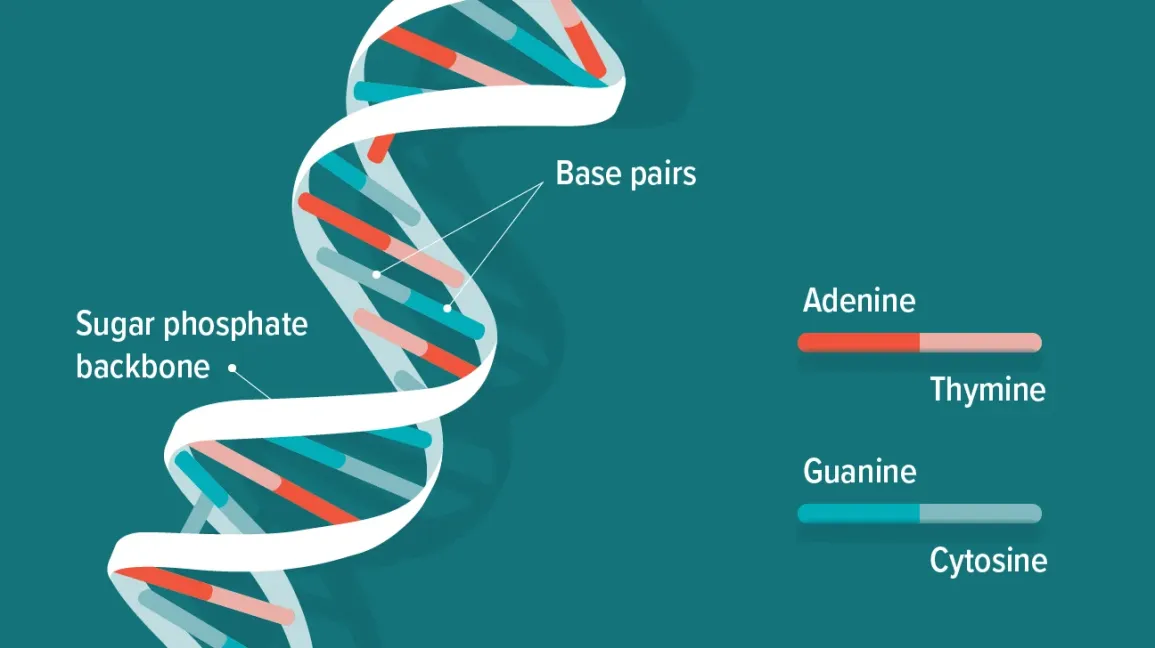 DNA, or Deoxyribonucleic Acid, is the molecule responsible for carrying genetic information in all living organisms. It is a long chain made up of deoxyribonucleotides, and its length is determined by the number of nucleotide base pairs.
DNA Structure
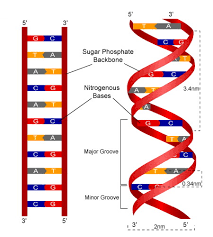
Watson and Crick were the first scientists to propose the double-helix model of DNA, using X-ray crystallography. Each strand of DNA is a polymer of nucleotides. Each nucleotide consists of three components: a deoxyribose sugar, a nitrogenous base, and a phosphate group. DNA follows the central dogma of molecular biology, where genetic information flows from DNA to RNA, and then to protein. The structure of DNA resembles a twisted ladder. The two strands are held together by weak hydrogen bonds between paired nitrogenous bases. In this pairing, a purine base (adenine or guanine) always pairs with a pyrimidine base (thymine or cytosine). Specifically, adenine (A) pairs with thymine (T), and guanine (G) pairs with cytosine (C).
Structure of Polynucleotide
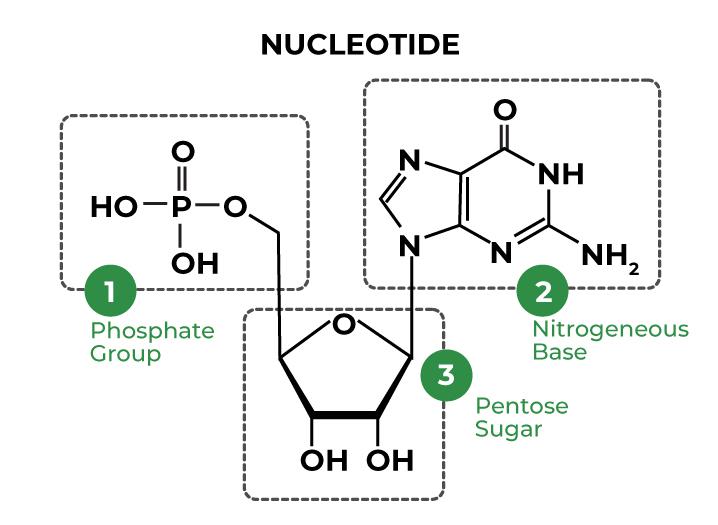
A polynucleotide is a long chain made up of repeating units called nucleotides, which are the building blocks of DNA and RNA.
Nucleotide Structure
Each nucleotide consists of three components:
Nitrogenous Base : These are classified into two types:
- Purines : Adenine (A) and Guanine (G)
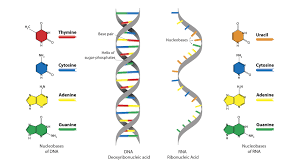
- Pyrimidines : Cytosine (C) and Thymine (T) in DNA (or Uracil (U) in RNA)
Sugar : The sugar is a pentose, which differs between DNA and RNA:
- Deoxyribose in DNA
- Ribose in RNA
Phosphate Group : The phosphate group connects the nucleotides together by linking the sugar of one nucleotide to the phosphate of the next, forming the sugar-phosphate backbone of the polynucleotide chain.
The combination of a sugar and a nitrogenous base forms a nucleoside , while a nucleoside with an added phosphate group becomes a nucleotide . These nucleotides link together to form the polynucleotide chain that makes up DNA or RNA.
Packaging DNA Helix
Inprokaryotes, DNA is organized as a large loop in the nucleoid region. Here, the negatively charged DNA is tightly held by positively charged proteins. In contrast,eukaryotic DNA is arranged in a more complex structure within chromosomes. In eukaryotes, DNA is wrapped around a core of histone proteins to form structures callednucleosomes. Anucleosomeconsists of DNA wound around a histone octamer, which is made up of 8 histone proteins. These histones are rich in basic amino acids like lysine and arginine, which give them a positive charge. There are five types of histone proteins:H1, H2A, H2B, H3, and H4, with the histone octamer containing two molecules each of H2A, H2B, H3, and H4. This packaging helps regulate gene expression. A nucleosome prevents DNA from becoming tangled and contains about200 base pairs (bp)of DNA. The further organization of chromatin (DNA and protein complex) is aided byNon-histone chromosomal (NHC) proteins.- Euchromatin : These are transcriptionally active regions of DNA where chromatin is loosely packed and appear lightly stained.
- Heterochromatin : These are transcriptionally inactive regions where chromatin is densely packed, taking up a darker stain.
RNA World
RNA is believed to have been the first genetic material, with substantial evidence suggesting that essential life processes evolved around RNA. It serves dual roles, acting both as genetic material and as a catalyst. However, RNA's highly reactive nature made it unstable as a catalyst. This instability led to the evolution of DNA from RNA, with chemical modifications that enhanced its stability.Replication
Watson and Crick proposed that DNA replication issemiconservative, meaning that each new DNA molecule consists of one original strand and one newly synthesized strand. This was experimentally confirmed by Meselson and Stahl in 1958. Taylor et al. conducted experiments using radioactive thymidine in faba beans (Vicia faba) to further demonstrate that DNA replication is indeed semiconservative. The enzyme DNA polymeraseplays a crucial role in DNA replication, catalyzing the process. It can only add nucleotides in the 5’ to 3’ direction. This results in two different replication processes:- Leading Strand : Replication is continuous along this strand, where the template strand runs in the 3’ to 5’ direction.
- Lagging Strand : Replication is discontinuous here because the template strand runs in the 5’ to 3’ direction. This strand is synthesized in short segments known as Okazaki fragments that are later joined together.
Genetic Code
The genetic code refers to the sequences of bases in messenger RNA (mRNA) that specify the order of amino acids in protein synthesis. Each code consists of three nucleotides, forming what are known ascodonsortriplets. There are a total of 64 possible codons; 61 of these codons correspond to specific amino acids, while the remaining three are known asstop codonsbecause they do not code for any amino acid. The codonAUGserves as both the start codon and codes for the amino acidmethionine, marking the beginning of protein synthesis. This code is essential for translating the genetic information from mRNA into functional proteins, which are vital for the structure and function of cells.How to Use PW Notes?
Using PW notes can make studying easier and help you focus on important points for Class 12 Biology. Here are some simple tips for using them effectively:
-
Start with the Molecular Basis of Inheritance class 12 notes to get a clear understanding of DNA, RNA, and gene regulation.
-
Use the molecular basis of inheritance notes to revise key concepts after reading your textbooks.
-
Refer to Class 12 Biology Molecular Basis of Inheritance notes for diagrams and flowcharts that simplify complex processes like replication and transcription.
-
Keep the molecular basis of inheritance short notes handy for quick revision before exams or tests.
-
Make your own small points or highlights while going through PW notes to remember important terms and processes.
-
Combine reading from textbooks with PW notes for better clarity and stronger preparation for questions in exams.
Read More: CBSE Class 12 Biology Important Questions for Board Exam
Molecular Basis of Inheritance Class 12 Notes FAQs
1. What are the Molecular Basis of Inheritance Class 12 notes?
These notes summarise the key points of the chapter on how genetic information is stored, copied, and passed on. They include diagrams, important terms, and explanations for easy revision.
2. What is the name of Chapter 6 of Class 12 Biology?
Chapter 6 of Class 12 Biology is Molecular Basis of Inheritance.
3. What topics are covered in Molecular Basis of Inheritance notes?
The notes cover DNA structure, replication, transcription, translation, gene regulation, and the fundamentals of hereditary information.
4. How can I use Molecular Basis of Inheritance Class 12 notes?
You can read them after the textbook, revise key points, practise diagrams, and keep Molecular Basis of Inheritance short notes for quick revision before exams.
5. Are diagrams included in Molecular Basis of Inheritance notes?
Yes, these notes include clear diagrams of DNA, RNA, replication, transcription, and translation, making difficult concepts easier to understand.