CBSE Class 12 Chemistry Sample Papers for 2026 Exams
CBSE Class 12 Chemistry Sample Papers
CBSE Class 12 Chemistry can feel a bit difficult because it covers three major areas: Physical, Organic, and Inorganic Chemistry. Each section has its own style of questions, formulas, reactions, and concepts that students need to remember. Many students find Organic Chemistry challenging because of reaction mechanisms, while Physical Chemistry requires careful numerical calculations. Inorganic Chemistry may seem easier to memorise, but it still needs attention for details like periodic properties and coordination compounds. One of the most practical ways to manage this huge syllabus is by practising CBSE Class 12 Chemistry sample papers.
The 2026 CBSE Class 12 board exams are scheduled to begin in February 2026, and the Chemistry exam is typically allotted three hours. Theory questions carry 70 marks while practical exams contribute 30 marks. Before going through CBSE Class 12 sample papers chemistry, students are advised to go through the CBSE Class 12 Chemistry Syllabus and other details first. However, get the link to the CBSE Class 12 Sample Papers Chemistry here.
Check Out: CBSE Class 12 Books
CBSE Class 12 Sample Papers Chemistry
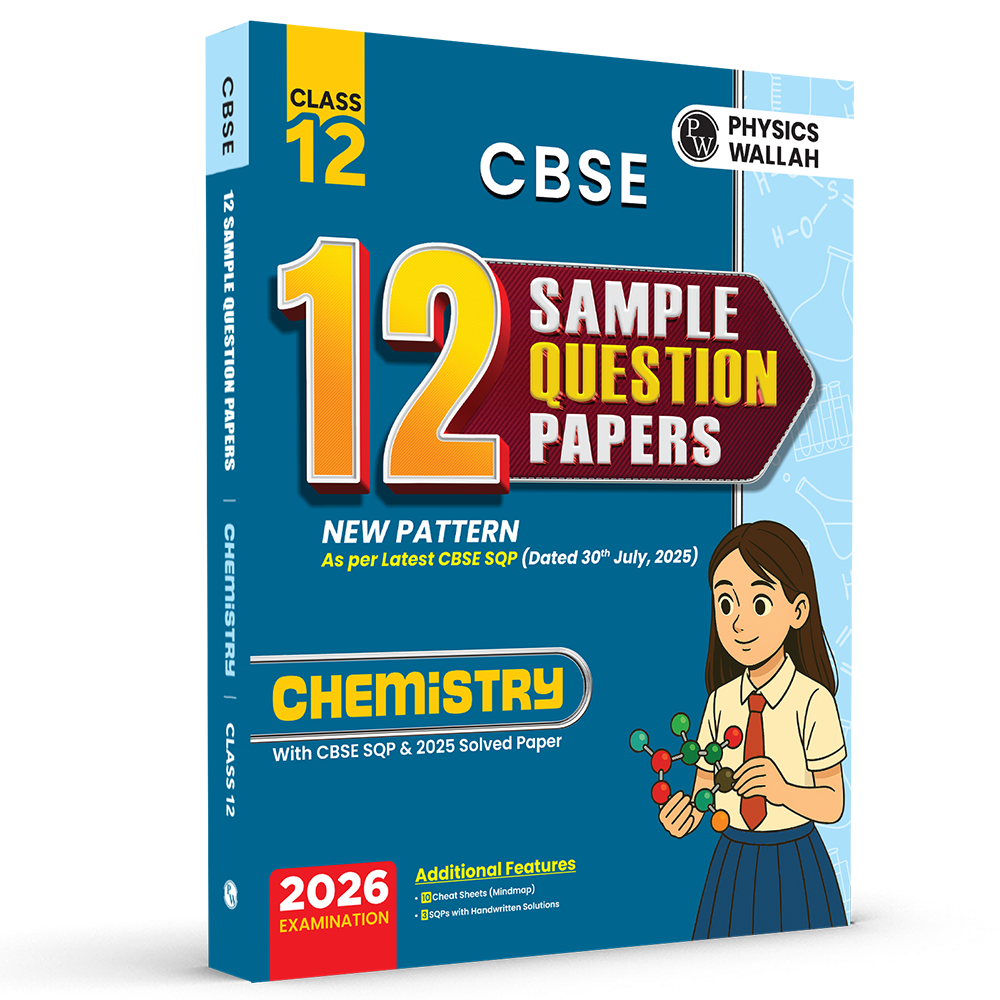
PW CBSE Class 12 Chemistry sample papers are made based on NCERT textbooks and follow the latest exam pattern. They include questions similar to what students can expect in the actual board exam. Practising these papers regularly helps students understand the distribution of marks, the structure of questions, and which chapters are most frequently tested.
-
They cover all chapters from the NCERT syllabus, including Physical Chemistry, Organic Chemistry, and Inorganic Chemistry.
-
Each paper contains a mix of short-answer questions, long-answer questions, and numerical problems.
-
Detailed solutions are provided so that students can check their answers and understand the correct method.
-
Regular practice from the CBSE 12 sample paper with solution helps in identifying weaker areas, such as Electrochemistry, Chemical Kinetics, or Organic reaction mechanisms.
CBSE Class 12 Chemistry Sample Papers
Tips to Score 90+ in CBSE Class 12 Chemistry Exam 2026
Scoring 90+ in Chemistry is possible if you plan well, practise regularly, and revise smartly. Chemistry can feel tricky because it has three parts: Physical Chemistry (numericals), Organic Chemistry (reactions and mechanisms), and Inorganic Chemistry (concepts and facts). Here’s a simple, step-by-step guide to help you:-
1. Read the Question Paper Carefully
The first thing to do in the exam is to read the paper carefully for 10–15 minutes. Don’t start writing immediately. Check which questions you can answer confidently and which might take more time. For example:
-
Physical Chemistry numericals may seem tough at first, but if you know the formulas, they will become easy.
-
Organic Chemistry reactions may be easier if you remember the steps.
-
Inorganic Chemistry questions are mostly about facts, definitions, or trends, so they can be done quickly if you have revised.
-
Practising CBSE Class 12 Chemistry sample papers helps you get familiar with which questions are usually easy and which are tough.
2. Start with Your Strong Areas
Always start with topics you are confident in. This builds confidence and secures marks early.
-
If you like Physical Chemistry numericals, solve them first. Show your calculations step by step.
-
If you are good at Organic Chemistry, answer reaction and mechanism questions next. Write the reaction clearly and then show the steps of the mechanism.
-
If Inorganic Chemistry is your strength, do those questions after your strongest areas.
3. Keep Your Answers Neat and Clear
Neat and clear writing helps you get marks even if your answer is slightly not to the mark.
-
For numericals, write step-by-step solutions. Start with the formula, then substitute the values, then give the answer with units.
-
For theory answers, underline important points. For example, in VSEPR theory, underline “electron pairs repel each other” and “determine molecular shape.”
-
Write chemical equations carefully and make sure they are balanced.
-
Plan your answers first. Avoid writing too much unnecessarily. A small, well-organised answer is better than a long, messy one.
4. Revise the NCERT Properly
NCERT is the backbone of CBSE Chemistry. Most questions in sample papers and exams come directly from the NCERT. So:
-
Revise all reactions and mechanisms in Organic Chemistry, like Aldol condensation, Cannizzaro reaction, and reactions of benzene.
-
Make a formula sheet for Physical Chemistry (like ΔG = ΔH – TΔS, rate laws, molarity, molality, etc.).
-
Learn all definitions and exceptions in Inorganic Chemistry, such as oxidation states, hybridisation, and important properties.
-
Making small notes chapter-wise will help a lot in last-minute revision.
5. Practice Regularly
Daily practice is key. Solve CBSE sample papers and previous year papers regularly. This helps in:
-
Time management: Know how long to spend on numericals and theory questions.
-
Reducing mistakes: Practising regularly reduces silly errors in calculations and reaction steps.
-
Try solving 5–6 sample papers before the exams and check where you are making mistakes.
Check Out: Class 12 Question Banks
6. Strengthen Your Problem-Solving Skills
Physical Chemistry numericals can carry a lot of marks, so practice is important. Focus on:
-
Chemical Kinetics: Rate law, order of reaction, half-life
-
Thermodynamics: ΔH, ΔS, ΔG calculations
-
Electrochemistry: Cell potential, Nernst equation
-
Solutions and Colligative Properties: Molar mass, Raoult’s law
-
Always follow formula → substitution → answer with units. This makes calculations clear and helps avoid losing marks.
7. Focus on Theory Questions
Theory questions in Organic and Inorganic Chemistry carry high marks. Here’s how to score:
-
Write answers in points wherever possible. For example, when explaining properties of s-block elements, list them one by one.
-
Always include chemical equations when needed. For example, while explaining the preparation of ethanol, write the reaction along with the reagents.
-
Keep answers short and clear, don’t add unnecessary details.
-
Using CBSE sample papers with solutions is a good way to learn how to structure your answers.
8. Make Notes and Shortcuts
Good notes will save time in revision. For example:
-
Physical Chemistry: Keep all formulas on one sheet.
-
Organic Chemistry: Keep a notebook of reactions with name, reagents, mechanism, and products.
-
Inorganic Chemistry: Make tables for elements, oxidation states, compounds, colours, and uses.
9. Revise in the Last Days
Keep 7–10 days before the exam only for revision. Tips:
-
Revise your formula sheet daily.
-
Go through Organic Chemistry reactions and mechanisms.
-
Revise tables and exceptions in Inorganic Chemistry.
-
Solve 1–2 sample papers under exam conditions to practise speed and accuracy.
10. Solve Previous Year Papers
Previous year papers are very helpful because:
They show frequently asked questions. Some reactions or numbers repeat every year.
They help you understand the marking pattern. For example, Physical Chemistry numericals 30–35 marks, Organic Chemistry 25–30 marks, Inorganic Chemistry 25–30 marks.
They prepare you for unexpected questions by improving problem-solving skills.
Read More: CBSE Sample Papers Class 12 and Marking Scheme for Exam 2025-26
CBSE Class 12 Chemistry Sample Paper FAQs
1. How can I prepare effectively for CBSE Class 12 Chemistry?
Focus on NCERT thoroughly, practise numericals daily, and solve CBSE Class 12 Chemistry Sample Papers to understand the pattern and important questions.
2. Which chapters carry more weight in the Chemistry exam?
Physical Chemistry numericals like Mole Concept, Thermodynamics, and Electrochemistry, Organic Chemistry reactions like Alcohols, Phenols, and Ethers, and Inorganic Chemistry elements and their properties are high-yield topics.
3. How many sample papers should I solve before the exam?
Solve at least 5–6 CBSE Class 12 chemistry sample papers or previous year papers to improve speed, accuracy, and confidence.
4. How can I manage time during the Chemistry exam?
Spend 10–15 minutes reading the question paper, start with strong areas, and solve numericals and theory questions stepwise.
5. Should I make short notes for revision?
Yes, short notes for formulas in Physical Chemistry, reactions in Organic Chemistry, and tables in Inorganic Chemistry make last-minute revision faster and easier.