CBSE Class 12 Human Reproduction Important Questions with Answers
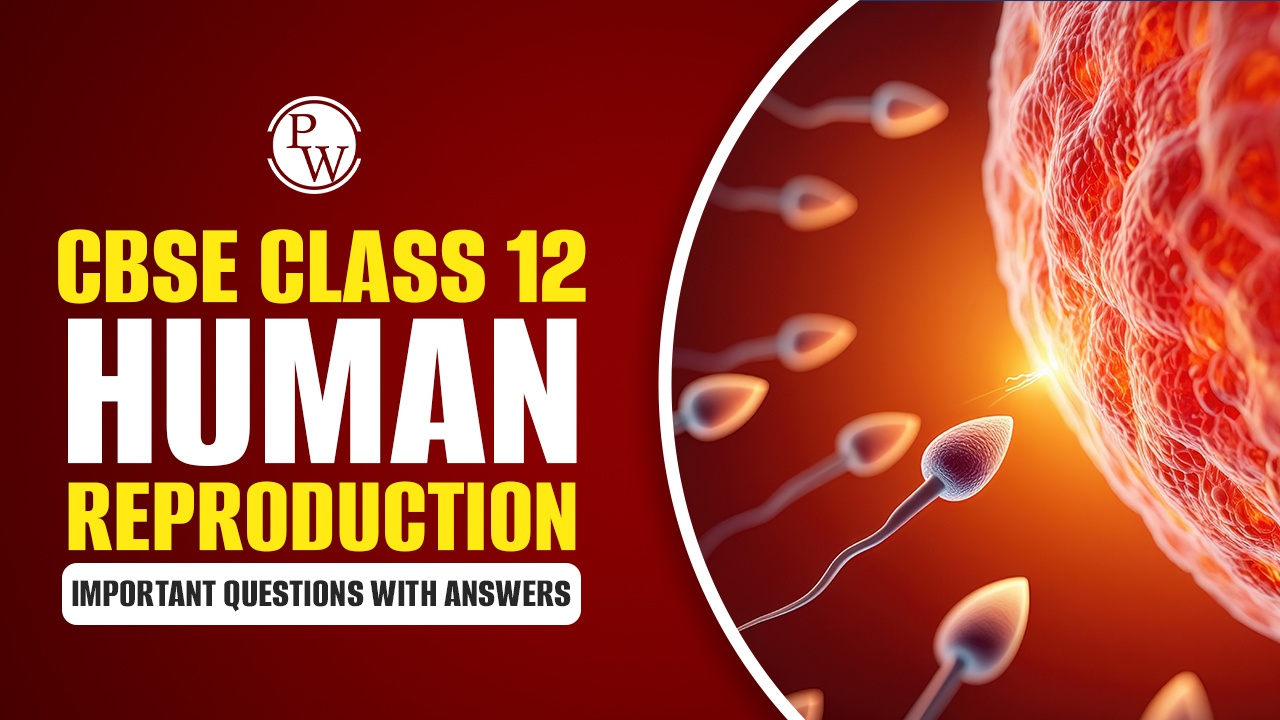
CBSE Class 12 Human Reproduction Important Questions with Answers
The CBSE Class 12 Board Exams 2026 are scheduled to start on 17 February 2026, and the Biology exam is set for 27 March 2026. Biology is an important subject for students, and one of the key chapters in Class 12 is Human Reproduction. This chapter explains the male and female reproductive systems, gametogenesis, fertilisation, pregnancy, parturition, and lactation. It also covers the structure and function of organs like testes, ovaries, fallopian tubes, uterus, and accessory glands, along with the hormonal control of reproductive processes.
After completing the chapter, it is very important to practise human reproduction class 12 questions and answers as much as possible. Regular practice helps students revise important concepts, understand the types of questions asked in exams, and improve accuracy. These also cover short-answer, long-answer, and multiple-choice questions. Solving them helps in understanding key topics, reactions, and mechanisms, and builds confidence for the 2026 board exams.
Check Out: CBSE Class 12 Books
CBSE Class 12 Human Reproduction Important Questions
1. The uterus opens into the vagina through a narrow: (Re) (CBSE, 2022 Term-I)
(a) Ampulla (b) Isthmus
(c) Cervix (d) Infundibulum
2. The immature male germ cell undergoes division to produce sperms by the process of spermatogenesis.
Choose the correct one with reference to above. (Un)
(a) Spermatogonia have 46 chromosomes and always
undergo meiotic cell division.
(b) Primary spermatocytes divide by mitotic cell division.
(c) Secondary spermatocytes have 23 chromosomes and
undergo second meiotic division.
(d) Spermatozoa are transformed into spermatids.
3. During the time of ovulation in a female, which combination of hormones is observed at their maximum plasma concentrations? (Un)
(a) Highest concentrations of estrogen and progesterone
(b) Highest concentrations of LH and progesterone
(c) Highest concentrations of LH and FSH
(d) Highest concentrations of FSH and progesterone
4. Which of these cells of the human male reproductive system is haploid? (Un) (CBSE CFPQ, 2023)
(a) Spermatid (b) Sertoli cells
(c) Leydig cells (d) Spermatogonium
5. Spot the odd one out from the following structures with reference to the male reproductive system:(Un) (NCERT Exemplar)
(a) Rete testis (b) Epididymis
(c) Vasa efferentia (d) Isthmus
6. Seminal plasma, the fluid part of semen, is contributed by. (Re) (NCERT Exemplar)
i. Seminal vesicle ii. Prostate gland
iii. Urethra iv. Bulbourethral gland
(a) i and ii (b) i, ii and iv
(c) ii, iii and iv (d) i and iv
For more CBSE Class 12 Human Reproduction Important Questions with Answers, click Human Reproduction Class 12 Important Questions
Summary of Human Reproduction
Check out the quick summary of human reproduction:-
-
Testes are the male reproductive organs located in the scrotum. They produce sperm and the hormone testosterone. Inside the testes, seminiferous tubules are highly coiled structures where sperm is formed.
-
The epididymis is a long, coiled tube on the posterior surface of each testis where sperm mature and are stored before ejaculation.
-
Vas deferens is the duct that carries sperm from the epididymis, ascends to the abdomen, loops over the urinary bladder, and joins the seminal vesicle duct to form the ejaculatory duct.
-
Gametogenesis is the process of forming gametes. In males, spermatogonia divide and develop into sperm cells. Male sex hormones called androgens regulate reproductive functions and secondary sexual characteristics.
-
Seminal plasma, secreted by the seminal vesicles, prostate, and bulbourethral glands, is rich in fructose, calcium, and enzymes that nourish and support sperm.
-
Ovaries are the female reproductive organs located in the lower abdomen. They produce the female gamete (ovum) and hormones such as estrogen and progesterone.
-
Fallopian tubes extend from each ovary to the uterus. The infundibulum is the funnel-shaped end near the ovary, the ampulla is the widest part where fertilisation occurs, and the isthmus connects the ampulla to the uterine cavity.
-
The cervix is the narrow lower part of the uterus that opens into the vagina. The cervical canal forms a passage within the cervix that allows sperm to enter and menstrual blood to exit.
-
Fertilisation occurs when a sperm fuses with an ovum in the ampulla of the fallopian tube, forming a zygote that divides into a blastocyst and implants in the uterine wall.
Check Out: Class 12 Sample Papers
How to Prepare for Human Reproduction?
1. Check the Class 12 Biology Exam Pattern
Before starting, students should check the CBSE Class 12 exam pattern for Biology. Understand the types of questions like short-answer, long-answer, and multiple-choice questions.
-
Go through previous year papers to see which sections carry more weight.
-
Note the marks distribution for each chapter.
-
Familiarise yourself with class 12 biology chapter 3 questions and answers for better preparation.
2. Focus on the Male Reproductive System
Understand the structure and function of testes, seminiferous tubules, epididymis, vas deferens, urethral meatus, and seminal plasma.
-
Learn the process of gametogenesis and the role of spermatogonia.
-
Study how androgens regulate male reproductive functions.
-
Practice human reproduction class 12 important questions related to male anatomy.
3. Focus on the Female Reproductive System
Study the ovaries, fallopian tubes (infundibulum, ampulla, isthmus), uterus, cervix, and cervical canal.
-
Understand ovulation, fertilisation, and implantation.
-
Learn about hormonal regulation by FSH, LH, estrogen, and progesterone.
-
Solve human reproduction class 12 questions and answers for female reproductive anatomy.
4. Understand Fertilisation and Pregnancy
Know the journey of sperm to the ovum, fertilisation in the ampulla, and zygote formation.
-
Learn about cleavage, blastocyst formation, and implantation in the uterus.
-
Study the stages of embryonic and fetal development.
-
Refer to human reproduction class 12 important questions pdf for related questions.
5. Study Parturition and Lactation
Understand how childbirth occurs through uterine contractions and the role of hormones like oxytocin.
-
Learn about lactation and milk production by mammary glands.
-
Study the hormonal control of parturition and lactation.
-
Solve related questions from class 12 biology chapter 3 questions and answers.
6. Focus on Important Terms and Diagrams
Draw clear diagrams of male and female reproductive systems, fertilization, and embryonic development.
-
Label all structures properly.
-
Make short notes for hormones and their functions.
-
Practise human reproduction class 12 important questions involving diagrams.
Read More: CBSE Topper Answer Sheet for Class 12 PDF Download
CBSE Class 12 Human Reproduction Question FAQs
1. What is human reproduction?
Human reproduction is a sexual process in which a sperm cell from the male fuses with an ovum from the female to form a zygote.
2. What are the main male reproductive organs?
The main male organs are testes, epididymis, vas deferens, urethra, and accessory glands that produce semen.
3. What are the important female reproductive organs?
The female reproductive system includes ovaries, fallopian tubes (infundibulum, ampulla, isthmus), uterus, cervix, and vagina.
4. What is gametogenesis?
Gametogenesis is the process of forming gametes – sperm in males and ovum in females.
5. Where does fertilization occur in humans?
Fertilization usually occurs in the ampulla of the fallopian tube when sperm meets the ovum.