CBSE Class 12 Maths Important 5 Mark Questions with Answers
The final stretch of board exam preparation often brings a mix of focus and anxiety, especially when dealing with a subject as vast as Mathematics. For students aiming to secure a high percentage, the long-answer section—specifically the 5-mark questions—is where the battle is won or lost. Mastering cbse class 12 maths questions in this category requires more than just knowing the formulas; it demands a strategic understanding of the weightage and the specific types of problems that examiners prefer. As you look toward the cbse class 12 maths question paper 2025, analyzing the patterns found in the cbse class 12 maths question paper 2025 becomes a vital part of your study routine. These high-value questions usually come from Section D of the paper, and they are designed to test your conceptual depth and your ability to execute long, multi-step solutions without errors.
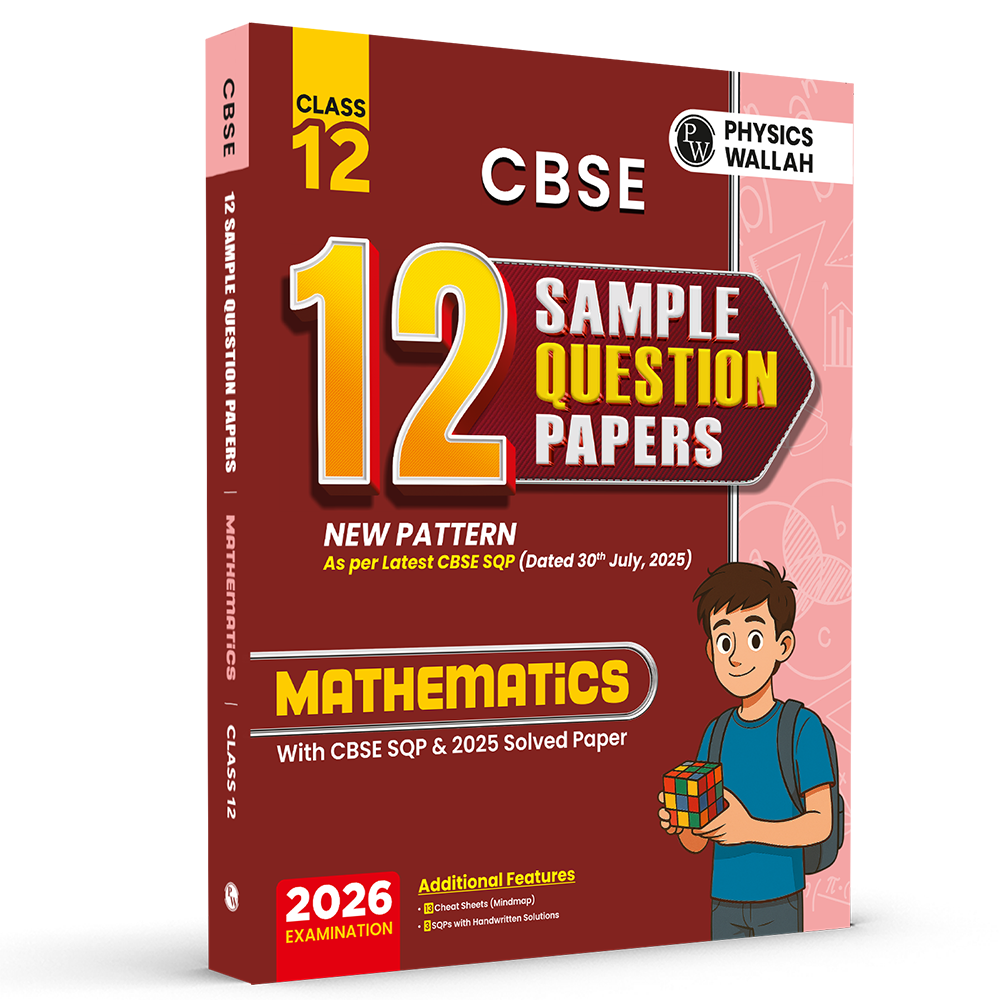
Check Out: CBSE Class 12th Books
Analyzing the CBSE Class 12 Maths Question Paper 2025 with Solutions
Reflecting on the cbse class 12 maths question paper 2025 with solutions reveals a clear trend: the board is moving away from rote memorization and toward application-based testing. In the 2026 exam, the 5-mark questions were heavily concentrated in specific units like Calculus, Vectors, and 3D Geometry. By studying the cbse class 12 maths question paper, students can see that the examiners often pair a direct theoretical application with a complex numerical calculation.
For the upcoming cbse class 12 maths question paper 2025, you should expect Section D to contain five questions of 5 marks each. These are the "make or break" questions. A common mistake students make is focusing solely on the final answer. However, the marking scheme for the cbse class 12 maths questions is strictly step-based. Even if your final result is slightly off due to a calculation error, you can still secure 3.5 or 4 marks if your logic and intermediate steps are clearly presented. Reviewing the cbse class 12 maths question paper 2025 shows that topics like the Matrix Method for solving linear equations and the Shortest Distance between two lines are perennial favorites for the 5-mark slot.
High-Weightage Chapters for CBSE Class 12 Maths Questions
To score well, you must prioritize chapters that traditionally yield 5-mark questions. Based on the syllabus structure and previous trends, the following areas are essential:
-
Calculus (Integrals and Applications): This is the heaviest unit. Questions on the properties of definite integrals or finding the area bounded by curves (Applications of Integration) are standard 5-mark fare. You are often asked to find the area between a circle and a line or two parabolas.
-
Algebra (Matrices and Determinants): The "Matrix Method" is probably the most common 5-mark question. You have to find the inverse of a 3x3 matrix and use it to solve three linear equations.
-
Vectors and 3D Geometry: Questions on calculating the shortest distance between two skew lines or the equation of a plane that goes through certain points are common in the 3D Geometry course.
-
Linear Programming (LPP): This question gets 4 marks some years, but most years it gets 5 marks. This is all about optimising the objective function in constrained and unbounded locations.
-
Relations and Functions: Advanced questions on equivalence relations or proving a function is bijective (one-to-one and onto) are common in the long-answer section.
Check out: Class 12th Sample Papers
The "Structural Hierarchy" Insight: How to Approach Section D
Here is a unique framing of the 5-mark questions that you won't typically find in standard guides: The Structural Hierarchy Method. Think of a 5-mark question not as one big problem, but as a three-tier hierarchy: The Setup, The Execution, and The Conclusion. * The Setup (1 Mark): This is where you define your variables, state the theorem you are using, and draw a diagram (especially in 3D Geometry and LPP).
-
The Execution (3 Marks): This is the algebraic "heavy lifting." For an integration problem, this is the substitution and simplification.
-
The Conclusion (1 Mark): This is the final simplification and the inclusion of units (like "sq. units" for area).
In many online resources, the emphasis is just on "solving the sum." However, the unique insight here is that examiners often look for the "Logical Bridge"—a sentence or two explaining why you moved from step A to step B. For instance, in a Matrix Method question, explicitly stating "Since $|A| \neq 0$, the system is consistent and has a unique solution" acts as that bridge. This ensures that even if you make a calculation error in the "Execution" tier, your "Setup" and "Logical Bridge" marks remain untouched.
Learning Section D in the CBSE Class 12 Maths Question Paper
To truly master the cbse class 12 maths question paper, you need to practice the art of presentation. In Section D, your handwriting and the neatness of your work matter. Use a ruler for margins and diagrams. When solving questions from the cbse class 12 maths question paper 2025 with solutions, notice how the steps are indented.
For the cbse class 12 maths question paper 2025, keep an eye on "Case-Study" style questions as well, though these usually fall into the 4-mark category (Section E). For the 5-mark questions, focus on the NCERT Miscellaneous Exercises. These exercises are often the source material for the most challenging questions in the cbse class 12 maths questions bank. If you can solve the miscellaneous problems in Calculus and 3D Geometry, you are well-prepared for anything the board throws at you.
Read More: CBSE Class 12 Maths Important Questions
PW Study Material for CBSE Class 12 Maths
-
Physics Wallah (PW) has a full set of resources to help you be ready and make sure you cover all the important elements listed above. The PW CBSE Class 12 Maths Study Material is made to help you with the problems in Section D.
-
By chapter Detailed Notes: We break down complicated theorems into easy-to-follow steps in our notes. This makes sure you know what to do in the "Setup" and "Execution" portions of every 5-mark question.
-
Bank of Previous Year Questions (PYQ): You can get the cbse class 12 maths question paper 2025 with answers and previous years' papers. The papers are sorted by marks, so you can practise 5-mark questions on their own.
-
Sample Papers for 2025: The PW expert faculty has made sample papers that are similar in difficulty to the cbse class 12 maths question paper 2025. Here is how to mark them step by step: Our answers not only tell you the answer, but they also show you exactly where the points are given, so you don't lose points for small mistakes.
-
Help from Expert Faculty: Learn the "Logical Bridge" techniques from India's best teachers, which will help you understand even the hardest Calculus problems.
Check Out: Class 12 Question Banks
FAQs on CBSE Class 12 Maths Questions
-
What chapters are most likely to include 5-mark questions on the 2025 test?
The most likely chapters are Matrices (Matrix Method), Applications of Integrals (Area), 3D Geometry (Shortest Distance), and Linear Programming. This is based on the syllabus and past examinations like the cbse class 12 mathematics question paper 2025. -
If the final answer is inaccurate, does the CBSE board offer points for steps?
Yes, the board has a specific policy for marking steps. You can get points for the right formula, the right substitution, and the right intermediate logical stages on cbse class 12 maths questions, even if the final answer is wrong. -
How can I plan my time for the 5-mark questions in Section D?
Most people say that you should spend roughly 10 to 12 minutes on each 5-mark question. You can get faster by practicing with a cbse class 12 mathematics question paper under time pressure. -
Are NCERT examples good enough to answer questions worth 5 marks?
NCERT is the base, but 5-mark problems often need the depth that can be found in NCERT Miscellaneous Exercises. If you use PW study material with NCERT, you'll be ready for the more difficult uses of those ideas. -
How can I be ready for the 5-mark questions in 3D Geometry?
Pay attention to the distance between two lines (skew and parallel) and where lines and planes cross. Always make a rough sketch to show the scenario. This helps you see the vectors involved and is often needed to get full credit.