CBSE Class 12 Physics Notes Chapter 1 Electric Charges and Fields

Class 12 Physics chapter 1 notes explain the basic rules of static electricity. This chapter is all about how tiny things called "charges" push or pull each other without even touching. You will learn about how lightning happens, why your hair stands up with a balloon, and how to measure the invisible power fields around us.
Check Out: CBSE Class 12 Books
CBSE Class 12 Physics Notes Chapter 1 Electric Charges and Fields
Here are the notes for CBSE Class 12 Physics Chapter 1 Electric Charges and Fields. This chapter explains the basics of electric charges and the electric fields they create. It includes key concepts like Coulomb's Law, which describes the force between two charged objects, and the superposition principle, which helps calculate the total electric field from multiple charges. You'll also learn about electric field lines, their properties and electric flux. These concepts are essential for understanding how electric forces work. You can find the full notes through the link provided for more details.
Electric Charge
The term 'electricity' comes from the Greek word "Elektron," which means amber. This is because the ancient Greeks discovered that rubbing amber would generate static electricity. In physics, electric charge is a fundamental property of matter, influencing how atoms and molecules interact. There are two types of electric charge: positive and negative. The fundamental rule of electric charges is that like charges repel each other, while unlike charges attract. This property is known as the polarity of charge and is key to understanding many electrical phenomena.
Conductors and Insulators
In experiments with electric charges, it was discovered that conductors and insulators behave very differently. Conductors, such as metals, the Earth, and the human body, allow electric charges to move freely through them. This means that they can easily carry electricity. On the other hand, insulators, like porcelain, nylon, and wood, resist the flow of electric charges. They do not conduct electricity well, making them useful for preventing unwanted electrical flow and protecting us from electric shocks. Read More - Strategy to Solve Class 12 Sample Papers Efficiently
Properties of Electric Charge
Electric charge has three key properties: Quantization : This property indicates that the total charge on a body is an integer multiple of a basic unit of charge. This means that electric charge comes in discrete amounts rather than continuous values. Additivity : The total charge in a system is the algebraic sum of all individual charges present. This means that if multiple charges act on a system, their effects add together to give the overall charge. Conservation : This principle states that the total charge in an isolated system remains constant over time. Charges cannot be created or destroyed, only transferred from one object to another. This ensures that the total charge of a system is always conserved.
Coulomb's Law
Coulomb's law describes the electrostatic force between two point charges. If two stationary point charges Q1 and Q2 are placed a distance r apart, the magnitude of the electrostatic force F between them is given by: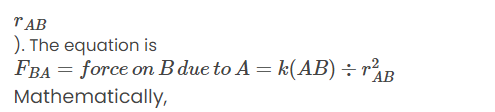 Key Points: Direction of Force : The force acts along the line joining the two charges. Nature of Force :
- Repulsive : If the charges are of the same sign (both positive or both negative).
- Attractive : If the charges are of opposite signs (one positive and one negative).
Conservative Nature : The electrostatic force is conservative, meaning that the work done in moving a charge between two points is independent of the path taken. Inverse Square Law : The force follows the inverse square law, meaning the force decreases with the square of the distance between the charges.
Forces Between Multiple Charges
When dealing with multiple charges, Coulomb's law applies to the interaction between any two charges. However, calculating the net force on a specific charge in the presence of several other charges requires a different approach. The net force on a charge due to multiple other charges is determined by taking the vector sum of all the individual forces exerted on that charge by each of the other charges, considered one at a time. This principle is known as the superposition principle .
Superposition Principle
The superposition principle states that the interaction between any two charges is not influenced by the presence of other charges. In simpler terms if you have multiple charges in a system the force between any two specific charges remains the same, regardless of other charges in the vicinity.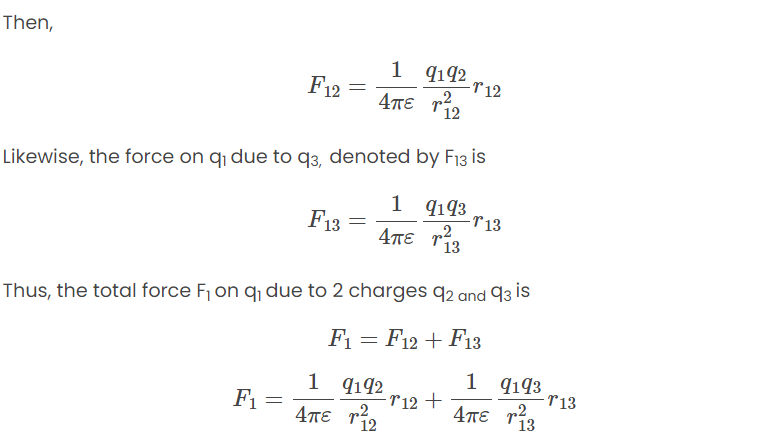
Properties of Electric Field Lines
Electric field lines have several key properties that help visualize the behavior of electric fields: Continuous Curves : Electric field lines form continuous curves without any breaks in regions where there are no charges. This continuity shows the direction of the field at every point in space. No Intersection : Two electric field lines never cross each other. If they did, it would imply that the electric field has two different directions at the same point, which is impossible. Starting and Ending Points : Electric field lines originate from positive charges and terminate on negative charges. This indicates the direction of the force that a positive test charge would experience in the field. No Closed Loops : Electrostatic field lines never form closed loops. They always start on a positive charge and end on a negative charge, or they extend to infinity if no negative charge is present. This distinguishes electric fields from magnetic fields, where lines can form closed loops.
Electric Flux
Electric flux refers to the total number of electric field lines passing through a given area. It doesn't involve a physical flow like liquids but is a measure of how strong the electric field is over that area. The electric flux Δθ through a small area element ΔS is given by:
Δθ= E.ΔS= E ΔS cosθ
Here:
- E is the electric field strength,
- ΔS is the area element,
- θ is the angle between the electric field E and the normal (perpendicular) to the area element ΔS
Electric Dipole
An electric dipole is a system of two equal and opposite charges, typically denoted as +q and −q separated by a certain distance. The dipole moment is calculated as the product of the magnitude of one of the charges and the distance separating them, mathematically expressed as:
p = q × 2 a
Here, 2a represents the distance between the charges, and the direction of the dipole moment vector is from the negative charge to the positive charge. The concept of an electric dipole is important in understanding how molecules and other systems interact with electric fields.
Charge on a Capacitor
The net charge on a capacitor is always zero because the charges on its two plates are equal in magnitude but opposite in sign. However, when we talk about the charge Q on a capacitor, we refer to the magnitude of the charge on one of the plates.
Properties of an Ideal Battery
An ideal battery is a theoretical model that simplifies the behavior of real batteries by assuming certain ideal characteristics. The properties of an ideal battery include: Two Terminals :
- A battery has two terminals: one positive and one negative.
Constant Potential Difference :
- The potential difference V between the terminals of the battery remains constant regardless of the load connected to it.
- The terminal with the higher potential is the positive terminal, and the terminal with the lower potential is the negative terminal.
Electromotive Force (emf) :
- The fixed potential difference between the terminals of the battery is referred to as the electromotive force (emf) of the battery.
- When a conductor is connected to a terminal of the battery, the potential of the conductor matches the potential of the terminal.
- If the plates of a capacitor are connected to the terminals of the battery, the potential difference across the capacitor becomes equal to the emf of the battery.
Charge Conservation :
- The total charge within the battery remains zero. If the positive terminal of the battery supplies a charge Q the negative terminal will supply an equal and opposite charge −Q.
Work Done by the Battery :
- When a charge Q moves from the negative terminal to the positive terminal through the battery, the battery does work QE , where E is the emf of the battery.
Symbol Representation :
- An ideal battery is often represented by a symbol with two parallel lines of unequal length. The longer line represents the positive terminal, and the shorter line represents the negative terminal.
- The potential difference between these lines is equal to the emf of the battery.
Check Out: Class 12th Sample Papers
Basics of Class 12 Physics Chapter 1 Notes
Everything around us is made of tiny bits. Some of these bits have a special power called "electric charge." In these Class 12 Physics chapter 1 notes, we look at how these charges behave when they are just sitting still. This is called "Static Electricity."
-
Two Types of Charges: There are positive (+) and negative (-) charges.
-
Like and Unlike: Similar charges (like + and +) push each other away. Different charges (like + and -) pull toward each other.
-
Charging by Friction: When you rub two things together, like a comb and your hair, charges move from one to the other.
-
Unit of Charge: We measure how much charge there is using a unit called the Coulomb (C).
|
Action |
Result |
|
Positive + Positive |
Push away |
|
Negative + Negative |
Push away |
|
Positive + Negative |
Pull together |
Check Out: Class 12th Question Banks
Using Class 12 Physics Chapter 1 Notes Handwritten
Many students find that Class 12 Physics chapter 1 notes handwritten are better for learning because they show the drawings clearly. This part of the chapter introduces "Coulomb’s Law," which is just a math rule to show how strong the pull or push is between two charges.
Coulomb’s Law
Imagine two small balls with charges. If they are close, they pull hard. If they are far, the pull gets weak very fast. The math rule is:
F = k \frac{q_1 q_2}{r^2}
-
F : The force (push or pull).
-
q_1, q_2 : The two charges.
-
r : The distance between them.
-
k : A special number that stays the same.
The Power of the Electric Field
Even if charges don't touch, they feel each other. This is because every charge has an "Electric Field" around it. It is like an invisible circle of influence. If another charge enters this circle, it gets pushed or pulled. You can find diagrams of these invisible lines in the Class 12 Physics Chapter 1 notes pdf.
Electric Dipoles and Flux in Hindi
If you are looking for Class 12 Physics Chapter 1 notes in Hindi, you will learn about the "Electric Dipole." This is just a pair of two opposite charges (+ and -) kept very close together. They are like a tiny team.
-
Dipole Moment: This tells us how strong this "team" is.
-
Electric Flux: This is a way to count how many invisible field lines are passing through a window or a hoop.
-
Gauss's Law: This is a very famous rule. it says that the total flux coming out of a closed box depends only on the charge trapped inside the box.
Using Class 12 Physics chapter 1 notes in Hindi UP Board PDF can help you understand these rules in your own language, making it much easier to remember the big words like "Vidyut Kshetra" (Electric Field).
Important Rules for Class 12 Physics Chapter 1 Notes PDF
When you get a Class 12 Physics Chapter 1 notes pdf, you should focus on the "Properties of Charge." These are the three golden rules that every student must know to pass their tests.
-
Additivity: You can add charges like normal numbers. +2 and -1 makes +1 .
-
Conservation: You cannot create or destroy a charge. You can only move it from one object to another.
-
Quantization: Charges only come in set sizes. You can have 1, 2, or 3 tiny units, but never 1.5. It is like buying eggs; you buy the whole egg, not half.
Why Do We Study This?
This chapter is the start of everything. Without understanding these charges, we wouldn't understand how batteries, phones, or even our own hearts work! The Class 12 Physics Chapter 1 notes make sure you have a strong base for the rest of the year.
Tips to Use Class 12 Physics Chapter 1 Notes
Whether you use Class 12Pphysics chapter 1 notes in Hindi or English, the best way to study is through practice. Here is a simple plan to help you do well.
-
Draw the Lines: Practice drawing the electric field lines. They always start at the plus (+) and end at the minus (-).
-
Learn the Constants: Remember the value of k in Coulomb's Law. It is a big number: 9 \times 10^9 .
-
Focus on Gauss's Law: This is the most popular topic for exam questions. Learn how to use it for a long wire or a flat sheet.
-
Keep your Notes Handy: Keep your Class 12 Physics Chapter 1 notes pdf open while you solve the NCERT questions at the end of the book.
By learning these bits, you will understand how the smallest things in the world create the biggest powers!
Also Check: CBSE Class 12 Last 3 Years Previous Year Paper
Class 12 Physics Notes Chapter 1 FAQs
1. What is the smallest charge?
The smallest charge is the charge of one electron. It is about 1.6 \times 10^{-19} Coulombs.
2. Can I get Class 12 Physics Chapter 1 notes in Hindi UP Board PDF?
Yes, these are widely available to help students study in their preferred language according to the UP Board style.
3. What is an Electric Dipole?
An electric dipole is a set of two equal and opposite charges separated by a very small distance.
4. What does Gauss's Law help us find?
It helps us find the electric field around different shapes, like a long charged wire or a big flat plate, very easily.
5. Why are charges pushing each other?
It is just a natural rule of physics. Just like the same ends of two magnets push away, the same types of electric charges do the same.