CBSE Class 12 Physics Sample Papers for 2026 Exams

CBSE Class 12 Physics sample papers are very helpful study materials for students preparing for the upcoming 2026 board exams. These papers are made as per the latest CBSE exam pattern and syllabus. Solving CBSE class 12 sample papers gives students a clear idea of the types of questions asked, the marking scheme, and the level of difficulty they can expect in the real exam.
Physics is one of the most important subjects for class 12th science students. It helps in building a strong base for higher studies in engineering, research, and other science fields. Physics in class 12th includes both theory and practical concepts. As per the expected CBSE board exam schedule, Class 12 exams will start around February 15, 2026, so students must start revising early.
Practising CBSE class 12 physics sample papers on a regular basis helps improve time management, speed, and accuracy. It also allows students to find their weak areas and strengthen them before the final exam. By solving the CBSE 12 physics sample paper with solutions, they can understand how to write ideal answers in the board exam.
Check out: CBSE Class 12 Books
CBSE Class 12 Physics Syllabus
CBSE Class 12 Physics syllabus includes around 14 chapters that cover both theory and practical concepts. Topics like electricity, magnetism, optics, and modern physics from the syllabus need a deep understanding of the basics. Since physics involves formulas, numericals, and derivations, many students find it a bit tough at first.
That’s why solving the CBSE board class 12 physics sample paper becomes very important. Sample papers are prepared according to the latest syllabus, which helps students revise all chapters in a proper way. Let's now go through the detailed physics syllabus first:
|
CBSE Class 12 Physics Syllabus |
||
|
Unit |
Chapter |
Important Topics Covered |
|
Unit I: Electrostatics |
Chapter 1: Electric Charges and Fields |
Electric charges, conservation of charge, Coulomb's law, superposition principle, electric field and field lines, dipole, torque on dipole, Gauss’s theorem and applications. |
|
Chapter 2: Electrostatic Potential and Capacitance |
Electric potential, potential difference, potential due to point charge and dipole, equipotential surfaces, conductors and insulators, dielectrics, capacitors, combination of capacitors, energy stored in a capacitor. |
|
|
Unit II: Current Electricity |
Chapter 3: Current Electricity |
Electric current, drift velocity, Ohm’s law, electrical energy and power, resistivity and conductivity, temperature effect on resistance, EMF of cell, Kirchhoff’s rules, Wheatstone bridge. |
|
Unit III: Magnetic Effects of Current and Magnetism |
Chapter 4: Moving Charges and Magnetism |
Magnetic field, Biot–Savart law, Ampere’s law, solenoid, force on moving charge, force on conductor, torque on current loop, moving coil galvanometer. |
|
Chapter 5: Magnetism and Matter |
Bar magnet, magnetic dipole, torque on magnetic dipole, magnetic field lines, magnetic properties of materials (para-, dia-, ferro-), magnetisation, temperature effect on magnetism. |
|
|
Unit IV: Electromagnetic Induction and Alternating Currents |
Chapter 6: Electromagnetic Induction |
Faraday’s laws, induced EMF and current, Lenz’s law, self and mutual induction. |
|
Chapter 7: Alternating Current |
AC current and voltage, RMS and peak values, reactance, impedance, LCR circuit, resonance, power and power factor, AC generator, transformer. |
|
|
Unit V: Electromagnetic Waves |
Chapter 8: Electromagnetic Waves |
Displacement current, nature and characteristics of EM waves, EM spectrum and uses (radio, microwaves, infrared, visible, UV, X-rays, gamma rays). |
|
Unit VI: Optics |
Chapter 9: Ray Optics and Optical Instruments |
Reflection and refraction, mirror and lens formula, total internal reflection, prism, optical instruments (microscope, telescope) and magnification. |
|
Chapter 10: Wave Optics |
Wavefront, Huygen’s principle, interference (Young’s double slit), diffraction by a single slit, fringe width, coherent sources. |
|
|
Unit VII: Dual Nature of Radiation and Matter |
Chapter 11: Dual Nature of Radiation and Matter |
Photoelectric effect, Einstein’s equation, particle nature of light, de Broglie relation, matter waves. |
|
Unit VIII: Atoms and Nuclei |
Chapter 12: Atoms |
Rutherford’s model, Bohr’s model, orbit radius and energy, and the hydrogen spectrum. |
|
Chapter 13: Nuclei |
Nucleus composition, nuclear force, mass defect, binding energy, nuclear fission and fusion. |
|
|
Unit IX: Electronic Devices |
Chapter 14: Semiconductor Electronics |
Energy bands, intrinsic and extrinsic semiconductors, p-n junction diode, I-V characteristics, diode as rectifier, basic circuits. |
Read More: CBSE Class 12 Physics Chapter-Wise PYQs
CBSE Physics Class 12 Chapter-Wise Weightage 2026
Before solving the CBSE board class 12 physics sample paper, it is very important to understand the chapter-wise weightage for the upcoming board exams. This helps students focus on the most scoring topics and manage their time better while preparing.
So, before you start solving CBSE sample papers for class 12, check the weightage to know which chapters need more revision and which ones carry higher marks in the final paper here:
|
CBSE Physics Class 12 Chapter-Wise Weightage 2026 |
|
|
Unit & Chapter |
Marks |
|
Unit I: Electrostatics |
|
|
Electric Charges and Fields |
5 |
|
Electrostatic Potential and Capacitance |
5 |
|
Unit II: Current Electricity |
|
|
Current Electricity |
6 |
|
Total for Units I & II |
16 Marks |
|
Unit III: Magnetic Effects of Current and Magnetism |
|
|
Moving Charges and Magnetism |
6 |
|
Magnetism and Matter |
5 |
|
Unit IV: Electromagnetic Induction and Alternating Current |
|
|
Electromagnetic Induction |
4 |
|
Alternating Current |
2 |
|
Total for Units III & IV |
17 Marks |
|
Unit V: Electromagnetic Waves |
|
|
Electromagnetic Waves |
4 |
|
Unit VI: Optics |
|
|
Ray Optics and Optical Instruments |
10 |
|
Wave Optics |
4 |
|
Total for Units V & VI |
18 Marks |
|
Unit VII: Dual Nature of Radiation and Matter |
|
|
Dual Nature of Radiation and Matter |
4 |
|
Unit VIII: Atoms and Nuclei |
|
|
Atoms |
4 |
|
Nuclei |
4 |
|
Total for Units VII & VIII |
12 Marks |
|
Unit IX: Electronic Devices |
|
|
Semiconductor Electronics: Materials, Devices and Circuits |
7 |
|
Total for Unit IX |
7 Marks |
CBSE Class 12 Physics New Pattern Sample Papers by PW
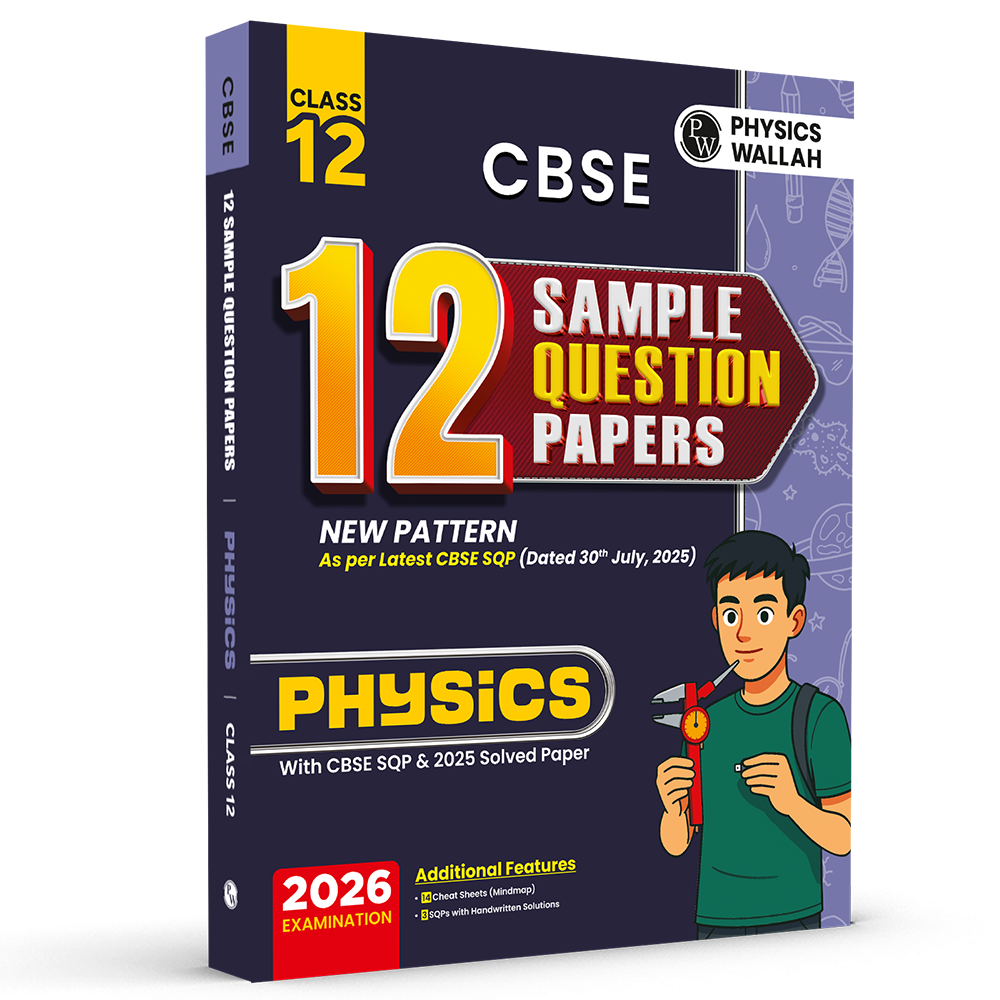
CBSE Class 12 physics new pattern sample papers by PW are made to help students prepare in the smartest and most effective way for their upcoming 2026 board exams. These CBSE 12 Physics sample papers with solution sets follow the latest CBSE guidelines and exam pattern, so students can practise exactly what they’ll face in the real exam.
These class 12 physics sample papers are not just for practice; they are complete study resources that cover important physics topics, question trends, and stepwise marking systems. Get the direct link to access CBSE Class 12 Physics New Pattern Sample Papers by PW below:
|
CBSE Class 12 Physics New Pattern Sample Papers by PW |
|
|
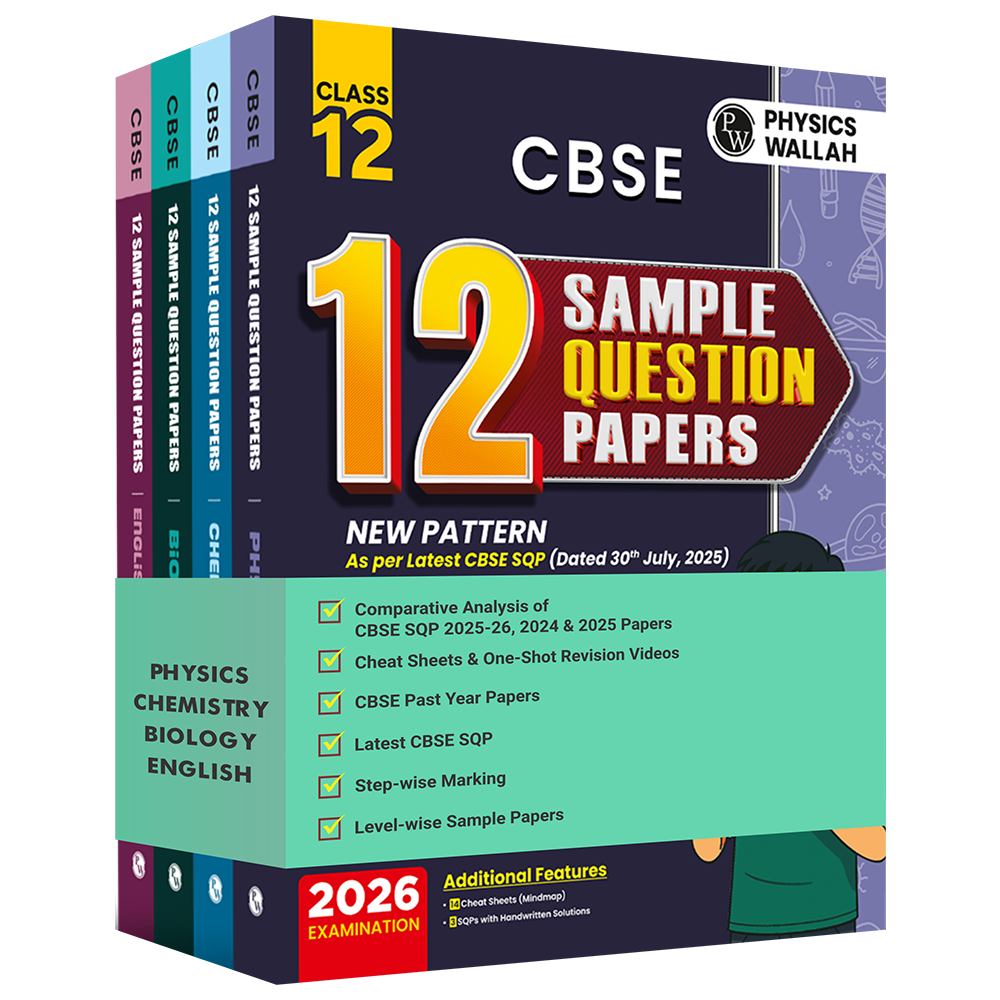
Class 12 CBSE Sample Papers Physics, Chemistry, Biology & English Core Combo Set of 4 |
|
|
CBSE Class 12 Last 3 Years (2022 - 2024) Solved Papers For 2026 |
|
Why PW CBSE Class 12 Physics Sample Papers Are Important
PW’s CBSE sample papers class 12 physics cover all important topics that help students score well in their board exam. Here are the main features of PW’s CBSE 12 physics sample paper with solution:
-
Learn from Past Papers: PW CBSE class 12 sample papers include past years’ questions, so students can understand the question pattern and important topics.
-
Quick Revision Help: These papers come with short revision notes and one-shot videos to help students remember key points quickly.
-
Follows the Official Marking Scheme: Every CBSE class 12 physics new pattern sample paper comes with a marking scheme, so students know how marks are given and how to improve their answers.
-
Different Types of Question Practice: There are many class 12 physics sample papers with detailed solutions to give students plenty of practice and clarity on different types of questions.
-
Access to Handwritten Solutions: PW CBSE class 12 sample papers come with QR codes to view handwritten solutions. This makes understanding easier and more effective for exam preparation.
-
Different Difficulty Level Practice Papers: Physics Class 12 CBSE sample papers are arranged in easy, medium, and hard levels to help students improve step by step.
-
Step-by-Step Answer Guidance: Proper marking steps are given so students can learn how to answer in the right way and score better.
-
Self-Check Tools: Built-in self-assessment tools help students track progress and find out which topics need more practice after solving CBSE sample papers class 12.
Also Check, Class 12th Question Banks
How to Use Sample Paper CBSE Class 12th Physics to Score Well
Using CBSE Class 12 Physics Sample Papers in the right way can be a game-changer during board exam preparation. Here's how students can utilise CBSE sample papers class 12th:
-
Start with Easy Papers: Begin with easier class 12 physics sample papers to understand the question pattern first. This will also help in identifying which topics need more focus.
-
Practice PYQs to Identify High-Scoring Repeated Topics: Use CBSE class 12 sample papers to know which concepts are repeated often. Students can prioritise these topics to score well.
-
Use a Timer: Solve each CBSE 12 physics sample paper with solutions within the set exam time. This improves speed and time management, which is important for scoring well in the actual board exam.
-
Mark Yourself: After solving each paper, check your answers with the marking scheme given in the sample papers. This helps understand how marks are awarded and where improvements are needed.
-
Slowly Move to Difficult Papers: Once comfortable, practise CBSE sample papers class 12 of medium and hard levels. This builds exam readiness and prepares students for unexpected questions.
By using these tips and practising regularly with CBSE sample papers for class 12, students can improve their preparation and score better marks in physics.
Also Read: CBSE Sample Papers Class 12 and Marking Scheme for Exam 2025-26
CBSE Class 12 Physics Sample Papers for 2026 Exams FAQs
Q.1. What are CBSE Class 12 Physics Sample Papers?
Ans. CBSE Class 12 Physics sample papers are practice papers made as per the latest exam pattern. They help students understand the type of questions, marking scheme, and important topics for the exam.
Q.2. Do CBSE Class 12 physics new pattern sample papers help in scoring good marks?
Ans. Yes. Solving CBSE Class 12 physics new pattern sample papers helps improve time management, accuracy, and confidence, which can help students score better marks in exams.
Q.3. When should I use Class 12 CBSE sample papers?
Ans. Class 12 CBSE sample papers should be used after finishing the syllabus and revision. They are most useful for practising before the board exams to check the preparation level.
Q.4. Do questions from the CBSE board class 12 physics sample paper appear in the real exam?
Ans. While the exact question may not come, many questions included in the CBSE board class 12 physics sample papers are based on past year questions and exam patterns. So, similar questions may appear in the upcoming board exam.