CBSE Class 12 Syllabus 2026-27 for All Subjects
CBSE Class 12 Syllabus 2027 for all streams has been released by the Central Board of Secondary Education (CBSE). Understanding the syllabus is very important if you're preparing for the upcoming Class 12 boards. You can check the latest CBSE class 12 syllabus 2026-27 on the official website at cbseacademic.nic.in.
Class 12 CBSE Syllabus 2026-27 includes all the topics and chapters you need to study for your board exams, expected to start from February, 2027. Moreover, the syllabus is updated for all subjects, including science, commerce, and arts. You can download the complete CBSE Class 12 Syllabus 2027 in PDFs to check the topics from which questions will be asked on your exams.
Check Out: CBSE Class 12th Books
CBSE Class 12 Syllabus 2026-27- Latest Updates
The Central Board of Secondary Education conducts Class 12 board exams once a year. For the upcoming year's class 12 board exams, about 20 lakh students are expected to appear. Find the latest CBSE Class 12 Syllabus 2026-27 updates here:
-
New Skill Subject Addition: This year, CBSE added four new skill subjects for Class 12 students. These are the Land Transportation Associate, Electronics and Hardware, Physical Activity Trainer, and Design Thinking and Innovation. These new subjects help students learn different skills.
-
9-Point Grading: Another change is the 9-point grading system. Just like Class 10, Class 12 will also use this system to give marks and grades to students.
-
Elective Choices: Students need to pick one subject from these three: Informatics Practices, Computer Science, or Information Technology.
-
Optional Subjects: For the exams, students will study some main subjects and some optional ones. The main subjects are Hindi (Core or Elective) and English (Core or Elective).
-
There are also extra optional subjects or languages that students can choose from any group. The syllabus of class 12 CBSE 2026-27 also includes internal work like Health and Physical Education, Work Experience, and General Studies.
Hence, to score good marks in the board exams, you must carefully go through the complete CBSE Class 12 Syllabus 2026-27 available on the official website. After understanding the syllabus of class 12 CBSE 2026-27, start practicing by solving Class 12th Sample Papers and past question papers. This will help you know your level of preparation so that you can improve your weak areas.
Class 12 PCM Syllabus 2026-27
Class 12 PCM syllabus covers subjects like Physics, Chemistry, and Mathematics as their main subjects in the science stream. Along with these, English is a compulsory subject for all students. The CBSE Class 12 syllabus 2026-27 for PCM covers all the important chapters and topics that you need to study for your board exams and other competitive examinations.
For making a robust study plan, it is very important to know the complete Class 12 CBSE syllabus 2026-27. When you know the syllabus well, it helps you focus on important topics and manage your time better. Find the detailed Class 12 PCM Syllabus 2026-27, as outlined below.
CBSE Class 12 Syllabus 2026-27 for Physics
CBSE has released the detailed Class 12th Syllabus 2026-27 for Physics in PDF format. The syllabus includes all the chapters and units of Physics from which questions in the board exam will be asked.
So, knowing the CBSE Class 12 Physics Syllabus 2026-27 helps all students focus on important topics and prepare well for the board exams. Check the key units, chapter names, and marks distribution for Physics in Class 12 here:
|
CBSE Class 12 Syllabus 2026-27 for Physics |
|||
|
Unit |
Chapter |
Key Topics |
Marks |
|
Unit I: Electrostatics |
Chapter 1: Electric Charges and Fields |
Electric charges, conservation of charge, Coulomb's law (force between point charges), superposition principle, continuous charge distribution, electric field (due to point charge & dipole), electric dipole torque, electric flux, Gauss's theorem & applications (infinitely long straight wire, infinite plane sheet, thin spherical shell – inside & outside field). |
16 |
|
Chapter 2: Electrostatic Potential and Capacitance |
Electric potential & potential difference, potential due to point charge, dipole & system of charges, equipotential surfaces, potential energy (two point charges & dipole), conductors & insulators, dielectrics, electric polarization, capacitors (series & parallel), parallel plate capacitor with/without dielectric, energy stored in capacitor. |
||
|
Unit II: Current Electricity |
Chapter 3: Current Electricity |
Electric current, drift velocity, mobility, Ohm’s law, V-I characteristics (linear & non-linear), electrical energy & power, resistivity & conductivity, temperature dependence, internal resistance of cell, potential difference & EMF, combination of cells (series & parallel), Kirchhoff’s rules, Wheatstone bridge. |
|
|
Unit III: Magnetic Effects of Current and Magnetism |
Chapter 4: Moving Charges and Magnetism |
Magnetic field concept, Oersted’s experiment, Biot–Savart law (application to circular loop), Ampere’s law (applications to straight wire, solenoid), force on moving charge, force on current-carrying conductor, force between two parallel conductors (ampere definition), torque on current loop, current loop as magnetic dipole, moving coil galvanometer (conversion to ammeter/voltmeter). |
17 |
|
Chapter 5: Magnetism and Matter |
Bar magnet as equivalent solenoid, magnetic field due to bar magnet (axis & equator – qualitative), torque on magnetic dipole, magnetic field lines, magnetic materials (para, dia, ferro), magnetization, effect of temperature on magnetic properties. |
||
|
Unit IV: Electromagnetic Induction and Alternating Currents |
Chapter 6: Electromagnetic Induction |
Faraday’s laws, induced EMF, Lenz’s law, self & mutual induction. |
|
|
Chapter 7: Alternating Current |
AC basics, peak & RMS values, reactance & impedance, LCR series circuit (phasors only), resonance, AC power, power factor, wattless current, AC generator, transformer. |
||
|
Unit V: Electromagnetic Waves |
Chapter 8: Electromagnetic Waves |
Displacement current, properties of EM waves, transverse nature (qualitative), electromagnetic spectrum (radio to gamma rays) & uses. |
18 |
|
Unit VI: Optics |
Chapter 9: Ray Optics and Optical Instruments |
Reflection, spherical mirrors, mirror formula, refraction, total internal reflection, optical fibers, refraction at spherical surfaces, lenses (thin lens formula, lens maker’s formula, magnification, power, combination), prism refraction, microscopes & telescopes (magnifying power). |
|
|
Chapter 10: Wave Optics |
Wavefront & Huygen’s principle, reflection & refraction using wavefronts, interference (Young’s double slit, fringe width formula), coherent sources, diffraction at a single slit (qualitative). |
||
|
Unit VII: Dual Nature of Radiation and Matter |
Chapter 11: Dual Nature of Radiation and Matter |
Dual nature of light, photoelectric effect (Hertz & Lenard’s observations), Einstein’s equation, experimental study of photoelectric effect, de Broglie relation, matter waves. |
12 |
|
Unit VIII: Atoms and Nuclei |
Chapter 12: Atoms |
Alpha particle scattering, Rutherford’s model, Bohr’s model (radius, velocity, energy of nth orbit), hydrogen spectrum (qualitative). |
|
|
Chapter 13: Nuclei |
Nucleus composition & size, nuclear force, mass-energy relation, mass defect, binding energy, variation of binding energy per nucleon, nuclear fission & fusion. |
||
|
Unit IX: Electronic Devices |
Chapter 14: Semiconductor Electronics |
Energy bands (conductors, semiconductors, insulators – qualitative), intrinsic & extrinsic semiconductors (p & n type), p–n junction diode (I-V characteristics), diode as rectifier. |
7 |
Class 12 CBSE Syllabus 2026-27 for Chemistry
Class 12 Chemistry syllabus covers units like Solutions, Electrochemistry, Chemical Kinetics, d- and f-Block Elements, Coordination Compounds, and Biomolecules. The Class 12 CBSE Syllabus 2026-27 for Chemistry includes Physical Chemistry, Organic Chemistry, and Inorganic Chemistry. Check the detailed syllabus of class 12 CBSE 2026-27 for Chemistry with the marks for each unit here:
|
Class 12 CBSE Syllabus 2026-27 for Chemistry |
||
|
Units |
Key Topics |
Marks |
|
Unit 1: Solutions |
Types of solutions, expression of concentration of solutions of solids in liquids, solubility of gases in liquids, solid solutions, Raoult’s law, colligative properties -relative lowering of vapor pressure, elevation of boiling point, depression of freezing point, osmotic pressure, determination of molecular masses using colligative properties, abnormal molecular mass, Van't Hoff factor |
7 |
|
Unit 2: Electrochemistry |
Redox reactions, EMF of a cell, standard electrode potential, Nernst equation and its application to chemical cells, Relation between Gibbs energy change and EMF of a cell, conductance in electrolytic solutions, specific and molar conductivity, variations of conductivity with concentration, Kohlrausch's Law, electrolysis and law of electrolysis (elementary idea), dry cell-electrolytic cells and Galvanic cells, lead accumulator, fuel cells, corrosion. |
9 |
|
Unit 3: Chemical Kinetics |
Rate of a reaction (Average and instantaneous), factors affecting rate of reaction: concentration, temperature, catalyst; orderand molecularity of a reaction, rate law and specific rate constant, integrated rate equations and half-life (only for zero and first order, reactions), concept of collision theory (elementary idea, no mathematical treatment), activation energy, Arrhenius equation |
7 |
|
Unit 4: d and f Block Elements |
General introduction, electronic configuration, occurrence and characteristics of transition metals, general trends in properties of the first row transition metals –metallic character, ionization enthalpy, oxidation states, ionic radii, colour, catalytic property, magnetic properties, interstitial compounds, alloy formation, preparation and properties of K2Cr2O7and KMnO4.Lanthanides -Electronic configuration, oxidation states, chemical reactivity and lanthanide contraction and its consequences.Actinides -Electronic configuration, oxidation states and comparison with lanthanides |
7 |
|
Unit 5: Coordination Compounds |
Coordination compounds -Introduction, ligands, coordination number, colour, magnetic properties and shapes, IUPAC nomenclature of mononuclear coordination compounds. Bonding, Werner's theory, VBT, and CFT; structure and stereoisomerism, importance of coordination compounds (in qualitative analysis, extraction of metals and biological system). |
7 |
|
Unit 6: Haloalkanes and Haloarenes |
Haloalkanes: Nomenclature, nature of C–X bond, physical and chemical properties, optical rotation mechanism of substitution reactions.Haloarenes: Nature of C–X bond, substitution reactions (Directive influence of halogen in monosubstituted compounds only).Uses and environmental effects of -dichloromethane, trichloromethane, tetrachloromethane, iodoform, freons, DDT |
6 |
|
Unit 7: Alcohols, Phenols and Ethers |
Alcohols: Nomenclature, methods of preparation, physical and chemical properties(of primary alcohols only), identification of primary, secondary and tertiary alcohols, mechanism of dehydration, uses with special reference to methanol and ethanol.Phenols: Nomenclature, methods of preparation, physical and chemical properties, acidic nature of phenol, electrophilic substitution reactions, uses of phenols.Ethers: Nomenclature, methods of preparation, physical and chemical properties, uses |
6 |
|
Unit 8: Aldehydes, Ketones and Carboxylic Acids |
Aldehydes and Ketones: Nomenclature, nature of carbonyl group, methods of preparation, physical and chemical properties, mechanism of nucleophilic addition, reactivity of alpha hydrogen in aldehydes, uses. |
8 |
|
Unit 9: Amines |
Amines: Nomenclature, classification, structure, methods of preparation, physical and chemical properties, uses, identification of primary, secondary and tertiary amines.Diazonium salts: Preparation, chemical reactions and importance in synthetic organic chemistry. |
6 |
|
Unit 10: Biomolecules |
Carbohydrates -Classification (aldoses and ketoses), monosaccahrides(glucose and fructose), D-L configuration oligosaccharides (sucrose, lactose, maltose), polysaccharides (starch, cellulose, glycogen); Importance of carbohydrates.Proteins -Elementary idea of -amino acids, peptide bond, polypeptides, proteins, structureof proteins-primary, secondary, tertiary structure and quaternary structures (qualitative idea only), denaturation of proteins; enzymes. Hormones -Elementary idea excluding structure.Vitamins -Classification and functions.Nucleic Acids: DNA and RNA |
7 |
Class 12 CBSE 2026-27 Syllabus for Mathematics
Maths is one of the most important subjects, especially if you're aiming to prepare for engineering, medical, or other competitive exams after 12th. The Class 12 CBSE syllabus for Mathematics is designed to strengthen students' problem-solving skills, logical thinking, and conceptual understanding.
Understanding the syllabus helps you study better by focusing on important topics according to their weightage in the exam. Find the detailed CBSE Class 12 Syllabus 2026-27 for Maths with unit-wise chapters, key topics, and marks distribution below.
|
Class 12 CBSE 2026-27 Syllabus for Mathematics |
|||
|
Unit |
Chapter |
Key Topics |
Marks |
|
Unit I: Relations and Functions |
Chapter 1: Relations and Functions |
Types of relations – reflexive, symmetric, transitive, equivalence; one-to-one and onto functions. |
08 |
|
Chapter 2: Inverse Trigonometric Functions |
Definition, domain, range, principal values, graphs of inverse trigonometric functions. |
||
|
Unit II: Algebra |
Chapter 3: Matrices |
Types of matrices, operations (addition, multiplication, scalar multiplication), properties, transpose, inverse of a matrix. |
10 |
|
Chapter 4: Determinants |
Determinant of up to 3×3 matrix, minors, cofactors, adjoint, inverse, area of triangle, solving linear equations using inverse of a matrix. |
||
|
Unit III: Calculus |
Chapter 5: Continuity and Differentiability |
Continuity, differentiability, chain rule, derivatives of inverse trigonometric, exponential, and logarithmic functions, second-order derivatives. |
35 |
|
Chapter 6: Applications of Derivatives |
Rate of change, increasing/decreasing functions, maxima and minima (first and second derivative test). |
||
|
Chapter 7: Integrals |
Integration as the reverse of differentiation, methods (substitution, partial fractions, by parts), properties of definite integrals. |
||
|
Chapter 8: Application of the Integrals |
Area under curves – lines, circles, parabolas, ellipses (standard form). |
||
|
Chapter 9: Differential Equations |
Order, degree, general and particular solutions, solving by separation of variables and homogeneous equations. |
||
|
Unit IV: Vectors and Three-dimensional Geometry |
Chapter 10: Vectors |
Magnitude and direction, types of vectors, scalar (dot) and vector (cross) product, and applications. |
14 |
|
Chapter 11: Three-dimensional Geometry |
Direction cosines/ratios, equations of lines, shortest distance, angle between two lines. |
||
|
Unit V: Linear Programming |
Chapter 12: Linear Programming Problem |
Constraints, objective function, graphical method, feasible/infeasible regions, optimal solutions. |
05 |
|
Unit VI: Probability |
Chapter 13: Probability |
Conditional probability, multiplication theorem, independent events, Bayes’ theorem, total probability. |
08 |
Check Out: CBSE Question Bank Class 12 PCM Combo Set of 3 Books
CBSE Class 12 Syllabus 2026 PDF for All Subjects
CBSE Class 12 Syllabus 2026 is like a roadmap for those who are preparing for the upcoming board exams. It covers all the units, including important topics, chapter-wise weightage, and marks distribution. Whether you are from the Science, Commerce, or Arts stream, knowing the complete syllabus of class 12 CBSE 2026-27 helps you prepare in a focused and effective way.
For your easy access, we have provided the CBSE Class 12 Syllabus 2026 for All Subjects PDFs here so you can download them and keep them handy during your preparation. These CBSE Class 12 Syllabus 2026 PDFs for all subjects will help you understand the marking scheme and key topics for theory and practical in a better way.
|
CBSE Class 12 Syllabus 2026 for All Subjects |
|
|
Class 12 CBSE Syllabus 2026-27 for English Core |
|
|
Class 12 CBSE Syllabus 2026-27 for English Elective |
|
|
Class 12th Syllabus 2026-27 for Hindi Elective |
|
|
Class 12th Syllabus 2026-27 for Hindi Core |
|
|
CBSE Class 12 Home Science Syllabus 2026-27 |
|
|
Class 12th Syllabus 2026-27 for Biology |
|
|
Class 12 CBSE 2026-27 Syllabus for Biotechnology |
|
|
Class 12th Syllabus 2026-27 for Chemistry |
|
|
Class 12 CBSE 2026-27 Syllabus for Computer Science |
|
|
Class 12 CBSE 2026-27 Syllabus for Geography |
|
|
CBSE Class 12 History Syllabus 2026-27 |
|
|
CBSE Class 12 Physics Syllabus 2026-27 |
|
|
Class 12th Syllabus 2026-27 for Mathematics |
|
|
Class 12th Syllabus 2026-27 for Accountancy |
|
Importance of CBSE Class 12 Syllabus 2026-27
CBSE Class 12 Syllabus 2026-27 is much more than just a list of chapters. It is a complete study material that can boost your overall preparation for board exams. Knowing the syllabus of class 12 CBSE 2026-27 thoroughly helps you:
-
Understand what to study: The syllabus helps you know the exact topics and chapters from which questions will be asked in the exams in a clear way.
-
Plan your time better: With the marks distribution and weightage given along with the detailed Class 12 CBSE 2026 syllabus, you can focus more on the high-scoring chapters.
-
Avoid studying unnecessary topics: CBSE Class 12 Syllabus 2026-27 helps you save time and effort by giving you the list of topics and chapters that are important for exams.
-
Prepare for competitive exams: Many entrance tests like JEE, NEET, and CUET are based on the class 12 CBSE syllabus.
How to Prepare the CBSE Class 12 Syllabus 2026-27 for Board Exams
Studying for the CBSE Class 12 Board Exams 2026-27 becomes easy when you have an effective study plan that includes the right resources. Here are some tips that will help you cover the CBSE Class 12 syllabus 2026-27 completely to score high marks:
Start with NCERT Class 12th Textbooks:
NCERT books are the base for all subjects, and most of the board exam questions come directly or indirectly from them. Read every chapter carefully, highlight important points, and solve all examples and exercise questions.
Read Additional CBSE Class 12th Books for Extra Practice
Along with NCERT, you can read additional CBSE Class 12th Books to strengthen your concepts for tricky subjects like Mathematics, Physics, and Chemistry. Because they will also help you later in competitive exams.
Practice With Question Banks
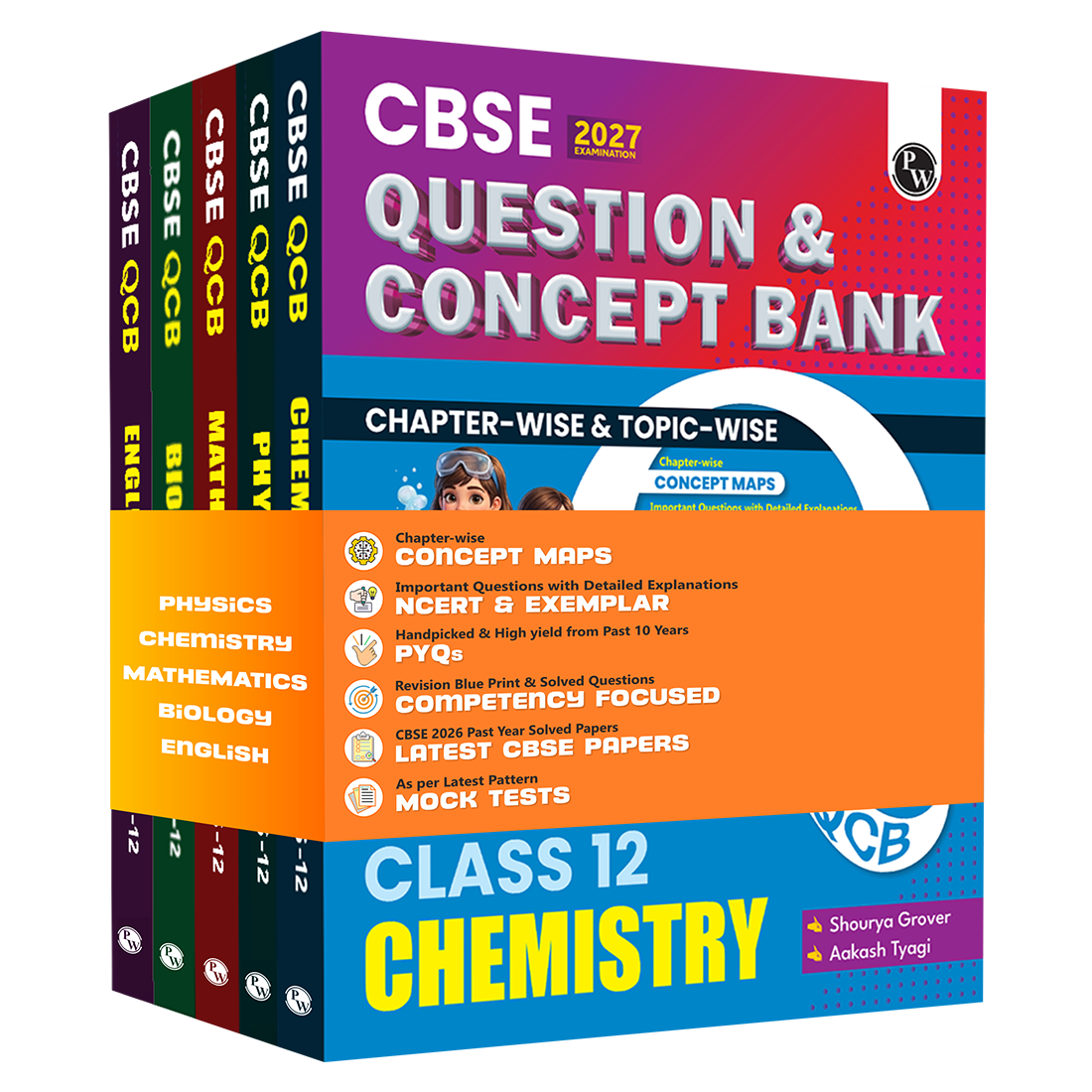
Class 12th Question Banks by PW cover chapter-wise concept maps, solved previous year important questions, and competency-based questions. Solving them on a daily basis helps you understand the latest paper pattern and improves your speed and accuracy.
Solve Class 12 Sample Papers
PW offers Class 12 Sample Papers for Science, Humanities, and Commerce streams. These sample papers are prepared as per the latest CBSE exam pattern, covering both competency-based and traditional questions to make sure of complete readiness for the revised exam structure.
Each sample paper includes detailed solutions, marking scheme insights, and proven strategies, along with previous years’ questions and targeted exercises to help you ace the concepts and score high marks in boards.
Practice Class 12 Previous Year Question Papers
Previous year papers are very helpful for exam preparation, as they show you the type of questions asked, important topics that are repeated, and the level of difficulty in the exam.
You can use books like CBSE Class 12 PYQ for PCMB by PW, which come with complete solutions, step-by-step explanations, and marking scheme details to help you prepare effectively for the board exams.
Know How Toppers Write Answers
Toppers score high marks because they write their answers in a clear, structured, and to-the-point manner. Check CBSE Class 12 Toppers’ Answer Sheet Book by PW, which has real toppers' handwritten notes to help you know how to write answers in a proper way.
Make a Revision Plan
Once you complete the syllabus of class 12 CBSE 2026-27, revise for at least one month properly. Use short notes, flashcards, and mock tests for quick revision sessions. Give more time to high-weightage chapters and keep practicing numericals and derivations daily.
Read More: CBSE Class 12 Important Questions All Subjects
CBSE Class 12 Syllabus 2026 for All Subjects FAQs
Q.1. Where can I download the CBSE Class 12 Syllabus 2026 for all subjects?
Ans. You can download the official CBSE Class 12 Syllabus 2026-27 for all subjects from the official website or from the direct links given in the article above.
Q2. Has the Class 12 CBSE syllabus 2026-27 changed from last year?
Ans. Yes, the CBSE Class 12 syllabus 2026-27 includes new skill-based subjects, a few chapters have been removed, and more focus is given to practical learning, critical thinking, and problem-solving skills.
Q.3. How does the Class 12th syllabus 2026-27 help in scoring well in boards?
Ans. The class 12th syllabus 2026-27 has a list of all important topics and shows the distribution of marks. It helps students focus on key chapters and concepts that carry a high weightage of marks.
Q.4. Is the class 12 PCM syllabus also useful for engineering entrance exams?
Ans. Yes, the Class 12 PCM syllabus is very useful for engineering entrance exams like JEE as many topics in Physics, Chemistry, and Mathematics are common in these exams.