How PW Class 9 Maths Question Bank Builds Foundation for Class 10 Boards
A common mistake during this end-term phase is relying on passive reading rather than active problem-solving. When core fundamentals in coordinate geometry or linear equations remain weak, stepping up to Class 10 board preparation feels like an uphill battle.
Students require a reliable learning companion that simplifies difficult topics and encourages independent practice. A well-structured CBSE class 9 maths question bank solves this exact issue.
It transforms routine revision into targeted practice, helping learners master core concepts while gaining the exam confidence needed for long-term academic success.
What Is CBSE Class 9 Maths Question Bank?
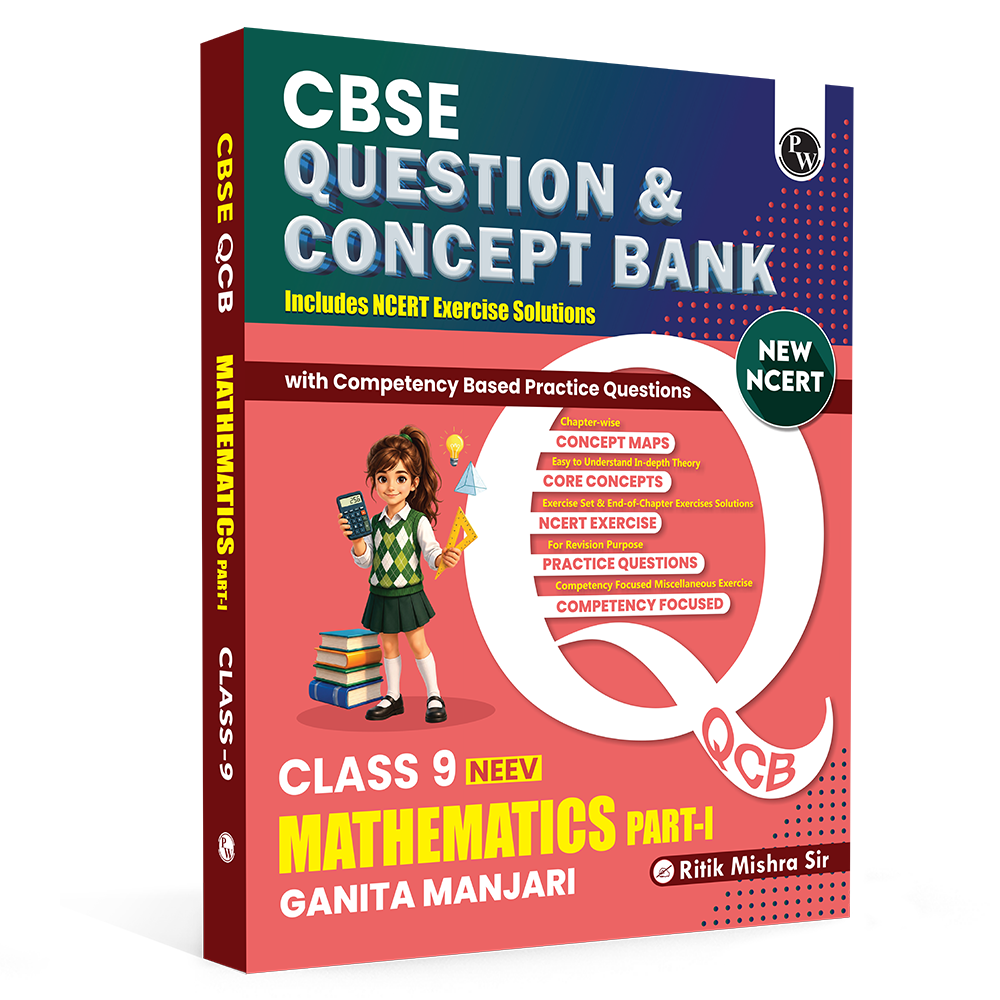
A CBSE class 9 maths question bank is an all-in-one learning resource built strictly according to the latest CBSE and New NCERT curriculum framework. Instead of overwhelming learners with endless theoretical paragraphs, it focuses on structured application, helping students develop mathematical reasoning and sharp calculation skills.
Key Components of a Comprehensive Question Bank
-
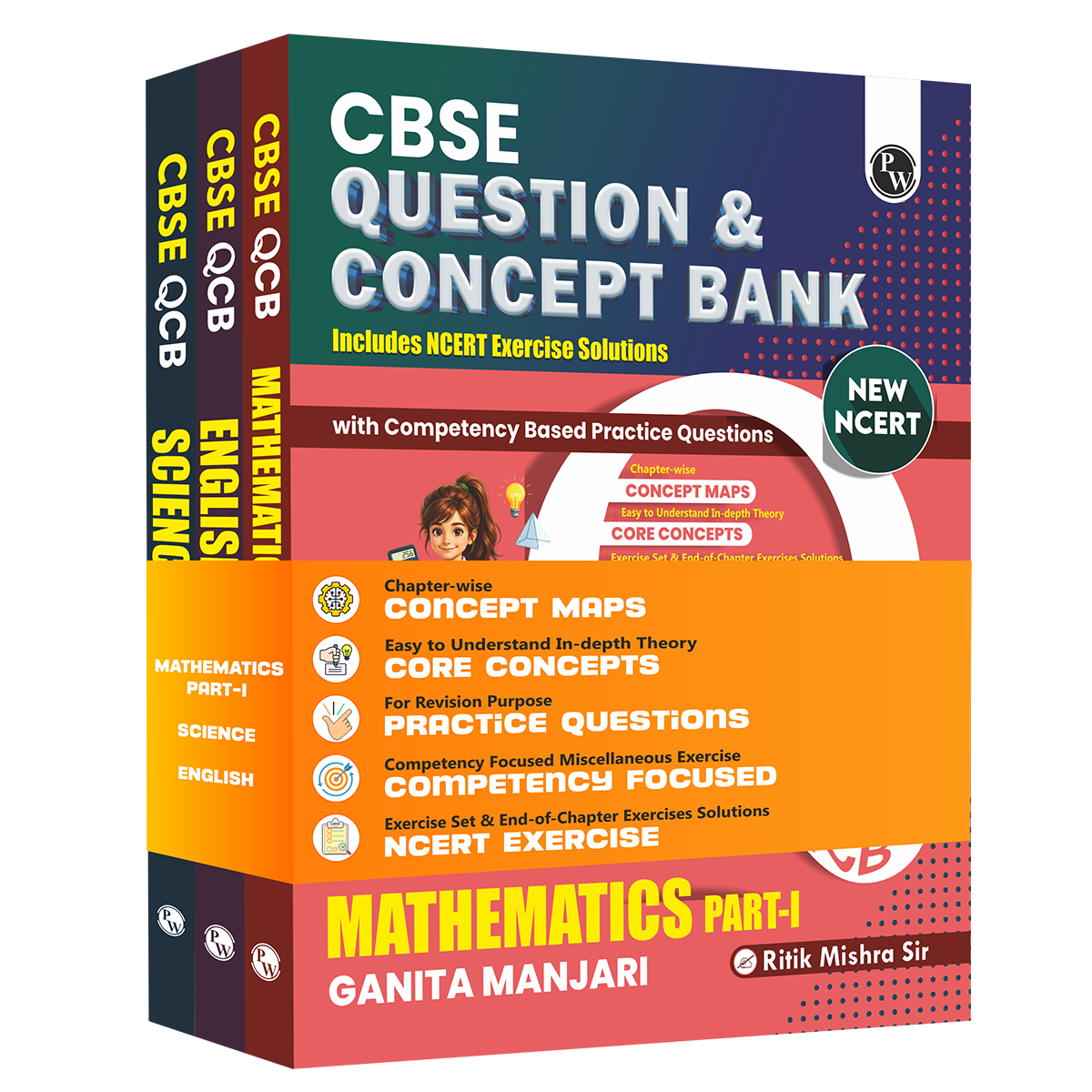
Concept Maps: Visual summaries that clarify complex theoretical ideas instantly for quick end-term review.
-
Detailed Theory: Clear explanations that break down core mathematical principles before practice begins.
-
NCERT Solutions: Complete, step-by-step answers for textbook questions that aid independent error correction.
-
Competency-Based Questions: Practical, application-oriented problems aligned with modern CBSE assessment patterns.
-
Chapterwise Practice Sets: Structured exercises tailored to reinforce learning and evaluate personal growth.
Why Is CBSE Class 9 Maths Question Bank Important for Class 10?
Class 9 serves as the direct launching pad for Class 10 board performance. Without a solid maths foundation, tackling advanced topics like quadratic equations or trigonometry becomes unnecessarily stressful. Integrating a CBSE class 9 question bank into daily study routines ensures smooth conceptual transitions between grades.
|
Feature Provided |
Direct Benefit in Class 9 |
Board Readiness for Class 10 |
|
Competency-Based Learning |
Improves analytical thinking and real-world problem solving. |
Adapts students early to updated CBSE board exam question styles. |
|
Step-by-Step Solutions |
Helps identify exact calculation mistakes independently. |
Builds logical presentation skills necessary for board marking schemes. |
|
Structured Revision |
Prevents last-minute cramming before final term exams. |
Ensures long-term retention of core formulas and theorems. |
|
Concept Mapping |
Simplifies complex chapters into quick visual notes. |
Speeds up multi-subject revision schedules during board preparation. |
Important Chapters in CBSE Class 9 Maths Question Bank
To maximize results during end-term tests, students must prioritize high-weightage chapters. Consistent CBSE maths practice across these specific areas establishes strong problem-solving habits.
1. Polynomials and Linear Equations
Algebra forms the backbone of higher secondary mathematics. Solving various question types ensures speed, accuracy, and strong algebraic manipulation skills.
2. Triangles and Lines & Angles
Geometry requires clear logical reasoning rather than memory work. Practicing step-by-step proofs helps students master geometric theorems systematically.
3. Coordinate Geometry
Understanding grid plots, axes, and quadrant rules lays the foundation for advanced coordinate systems used in Class 10 graphs and calculus basics.
4. Mensuration (Surface Areas and Volumes)
This chapter demands high calculation accuracy and formula application. Regular practice prevents simple calculation errors during long exam papers.
How to Use CBSE Class 9 Maths Question Bank for Daily Practice?
Owning a reference guide is only half the battle; knowing how to use it matters most. Establishing a disciplined routine through chapterwise maths practice guarantees steady academic improvement over time.
-
Start with Concept Maps: Review the visual map at the beginning of each unit to refresh formulas and key definitions.
-
Work Through Solved Examples: Study step-by-step solved problems to understand proper answer structuring before attempting exercises independently.
-
Solve Standard Exercises: Complete baseline questions to ensure textbook-level understanding is completely secure.
-
Challenge Yourself with Application Questions: Move on to competency-based problems to sharpen critical thinking abilities.
-
Verify Answers for Self-Assessment: Compare your working against the provided step-by-step solutions to fix recurring mistakes.
To strengthen your preparation further, study alongside CBSE Class 9 Books, which provide comprehensive theory, concept explanations, worked examples, and chapter-wise practice across subjects. Combining detailed textbook learning with regular question bank practice helps build strong fundamentals, improve accuracy, and perform confidently in school examinations.
Study Strategy Plan with CBSE Class 9 Maths Question Bank
An organized preparation timeline keeps students focused as final assessments draw close. Using a CBSE class 9 maths question bank systematically prevents study burnout.
Phase 1: Conceptual Clarity (Weeks 1–2)
Begin by reading short theoretical summaries and concept maps for two chapters per week. Focus on understanding definitions, standard identities, and primary theorems thoroughly.
Phase 2: Intensive Practice (Weeks 3–4)
Dedicated daily slots should be reserved for solving maths important questions. Divide study time evenly between basic textbook problems and challenging competency-focused scenarios.
Phase 3: Timed Evaluation (Weeks 5–6)
Simulate realistic exam conditions by solving complete practice sets without looking at reference material. Evaluate completed tests using step-by-step solutions to measure speed and precision.
Revision Tips for Using CBSE Class 9 Maths Question Bank
Smart class 9 revision strategies focus on active recall and targeted error correction during the final days leading up to school exams.
-
Maintain an Error Notebook: Note down every calculation or logical mistake made during self-assessment, then resolve those specific questions after two days.
-
Use Concept Maps for Speed: Skip heavy text and review visual summaries right before entering the exam hall.
-
Practice Step-by-Step Writing: CBSE evaluation rewards method steps. Ensure every formula and intermediate step is clearly written out during daily practice.
-
Mix Up Chapters: Avoid practicing just one chapter all day. Shuffle algebra, geometry, and mensuration problems to train your brain to switch concepts quickly.
Practice Sheet for CBSE Class 9 Maths Question Bank
Test your current preparation level using this short practice template designed around key competency levels.
Section A: Foundational Concepts
-
Question 1: Explain the geometric properties of vertically opposite angles and state their relationship when two straight lines intersect.
-
Question 2: Express a linear equation in two variables in standard form and demonstrate how to find two distinct solutions.
Section B: Application and Analysis
-
Question 3: Calculate the total surface area of a solid shape composed of a cylinder capped by a hemisphere, showing all intermediate step calculations clearly.
-
Question 4: Factorise a cubic polynomial completely using the factor theorem and long division method.
Read More: How to Get 95 Percent in CBSE Class 9 Exam
CBSE Class 9 Maths Question Bank FAQs
Q1. How does a CBSE class 9 maths question bank help in school final exams?
It offers structured practice through concept maps, detailed theory, NCERT solutions, and competency-based questions that align directly with latest school assessment patterns.
Q2. Does a class 9 maths question bank include solutions for self-assessment?
Yes, it includes detailed solutions that allow students to check their work independently and fix calculation errors during daily study.
Q3. Why is building a strong maths foundation in Class 9 necessary for board exams?
Class 10 board topics rely heavily on core principles taught in Class 9, such as polynomials, linear equations, and basic geometry proofs.
Q4. Are competency-based questions included for regular CBSE maths practice?
Yes, modern question banks feature competency-based problems designed to build analytical thinking and real-world problem-solving skills.
Q5. How can chapterwise maths practice improve exam speed?
Solving chapterwise practice sets under timed conditions helps students become familiar with problem structures, leading to faster calculations and better time.