

NCERT Solutions for Class 12 Maths Chapter 11 Exercise 11.2
Ex 11.2 class 12 Maths is a set of math problems about lines in 3D space. It teaches you how to find the path of a line and the space between two different lines. By solving these questions, you learn how lines lean, how they cross, and how to measure the gap between them.
Check Out: Class 11th Books
NCERT Solutions for Class 12 Maths Chapter 11 Exercise 11.2
Solve The Following Questions of NCERT Solutions for Class 12 Maths Chapter 11 Exercise 11.2
Question 1. Show that the three lines with direction cosines are mutually perpendicular. Solution : Two lines with direction cosines, l 1 , m 1 , n 1 and l 2 , m 2 , n 2 , are perpendicular to each other, if l 1 l 2 + m 1 m 2 + n 1 n 2 = 0
 Therefore, the lines are perpendicular. Thus, all the lines are mutually perpendicular.
Question 2. Show that the line through the points (1, −1, 2) (3, 4, −2) is perpendicular to the line through the points (0, 3, 2) and (3, 5, 6).
Solution : Let AB be the line joining the points, (1, −1, 2) and (3, 4, − 2), and CD be the line joining the points, (0, 3, 2) and (3, 5, 6). The direction ratios, a 1 , b 1 , c 1 , of AB are (3 − 1), (4 − (−1)), and (−2 − 2) i.e., 2, 5, and −4. The direction ratios, a 2 , b 2 , c 2 , of CD are (3 − 0), (5 − 3), and (6 −2) i.e., 3, 2, and 4. AB and CD will be perpendicular to each other, if a 1 a 2 + b 1 b 2 + c 1 c 2 = 0 a 1 a 2 + b 1 b 2 + c 1 c 2 = 2 × 3 + 5 × 2 + (− 4) × 4 = 6 + 10 − 16 = 0 Therefore, AB and CD are perpendicular to each other.
Question 3. Show that the line through points (4, 7, 8), (2, 3, 4) is parallel to the line through the points (−1, −2, 1), (1, 2, 5).
Solution : Let AB be the line through the points, (4, 7, 8) and (2, 3, 4), and CD be the line through the points, (−1, −2, 1) and (1, 2, 5). The directions ratios, a 1 , b 1 , c 1 , of AB are (2 − 4), (3 − 7), and (4 − 8) i.e., −2, −4, and −4. The direction ratios, a 2 , b 2 , c 2 , of CD are (1 − (−1)), (2 − (−2)), and (5 − 1) i.e., 2, 4, and 4. AB will be parallel to CD, if a1/a2 = b1/b2 = c1/c2 a1/a2 = -2/2 = -1 b1/b2 = -4/4 = -1 c1/c2 = -4/4 = -1 ∴a1/a2 = b1/b2 = c1/c2 Thus, AB is parallel to CD.
Question 4. Find the equation of the line which passes through the point (1, 2, 3) and is parallel to the vector
Solution : It is given that the line passes through the point A (1, 2, 3). Therefore, the position vector through A is
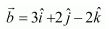
It is known that the line which passes through point A and parallel to is given by λ is a constant..png)


This is the required equation of the line.
Question 5. Find the equation of the line in vector and in Cartesian form that passes through the point with position vector and is in the direction

Solution : It is given that the line passes through the point with position vector

It is known that a line through a point with position vector and parallel to is given by the equation,.png)
 This is the required equation of the line in vector form.
Eliminating λ, we obtain the Cartesian form equation as 
Question 6. Find the Cartesian equation of the line which passes through the point (−2, 4, −5) and parallel to the line given by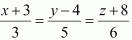
Solution : It is given that the line passes through the point (−2, 4, −5) and is parallel to
The direction ratios of the line,
,
are 3, 5, and 6. The required line is parallel to
Therefore, its direction ratios are 3 k , 5 k , and 6 k , where k ≠ 0 It is known that the equation of the line through the point ( x 1 , y 1 , z 1 ) and with direction ratios, a , b , c , is given by Therefore the equation of the required line is
Question 7. The Cartesian equation of a line is Write its vector form.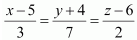
Solution : The Cartesian equation of the line is ....(1)
The given line passes through the point (5, −4, 6). The position vector of this point is
Also, the direction ratios of the given line are 3, 7, and 2. This means that the line is in the direction of vector, 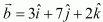 It is known that the line through position vector and in the direction of the vector is given by the equation,

This is the required equation of the given line in vector form.
Question 8. Find the vector and Cartesian equations of the line that passes through the origin and (5, −2, 3). Solution :
The required line passes through the origin. Therefore, its position vector is given by, = 0
.....(1)The direction ratios of the line through origin and (5, −2, 3) are (5 − 0) = 5, (−2 − 0) = −2, (3 − 0) = 3
The line is parallel to the vector given by the equation,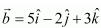
The equation of the line in vector form through a point with position vector and parallel to is,

The equation of the line through the point ( x 1 , y 1 , z 1 ) and direction ratios a , b , c is given by,
Therefore, the equation of the required linein the Cartesian form is

Question 9. Find vector and Cartesian equations of the line that passes through the points (3, −2, −5), (3, −2, 6).
Solution : Let the line passing through the points, P (3, −2, −5) and Q (3, −2, 6), be PQ.
Since PQ passes through P (3, −2, −5), its position vector is given by, 
The direction ratios of PQ are given by, (3 − 3) = 0, (−2 + 2) = 0, (6 + 5) = 11
The equation of the vector in the direction of PQ is
The equation of PQ in vector form is given by,

The equation of PQ in Cartesian form is i.e.,

Question 10. Find the angle between the following pairs of lines: (i) (ii)
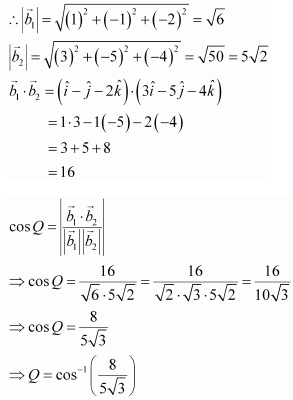
(ii) Solution : (i) Let Q be the angle between the given lines. The angle
between the given pairs of lines is given by
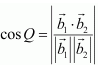
The given lines are parallel to the vectors,
, respectively.

(ii) The given lines are parallel to the vectors, respectively.
Question 11. Find the angle between the following pair of lines
(i) (ii)
(ii) Solution : Let 1 and 2 be the vectors parallel to the pair of lines,, respectively.
 (ii) Let 1 2 be the vectors parallel to the given pair of lines,, respectively.
Question 12. Find the values of p so that the lines are at right angles.
Solution : The given equations can be written in the standard form asThe direction ratios of the lines are respectively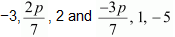 Two lines with direction ratios , a 1 , b 1 , c 1 and a 2 , b 2 , c 2 , are perpendicular to each other, if a 1 a 2 + b 1 b 2 + c 1 c 2 = 0
Question 13. Show that the lines are perpendicular to each other.
Solution : The equations of the given lines are
The direction ratios of the given lines are 7, −5, 1 and 1, 2, 3 respectively.
Two lines with direction ratios, a 1 , b 1 , c 1 and a 2 , b 2 , c 2 ,
are perpendicular to each other,
if a 1 a 2 + b 1 b 2 + c 1 c 2 = 0 ∴ 7 × 1 + (−5) × 2 + 1 × 3 = 7 − 10 + 3 = 0
Therefore, the given lines are perpendicular to each other.
Question 14. Find the shortest distance between the lines
Solution : The equations of the given lines areSince, the shortest distance between the two skew lines is given by Therefore, the shortest distance between the two lines is 3√2/2 units.
Question 15. Find the shortest distance between the lines .
Solution : The given lines are
It is known that the shortest distance between the two lines, ,
is given by Comparing this equation we have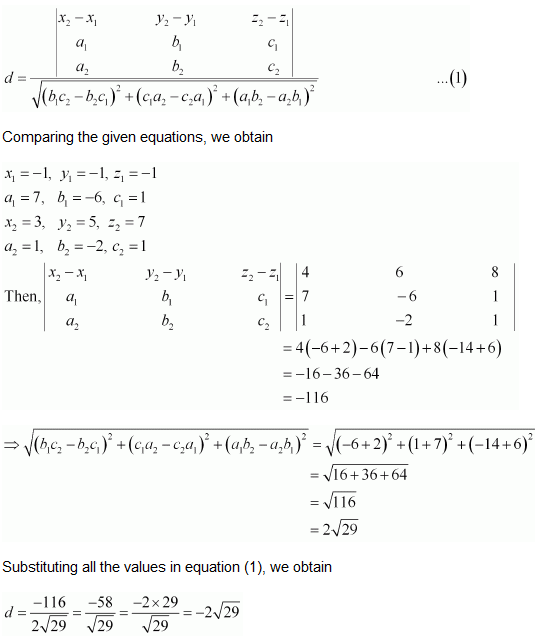 Since distance is always non-negative, the distance between the given lines is 2√29 units.
Question 16. Find the shortest distance between the lines whose vector equations are

Solution : The given lines areIt is known that the shortest distance between the lines, is given by, .....
.....
(1)
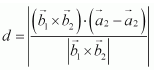
Comparing the given equations with , we obtain
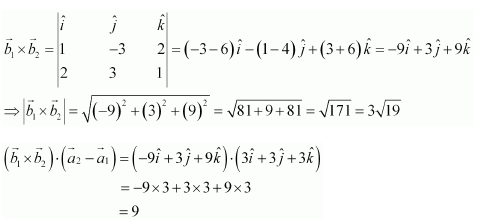 Substituting all the values in equation
(1), we obtain 
Therefore, the shortest distance between the two given lines is 3/√19 units.
Question 17. Find the shortest distance between the lines whose vector equations are
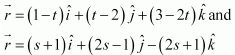
Solution : The given lines are It is known that the shortest distance between the lines, is given by,For the given equations,
 Substituting all the values in equation (3), we obtain
 Therefore, the shortest distance between the lines is 8/√29 units.
Check Out: Class 11th Question Banks
Ex 11.2 Class 12 Maths
When you study ex 11.2 class 12 Maths, you are looking at how lines move in a world with three sides: length, width, and height. This is called 3D geometry. In this exercise, we use special numbers called direction ratios and cosines to talk about where a line is going. It's like giving a line its own home address in space.
Why is this exercise helpful
-
It shows you how to write the "name" of a line using vectors.
-
It teaches you how to find if two lines are standing straight against each other.
-
You learn the way to find the shortest gap between two lines that never touch.
-
It helps you get ready for big tests by practicing 17 different types of questions.
Most students use the ex 11.2 class 12 Maths NCERT solutions to check their steps. These solutions show you how to move from a vector form to a Cartesian form. This sounds hard, but it’s just two different ways to write the same math story. One uses arrows (vectors) and the other uses letters like x , y , and z .
Class 12 Maths Chapter 11 Exercise 11.2
The class 12 Maths chapter 11 exercise 11.2 focus is all about the "Equation of a Line." Imagine a line as a walking path. To know this path, you only need two things: a point where it starts and the way it is pointing. If you have these, you can write the whole equation.
|
Concept Type |
What it tells us |
Key Formula |
|
Vector Form |
The path using arrows |
\vec{r} = \vec{a} + \lambda\vec{b} |
|
Cartesian Form |
The path using coordinates |
\frac{x-x_1}{a} = \frac{y-y_1}{b} = \frac{z-z_1}{c} |
|
Shortest Distance |
The smallest gap between lines |
Uses the "Cross Product" rule |
Tips for Class 12 Maths Chapter 11 Exercise 11.2 Solutions
If you are stuck on a problem, try to draw it! Even a simple drawing helps you see if the lines are parallel (running side-by-side) or perpendicular (crossing like a "+" sign). Many ex 11.2 class 12 maths solutions suggest finding the "direction ratios" first because they make the rest of the work much easier.
Ex 11.2 Class 12 Maths Ncert Solutions PDF
Using an ex 11.2 class 12 maths NCERT solutions pdf is very smart because you can carry it on your phone. You can look at it whenever you have a doubt about a formula. The PDF versions usually have every step written out clearly so you don't miss a single thing.
Important things in the PDF:
-
Angle between two lines: You use a formula with "cos" to find the corner where two lines meet.
-
Shortest Distance: This is the most famous part of ex 11.2 class 12 Maths. It's used for skew lines—lines that are in different planes and never meet.
-
Proving Perpendicularity: You multiply the direction numbers. If the final answer is 0, the lines are perpendicular!
To find the ex 11.2 class 12 maths NCERT answers, always look for the most updated version. The board sometimes changes the numbers or the syllabus, so staying updated is a good habit.
Ex 11.2 Class 12 Maths Solutions
To do well in Ex 11.2 class 12 Maths, you should follow a set of steps. Don't jump to the end! Math is like building a house; you need a strong base first.
-
Step 1: Write down what the question gives you (points or vectors).
-
Step 2: Decide which formula to use. Are you finding a distance or an angle?
-
Step 3: Put the numbers into the formula carefully.
-
Step 4: Check your plus and minus signs. This is where most kids make mistakes!
The class 12 Maths chapter 11 exercise 11.2 solutions usually highlight Question 12 and Question 15. These are the "star" questions that often show up in exams. Question 12 asks you to find a missing value (like p ) so that lines are at right angles. Question 15 asks for the distance between two lines. If you can do these two, you can do anything in this chapter!
Summary of Ex 11.2 Class 12 Maths NCERT
When we look at ex 11.2 class 12 Maths NCERT, we see that it's the heart of 3D geometry. It links what we know about points in 2D to the real world of 3D. Every line has its own unique direction. If you know how to find that direction, you've won half the battle.
Key Takeaways
-
Direction Cosines: These are the cosine angles a line makes with the x , y , and z axes.
-
Skew Lines: These are special lines that are not parallel but still never touch because they are at different heights.
-
Cartesian Equation: A way to write a line's path using a set of ratios.
Using ex 11.2 class 12 Maths helps you think in 3D. This is useful for many jobs like making video games, building bridges, or even flying planes! It is all about knowing where things are and how they move in space.
Read More: How to Prepare for CBSE Class 11 Exams 2026?
Class 12 Maths Chapter 11 Exercise 11.2 FAQs
Q1: What is the main topic of ex 11.2 class 12 Maths?
The main topic is the "Equation of a Line in Space." It covers how to find line paths, angles between lines, and the distance between them.
Q2: Is ex 11.2 class 12 maths hard?
It might seem hard at first because of the formulas, but once you learn the difference between Vector and Cartesian forms, it becomes easy.
Q3: Where can I find ex 11.2 class 12 maths NCERT solutions pdf?
You can find them on the official NCERT website or trusted study apps. They are free to download and very helpful.
Q4: What are "Skew Lines" in exercise 11.2?
Skew lines are lines that are not parallel and never intersect. They sit in different planes, like one road going over another on a bridge.
Q5: Which questions are most important in class 12 maths chapter 11 exercise 11.2?
Questions 10, 12, and 15 are very important. They deal with finding angles and distances, which are common in board exams.





