NCERT Solutions for Class 10 Science Chapter 5 Periodic Classification of Elements
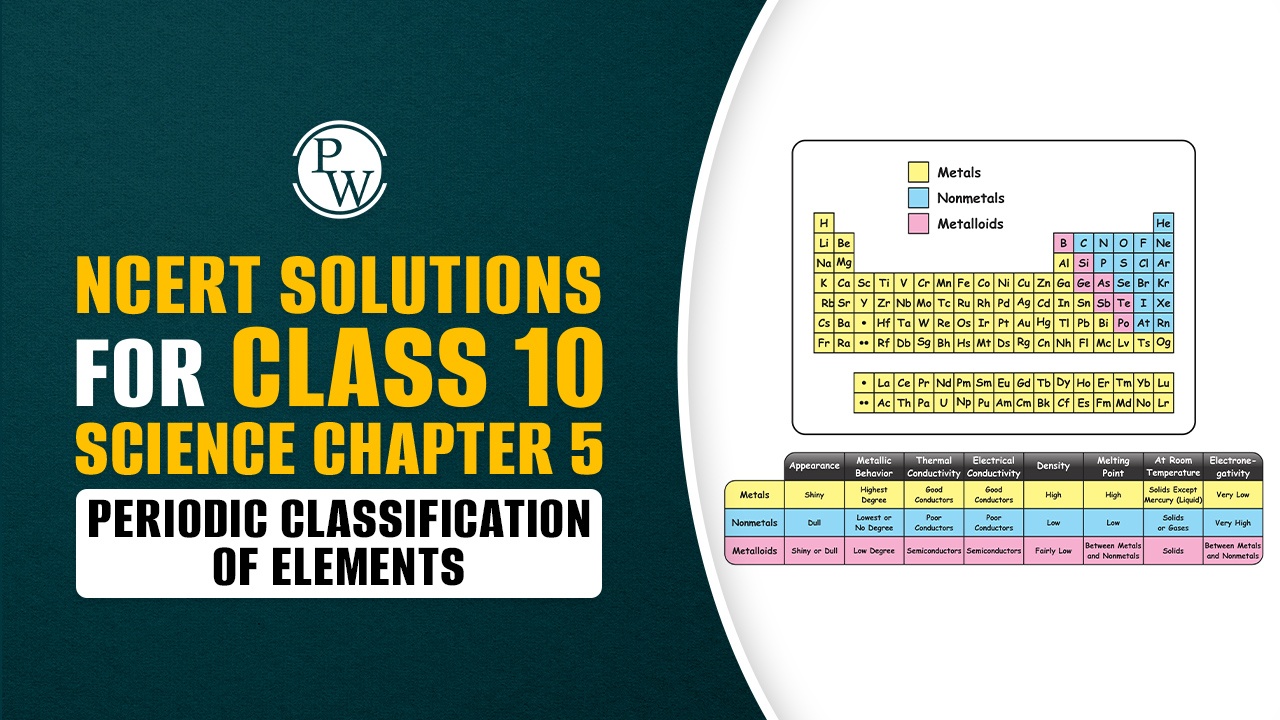
NCERT Solutions for Class 10 Science Chapter 5 Periodic Classification of Elements
Class 10 is one of the most important stages for students, as the CBSE board exam plays a major role in shaping their future academic choices. As per the tentative schedule, the CBSE Class 10 Science exam for the main phase is expected to be held on Wednesday, February 25, 2026, while the compartment exam may take place on Tuesday, May 19, 2026. These dates are provisional, and students can expect the final timetable by mid-January 2026. Among all subjects, Science is a key scoring subject because it builds basic concepts that are useful in higher classes and competitive exams.
In the Class 10 Science syllabus, Ch 5 Science Class 10, Periodic Classification of Elements, is a very important chapter. This topic explains how different scientists arranged elements based on their properties. You will learn about Dobereiner’s Triads, Newlands’ Law of Octaves, and Mendeleev’s Periodic Table, which laid the foundation for the modern classification. Understanding these ideas helps students know why elements are placed in specific groups and periods in the modern periodic table. For effective preparation, we provide complete Periodic Classification of Elements Class 10 question and answers that cover every concept in a simple and clear manner. These solutions are designed to help you revise quickly and understand the logic behind each question. Whether you are looking for Class 10 Chemistry Chapter 5 explanations or Chapter 5 Science Class 10 question answer, everything is available in one place.
Our NCERT Class 10 Science Chapter 5 exercise solutions include solved examples, in-text questions, and extra practice questions. These resources are perfect for last-minute revision and help you strengthen your understanding of Science Class 10 Chapter 5. Students preparing for board exams can rely on these well-structured solutions to score full marks in Class 10th Science Chapter 5 and build a strong base.
Check Out: CBSE Class 10 Books
Class 10 Science Chapter 5 Periodic Classification of Elements
Check out the Class 10 Science Chapter 5 Periodic Classification of Elements:-
1. Did Döbereiner’s triads also exist in the columns of Newlands’ Octaves? Compare and find out.
Solution: Döbereiner’s triads did exist in the columns of Newlands’ Octaves; For example, the elements Lithium (Li), Potassium (K) and Sodium (Na) constitute a Dobereiner’s Triad but are also found in the second column of Newland’s Octaves.
Read More: NCERT Solutions for Class 10 Science Chapter 1
2. What were the limitations of Döbereiner’s classification?
Solution:
(i) Neither very low mass nor very high mass elements could use them. (ii) Dobereiner's triads could not include all of the components. (iii) The validity of Dobereiner's triads started to wane as techniques for calculating atomic mass advanced. For instance, the atomic mass of CI is not equal to the arithmetic mean of the atomic masses of F and Br in the trio of F, Cl, and Br.
3. What were the limitations of Newlands’ Law of Octaves?
Solution: The following are Newlands' Law of Octaves' limitations:
-
Applying Newlands' Law of Octaves to elements up to Calcium only Newland made the assumption that there were already 56 elements in nature and that no more would be found in the future.
-
Newland inserted two items into a single slot in order to fit them into the table. Newland combined dissimilar items with various attributes into a single column.
-
Iron (Fe) was kept apart from substances with similar characteristics. Ex: Cobalt and nickel
Read More: NCERT Solutions for Class 10 Science Chapter 2
Questions Page number 85
1. Use Mendeleev’s Periodic Table to predict the formulae for the oxides of the following elements: K, C, AI, Si, Ba.

Solution:
K- K 2 O C-C 2 O 4 or CO 2 Al- Al 2 O 3 Si-Si 2 O 4 or SiO 2 Ba 2 O 2 or BaO Oxygen is a member of group VI A in Mendeleev’s periodic table. Its valency is 2. Similarly, the valencies of all the elements listed can be predicted from their respective groups. This will help in writing the formulae of their oxides. (i) Potassium (K) is a member of group IA. Its valency is 1. Therefore, its formula is K 2 O. (ii) Carbon (C) is a member of group IV A. Its valency is 4. Therefore, the formula is C 2 O 4 or CO 2 . (iii) Aluminium (Al) belongs to groups III A and its valency is 3. The formula of its oxide is Al 2 O 3 . (iv) Silicon (Si) is present in group IV A after carbon. Its valency is also 4. The formula of oxide is Si 2 O 4 or SiO 2 . (v) Barium (Ba) belongs to group II A and the valency of the element is 2. The formula of the oxide of the element is Ba 2 O 2 or BaO.
2. Besides gallium, which other elements have since been discovered that were left by Mendeleev in his Periodic Table? (Any two)
Solution: Germanium and Scandium are the elements that are left by Mendeleev in his Periodic Table since its discovery.
Read More: NCERT Solutions Class 10 Science Chapter 3
3. What were the criteria used by Mendeleev in creating his Periodic Table?
Solution: Mendeleev focused on the different compounds that elements containing hydrogen and oxygen could form. When constructing his periodic table, he took note of the link between the atomic masses of different elements in addition to other physical characteristics.
4. Why do you think the noble gases are placed in a separate group?
Solution: Because they are inert and present in small amounts in our environment, noble gases are categorised under a different group. To prevent them from upsetting the current order, they are housed in a distinct group known as the Zero group.
Questions Page number 90
1. How could the Modern Periodic Table remove various anomalies of Mendeleev’s Periodic Table?
Solution:
(a) Elements are grouped in the Modern Periodic Table according to increasing atomic number. This eliminates the irregularity pertaining to specific element pairs in Mendeleev's periodic table. (b) Cobalt has an atomic number of 27, while nickel has a number of 28. Because of this, cobalt will arrive before nickel despite having a larger atomic mass. c) The contemporary periodic table arranges all isotopes of the same element in the same position because they have different atomic masses but the same atomic number.
Read More: NCERT Solutions for Class 10 Science Chapter 4
2. Name two elements you would expect to show chemical reactions similar to magnesium. What is the basis for your choice?
Solution: Calcium and Beryllium are similar to Magnesium because all three elements belong to the same group and have 2 valence electrons in their outer shell.
3. Name
(a) Three elements that have a single electron in their outermost shells.
(b) Two elements that have two electrons in their outermost shells.
(c) Three elements with filled outermost shells
Solution:
-
Lithium (Li), Sodium (Na) and potassium (k) have a single electron in their outermost shells.
-
Magnesium (Mg) and Calcium (Ca) have two electrons in their outermost shells
-
Neon (Ne), Argon (Ar and Xenon (Xe) filled outermost shells
4. a) Lithium, sodium, and potassium are all metals that react with water to liberate hydrogen gas. Is there any similarity in the atoms of these elements?
(b) Helium is an unreactive gas and neon is a gas of extremely low reactivity. What, if anything, do their atoms have in common?
Solution: They are extremely unstable because they only have one valence electron in their outermost shells. Thus, they react with water easily to release hydrogen. Another name for them is alkali metals. High stability results from the fullness of their outermost shells. They are referred to be noble gases because they only react under very specific conditions.
5. In the Modern Periodic Table, which are the metals among the first ten elements?
Solution: Lithium and Beryllium are the metals among the first ten elements in the Modern Periodic Table.
Read More: NCERT Solutions for Class 10 Science Chapter 6
6. By considering their position in the Periodic Table, which one of the following elements would you expect to have maximum metallic characteristic? Ga Ge As Se Be
Solution: Among the elements listed in the question. Be and Ga are expected to be the most metallic. Out of Be and Ga, Ga is bigger in size and hence has a greater tendency to lose electrons than Be. Therefore, Ga is more metallic than Be.
Exercise questions Page number 91-92
1. Which of the following statements is not a correct statement about the trends when going from left to right across the periods of Periodic Table.
(a) The elements become less metallic in nature.
(b) The number of valence electrons increases.
(c) The atoms lose their electrons more easily.
(d) The oxides become more acidic
Solution: The atoms lose their electrons more readily, hence option (c) is the right response. The claim that atoms lose their electrons more readily is false because the non-metallic nature of atoms increases as we move from left to right throughout the periodic table. As a result, there is less of a tendency to lose an electron.
2. Element X forms a chloride with the formula XCl 2 , which is a solid with a high melting point. X would most likely be in the same group of the Periodic Table as (a) Na (b) Mg (c) AI (d) Si
Solution: The answer is Magnesium because Mg has the valency 2, which is the same as the group (a) Na (b) Mg (c) AI (d) Si Also, Mg, when combined with chloride, forms MgCl 2 .
3. Which element has?
(a) Two shells, both of which are completely filled with electrons?
(b) The electronic configuration 2, 8, 2?
(c) A total of three shells, with four electrons in its valence shell?
(d) A total of two shells, with three electrons in its valence shell?
(e) twice as many electrons in its second shell as in its first shell?
Solution:
a) Neon has two shells which are completely filled. b) Magnesium has electronic configuration 2, 8, 2 c) Silicon has a total of three shells, with four electrons in its valence shell d) Boron has a total of two shells, with three electrons in its valence shell e) Carbon has twice as many electrons in its second shell as in its first shell
4. (a) What property do all elements in the same column of the Periodic Table as boron have in common?
(b) What property do all elements in the same column of the Periodic Table as fluorine have in common?
Solution:
(a) Group 13 includes all elements that are in the same column as boron. They each have three electrons in their valence shell as a result. All of the elements in this group—aluminum, gallium, indium, and thallium—apart from boron, which is a non-metal. (b) All elements in group thirteen of the Periodic Table that are located in the same column as fluorine share three electrons in their valence shell.
5. An atom has electronic configuration 2, 8, 7.
(a) What is the atomic number of this element?
(b) To which of the following elements would it be chemically similar? (Atomic numbers are given in parentheses.) N(7), F(9), P(15), Ar(18)
Solution:
(a)The element with electronic configuration (2+8+7) 17 is chlorine. The no. of atomic number = no. of electrons Therefore, the atomic number is 17. (b) An atom with electronic configuration 2, 8, 7 would be chemically similar to F (9)
6. The position of three elements A, B and C in the Periodic Table are shown below–
Group 16 Group 17
– –
– A
– –
B C
(a) State whether A is a metal or non-metal.
(b) State whether C is more reactive or less reactive than A.
(c) Will C be larger or smaller in size than B?
(d) Which type of ion, cation or anion, will be formed by element A?
Solution:
-
Element A is a non-metal
-
Element C is less reactive than Element A
-
C is smaller in size than B
-
A will form anion
Read More: NCERT Solutions for Class 10 Science Chapter 7
7. Nitrogen (atomic number 7) and phosphorus (atomic number 15) belong to group 15 of the Periodic Table. Write the electronic configuration of these two elements. Which of these will be more electronegative? Why?
Solution:
The atomic number of Nitrogen is 7 hence Electronic configuration of Nitrogen is 1s 2 2s 2 2p 3 The atomic number of Nitrogen is 15 hence Electronic configuration of Phosphorous is 1s 2 2s 2 2p 6 3s 2 3p 3 As one moves down a group in the periodic table, one encounters more shells. As a result, the effective nuclear charge drops and the valence electrons separate from the electrons. As a result, there is less of an inclination to attract electrons, which lowers electro negativity. Nitrogen is more electronegative than phosphorus for all of the aforementioned reasons.
8. How does the electronic configuration of an atom relate to its position in the Modern Periodic Table?
Solution:
An atom's location in the periodic table is determined by its number of valence electrons, whereas the number of valence electrons is determined by its electronic configuration.
9. In the Modern Periodic Table, calcium (atomic number 20) is surrounded by elements with atomic numbers 12, 19, 21 and 38. Which of these have physical and chemical properties resembling calcium?
Solution: Calcium has an electrical configuration of 2, 8, 8, 2, according to its atomic number of 20. Calcium therefore has two valence electrons. The element with atomic number 12 has an electrical configuration of 2, 8.2. Thus, calcium is the element that closest resembles this one with two valence electrons.
10. Compare and contrast the arrangement of elements in Mendeleev’s Periodic Table and the Modern Periodic Table.
Solution:
|
Mendeleev’s Periodic Table |
Modern Periodic Table |
|
Elements are arranged in the increasing order of their atomic masses. |
Elements are arranged in the increasing order of their atomic numbers. |
|
There are 8 groups |
There are 18 groups |
|
Each group is subdivided into sub-groups ‘a’ and ‘b’ |
Groups are not subdivided into sub-groups. |
|
Groups for Noble gases were not present as noble gases were not discovered by that time |
A separate group is meant for noble gases. |
|
There was no place for isotopes. |
This problem has been rectified as slots are determined according to atomic number. |
Read More: NCERT Solutions for Class 10 Science Chapter 10
Summary of Periodic Classification of Elements
Here are quick summary of Periodic Classification of Elements:-
-
Need for Classification: As the number of elements increased, scientists felt the need to classify them for easy study. Without classification, learning the properties of each element separately was very difficult.
-
Dobereiner’s Triads: He grouped elements in sets of three (triads). The atomic mass of the middle element was nearly equal to the average of the other two. Example: Lithium, Sodium, Potassium. But this method could not include all known elements.
-
Newlands’ Law of Octaves: Newlands arranged elements in the order of increasing atomic mass. He found that every 8th element had properties similar to the first one, just like musical notes. But this law worked only up to calcium, after which the pattern failed.
-
Mendeleev’s Periodic Table:
-
Arranged elements on the basis of atomic mass and chemical properties.
-
Left gaps for undiscovered elements and predicted their properties correctly (like Gallium and Germanium).
-
Limitations: He could not explain the exact position of hydrogen and isotopes.
-
Modern Periodic Table:
-
Elements are arranged in increasing order of atomic number.
-
Solves the problems of Mendeleev’s table.
-
Elements are placed in periods (horizontal rows) and groups (vertical columns).
Check Out: CBSE Class 10 Sample Papers
-
Periodic Trends:
-
Atomic size decreases across a period and increases down a group.
-
Valency remains the same in a group but changes across a period.
-
Metallic character decreases across a period and increases down a group.
-
Non-metallic character shows the opposite trend of metallic character.
Also check: CBSE Class 10 Question Banks
Class 10 Science Chapter 5 FAQs
Q1. What is the main idea of Class 10 Science Chapter 5?
Ans: The chapter explains how elements are arranged in a systematic way in the periodic table and how their properties show trends.
Q2. Who introduced the idea of triads in the periodic classification of elements?
Ans: Dobereiner introduced the concept of triads in which the atomic mass of the middle element was the average of the other two.
Q3. What is Newlands’ Law of Octaves?
Ans: It states that when elements are arranged by increasing atomic mass, every eighth element has properties similar to the first one.
Q4. What are the drawbacks of Newlands’ Law of Octaves?
Ans: It worked only up to calcium and failed for heavier elements.
Q5. Why is Mendeleev’s periodic table important?
Ans: Mendeleev left gaps for undiscovered elements and predicted their properties correctly, which proved his table’s usefulness.