NCERT Solutions for Class 11 Biology Chapter 6 Anatomy of Flowering Plants
The study of internal structures in plants, known as anatomy, is important for understanding how plants function, survive, and adapt to their environment. In the senior secondary syllabus, learning NCERT solutions for Class 11 Biology Chapter 6 and practising class 11 biology chapter 6 question answers is essential for students preparing for board exams and medical entrance tests.
This chapter explains the tissue systems and internal structure of roots, stems, and leaves in both monocots and dicots in a clear and detailed way. Using NCERT-based class 11 bio chapter 6 questions answers helps students understand concepts accurately as per the syllabus. By studying these solutions, students can go beyond surface-level features and explore the cellular structure of plants. This strengthens conceptual clarity, improves answer writing, and builds a strong foundation for higher-level biology and competitive exam preparation.
Check Out: Class 11th Books
Class 11 Biology Chapter 6 Anatomy of Flowering Plants Questions Answers
Here are the NCERT Solutions for Class 11 Biology Chapter 6 Anatomy of Flowering Plants.
Q.1. State the location and function of different types of meristems.
Answer-
Meristems are tissues responsible for plant growth, and they are classified into three types based on their location and function:
Apical meristem : Found at the tips of roots and shoots, responsible for the growth in length of the plant.
Intercalary meristem : Located at the base of leaves or internodes, helps in the elongation of these parts.
Secondary meristem : Found in the periphery of roots and stems, involved in the thickening of plant parts.
Q.2. Cork cambium forms tissues that form the cork. Do you agree with this statement? Explain.
Answer-
Yes, cork cambium (also known as phellogen) is responsible for forming cork tissues. As the plant grows, cork cambium forms new cells. The outer cells develop into the cork (phellem), while the inner cells become the secondary cortex (phelloderm). The cork is impermeable to water, protecting the plant.
Q.3. Explain the process of secondary growth in the stems of woody angiosperms with the help of schematic diagrams. What is its significance?
Answer-
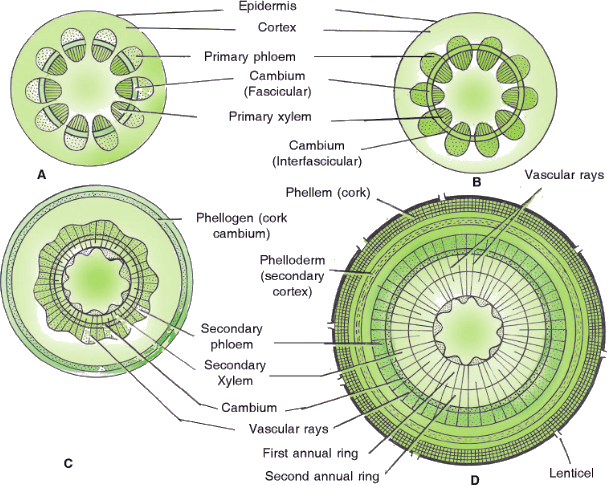 Secondary growth occurs due to the activity of the vascular cambium. It forms secondary xylem and phloem, increasing the girth of the plant. The cambium produces secondary xylem (wood) towards the inside and secondary phloem towards the outside. This growth is significant as it supports the plant structurally and increases its capacity to transport water and nutrients.
Read More: NCERT Solutions for Class 11 Biology Chapter 1
Q.4. Draw illustrations to bring out the anatomical difference between:
Answer:
(a) Monocot root and Dicot root :
- Monocot root : Vascular bundles are scattered.
- Dicot root : Vascular bundles are arranged in a central cylinder.
(b) Monocot stem and Dicot stem :
Monocot stem : Vascular bundles are scattered without a defined arrangement.
Dicot stem : Vascular bundles are arranged in a circle or ring.
Q.5. Cut a transverse section of the young stem of a plant from your school garden and observe it under a microscope. How would you ascertain whether it is a monocot stem or a dicot stem?
Answer:
Monocot stems can be identified by scattered vascular bundles, while dicot stems have vascular bundles arranged in a ring. Additionally, dicot stems show an open vascular bundle, while monocot stems have closed bundles.
Read More: NCERT Solutions for Class 11 Biology Chapter 2
Q.6. The transverse section of a plant material shows the following anatomical features: (a) the vascular bundles are conjoint, scattered, and surrounded by sclerenchymatous bundle sheaths. (b) Phloem parenchyma is absent. What will you identify it as?
Answer: Based on the features described, this section would belong to a Monocot stem . The scattered, conjoint vascular bundles and absence of phloem parenchyma are typical characteristics of monocots.
Q.7. Why are the xylem and phloem called complex tissues?
Answer: Xylem and phloem are considered complex tissues because they are composed of multiple cell types that work together. Xylem consists of tracheids, vessels, and fibers, while phloem consists of sieve tubes, companion cells, and phloem parenchyma.
Read More: CBSE Class 11 Biology Notes Chapter 3 Plant Kingdom
Q.8. What is the stomatal apparatus? Explain the structure of stomata with a labelled diagram.
Answer: The stomatal apparatus controls gas exchange and water loss in plants. It consists of two guard cells that regulate the opening and closing of the stomatal pore. The guard cells have chloroplasts and are responsible for the stomatal function, while surrounding subsidiary cells support the guard cells.
Q.9. Name the three basic tissue systems in flowering plants. Give the tissue names under each system.
Answer:
Epidermal tissue system : Includes epidermis and epidermal appendages like guard cells, root hairs, and glandular hairs.
Ground tissue system : Comprised of simple tissues such as parenchyma, collenchyma, and sclerenchyma.
Vascular tissue system : Contains complex tissues like xylem, phloem, and vascular cambium.
Q.10. How is the study of plant anatomy useful to us?
Answer:
The study of plant anatomy is useful to us in several ways:
- Understanding Plant Adaptations : By studying plant anatomy, we can understand how plants adapt to different environmental conditions, such as extreme climates, droughts, or high altitudes. This helps in improving plant cultivation practices and managing crops more effectively.
- Identification of Plant Species : Plant anatomy is crucial in identifying different plant species, especially monocots, dicots, and gymnosperms. This knowledge is useful for classification, conservation, and botanical research.
- Crop Improvement : The study of plant anatomy helps in understanding the physiological processes within plants, such as nutrient transport and photosynthesis. This aids in crop breeding and improvement, helping to increase agricultural productivity and food security.
- Commercial Use of Plant Products : Plant fibers, such as jute, flax, and cotton, have significant commercial value. Analyzing the anatomical structure of these fibers helps in understanding their strength and other properties, which is important for industries such as textiles and paper production.
- Medical and Pharmaceutical Applications : The anatomy of plants can help in identifying the presence of useful compounds, like medicinal alkaloids, that can be used in the development of drugs and treatments for various diseases.
Q.11. What is periderm? How does periderm formation take place in the dicot stems?
Answer:
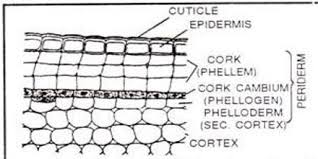
Periderm is the protective tissue that replaces the epidermis in plants during secondary growth. It consists of three main components:
- Phellogen (Cork Cambium) : A meristematic tissue that produces the other two components of the periderm.
- Phellem (Cork) : The outermost layer formed from the cells produced by the phellogen. These cells become suberized, making them impermeable to water and providing protection against mechanical injury and pathogen entry.
- Phelloderm (Secondary Cortex) : The inner layer formed by the phellogen, which consists of parenchyma cells.
Periderm Formation in Dicot Stems:
In dicot stems, during secondary growth, the epidermis and cortical tissues are often broken due to the expanding girth of the plant. To replace these layers, a new meristematic tissue called cork cambium (phellogen) is formed from the outer cortex cells. The cork cambium divides and forms new cells on both sides:
- Outer cells differentiate into cork (phellem), which contains suberin, making it water-resistant.
- Inner cells differentiate into phelloderm, which is composed of parenchymatous cells that help in storage and provide structural support.
Q.12. Describe the internal structure of a dorsiventral leaf with the help of a labelled diagram.
Answer:
A dorsiventral leaf has two distinct surfaces:
Epidermis : The upper epidermis is thicker and has fewer stomata, while the lower epidermis has more stomata.
Mesophyll : The tissue between the two epidermal layers, consisting of palisade parenchyma (tightly packed cells for photosynthesis) and spongy parenchyma (loose cells for gas exchange).
Vascular system : Vascular bundles in the leaf are conjoint and closed, surrounded by bundle sheath cells.

Read More: NCERT Solutions for Class 11 Biology Chapter 5
The Fabric of Plants: Meristematic and Permanent Tissues
At the heart of class 11 biology chapter 6 question answers is the classification of plant tissues based on their ability to divide. The source material defines tissues as groups of cells with a common origin and function.3 These are broadly categorized into Meristematic and Permanent tissues.4
Meristematic Tissues: These are the growth engines of the plant.5 Based on their location, they are divided into:
-
Apical Meristems: Found at the tips of roots and shoots, responsible for primary growth and elongation.6
-
Intercalary Meristems: Occur between mature tissues and help in regenerating parts removed by grazing herbivores.7
-
Lateral Meristems: Also known as secondary meristems (like vascular cambium), these are responsible for increasing the girth or thickness of the plant.8
Permanent Tissues: Once cells lose the ability to divide, they become permanent.9 These are further split into Simple Tissues (Parenchyma, Collenchyma, and Sclerenchyma) and Complex Tissues (Xylem and Phloem). Xylem serves as the water-conducting tissue, while Phloem is responsible for the translocation of food.10 Understanding the specific cell types, such as tracheids and vessels in xylem or sieve tubes and companion cells in phloem, is a critical part of the class 11 bio chapter 6 question answers curriculum.
Check Out: Class 11th Question Banks
Comparative Anatomy: Dicot vs. Monocot Structures
A significant portion of the class 11 biology chapter 6 question answer assamese medium and English resources focuses on the structural differences between dicotyledonous and monocotyledonous plants.11 The internal organization of roots and stems varies significantly between these two groups.
Dicot vs. Monocot Roots:
In a dicot root, the vascular bundles are usually fewer (diarch to hexarch), and the pith is small or inconspicuous. In contrast, monocot roots typically have more than six vascular bundles (polyarch) and a large, well-developed pith.
Dicot vs. Monocot Stems:
The arrangement of vascular bundles is a favorite topic in class 11 biology chapter 6 question answers. In dicot stems, vascular bundles are arranged in a ring, which is a characteristic feature.12 These bundles are "open" because they possess cambium, allowing for secondary growth.13 Monocot stems, however, have "closed" vascular bundles that are scattered throughout the ground tissue, surrounded by a sclerenchymatous bundle sheath.14
The Tissue System: Epidermal, Ground, and Vascular
The class 11 biology chapter 6 question answers categorize the plant body into three tissue systems based on their structure and location.15
-
Epidermal Tissue System: This forms the outermost covering. It includes epidermal cells, stomata, and epidermal appendages like trichomes (on stems) and root hairs.16 Stomata regulate transpiration and gaseous exchange, guarded by kidney-shaped (dicots) or dumb-bell shaped (monocots) guard cells.17
-
Ground Tissue System: This constitutes the bulk of the plant. It consists of simple tissues like parenchyma, collenchyma, and sclerenchyma. In leaves, the ground tissue consists of thin-walled chloroplast-containing cells called mesophyll.18
-
Vascular Tissue System: This consists of complex tissues, xylem and phloem.19 The arrangement of these tissues can be Radial (xylem and phloem on different radii, as in roots) or Conjoint (xylem and phloem on the same radius, as in stems and leaves).
Check Out: CBSE Class 11 Chapterwise 20 Most Probable Questions
Secondary Growth: The Process of Increasing Girth
Secondary growth is an increase in the thickness of the plant body caused by the activity of lateral meristems.20 This is a primary focus for students looking at class 11 biology chapter 6 question answer study rankers notes. It occurs mainly in dicot stems and roots but is absent in monocots.
The two lateral meristems involved are:
-
Vascular Cambium: It forms a complete ring and cuts off secondary xylem toward the inside and secondary phloem toward the outside. Due to seasonal variations, it produces Spring wood (lighter, with wider vessels) and Autumn wood (darker, with narrower vessels), which together form annual rings.
-
Cork Cambium (Phellogen): It develops in the cortex and produces cork (phellem) on the outside and secondary cortex (phelloderm) on the inside.21
A unique takeaway often omitted in standard summaries is the concept of Lenticels. While stomata handle gas exchange in leaves, lenticels are lens-shaped openings that develop in the bark of woody stems to facilitate gas exchange between the atmosphere and the internal tissues of the stem.22
The "Anatomical Signature"
While many study guides treat plant anatomy as a static map, a unique way to view these structures is as an "Anatomical Signature" of Environmental Stress. Plant tissues are not just fixed designs; they are historical records of the plant's struggle.23 For example, the ratio of xylem vessels to tracheids in a specific stem section acts as a "signature" of the water availability during that plant's growth period. Similarly, the thickness of the sclerenchyma in the bundle sheath of a monocot reflects the mechanical stress (wind or gravity) the plant had to overcome. Viewing anatomy this way transforms the class 11 biology chapter 6 question answers from a list of names into a story of biological resilience and engineering.
Also Check, CBSE Question Bank Class 11 Biology
PW Study Material for Class 11 Biology
Complete NCERT Syllabus Coverage
PW Study Material for Class 11 Biology is designed strictly as per the latest NCERT and CBSE syllabus. It covers all chapters in a clear and structured manner to ensure complete topic understanding.
Simple and Concept-Based Explanations
Complex biological concepts are explained in simple language with the help of diagrams and examples. This makes learning easy and helps students build strong fundamentals.
NCERT Solutions and Question Answers
The material includes detailed NCERT solutions and chapter-wise question answers to support board exam preparation and concept clarity.
Practice Questions and PYQs
Ample practice questions and previous years’ questions help students improve accuracy and exam confidence.
Revision Notes and Key Diagrams
Quick revision notes, important definitions, and labelled diagrams support effective revision before exams and entrance tests.
NCERT Solutions for Class 11 Biology Chapter 6 FAQs
1. What sets heartwood apart from sapwood?
Heartwood is the dark brown, hard center of the secondary xylem of old trees. This is because organic compounds have built up there. It doesn't work for conduction, but it does give mechanical support. The periphery portion, called sapwood, is lighter in color and helps move water.
2. Why don't monocotyledonous plants have secondary growth?
Lateral meristems, like vascular cambium, are needed for secondary growth to happen.24 Monocot vascular bundles are "closed" since they don't have cambium, therefore they can't grow again.25 This is a question that comes up a lot in chapter 6 of the class 11 biology book.
3. What is a "stelar" system in the context of plant anatomy?
All tissues on the inner side of the endodermis, such as pericycle, vascular bundles, and pith, constitute the stele. The organization of the stele varies between roots and stems and between dicots and monocots.
4. How does PW Study Material assist in learning class 11 biology chapter 6 question answers?
PW provides high-resolution diagrams and comparative charts that simplify the structural differences between plant groups, making it easier to memorize complex anatomical features for both boards and competitive exams.
5. What is the function of the Casparian strip?
Found in the endodermis of roots, the Casparian strip is a water-impermeable waxy material (suberin) that prevents water from leaking back out of the vascular cylinder, forcing it into the xylem.26