NCERT Solutions for Class 11 Maths Chapter 2 Relations and Functions
NCERT Solutions for Class 11 Maths: Relations and Functions form a strong base for learning calculus and advanced mathematics. This chapter helps students understand how inputs are connected to outputs through well-defined rules. With step-by-step explanations, students can easily learn concepts like Cartesian products, domain, range, and different types of functions. These relations and functions questions and answers make learning simple and structured, helping students clear doubts and improve problem-solving skills. A clear understanding of relations and functions is essential for tackling complex algebraic questions and performing well in school exams as well as competitive examinations.
Check Out: CBSE Class 11 Books
Class 11 Maths Relations and Functions Questions Answers
Exercise 2.1
Below is the NCERT Solutions for Class 11 Maths Chapter 2 Relations And Functions Exercise 2.1:
1. If NCERT Solutions Class 11 Mathematics Chapter 2 ex.2.1 - 1, find the values of x and y .
Solution: Given,NCERT Solutions Class 11 Mathematics Chapter 2 ex.2.1 - 2As the ordered pairs are equal, the corresponding elements should also be equal. Thus, x/3 + 1 = 5/3 and y – 2/3 = 1/3 Solving, we get x + 3 = 5 and 3y – 2 = 1 [Taking L.C.M and adding] x = 2 and 3y = 3 Therefore, x = 2 and y = 1
2. If set A has 3 elements and set B = {3, 4, 5}, then find the number of elements in (A × B).
Solution: Given, set A has 3 elements, and the elements of set B are {3, 4, and 5}. So, the number of elements in set B = 3 Then, the number of elements in (A × B) = (Number of elements in A) × (Number of elements in B) = 3 × 3 = 9 Therefore, the number of elements in (A × B) will be 9.
3. If G = {7, 8} and H = {5, 4, 2}, find G × H and H × G.
Solution: Given, G = {7, 8} and H = {5, 4, 2} We know that The Cartesian product of two non-empty sets, P and Q, is given as P × Q = {( p , q ): p ∈ P, q ∈ Q} So, G × H = {(7, 5), (7, 4), (7, 2), (8, 5), (8, 4), (8, 2)} H × G = {(5, 7), (5, 8), (4, 7), (4, 8), (2, 7), (2, 8)}
4. State whether each of the following statements is true or false. If the statement is false, rewrite the given statement correctly.
(i) If P = { m , n } and Q = { n , m }, then P × Q = {( m , n ), ( n , m )}.
(ii) If A and B are non-empty sets, then A × B is a non-empty set of ordered pairs ( x , y ) such that x ∈ A and y ∈ B.
(iii) If A = {1, 2}, B = {3, 4}, then A × (B ∩ Φ) = Φ.
Solution:
(i) The statement is False. The correct statement is If P = { m , n } and Q = { n , m }, then P × Q = {( m , m ), ( m , n ), ( n, m ), ( n , n )} (ii) True (iii) True
5. If A = {–1, 1}, find A × A × A.
Solution: The A × A × A for a non-empty set A is given by A × A × A = {( a , b , c ): a , b , c ∈ A} Here, it is given A = {–1, 1} So, A × A × A = {(–1, –1, –1), (–1, –1, 1), (–1, 1, –1), (–1, 1, 1), (1, –1, –1), (1, –1, 1), (1, 1, –1), (1, 1, 1)}
6. If A × B = {( a , x ), ( a , y ), ( b , x ), ( b , y )}. Find A and B.
Solution: Given, A × B = {( a , x ), ( a, y ), ( b , x ), ( b , y )} We know that the Cartesian product of two non-empty sets, P and Q, is given by P × Q = {( p , q ): p ∈ P, q ∈ Q} Hence, A is the set of all first elements, and B is the set of all second elements. Therefore, A = { a , b } and B = { x , y }
7. Let A = {1, 2}, B = {1, 2, 3, 4}, C = {5, 6} and D = {5, 6, 7, 8}. Verify that
(i) A × (B ∩ C) = (A × B) ∩ (A × C)
(ii) A × C is a subset of B × D
Solution: Given, A = {1, 2}, B = {1, 2, 3, 4}, C = {5, 6} and D = {5, 6, 7, 8} (i) To verify: A × (B ∩ C) = (A × B) ∩ (A × C) Now, B ∩ C = {1, 2, 3, 4} ∩ {5, 6} = Φ Thus, L.H.S. = A × (B ∩ C) = A × Φ = Φ Next, A × B = {(1, 1), (1, 2), (1, 3), (1, 4), (2, 1), (2, 2), (2, 3), (2, 4)} A × C = {(1, 5), (1, 6), (2, 5), (2, 6)} Thus, R.H.S. = (A × B) ∩ (A × C) = Φ Therefore, L.H.S. = R.H.S. Hence, verified (ii) To verify: A × C is a subset of B × D First, A × C = {(1, 5), (1, 6), (2, 5), (2, 6)} And, B × D = {(1, 5), (1, 6), (1, 7), (1, 8), (2, 5), (2, 6), (2, 7), (2, 8), (3, 5), (3, 6), (3, 7), (3, 8), (4, 5), (4, 6), (4, 7), (4, 8)} Now, it’s clearly seen that all the elements of set A × C are the elements of set B × D. Thus, A × C is a subset of B × D. Hence, verified
8. Let A = {1, 2} and B = {3, 4}. Write A × B. How many subsets will A × B have? List them.
Solution: Given, A = {1, 2} and B = {3, 4} So, A × B = {(1, 3), (1, 4), (2, 3), (2, 4)} Number of elements in A × B is n (A × B) = 4 We know that If C is a set with n (C) = m , then n [P(C)] = 2 m . Thus, the set A × B has 2 4 = 16 subsets And these subsets are as below: Φ, {(1, 3)}, {(1, 4)}, {(2, 3)}, {(2, 4)}, {(1, 3), (1, 4)}, {(1, 3), (2, 3)}, {(1, 3), (2, 4)}, {(1, 4), (2, 3)}, {(1, 4), (2, 4)}, {(2, 3), (2, 4)}, {(1, 3), (1, 4), (2, 3)}, {(1, 3), (1, 4), (2, 4)}, {(1, 3), (2, 3), (2, 4)}, {(1, 4), (2, 3), (2, 4)}, {(1, 3), (1, 4), (2, 3), (2, 4)}
9. Let A and B be two sets such that n (A) = 3 and n (B) = 2. If ( x , 1), ( y , 2), ( z , 1) are in A × B, find A and B, where x , y and z are distinct elements.
Solution: Given, n (A) = 3 and n (B) = 2; and ( x , 1), ( y , 2), ( z , 1) are in A × B. We know that A = Set of first elements of the ordered pair elements of A × B B = Set of second elements of the ordered pair elements of A × B. So, clearly, x , y , and z are the elements of A; and 1 and 2 are the elements of B. As n (A) = 3 and n (B) = 2, it is clear that set A = { x , y , z } and set B = {1, 2}.
10. The Cartesian product A × A has 9 elements, among which are found (–1, 0) and (0, 1). Find the set A and the remaining elements of A × A.
Solution: We know that If n (A) = p and n (B) = q, then n (A × B) = pq . Also, n (A × A) = n (A) × n (A) Given, n (A × A) = 9 So, n (A) × n (A) = 9 Thus, n (A) = 3 Also, given that the ordered pairs (–1, 0) and (0, 1) are two of the nine elements of A × A. And, we know in A × A = {( a, a ): a ∈ A}. Thus, –1, 0, and 1 have to be the elements of A. As n (A) = 3, clearly A = {–1, 0, 1} Hence, the remaining elements of set A × A are as follows: (–1, –1), (–1, 1), (0, –1), (0, 0), (1, –1), (1, 0), and (1, 1)
Exercise 2.2
1. Let A = {1, 2, 3, … , 14}. Define a relation R from A to A by R = {( x , y ): 3 x – y = 0, where x , y ∈ A}. Write down its domain, codomain and range.
Solution: The relation R from A to A is given as R = {( x , y ): 3 x – y = 0, where x , y ∈ A} = {( x , y ): 3 x = y , where x , y ∈ A} So, R = {(1, 3), (2, 6), (3, 9), (4, 12)} Now, The domain of R is the set of all first elements of the ordered pairs in the relation. Hence, Domain of R = {1, 2, 3, 4} The whole set A is the codomain of the relation R. Hence, Codomain of R = A = {1, 2, 3, …, 14} The range of R is the set of all second elements of the ordered pairs in the relation. Hence, Range of R = {3, 6, 9, 12}
2. Define a relation R on the set N of natural numbers by R = {( x , y ): y = x + 5, x is a natural number less than 4; x , y ∈ N}. Depict this relationship using roster form. Write down the domain and the range.
Solution: The relation R is given by
R = {( x , y ): y = x + 5, x is a natural number less than 4, x , y ∈ N } The natural numbers less than 4 are 1, 2, and 3. So, R = {(1, 6), (2, 7), (3, 8)} Now, The domain of R is the set of all first elements of the ordered pairs in the relation. Hence, Domain of R = {1, 2, 3} The range of R is the set of all second elements of the ordered pairs in the relation. Hence, Range of R = {6, 7, 8}
3. A = {1, 2, 3, 5} and B = {4, 6, 9}. Define a relation R from A to B by R = {( x , y ): the difference between x and y is odd; x ∈ A, y ∈ B}. Write R in roster form.
Solution: Given, A = {1, 2, 3, 5} and B = {4, 6, 9} The relation from A to B is given as R = {( x , y ): the difference between x and y is odd; x ∈ A, y ∈ B} Thus, R = {(1, 4), (1, 6), (2, 9), (3, 4), (3, 6), (5, 4), (5, 6)}
4. The figure shows a relationship between the sets P and Q. Write this relation
(i) in set-builder form (ii) in roster form.
What are their domain and range?
Solution: From the given figure, it’s seen that P = {5, 6, 7}, Q = {3, 4, 5} The relation between P and Q Set-builder form (i) R = {( x, y ): y = x – 2; x ∈ P} or R = {( x, y ): y = x – 2 for x = 5, 6, 7} Roster form (ii) R = {(5, 3), (6, 4), (7, 5)} Domain of R = {5, 6, 7} Range of R = {3, 4, 5}
5. Let A = {1, 2, 3, 4, 6}. Let R be the relation on A defined by
{( a , b ): a , b ∈ A, b is exactly divisible by a }.
(i) Write R in roster form.
(ii) Find the domain of R.
(iii) Find the range of R.
Solution: Given, A = {1, 2, 3, 4, 6} and relation R = {( a , b ): a , b ∈ A, b is exactly divisible by a } Hence, (i) R = {(1, 1), (1, 2), (1, 3), (1, 4), (1, 6), (2, 2), (2, 4), (2, 6), (3, 3), (3, 6), (4, 4), (6, 6)} (ii) Domain of R = {1, 2, 3, 4, 6} (iii) Range of R = {1, 2, 3, 4, 6}
6. Determine the domain and range of the relation R defined by R = {( x , x + 5): x ∈ {0, 1, 2, 3, 4, 5}}.
Solution: Given, Relation R = {( x , x + 5): x ∈ {0, 1, 2, 3, 4, 5}} Thus, R = {(0, 5), (1, 6), (2, 7), (3, 8), (4, 9), (5, 10)} So, Domain of R = {0, 1, 2, 3, 4, 5} and Range of R = {5, 6, 7, 8, 9, 10}
7. Write the relation R = {( x , x 3 ): x is a prime number less than 10} in roster form.
Solution: Given, Relation R = {( x , x 3 ): x is a prime number less than 10} The prime numbers less than 10 are 2, 3, 5, and 7. Therefore, R = {(2, 8), (3, 27), (5, 125), (7, 343)}
8. Let A = { x , y , z} and B = {1, 2}. Find the number of relations from A to B.
Solution: Given, A = { x , y , z} and B = {1, 2} Now, A × B = {( x , 1), ( x , 2), ( y , 1), ( y , 2), ( z , 1), ( z , 2)} As n (A × B) = 6, the number of subsets of A × B will be 2 6 . Thus, the number of relations from A to B is 2 6 .
9. Let R be the relation on Z defined by R = {( a , b ): a , b ∈ Z, a – b is an integer}. Find the domain and range of R.
Solution: Given, Relation R = {( a , b ): a , b ∈ Z, a – b is an integer} We know that the difference between any two integers is always an integer. Therefore, Domain of R = Z and Range of R = Z
Exercise 2.3
1. Which of the following relations are functions? Give reasons. If it is a function, determine its domain and range.
(i) {(2, 1), (5, 1), (8, 1), (11, 1), (14, 1), (17, 1)}
(ii) {(2, 1), (4, 2), (6, 3), (8, 4), (10, 5), (12, 6), (14, 7)}
(iii) {(1, 3), (1, 5), (2, 5)}
Solution:
(i) {(2, 1), (5, 1), (8, 1), (11, 1), (14, 1), (17, 1)} As 2, 5, 8, 11, 14, and 17 are the elements of the domain of the given relation having their unique images, this relation can be called a function. Here, domain = {2, 5, 8, 11, 14, 17} and range = {1} (ii) {(2, 1), (4, 2), (6, 3), (8, 4), (10, 5), (12, 6), (14, 7)} As 2, 4, 6, 8, 10, 12, and 14 are the elements of the domain of the given relation having their unique images, this relation can be called a function. Here, domain = {2, 4, 6, 8, 10, 12, 14} and range = {1, 2, 3, 4, 5, 6, 7} (iii) {(1, 3), (1, 5), (2, 5)} It’s seen that the same first element, i.e., 1, corresponds to two different images, i.e., 3 and 5; this relation cannot be called a function.
2. Find the domain and range of the following real function.
(i) f ( x ) = –| x | (ii) f(x) = √(9 – x 2 )
Solution:
(i) Given, f ( x ) = –| x |, x ∈ R We know that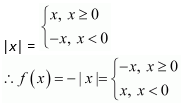 As f ( x ) is defined for x ∈ R, the domain of f is R. It is also seen that the range of f ( x ) = –| x | is all real numbers except positive real numbers. Therefore, the range of f is given by (–∞, 0]. (ii) f(x) = √(9 – x 2 ) As √(9 – x 2 ) is defined for all real numbers that are greater than or equal to –3 and less than or equal to 3, for 9 – x 2 ≥ 0 So, the domain of f ( x ) is { x : –3 ≤ x ≤ 3} or [–3, 3] Now, For any value of x in the range [–3, 3], the value of f ( x ) will lie between 0 and 3. Therefore, the range of f ( x ) is { x : 0 ≤ x ≤ 3} or [0, 3]
3. A function f is defined by f ( x ) = 2 x – 5. Write down the values of
(i) f (0), (ii) f (7), (iii) f (–3)
Solution:
Given, Function, f ( x ) = 2 x – 5 Therefore, (i) f (0) = 2 × 0 – 5 = 0 – 5 = –5 (ii) f (7) = 2 × 7 – 5 = 14 – 5 = 9 (iii) f (–3) = 2 × (–3) – 5 = – 6 – 5 = –11
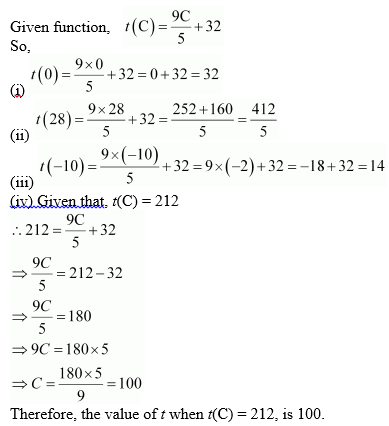
4. The function ‘ t ’, which maps temperature in degree Celsius into temperature in degree Fahrenheit is defined by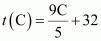 .
.
Find (i) t (0) (ii) t (28) (iii) t (–10) (iv) The value of C, when t (C) = 212
Solution:
5. Find the range of each of the following functions.
(i) f ( x ) = 2 – 3 x , x ∈ R, x > 0
(ii) f ( x ) = x 2 + 2, x is a real number.
(iii) f ( x ) = x , x is a real number.
Solution:
(i) Given, f(x) = 2 – 3 x , x ∈ R, x > 0 We have, x > 0 So, 3x > 0 -3x < 0 [Multiplying by -1 on both sides, the inequality sign changes.] 2 – 3x < 2 Therefore, the value of 2 – 3x is less than 2. Hence, Range = (–∞, 2) (ii) Given, f ( x ) = x 2 + 2, x is a real number
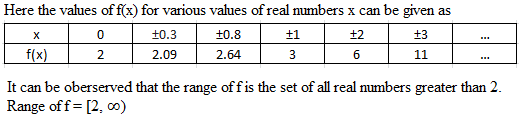 We know that x 2 ≥ 0 So, x 2 + 2 ≥ 2 [Adding 2 on both sides] Therefore, the value of x 2 + 2 is always greater or equal to 2, for x is a real number. Hence, Range = [2, ∞) (iii) Given, f ( x ) = x, x is a real number Clearly, the range of f is the set of all real numbers. Thus, Range of f = R
Check out: CBSE Class 11 Question Bank
Understand Concepts with Class 11 Maths Relations and Functions NCERT Solutions
Getting a grip on the second chapter of your textbook requires more than just memorizing a few formulas; it requires a deep grasp of how different sets interact with one another. When we look at the class 11 maths relations and functions chapter, we find it bridges the gap between basic set theory and advanced mathematical modeling. You'll start by learning about the Cartesian product of sets, which is simply the set containing all possible ordered pairs. This sounds simple, but it's the bedrock for defining what a relation actually is.
We know that a relation from set A to set B is a subset of the Cartesian product. To help you visualize this, we often use arrow diagrams. These diagrams show how elements from the first set "relate" to elements in the second. If you’re struggling with the exercise problems, using class 11 maths relations and functions ncert solutions helps clarify the distinction between a relation and a function. Every function is a relation, but not every relation is a function! That’s a vital part to remember when you're working through your homework or preparing for a class test.
Deep Dive into Class 11 Maths Relations and Functions Solutions
The systematic way that the class 11 math relations and functions solutions are set out makes sure you don't miss any important details about domain and range. The first elements in the ordered pairs make up the domain, while the second elements make up the range. The codomain is the whole second set. A lot of students mix up range with codomain, however our tutorials make it obvious that the range is always a part of the codomain.
|
Concept |
Description |
Key Takeaway |
|
Cartesian Product |
Set of all ordered pairs (a, b) |
Foundation of relations |
|
Relation |
Subset of Cartesian product |
Can have multiple outputs for one input |
|
Function |
Specific type of relation |
Each input has exactly one output |
|
Domain |
Set of all input values |
Essential for defining the function |
As you move through the exercises, you'll encounter different types of functions like the Identity function, Constant function, Polynomial function, and Rational function. Each has a unique graph. We suggest you practice drawing the Modulus function and the Signum function, as these frequently appear in exams. Don't forget the Greatest Integer Function! It might look intimidating, but once you see the "step" pattern on the graph, it becomes much easier to handle.
Solving Class 11 Maths Relations and Functions Miscellaneous Solutions
The miscellaneous exercise is where the real challenge lies because it blends all the concepts together. Using class 11 maths relations and functions miscellaneous solutions allows you to see how algebra is applied to functions. You’ll learn how to add, subtract, multiply, and divide two real functions. For instance, if you're adding two functions $f$ and $g$, the new domain is the intersection of the domains of $f$ and $g$.
We've found that students who spend extra time on the miscellaneous section tend to perform better in their final exams. It forces you to think critically. You aren't just following a template; you're applying logic. Whether it’s finding the domain of a square root function or determining the range of a fraction, these problems build the "math muscle" you need. If a denominator equals zero, the function is undefined. You must exclude those points from the domain immediately.
Strategies for Class 11 Maths Relations and Functions Important Questions
When it boils down to the final stretch of your revision, focusing on class 11 maths relations and functions important questions is a smart move. Focus on problems that ask you to find the domain and range of real-valued functions. These are the "bread and butter" of the chapter. Another common question type involves verifying if a given relation qualifies as a function based on the "one-output-per-input" rule.
-
Understand the Vertical Line Test: If a vertical line touches a graph at more than one point, it's not a function.
-
Practice Square Roots: Remember that the value inside a square root must be greater than or equal to zero for real functions.
-
Check Denominators: Never let the bottom of a fraction be zero, or you'll run into trouble.
-
Visualize with Graphs: Don't just solve algebraically; try to imagine what the function looks like on a coordinate plane.
We understand that maths can feel overwhelming at times. However, if you take it step-by-step, the logic starts to click. You don't have to be a genius to master this; you just need to be consistent. Every time you solve a problem from the class 11 maths relations and functions ncert solutions, you're one step closer to an A+. At the end of the day, these concepts will reappear in Class 12, so building a strong foundation now is a gift to your future self.
The PW Store offers comprehensive study materials that mirror these logical steps. We provide solved examples that break down the "why" behind every "how." Don't just copy the answers; try to understand the flow of the logic. If you can explain the concept of a "function" to a friend, you've truly mastered it. We're here to support that journey with clear, concise, and accurate resources.
Read: CBSE Class 11 Question Bank PDF Download
Benefits of PW CBSE Class 11 Study Material
1. NCERT-Based Content
PW CBSE Class 11 study material is strictly aligned with the latest NCERT syllabus, helping students prepare confidently for school exams.
2. Simple and Clear Explanations
Concepts are explained in easy language, making even tough topics simple to understand.
3. Chapter-wise Notes & Questions
Well-structured notes with practice questions help in quick revision and better concept clarity.
4. Exam-Oriented Approach
Important questions, examples, and solved problems focus on scoring well in exams.
5. Strong Foundation for Class 12 & Competitive Exams
The material builds strong basics needed for Class 12, JEE, NEET, and other competitive exams.
|
- |
|
NCERT Solutions for Class 11 Maths Relations and Functions FAQs
Q1: What sets a relation apart from a function?
A: A function is a specific type of relation in which each input has just one output. A relation is any set of ordered pairs.
Q2: How can I figure out what the domain of a real function is?
A: The domain is the set of all real numbers that the function can take and give a real number.
Q3: What does it mean for a function to be constant?
A: It's a function where the output stays the same no matter what the input is. It's generally represented as $f(x) = c$.
Q4: Is it possible for the range to be bigger than the codomain?
A: No, the range is always a part of the codomain, which means it is either smaller than or the same size as the codomain.
Q5: Why is it vital to do different kinds of exercise?
A: It brings together different ideas, giving you the high-level practice you need for competitive exams and a better grasp of the chapter.