NCERT Solutions for Class 12 Maths Chapter 6 Exercise 6.4 (Applications of Derivatives)
Mastering calculus in senior secondary school is often about understanding how small changes accumulate or influence a larger system. When students look for class 12 aod ncert solutions, they are typically navigating the transition from theoretical differentiation to practical application. Exercise 6.4 of Chapter 6 (Applications of Derivatives) focuses specifically on the concept of "Approximations." This section is a very crucial bridge between the principles in class 12 aod ncert solutions 6.2 (which speaks about functions that go up and down) and the harder optimisation problems in class 12 aod ncert solutions 6.4. When students utilise differentials to estimate values, they realise that calculus isn't only about locating exact points on a graph. It's also about being able to make reasonable guesses about what will happen. You need to grasp how linear approximations operate if you want to do well on board exams and competitive tests, whether you're looking at a class 12 aod ncert solutions pdf or your textbook.
Check out: CBSE Class 12th Books
NCERT Solutions for Class 12 Maths Chapter 6 Exercise 6.4
Solve The Following Questions NCERT Solutions for Class 12 Maths Chapter 6 Exercise 6.4:
Question 1. Using differentials, find the approximate value of each of the following up to 3 places of decimal:
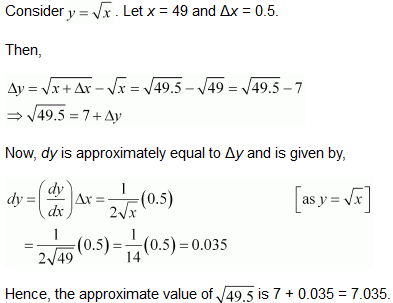
(i) √25.3 (ii)√49.5 (iii)√0.6 (iv)(0.009) 1/3 (v)(0.999) 1/10 (vi) (15) 1/4 (vii) (26) 1/3 (viii) (255)1/4 (ix) (82) 1/4 (x) (401)1/2 (xi) (0.0037)1/2 (xii) (26.57) 1/3 (xiii) (81.5) 1/4 (xiv) (3.968) 3/2 (xv) (32.15) 1/5 Solution : (i) √25.3 (ii) √49.5
 (iii) √0.6
(iv) (0.009) 1/3 (v) (0.999) 1/10
 (vi) (15) 1/4
 (vii) (26) 1/3
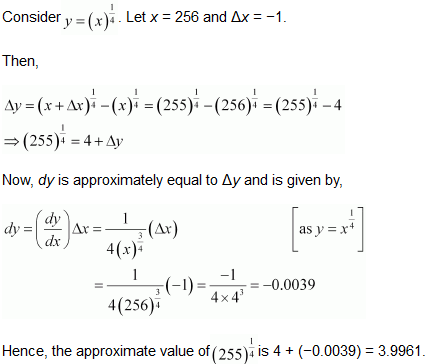
 (viii) (255)1/4
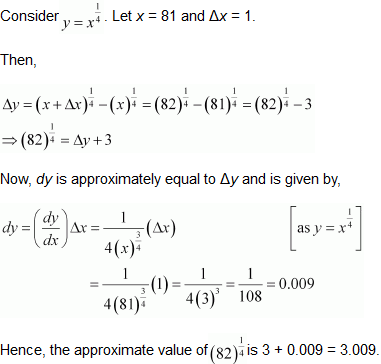
 (ix) (82) 1/4
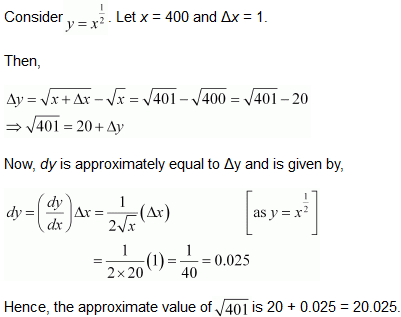
 (x) (401)1/2
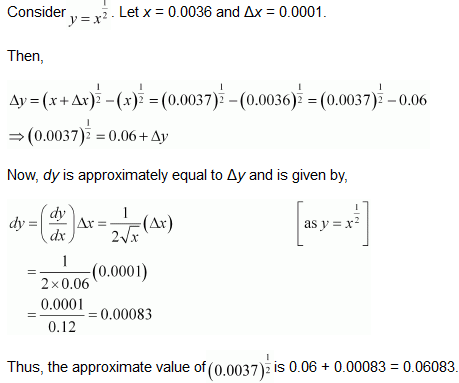
 (xi) (0.0037)1/2
 (xii) (26.57) 1/3
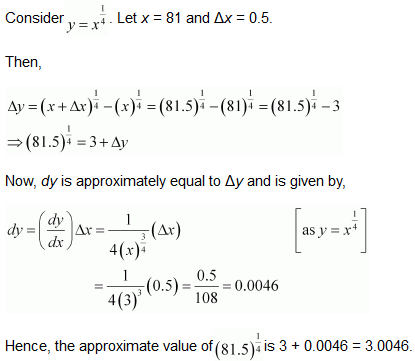
 (xiii) (81.5) 1/4
 (xiv) (3.968) 3/2
 (xv) (32.15) 1/5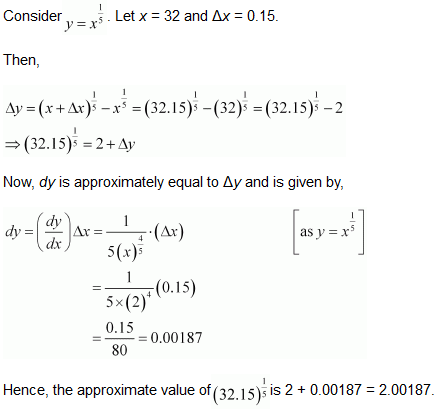
Question 2. Find the approximate value off (2.01), where f(x) = 4x 2 + 5x + 2 Solution :

Hence, the approximate value of f (2.01) is 28.21.
Question 3. Find the approximate value of f (5.001), wheref (x) =x 3 − 7x 2 + 15. Solution :
Hence, the approximate value of f (5.001) is −34.995.
Read More: NCERT Solutions for Class 12 Maths Chapter 6 Exercise 6.1
Question 4. Find the approximate change in the volume of a cube of side x meters caused by increasing the side by 1%. Solution :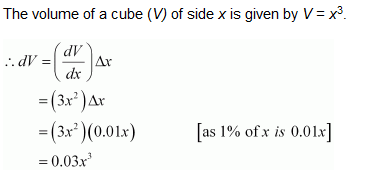 Hence, the approximate change in the volume of the cube is 0.03 x 3 m 3 .
Question 5. Find the approximate change in the surface area of a cube of side x meters caused by decreasing the side by 1%. Solution : The surface area of a cube ( S) of side x is given by S = 6 x 2 .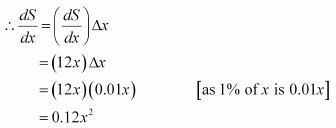
Hence, the approximate change in the surface area of the cube is 0.12 x 2 m 2 .
Read More: NCERT Solutions for Class 12 Maths Chapter 6 Exercise 6.2
Question 6. If the radius of a sphere is measured as 7 m with an error of 0.02 m, then find the approximate error in calculating its volume. Solution : Let r be the radius of the sphere and Δ r be the error in measuring the radius. Then, r = 7 m and Δ r = 0.02 m Now, the volume V of the sphere is given by, Hence, the approximate error in calculating the volume is 3.92 π m 3 .
Question 7. If the radius of a sphere is measured as 9 m with an error of 0.03 m, then find the approximate error in calculating its surface area. Solution : Let r be the radius of the sphere and Δ r be the error in measuring the radius. Then, r = 9 m and Δ r = 0.03 m Now, the surface area of the sphere ( S) is given by, S = 4πr 2
Hence, the approximate error in calculating the surface area is 2.16π m 2 .
Question 8. Iff (x) = 3x 2 + 15x + 5, then the approximate value of f (3.02) is A. 47.66 B. 57.66 C. 67.66 D.77.66 Solution :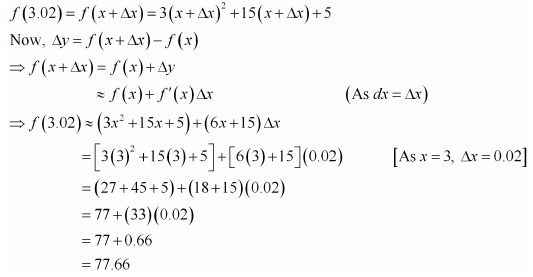
Therefore, option (D) is correct.
Question 9. The approximate change in the volume of a cube of sidex metres caused by increasing the side by 3% is A. 0.06x 3 m 3 B. 0.6x 3 m 3 C. 0.09x 3 m 3 D.0.9x 3 m 3 Solution : The volume of a cube ( V ) of side x is given by V = x 3 .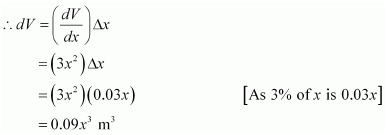
Therefore, option (C) is correct.
Read More: NCERT Solutions for Class 12 Maths Chapter 6 Exercise 6.5
Understanding the Core Concept of Approximations in Class 12 AoD NCERT Solutions
The fundamental logic of class 12 aod ncert solutions 6.4 revolves around the differential. In previous sections, such as class 12 aod ncert solutions 6.4, the focus was heavily on tangents and normals. Exercise 6.4 takes that tangent logic and applies it to find the approximate value of numbers that are difficult to calculate manually, such as the square root of 25.3 or the cube root of 0.009.
The core formula used throughout these solutions is f(x + \Delta x) \approx f(x) + f'(x)\Delta x. Here, x is chosen as a number whose root or power is easily known, and \Delta x is the small "increment" or "error" that deviates from that perfect number. If someone asks you to find \sqrt{25.3}, you would set x = 25 and \Delta x = 0.3. You may find out how much that adjustment of 0.3 impacts the final outcome by using the derivative of the function f(x) = √x. This method is much faster than long-division square root methods, and it is how calculators do internal estimates.
The Micro-Linearity Principle: A Unique Perspective on Approximations
While most textbooks and online guides explain Exercise 6.4 as a simple plug-and-play formula, there is a deeper "Original Framing" that helps in visualizing these problems: The Micro-Linearity Principle.
Think of a curve (like a square root graph) as a winding mountain road. If you look at the entire mountain, it is clearly curved. However, if you look at just one inch of that road under a microscope, it appears perfectly straight. This "straightness" is the tangent. Exercise 6.4 is like saying that the curve is a straight line for a very short distance (Delta x). The "Unique Insight" here is that the "error" in our approximation is really the distance between the straight line and the curve. When \Delta x gets smaller, this gap almost goes away. That's why the answers to this problem are called "approximations" instead of "exact values." Understanding that you are treating a curve as a temporary straight line makes it much easier to remember why we multiply the derivative (the slope of that line) by the change in x.
Breaking Down the Steps in Class 12 AoD NCERT Solutions 6.4
To solve questions in Exercise 6.4 effectively, students must follow a disciplined four-step process. This structure is consistent across the class 12 aod ncert solutions provided by experts.
-
Function Identification: First, define the function f(x). If the question asks for a square root, f(x) = \sqrt{x}. If it’s a cube root, f(x) = x^{1/3}.
-
Splitting the Value: Identify a "perfect" value x near the given number and calculate the difference \Delta x. This requires a bit of number sense. For instance, for (0.009)^{1/3}, the nearest perfect cube is 0.008.
-
Finding the Derivative: Calculate f'(x). This is where the knowledge from class 12 aod ncert solutions 6.4 regarding basic differentiation comes into play.
-
Substitution: Plug the values into the approximation formula y + \Delta y = f(x) + f'(x)\Delta x.
This systematic approach ensures that even if the numbers are cumbersome, the logic remains infallible. It reduces the chance of calculation errors which are common when students try to skip steps.
Check Out: Class 12th Sample Papers
Geometric Errors and Percentage Change in Exercise 6.4
Beyond calculating roots, Exercise 6.4 deals with geometric approximations. This involves finding the approximate change in the volume or surface area of a shape when its dimensions change slightly. For example, if the radius of a sphere increases by 1%, how does that affect its volume?
In these cases, the "relative error" and "percentage error" are key. The source material highlights that:
-
Absolute Error is simply \Delta x.
-
Relative Error is \Delta x / x.
-
Percentage Error is (\Delta x / x) \times 100.
You use the derivative of the area or volume formula to solve these. The volume V of a cube with side x is x^3. The volume change dV is equal to 3x^2 dx. If the side gets 1% bigger, dx = 0.01x. You can use this in the derivative formula to determine the rough change in volume without having to properly calculate (1.01x)^3. This particular application is a favourite among board examiners since it examines both calculus skills and knowledge of geometry.
Why You Should Use a Class 12 AoD NCERT Solutions PDF for Revision
Mathematics is a subject of patterns. When you use a class 12 aod ncert solutions pdf, you aren't just looking for answers; you are looking for the "flow" of logic. Comparing class 12 aod ncert solutions 6.4 with class 12 aod ncert solutions 6.5 (Maxima and Minima) allows you to see the progression of the "Application of Derivatives" chapter.
In 6.4, we use the derivative to find a nearby value. In 6.5, we use the derivative to find the highest or lowest possible value. Having a PDF resource allows you to jump between these sections to see how the derivative—which is essentially just a rate of change—is the common thread linking every exercise. It also serves as a quick reference for the various derivative formulas of geometric shapes (cubes, spheres, cones) which are frequently used in Exercise 6.4.
Benefits of PW Class 12 Study Material
1. Complete Syllabus Coverage
PW Class 12 Study Material is designed according to the latest CBSE syllabus and NCERT guidelines. All subjects and chapters are covered in detail, ensuring students do not miss any important topics for board exams.
2. Concept-Based Learning
The study material focuses on explaining concepts clearly and logically. Topics are broken down into simple steps, making it easier for students to understand and apply them in exams.
3. NCERT-Oriented Content
Since most board exam questions are based on NCERT, PW study material strictly follows NCERT textbooks. Important definitions, formulas, and examples are well explained.
4. Exam-Oriented Notes and Questions
PW Class 12 material includes short notes, important questions, and practice problems. This helps students understand the exam pattern and improve their answer-writing skills.
5. Easy Revision and Quick Recall
Key points, diagrams, and formulas are highlighted for quick revision. Students can revise entire chapters in less time before exams.
6. Practice with Sample Papers and PYQs
The study material often includes sample papers and previous year questions. This helps students understand the marking scheme and gain confidence.
7. Helpful for Competitive Exam Preparation
PW Class 12 Study Material also supports preparation for exams like JEE and NEET by strengthening core concepts from Class 12.
Also Check, Class 12th Question Banks
FAQs on NCERT Solutions for Class 12 Maths Exercise 6.4
Q1: What is the most important formula in NCERT Solutions 6.4 for Class 12 AoD?
The main formula is f(x + \Delta x) \approx f(x) + f'(x)\Delta x. When there is a tiny change in the input value (x), it is used to obtain the approximate value of a function.
Q2: How do I pick the value of "x" when I'm trying to guess?
You should pick a value for x that is as close as possible to the number given and has a "easy" or "perfect" value for the function given. For instance, if you want to find \sqrt{36.6}, you should pick x = 36 because \sqrt{36} is 6.
Q3: Does the PW Study Material cover both Exercise 6.4 and Exercise 6.5?
Yes, the PW Study Material has everything you need to know about the Applications of Derivatives chapter, including thorough notes and practice questions for Exercise 6.4 (Approximations) and Exercise 6.5 (Maxima and Minima).
Q4: Is there a Class 12 AoD NCERT Solutions PDF on the PW platform?
Yes, PW has PDFs and study notes that you can download that show you how to solve NCERT problems step by step. These materials are meant to assist students study quickly and offline, which will help them do well on their tests.