NCERT Solutions for Class 8 Civics Chapter 5 Judiciary
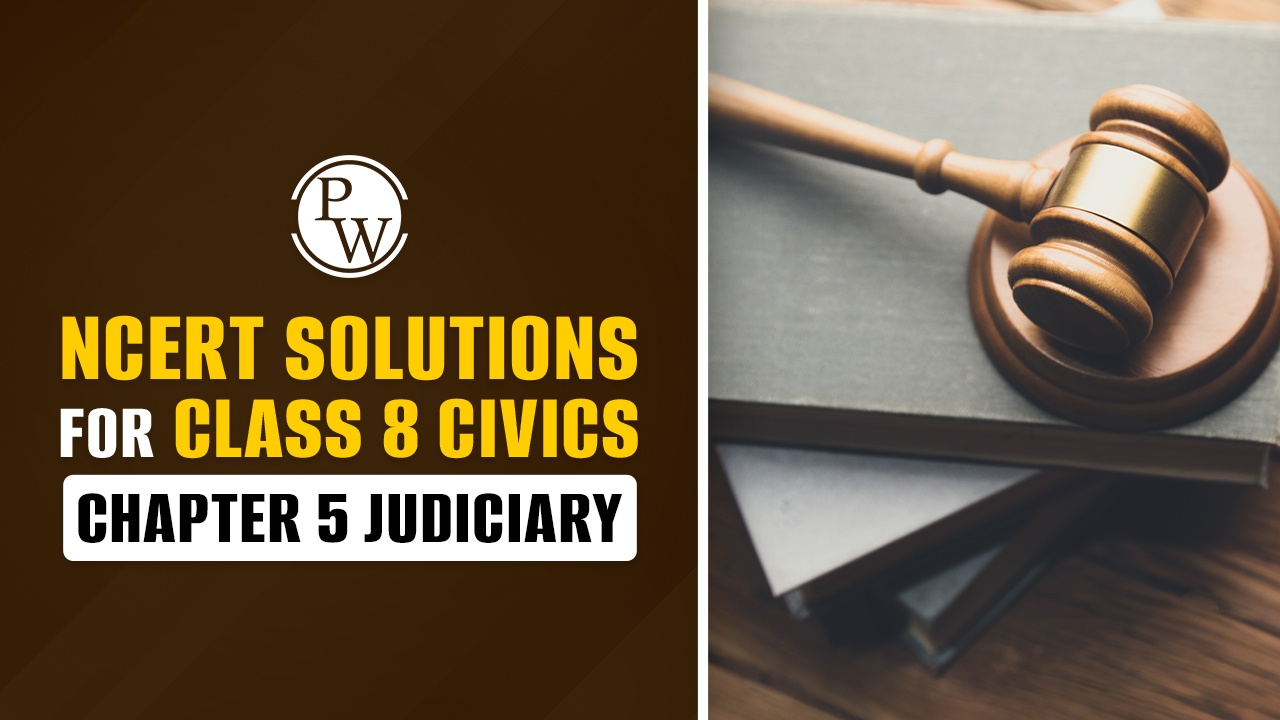
NCERT Solutions for Class 8 Civics Chapter 4
NCERT Solutions for Class 8 Civics Chapter 4 serves as a guide that gives easy-to-understand explanations to all the textbook questions. This chapter is important because it explains how courts help keep our country fair and safe. By learning about the judiciary, you can know how laws are applied and how judges make decisions to protect everyone’s rights. These class 8 judiciary question answers make it easier for you to understand these key concepts simply.
Class 8 Civics Chapter 5, “Judiciary”, talks about the role of courts in a democracy. It explains the structure of Indian courts and why an independent judiciary is needed. Judges must make fair decisions without being influenced by the government or other powers. The chapter also teaches how courts protect citizens’ fundamental rights and make sure laws are followed properly.
To help you learn better, these solutions include detailed judiciary class 8 questions and answers. By studying them, you can understand the chapter better and write the right answers in exams. Keep reading to find all the complete class 8 civics judiciary question answers for effective preparation.
Check Out: Class 8th Books
NCERT Class 8 Civics Chapter 5 Judiciary Question Answer
Find out these NCERT Class 8 Civics Chapter 5 Judiciary question answers to practise and revise the important points of the chapter. These will make it easier for you to remember key ideas and answer questions confidently.
NCERT Chapter 5 Judiciary Class 8 Questions and Answers
Q1. You read that one of the main functions of the judiciary is upholding the Law and Enforcing Fundamental Rights. Why do you think an independent Judiciary is necessary to carry out this important function?
Ans: No doubt, the most important function of the judiciary is to uphold the law and enforce Fundamental Rights. It protects the Fundamental Rights from being eroded, abridged or infringed upon by any person, group of persons or the state itself. An independent judiciary is necessary because if the judiciary is under the influence of the executive and members of the legislative houses, it won’t be able to give fair decisions.
Q2. Re-read the list of Fundamental Rights provided in Chapter 1. How do you think the Right the Constitutional Remedies connects to the idea of judicial review?
Ans: List of the Fundamental Rights:
a. Right to equality.
b. Right to Freedom.
c. Right to freedom of religion.
d. Right against exploitation.
e. Cultural and Education Rights.
f. Right to Constitutional remedies.
The right to Constitutional remedies allows a citizen to move to the court if they believe that any of the fundamental rights have been violated by the state. This right connects to the idea of judicial review also says that the judiciary has the power to strike down a popular law of the Parliament if it believes that there is a violation of the basic structure of the constitution.
Hence, it is clear that the right to constitutional remedies connects to the idea of judicial review
Q3. In the following illustration, fill in each tier with the judgments given by the various courts in the Sudha Goel case. Check your responses with others in class.
Ans.
i. The trial (lower) court convicted Laxman, his mother Shakuntla and his brother-in-law Subhash Chandra and sentenced all three of them to death.
ii. The High Court gave the judgment that Sudha had died due to an accidental fire caused by the Kerosene stove; Laxman, Shakuntla and Subhash Chandra were acquitted.
iii. The Supreme Court heard the arguments of the lawyers and reached a decision that was different from that of the High Court. They found Laxman and his mother guilty, but acquitted the brother-in-law, Subhash Chandra. But they did not have enough evidence against him. The Supreme Court decided to send the accused to prison for life.
Q4. Keeping the Sudha Goel case in mind, tick the sentences that are true and correct the ones that are false.
a. The accused took the case to the High Court because they were unhappy with the decision of the Trial Court.
b. They went to the High Court after the Supreme Court had given its decision.
c. If they don’t like the Supreme Court verdict, the accused can go back again to the Trial Court.
Answer:
a. True.
b. False: The decision of the Supreme Court is full and final.
c. False: The Supreme Court is the apex court of the country, and no appeal can be filed against the decision of the Supreme Court.
Q5. Why do you think the introduction of Public Interest Litigation (PIL) in the 1980s is a significant step in ensuring access to justice for all?
Ans. The introduction of Public Interest Litigation (PIL) in the 1980s is a significant step in ensuring access to justice for all because any individual or organisation is allowed to file a PIL in a High Court or the Supreme Court on behalf of those who are themselves unable to file a case, even if their rights are violated. The legal process is simplified, and a simple letter or telegram addressed to a High Court or the Supreme Court is to be regarded as a PIL.
Q6. Re-read the excerpts from the judgment on the Olga Tellis vs Bombay Municipal Corporation case. Now write in your own words what the judges meant when they said that the right to livelihood is part of the right to life.
Ans. The judges in Olga Tellis vs. Bombay Municipal Corporation observed an equally important fact of right to life is the right to livelihood because no person can live without the means of living, that is, the means of livelihood.
Trying to protect the livelihood of the slum dwellers, the judges decided that the eviction of a person from a pavement or slum will inevitably lead to the deprivation of his means of livelihood and consequently to the deprivation of life.
The Right of Life conferred by Article 21 is wide and far-reaching. Life means something more than mere animal existence.
Q7. Write a story around the theme, “Justice delayed is justice denied.”
Answer: The delay in giving justice amounts to a negation of the principle of justice.
A story around the theme runs like this:
Gopal took a loan of Rs. 1,00,000 from a moneylender for the marriage of his daughter. As he was coming back, a thief snatched the bag of money from him. He screamed, and luckily the people in the locality helped him to take his bag from the thief. However, the bag first went to the police custody, and the case took a long time in the court so that Gopal could not get the money on time, and the marriage of his daughter was cancelled, and he was also mentally harassed. Hence, it is true to say, “Justice delayed is justice denied.”
Q8. Make sentences with each of the glossary words given below:
a. Acquit
b. To appeal
c. Compensation
d. Eviction
e. Violation
Answer:
a. Acquit: He was honourably acquitted of blame by a court-martial.
b. To appeal: Our school made efforts for fundraising for the tsunami appeal.
c. Compensation: The court granted huge compensation to the young lady after the divorce.
d. Eviction: Unlawful eviction and harassment are criminal offences in the United Kingdom.
e. Violation: Violation of traffic rules can lead to huge losses.
Q9. The following is a poster made by the Right to Food campaign.
Read this poster and list the duties of the government to uphold the right to food.
How does the phrase “Hungry stomachs, overflowing godowns! We will not accept it!” used in the poster relate to the photo essay on the Right to Food?
Answer: The Constitution of India grants citizens the right to live. The right to live is closely associated with the right to food.
The duties of the government to uphold the right to food are:
(a) To provide at least a minimum food item to the people either totally free or charging a very nominal cost.
(b) To check the hoarding of wheat, rice, and sugar.
(c) To provide midday meals to the poor children in the school.
‘Hungry stomachs, overflowing godowns’ is not at all acceptable in a civilised society. Instead, the need of the hour is Guru Nanak’s saying,” oaM[KK] {KaM[KKA” If the hoarding of food is not discouraged, the people with hungry stomachs will attempt to commit crimes.
Read More: NCERT Solutions for Class 8 Civics Chapter 1
NCERT Solutions for Class 8 Civics Chapter 5 Judiciary
NCERT Class 8 Civics Chapter 5 The judiciary helps students understand one of the most important parts of our democracy, which is the judicial system. This chapter explains how the courts in India protect our rights and ensure fairness in society.
With the help of these NCERT Solutions for Class 8 Civics Chapter 5, you can easily learn these key concepts. Here are some additional benefits of the class 8 civics chapter judiciary question answers:.
Useful for Exam Preparation:
All the class 8 civics chapter 5 judiciary question answers are written as per the latest CBSE syllabus. These help you to write correct and complete answers in exams.
Give Complete Chapter Coverage:
Each class 8 judiciary question answer is explained clearly, covering all important points from the chapter. This makes it easier for students to revise the whole chapter quickly.
Easy and flexible learning:
You can use these class 8 civics judiciary question answers anytime, either online or offline. The chapter-wise format helps you study in a systematic and organised way.
Build strong concept understanding:
By reading the NCERT Class 8 Civics Chapter 5 Judiciary Question, you get a clear idea of how courts work in India. It builds a strong base for higher classes and helps you understand how laws protect every citizen.
Check Out: Students Stationery Items
NCERT Class 8 Civics Chapter 5 Judiciary Brief Summary
In order to understand the NCERT Solutions for Class 8 Civics Chapter 5 and write answers effectively on your own, it is important that you're well versed with the chapter's summary as well, which is given here:
1. Role of the Judiciary
The judiciary is responsible for solving different kinds of disputes, such as disputes between citizens, between the government and citizens, or even between different government bodies. It makes sure that laws are followed properly and that everyone gets fair treatment under the law.
2. Judicial Review
One of the main functions of the judiciary is judicial review. Through this, the courts can check whether the laws made by Parliament or the state assemblies are fair and follow the Constitution. If a law goes against the Constitution, the judiciary has the power to cancel it.
3. Independence of the Judiciary
The chapter highlights the importance of an independent judiciary. Judges must be free from the control of the government or any outside influence. This independence helps ensure that all decisions are fair, honest, and based only on the law.
4. Structure of the Judiciary
The Indian judicial system has three main levels. At the top is the Supreme Court, followed by High Courts in each state, and then District Courts at the local level. This structure helps manage cases at different levels and makes sure that justice reaches every corner of the country.
5. Rule of Law
The judiciary makes sure that the rule of law is maintained. This means everyone, rich or poor, is equal before the law. No one is above the law, and all cases must be handled through proper legal procedures.
6. Access to Justice
The chapter also explains that every citizen has the right to go to court if they feel their fundamental rights are being violated. This makes sure that justice is served to all and that the Constitution is protected at all times.
Also Read: How to Become Topper in Class 8
NCERT Solutions for Class 8 Civics Chapter 5 FAQs
Q.1. What is the theme of the NCERT Class 8 Civics Chapter 5?
Ans. The main theme of NCERT Class 8 Civics Chapter 5 is the importance of the judiciary in a democracy. It explains how courts protect people’s rights, solve disputes, and make sure that everyone follows the law fairly.
Q.2. Where can I find the class 8 civics chapter judiciary question answers?
Ans. You can find all the class 8 civics chapter judiciary question answers in the above article for easy learning and revision.
Q.3. What is the role of the judiciary?
Ans. The role of the judiciary is to solve disputes between people, between the government and citizens, and between different government bodies. It also makes sure that laws are followed properly and everyone gets justice.
Q.4. Does the NCERT class 8 civics chapter 5 judiciary question answer come in the final exam?
Ans. Yes, questions from the NCERT Class 8 Civics Chapter 5 Judiciary Question Answer are often asked in the final exams. So, students should read and practice them well to understand the chapter and score better marks.
Q.5. What is the structure of courts in India?
Ans. The Indian court system has three levels: the Supreme Court at the top, the High Courts in each state, and the District or Subordinate Courts at the local level.