NCERT Solutions for Class 8 Maths Chapter 13 Direct and Inverse Proportion
Class 8 maths direct and inverse proportion is a vital mathematical concept that explains how two quantities change in relation to each other. When one value increases, the other either increases at a constant rate or decreases proportionally. Understanding these relationships helps you solve real-world problems involving speed, time, work, and resource management accurately and very efficiently.
Check out: Class 8th Books
Understanding Class 8 Maths Direct and Inverse Proportion
When two amounts, x and y, change simultaneously in such a way that their ratio (x/y) stays the same, this is called direct proportion. The overall cost increases up if you buy additional pens. On the other hand, inverse proportion means that when one value goes up, the other goes down. For instance, adding additional people to a job usually makes the overall time it takes to finish go down a lot.
Core Concepts of Proportionality
-
Direct Variation: Represented as x/y = k. If x doubles, y must also double.
-
Inverse Variation: Represented as x \times y = k. If x increases, y decreases to keep the product the same.
-
The Constant 'k': This is the fixed value that defines the relationship between your two variables.
Real-World Examples
|
Situation |
Type of Proportion |
|
Distance traveled vs. Fuel used |
Direct |
|
Speed of car vs. Time taken |
Inverse |
|
Number of students vs. Food duration |
Inverse |
|
Weight of sugar vs. Total cost |
Direct |
NCERT Solution for Class 8 Maths Chapter 13
NCERT Solutions for Class 8 Maths Exercise 13.1
Question 1.
Following are he car parking charges near a railway station up to:
4 hours Rs.60
8 hours Rs.100
12 hours Rs.140
24 hours Rs.180
Check if the parking charges are in direct proportion to the parking time.
Solution :
Charges per hour:
Therefore, the parking charges are not in direct proportion to the parking time.
Question 2.
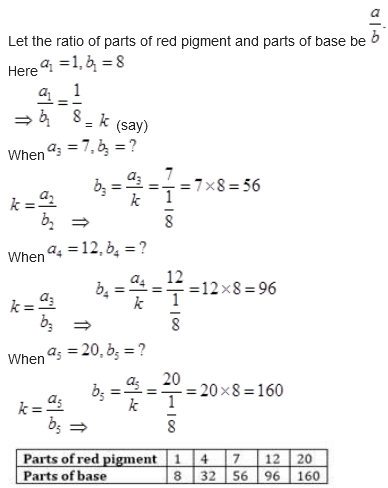
A mixture of paint is prepared by mixing 1 part of red pigments with 8 parts of base. In the following table, find the parts of base that need to be added.
Solution :
Question 3.
In Question 2 above, if 1 part of a red pigment requires 75 mL of base, how much red pigment should we mix with 1800 mL of base?
Solution :
Let the parts of red pigment mix with 1800 mL base be x.

Since it is in direct proportion.
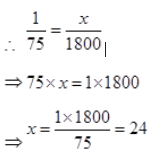
Hence with base 1800 mL, 24 parts red pigment should be mixed.
Question 4.
A machine in a soft drink factory fills 840 bottles in six hours. How many bottles will it fill in five hours?

Solution :
Let the number of bottles filled in five hours be x.
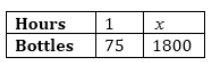
Here ratio of hours and bottles are in direct proportion.
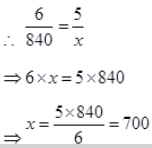
Hence machine will fill 700 bottles in five hours.
Question 5.
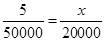
A photograph of a bacteria enlarged 50,000 times attains a length of 5 cm as shown in the diagram. What is the actual length of the bacteria? If the photograph is enlarged 20,000 times only, what would be its enlarged length?
Solution :
Let enlarged length of bacteria be x.
Actual length of bacteria
=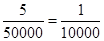 cm =
cm = cm
cm
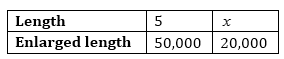
Here length and enlarged length of bacteria are in direct proportion.
∴
⇒
⇒ ⇒= 2 cm
Hence the enlarged length of bacteria
is 2 cm.
Question 6.
In a model of a ship, the mast is 9 cm high, while the mast of the actual ship is 12 m high. If the length if the ship is 28 m, how long is the model ship?

Solution :
Let the length of model ship be x.
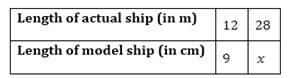
Here length of mast and actual length of ship are in direct proportion.
∴
⇒
⇒ = 21 cm
Hence length of the model ship is 21 cm.
Question 7.
Suppose 2 kg of sugar contains 9
 crystals. How many sugar crystals are there in (i) 5 kg of sugar? (ii) 1.2 kg of sugar?
Solution :
(i) Let sugar crystals be x.
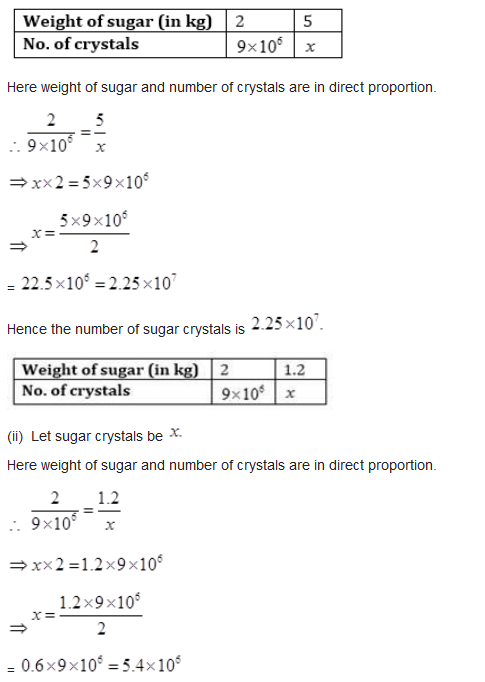
Hence the number of sugar crystals is
Question 8.
Rashmi has a road map with a scale of 1 cm representing 18 km. She drives on a road for 72 km. What would be her distance covered in the map?
Solution :
Let distance covered in the map be x.
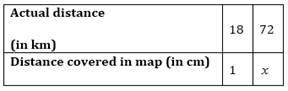
Here actual distance and distance covered in the map are in direct proportion.
⇒


 = 4 cm
Hence distance covered in the map is 4 cm.
Question 9 .
A 5 m 60 cm high vertical pole casts a shadow 3 m 20 cm long. Find at the same time (i) the length of the shadow cast by another pole 10 m 50 cm high (ii) the height of a pole which casts a shadow 5 m long.
Solution :
Here height of the pole and length of the shadow are in direct proportion.
And 1 m = 100 cm
5 m 60 cm = 5100 + 60 = 560 cm
3 m 20 cm = 3100 + 20 = 320 cm
10 m 50 cm = 10100 + 50 = 1050 cm
5 m = 5100 = 500 cm
(i) Let the length of the shadow of another pole be x.
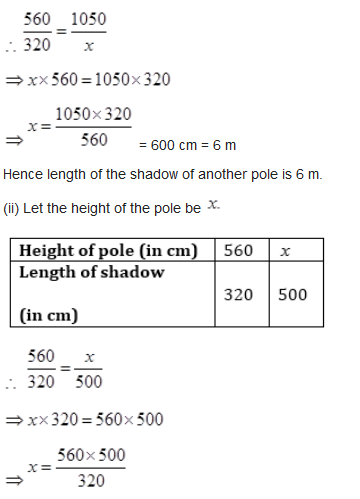
= 875 cm = 8 m 75 cm
Hence height of the pole is 8 m 75 cm.
Question 10.
A loaded truck travels 14 km in 25 minutes. If the speed remains the same, how far can it travel in 5 hours?
Solution :
Let distance covered in 5 hours be x km.
∵ 1 hour = 60 minutes
∴ 5 hours = 560 = 300 minutes
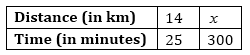
Here distance covered and time in direct proportion.
∴
⇒
⇒ = 168 km
Read More: NCERT Solution for Class 8 Maths Chapter 1 Rational Numbers
NCERT Solutions for Class 8 Maths Exercise 13.2
Question 1.
Which of the following are in inverse proportion:
(i) The number of workers on a job and the time to complete the job.
(ii) The time taken for a journey and the distance travelled in a uniform speed.
(iii) Area of cultivated land and the crop harvested.
(iv) The time taken for a fixed journey and the speed of the vehicle.

(v) The population of a country and the area of land per person.
Solution :
(i) The number of workers and the time to complete the job is in inverse proportion
because less workers will take more time to complete a work and more workers will take less time to complete the same work.
(ii) Time and distance covered in direct proportion.
(iii) It is a direct proportion because more are of cultivated land will yield more crops.
(iv) Time and speed are inverse proportion because if time is less, speed is more.
(v) It is a inverse proportion. If the population of a country increases, the area of land per person decreases.
Question 2.
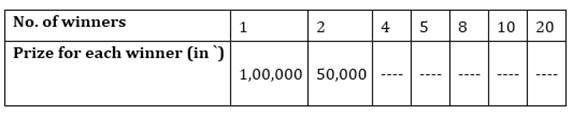
In a Television game show, the prize money of Rs.1,00,000 is to be divided equally amongst the winners. Complete the following table and find whether the prize money given to an individual winner is directly or inversely proportional to the number of winners:
Solution :
Here number of winners and prize money are in inverse proportion because winners are increasing, prize money is decreasing.
When the number of winners are 4, each winner will get = = Rs. 25,000
When the number of winners are 5, each winner will get = 100000/5= Rs. 20,000
When the number of winners are 8, each winner will get =100000/8 = Rs. 12,500
When the number of winners are 10, each winner will get = 100000/10 = Rs. 10,000
When the number of winners are 20, each winner will get = 100000/20 = Rs. 5,000
Question 3.
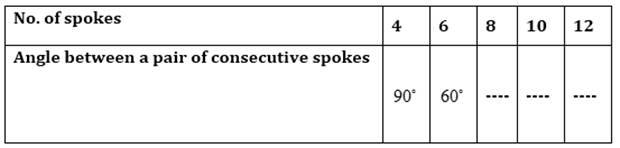
Rehman is making a wheel using spokes. He wants to fix equal spokes in such a way that the angles between any pair of consecutive spokes are equal. Help him by completing the following table:
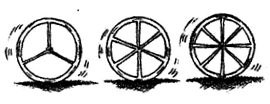
(i) Are the number of spokes and the angles formed between the pairs of consecutive spokes in inverse proportion?
(ii) Calculate the angle between a pair of consecutive spokes on a wheel with 15 spokes.
(iii) How many spokes would be needed, if the angle between a pair of consecutive spokes is 40°?
Solution :
Here the number of spokes are increasing and the angle between a pair of consecutive spokes is decreasing. So, it is a inverse proportion and angle at the centre of a circle is 360°.
When the number of spokes is 8, then angle between a pair of consecutive spokes = 360°/8 = 45°
When the number of spokes is 10, then angle between a pair of consecutive spokes= 360°/10 = 36°
When the number of spokes is 12, then angle between a pair of consecutive spokes= 360°/12 = 30°
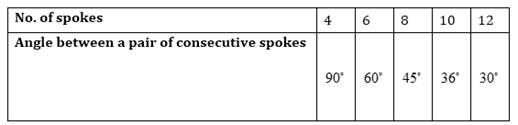
(i) Yes, the number of spokes and the angles formed between a pair of consecutive spokes is in inverse proportion.
(ii) When the number of spokes is 15, then angle between a pair of consecutive spokes= .360°/15 = 24°
(iii) The number of spokes would be needed = 360°/40 = 9°
Question 4.
If a box of sweets is divided among 24 children, they will get 5 sweets each. How many would each get, if the number of the children is reduced by 4?
Solution :
∵ Each child gets = 5 sweets
∴ 24 children will get 24 × 5 = 120 sweets
Total number of sweets = 120
If the number of children is reduced by 4, then children left = 24 – 4 = 20
Now each child will get sweets = 120 / 20
= 6 sweets
Question 5.
A farmer has enough food to feed 20 animals in his cattle for 6 days. How long would the food last if there were 10 more animals in his cattle?
Solution :
Let the number of days be x.
Total number of animals = 20 + 10 = 30
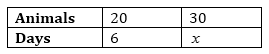
Here the number of animals and the number of days are in inverse proportion.
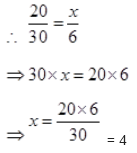
Hence the food will last for four days.
Question 6.
A contractor estimates that 3 persons could rewire Jasminder’s house in 4 days. If, he uses 4 persons instead of three, how long should they take to complete the job?
Solution :
Let time taken to complete the job be x.
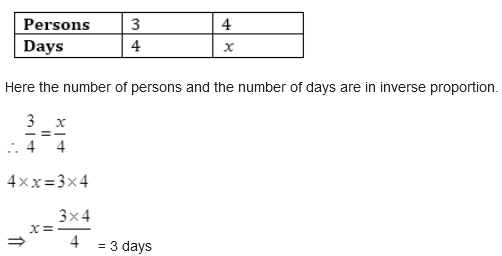
Hence they will complete the job in 3 days.
Question 7.
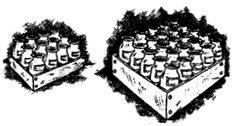
A batch of bottles was packed in 25 boxes with 12 bottles in each box. If the same batch is packed using 20 bottles in each box, how many boxes would be filled?
Solution :
Let the number of boxes be x.
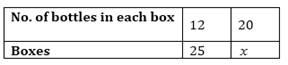
Here the number of bottles and the number of boxes are in inverse proportion.
∴ 12 /20 = x /25
⇒
⇒ x 12 × 25 / 20= 15
Hence 15 boxes would be filled.
Question 8.
A factory requires 42 machines to produce a given number of articles in 63 days. How many machines would be required to produce the same number of articles in 54 days?
Solution :
Let the number of machines required be x.

Here the number of machines and the number of days are in inverse proportion.
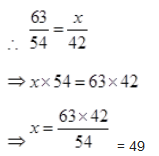
Hence 49machineswould be required.
Question 9.
A car takes 2 hours to reach a destination by travelling at the spe^ed of 60 km/hr. How long will it take when the car travels at the speed of 80 km/hr?
Solution :
Let the number of hours be x.
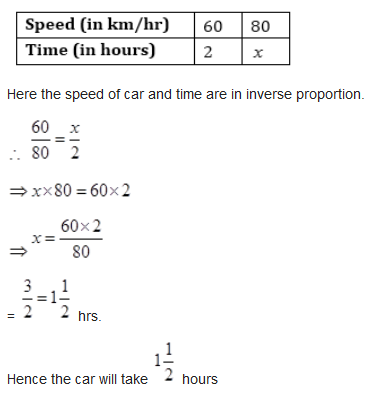
to reach its destination.
Question 10.
Two persons could fit new windows in a house in 3 days.
(i) One of the persons fell ill before the work started. How long would the job take now?
(ii) How many persons would be needed to fit the windows in one day?
Solution :
(i) Let the number of days be x.
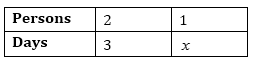
Here the number of persons and the number of days are in inverse proportion.

⇒ x × 1 = 2 × 3
⇒ x = 2×3 /1= 6 days
(ii) Let the number of persons be x.
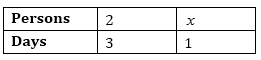
Here the number of persons and the number of days are in inverse proportion.
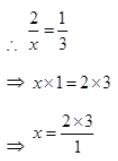
= 6 persons
Question 11.
A school has 8 periods a day each of 45 minutes duration. How long would each period be, if the school has 9 periods a day, assuming the number of school hours to be the same?
Solution :
Let the duration of each period be x.
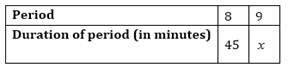
Here the number of periods and the duration of periods are in inverse proportion.

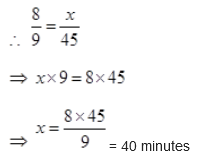
Hence duration of each period would be 40 minutes.
Read More: NCERT Solution for Class 8 Maths Chapter 2
Master Class 8 Maths Direct and Inverse Proportion Solutions
To excel in exams, you need to follow a step-by-step approach for solving these problems. The class 8 maths direct and inverse proportion solutions emphasize identifying which type of variation is at play before you start calculating. Always look for the "unitary method" or the "cross-multiplication method" mentioned in the NCERT guidelines to ensure your logic stays sound.
Steps to Solve Direct Proportion
-
Identify the two variables (e.g., x and y).
-
Set up the ratio: x_1/y_1 = x_2/y_2.
-
Substitute the known values into the equation.
-
Solve for the unknown variable using cross-multiplication.
Steps to Solve Inverse Proportion
-
Identify variables where one goes up and the other goes down.
-
Set up the product equation: x_1 \times y_1 = x_2 \times y_2.
-
Plug in the given numbers.
-
Divide to find the missing value.
Read More: NCERT Solution for Class 8 Maths Chapter 11
Class 8 Maths Direct and Inverse Proportions Exercise 11.2
Focusing on class 8 maths direct and inverse proportions exercise 11.2 is crucial because it specifically targets inverse relationships. You'll often find questions about pipes filling a tank or people completing a job. We've seen that students often confuse these with direct variation, so we recommend checking if the "total work" or "total quantity" remains fixed throughout the problem.
Key Problem Types in Exercise 11.2
-
Work and Time: If 15 men build a wall in 48 hours, how many men do we need for 30 hours?
-
Speed and Time: A car takes 2 hours to reach a place at 60 km/h; find the time at 80 km/h.
-
Distribution: Dividing sweets among a changing number of children.
Quick Check Table for Exercise 11.2
|
If x increases... |
And y decreases... |
It is Inverse Proportion |
|
More Workers |
Less Time |
Yes |
|
Higher Speed |
Less Time |
Yes |
|
More Guests |
Less Food per Person |
Yes |
Class 8 Maths Direct and Inverse Proportion Extra Questions
Practicing class 8 maths direct and inverse proportion extra questions helps you handle tricky exam scenarios. Sometimes, questions don't explicitly state the type of proportion. You must analyze the logic. For instance, if a map scale is given, that’s always direct. If the gears of a machine are turning, that is usually an inverse relationship based on the number of teeth.
Sample Extra Practice Problems
-
Map Scales: If 1 cm on a map represents 18 km, what does 72 km represent?
-
Electric Poles: If a 14m pole casts a 10m shadow, find the height of a tree with a 15m shadow.
-
Pump Efficiency: If 8 pumps empty a tank in 20 minutes, how long for 10 pumps?
Why Extra Practice Matters
-
It builds speed for the final exam.
-
You learn to identify "hidden" inverse proportions.
-
It prepares you for competitive Olympiad-style questions.
Class 8 Maths Direct and Inverse Proportion Solutions PDF
Having a class 8 maths direct and inverse proportion solutions pdf on your device allows for offline study and quick revision. Chapter 13 Direct and Inverse Proportion PDFs usually contain solved examples from Link 1, Link 2, and Link 3, ensuring you don't miss any variation of a problem. We suggest keeping a printed copy of the formula sheet to glance at before you start your homework.
Benefits of Using the PDF Guide
-
Structured Learning: Concepts are organized from easy to difficult levels.
-
Diagrams: Visual aids help you understand the "ratio" concept better.
-
Summary Notes: You get a quick recap of the x/y = k and xy = k rules.
How to Use the Solutions Effectively
Don't just copy the answers from the PDF. Read the problem, try it yourself, and then use the solution to check your logic. If your answer is wrong, look at the "constant of proportion" used in the guide to see where you tripped up. This method ensures you actually learn the math instead of just finishing the task.
Check Out: School Books
Chapter 13 Direct and Inverse Proportion FAQs
-
What is the main difference between direct and inverse proportion?
In direct proportion, both values move in the same direction (both up or both down). In inverse proportion, they move in opposite directions (one up, one down). -
Which formula do I use for direct proportion?
You should use the ratio formula x_1/y_1 = x_2/y_2. This keeps the relationship between the two quantities constant. -
How do I identify an inverse proportion problem?
Ask yourself: "If I increase one value, will the other logically decrease?" If the answer is yes, like speed and time, it's inverse. -
Is map reading a direct or inverse proportion?
Map reading is always a direct proportion. As the distance on the paper increases, the actual distance on the ground also increases proportionally -
How can I tell if a table shows direct or inverse proportion?
To check for direct proportion, divide each pair of values (x/y); if the result is always the same number, it's direct. To check for inverse proportion, multiply each pair (x \times y); if the product is constant for every pair, it is inverse.