NCERT Solutions for Class 9 Chapter 12 Heron’s Formula
One of the most important concepts in Class 9 is Heron's formula class 9 questions with solutions. This is a very useful formula because it helps you find the area of a triangle with the help of only lengths of its sides. This formula is different from the usual way to find the area of a triangle (½ base × height). It does not require us to know the height, one can easily find the area of a triangle only with the semi-perimeter and the lengths of the triangle's sides instead.
This blog will show you the NCERT Solutions for Class 9 Maths Chapter 12 Heron's Formula in a clear and easy-to-follow way so that you can understand the idea and use it to solve problems in your textbook. This blog will help you understand and use Heron's Formula, whether you're studying for school tests or just brushing up on your geometry skills.
Check Out: Class 9th Books
Heron’s Formula Class 9 Questions with Solutions Overview
In class 9 maths herons formula, the concept is introduced as a life-saver for working on complex shapes.
What are the Key Components of the Calculation for Heron’s Formula?
-
Sides: Let the three sides of the triangle be represented by the letters a, b, and c.
-
Semi-perimeter (s): This is calculated as: s = (a + b + c) / 2.
-
The Area Formula: Area = Square Root of [ s(s - a)(s - b)(s - c) ].
Why Heron’s Formula Is So Important?
-
It works for scalene triangles where the vertical height is hard to find.
-
It helps in calculating the area of complex quadrilaterals by splitting them into two triangles.
-
It is perfect for real-life land measurement problems involving uneven fields.
|
Term |
Symbol |
Definition |
|
Semi-perimeter |
s |
Half of the total sum of all three sides |
|
Sides |
a, b, c |
The lengths of the triangle's three boundaries |
|
Area |
A |
The total surface space contained inside the triangle |
Check Out: Class 9th Sample Papers
Heron’s Formula Class 9 Questions With Solutions
Practice the below class 9 maths Heron's formula questions. Most questions follow a simple pattern: find the third side if it is missing, calculate 's', and then find the area.
NCERT Solutions for Class 9 Maths Exercise 12.1
NCERT Solutions for Class 9 Maths Exercise 12.1 guide students in applying Heron’s Formula to find areas of triangles. Step-by-step explanations simplify complex problems, helping students strengthen geometry skills and prepare for exams along with CBSE class 9 sample papers.
(Questions 1–6 content as provided)
Question 1. A traffic signal board, indicating ‘SCHOOL AHEAD’, is an equilateral triangle with side a. Find the area of the signal board, using Heron’s formula.If its perimeter is 180 cm, what will be the area of the signal board?
Solution:
Let each side of the equilateral triangle be a.
Semi-perimeter of the triangle,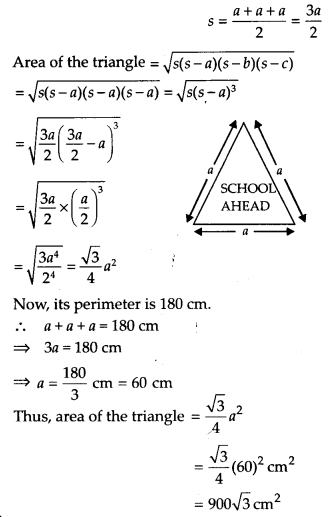
Question 2. The triangular side walls of a flyover have been used for advertisements. The sides of the walls are 122 m, 22 m and 120 m (see figure). The advertisements yield an earning of ₹5000 per m² per year. A company hired one of its walls for 3 months. How much rent did it pay?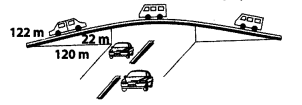
Solution:
Let the sides of the triangular will be
a = 122m, b = 12cm, c = 22m
Semi-perimeter, s =
( )m =
)m = m = 132m
The area of the triangular side wall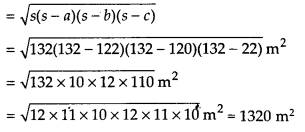
Rent for 1 year (i.e. 12 months) per m2 = Rs. 5000
∴ Rent for 3 months per m2 = Rs. 5000 x
= Rent for 3 months for 1320 m2
= Rs. 5000 xx 1320 = Rs. 16,50,000.
Question 3. There is a slide in a park. One of its side Company hired one of its walls for 3 months.walls has been painted in some colour with a message “KEEP THE PARK GREEN AND CLEAN” (see figure). If the sides of the wall are 15 m, 11 m and 6m, find the area painted in colour.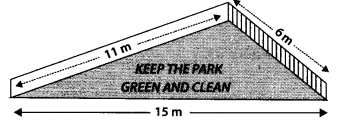
Solution:
Let the sides of the wall be
a = 15m, b = 11m, c = 6m
Semi-perimeter,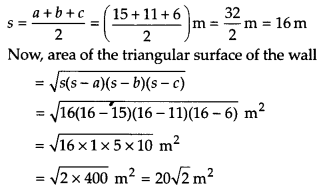
Thus, the required area painted in colour
= 20√2 m2
Question 4. Find the area of a triangle two sides of which are 18 cm and 10 cm and the perimeter is 42 cm.
Solution:
Let the sides of the triangle be a
=18 cm, b = 10 cm and c = x cm
Since, perimeter of the triangle
= 42 cm
∴ 18cm + 10 cm + xcm = 42
x = [42 – (18 + 10)cm = 14cm
Now, semi-permimeter, s = cm = 21 cm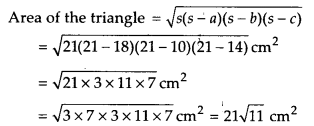
Thus, the required area of the triangle
= 21 cm2
cm2
Question 5. Sides of a triangle are in the ratio of 12 : 17 : 25 and its perimeter is 540 cm. Find its area.
Solution:
Let the sides of the triangle be
a = 12x cm, b = 17x cm, c = 25x cm
Perimeter of the triangle = 540 cm
Now, 12x + 17x + 25x = 540
⇒ 54x = 54 ⇒ x = 10
∴ a = (12 x10)cm = 120cm,
b = (17 x 10) cm = 170 cm
and c = (25 x 10)cm = 250 cm
Now, semi-perimeter, s = cm = 270 cm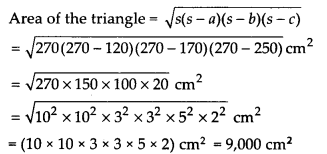
Question 6. An isosceles triangle has perimeter 30 cm and each of the equal sides is 12 cm. Find the area of the triangle.
Solution:
Let the sides of an isosceles triangle be
a = 12cm, b = 12cm,c = x cm
Since, perimeter of the triangle = 30 cm
∴ 12cm + 12cm + x cm = 30 cm
⇒ x = (30 – 24) = 6
Now, semi-perimeter, s = cm =15 cm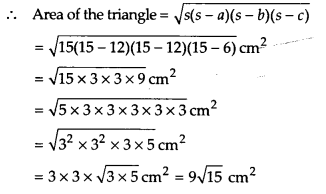
Thus, the required area of the triangle
= 9√15 cm2
Read More: NCERT Solutions for Class 9 Maths chapter-1 Number Systems
NCERT Solutions for Class 9 Maths Exercise 12.2
NCERT Solutions for Class 9 Maths Exercise 12.2 help students practice advanced problems on Heron’s Formula. The detailed solutions enhance problem-solving skills and build a strong conceptual understanding, supporting preparation according to the cbse class 9 syllabus. These solutions are a vital part of cbse class 9 maths ncert solutions and exam preparation.
(Questions 1–9 content as provided)
Question 1. A park, in the shape of a quadrilateral ABCD has C =
C = AB = 9 m, BC = 12 m, CD = 5 m and AD = 8 m. How much area does it occupy?
Solution:
Since BD divides quadrilateral ABCD in two triangles:
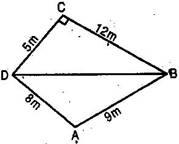
(i) Right triangle BCD and (ii) ABD.
ABD.
In right triangle BCD, right angled at C,
therefore, Base = CD = 5 m and Altitude = BC = 12 m
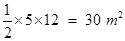
 Area ofBCD =
 =
=
InABD, AB = 9 m, AD = 8 m
And BD = [Using Pythagoras theorem]
 BD =
BD = =
= =
= = 13 m
Now, Semi=perimeter ofABD = = 15 m
Using Heron’s formula,
Area ofABD =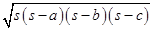
= =
=
= =
=
 (approx.)
 Area of quadrilateral ABCD = Area ofBCD + Area ofABD
= 30 + 35.4

Question 2. Find the area of a quadrilateral ABCD in which AB = 3 cm, BC = 4 cm, CD = 4 cm, DA = 5 cm and AC = 5 cm.
Solution:
In quadrilateral ABCE, diagonal AC divides it in two triangles,ABC andADC.
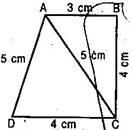
InABC, Semi-perimeter ofABC = = 6 cm
Using Heron’s formula,
Area ofABC =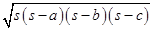
=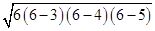 =
=

Again, InADC, Semi-perimeter ofADC = = 7 cm
Using Heron’s formula, Area ofABC =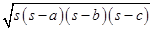
= =
= = 2
= 2
 (approx.)
Now area of quadrilateral ABCD = Area ofABC + Area ofADC
= 6 + 9.2

Question 3. Radha made a picture of an aeroplane with coloured paper as shown in figure. Find the total area of the paper used.
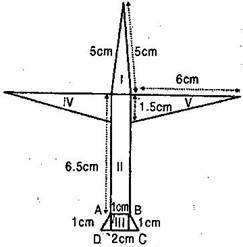
Solution:
Area of triangular part I: Here, Semi-perimeter
 = 5.5 cm
Therefore, Area =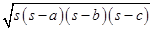
=
= =
=

Area of triangular part II = Length x Breadth
Area of triangular part III (trapezium):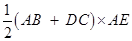
= (AB + DC)
 =(1 + 2)
=
 =
=

Area of triangular parts IV & V:

Total area = 2.4825 + 6.2 + 1.299 + 9
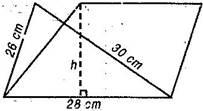
Question 4. A triangle and a parallelogram have the same base and the same area. If the sides of the triangle are 26 cm, 29 cm and 30 cm and the parallelogram stands on the base 28 cm, find the height of the parallelogram.
Solution:
Semi-perimeter of triangle =
= = 42 cm
Using Heron’s formula,
Area of triangle =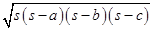
=
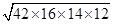
=

According to question, Area of parallelogram = Area of triangle
 Base x Corresponding height = 336
 = 336
= 336
Height = 12 cm
Question 5. A rhombus shaped field has green grass for 18 cows to graze. If each side of the rhombus is 30 m and its longer diagonal is 48 m, grass of how much area of grass field will each cow be getting?
Solution:
Here, AB = BC = CD = DA = 30 m and Diagonal AC = 48 m which divides the rhombus ABCD in two congruent triangle.
Area ofABC = Area ofACD
Now, Semi-perimeter ofABC =
= = 54 m
Now Area of rhombus ABCD = Area ofABC + Area ofACD
= 2 Area ofABC [
 Area ofABC = Area ofACD]
= [ Using Heron’s formula]
=
= =
=

 Field available for 18 cows to graze the grass
Field available for 1 cow to graze the grass =

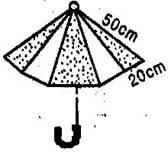
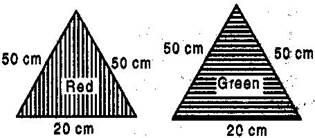
Question 6. An umbrella is made by stitching 10 triangular pieces of cloth of two different colours (see figure), each piece measuring 20 cm, 50 cm and 50 cm. How much cloth of each colour is required for the umbrella?
Solution:
Here, sides of each of 10 triangular pieces of two different colours are 20 cm, 50 cm and 50 cm.
Semi-perimeter of each triangle= = 60 cm
Now, Area of each triangle =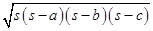
=
=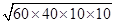 =
=
According to question, there are 5 pieces of red colour and 5 pieces of green colour.
Cloth required for 5 red pieces = =
=
And Cloth required to 5 green pieces ==
Question 7. A kite is in the shape of a square with a diagonal 32 cm and an isosceles triangle of base 8 cm and sides 6 cm each is to be made of three different shades as shown in figure.
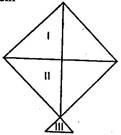
How much paper of each side has been used in it?
Solution:
Let ABCD is a square of side cm and diagonals AC = BD = 32 cm
In right triangle ABC, [Using Pythagoras theorem]


 = 512
= 512
Area of square [Area of square =
 ]
]
Diagonal BD divides the square in two equal triangular parts I and II.
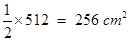
Area of shaded part I = Area of shaded part II
=
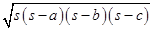
Now, semi-perimeter of shaded part III
 = 10 cm
Area of shaded part III
=
=
= =
=

Question 8. A floral design on a floor is made up of 16 tiles which are triangular, the sides of the triangle being 9 cm, 28 cm and 35 cm (see figure). Find the cost of polishing the tiles at the rate of 50 paise per cm2.
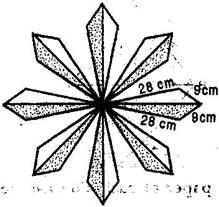
Solution:
Here, Sides of a triangular shaped tile area 9 cm, 28 cm and 35 cm.
Semi-perimeter of tile =
= = 36 cm
Area of triangular shaped tile =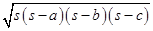
=
= =
=
 (approx.)
Area of 16 such tiles (Approx.)
 Cost of polishing
 of tile = Rs. 0.50
Cost of polishing of tile
= = Rs. 705.60 (Approx.)
Question 9. A field is in the shape of a trapezium whose parallel sides are 25 m and 10 m. The non-parallel sides are 14 m and 13 m. Find the area of the field.
Solution:
Let ABCD be a field in the shape of trapezium and parallel side AB = 10 m & CD = 25 m
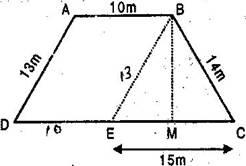
And Non-parallel sides AD = 13 m and BC = 14 m
Draw BM DC and BE
 AD so that ABED is a parallelogram.
BE = AD = 13 m and DE = AB = 10 m
Now inBEC, Semi-perimeter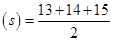
= 21 m
Area ofBEC =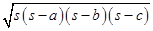
=
= =
=
And Area ofBEC =

 = 84
= 84
 = 84
= 84
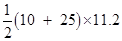
BM = = 11.2 m
Now area of trapezium ABCD =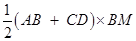
=

Read More: NCERT Solutions for Class 9 Maths chapter 2
Advanced Class 9 Math Heron’s Formula
Ratio-based problems are common in the class 9 chapter 12 maths course. These need you to first determine the actual lengths of the sides by use of a common variable, say, of x.
Ratio Based Questions
Question: The sides of a triangle are in the ratio 12:17:25 and its perimeter is 540 cm. Find its area.
Solution:
Set sides: Let sides be 12x, 17x, and 25x.
Solve for x: 12x + 17x + 25x = 540, which means 54x = 540, so x = 10.
Find actual sides: a = 120 cm, b = 170 cm, c = 250 cm.
Find s: s = 540 / 2 = 270 cm.
Calculate Area: Square Root of [ 270 (270 - 120) (270 - 170) * (270 - 250) ].
Simplify: Square Root of [ 270 150 100 * 20 ].
Final Result: 9,000 square cm.
Isosceles Triangle Application
Question: An isosceles triangle has a perimeter of 30 cm and each of the equal sides is 12 cm. Find its area.
Solution:
-
Identify sides: a = 12 cm, b = 12 cm.
-
Third side (c): 30 - (12 + 12) = 6 cm.
-
Semi-perimeter: s = 30 / 2 = 15 cm.
-
Area Calculation: Square Root of [ 15 (15 - 12) (15 - 12) * (15 - 6) ].
-
Simplify: Square Root of [ 15 3 3 * 9 ].
-
Final Result: 9 * Square Root of 15 square cm.
Park and Mural Problems
In class 9 math heron's formula problems, you might find "slides" in a park. Let’s understand with the case study:
-
Case Study: If sides are 15m, 11m, and 6m, we find the s value first.
-
Step 1: s = (15 + 11 + 6) / 2 = 16 m.
-
Step 2: Area = Square Root of [ 16 (16 - 15) (16 - 11) * (16 - 6) ].
-
Step 3: Area = Square Root of [ 16 1 5 10 ] = 20 Square Root of 2 square meters.
Check Out: Class 9th Question Banks
Practical Applications in Quadrilaterals for Heron’s Formula Class 9
To calculate the area of complicated four-sided figures such as a quadrilateral, you can apply class 9 maths formula herons to determine it. Divide a straight line diagonally and obtain two triangles, and then find the area of each triangle individually to obtain the sum of the areas.
Step-by-Step Quadrilateral Problems
-
Draw the shape: Make a quadrilateral and identify where to draw the diagonal.
-
Right-angle check: If a right angle is present at one corner, use the Pythagoras theorem to find the diagonal's length.
-
Triangle 1: Calculate the area using Heron's formula or the standard base-height formula if possible.
-
Triangle 2: Use Heron's formula for the other half of the shape using the diagonal as a side.
-
Total Area: Sum the results of both triangles to get the final answer.
Example: The Field Problem
A field is in the shape of a quadrilateral ABCD. If Angle C = 90 degrees, BC = 12 m, and CD = 5 m, then the diagonal BD is 13 m.
-
Area of Triangle BCD: (1/2) 12 5 = 30 square meters.
-
For Triangle ABD: If AB = 9 m and AD = 8 m, the sides are 9, 8, and 13.
-
s for Triangle ABD: (9 + 8 + 13) / 2 = 15 m.
-
Area of Triangle ABD: Square Root of [ 15 (15 - 9) (15 - 8) * (15 - 13) ].
-
Step 2: Square Root of [ 15 6 7 2 ] = 6 Square Root of 35, which is roughly 35.5 square meters.
-
Total Field Area: 30 + 35.5 = 65.5 square meters.
How to Design Objects with Heron’s Formula?
-
Umbrellas: Often made of 10 triangular pieces of cloth of two different colors.
-
Kites: A kite is usually made of a square and an isosceles triangle at the bottom.
-
Floral Designs: Many floor designs use small triangular tiles.
Check Out: Class 9th Revision Books
FAQs for Heron’s Formula Class 9 Solutions
Can Heron's formula be used for equilateral triangles?
Yes, it works for every single type of triangle. While the specific equilateral formula is faster, Heron's formula will give the exact same result if you plug in the three equal sides correctly.
What does the "s" stand for in the formula?
The s stands for semi-perimeter. You determine it by summing all three sides of the triangle and dividing the resultant sum by half. Don't forget this step!
Is Heron's formula used for quadrilaterals in school exams?
Yes, it is a very frequent exam topic. You must divide the quadrilateral into two triangles using a diagonal line and then solve for each part individually before adding them.
How do I solve problems where sides are given as ratios?
The ratios can be assigned a particular variable (e.g. 3x, 4x, 5x). The actual side lengths can be found by multiplying the given value of the perimeter to obtain the value of x and then multiplying the two.
What if the height of the triangle is already given in the question?
If the height and base are known, you don't need Heron's formula.
Use the simpler formula, Area = (1/2) base height to save time and effort during your test.
What are the tips to score good marks?
Make sure to memorize the formula and practice the questions everyday. You can find the most potential questions by downloading a class 9 heron's formula extra questions pdf.