Why PW CBSE Class 10 PYQ is Fastest Way to Revise All Subjects?

Preparing for the board exams presents a distinct challenge for every student. Sifting through vast textbooks during your final preparation months often leads to confusion and unnecessary stress rather than actual progress. The primary struggle is identifying which topics require deep attention and which ones merely need a quick review.
This is exactly where the CBSE Class 10 PYQ set becomes an indispensable asset for your study desk. By shifting your focus from passive reading to active, exam-aligned practice, you can streamline your final months and build the exact answering skills required by official examiners.
Importance of CBSE Class 10 PYQ
When you start your final board exam preparation, traditional reading strategies often fall short. Standard textbook chapters do not tell you how a question will be framed or how marks are distributed. Using real past papers bridges this gap perfectly.
-
Understanding the Examiner's Mindset: Practising real past questions shows you exactly how board examiners twist simple concepts into application-based problems.
-
Targeting High-Weightage Areas: Not all chapters carry equal weight. Reviewing past papers highlights the specific theorems, definitions, and formulas that appear year after year.
-
Gaining Exam Familiarity: Sitting for an exam becomes significantly less stressful when the question paper format looks identical to what you have practiced at home.
To give you a clearer picture of how past papers transform your approach compared to standard reading, consider this structural breakdown:
|
Revision Aspect |
Traditional Textbook Reading |
Practising with CBSE Class 10 PYQ |
|
Focus Area |
Complete theoretical data without structural hierarchy |
Real exam trends and high-yield questions |
|
Time Spent |
High time investment with lower revision output |
Quick, targeted review of critical topics |
|
Skill Built |
Information retention and passive memorisation |
Active problem-solving and answer-writing |
|
Marking Awareness |
No native insight into step-wise marks allocation |
Complete clarity on how marks are distributed |
Features of CBSE Class 10 PYQ
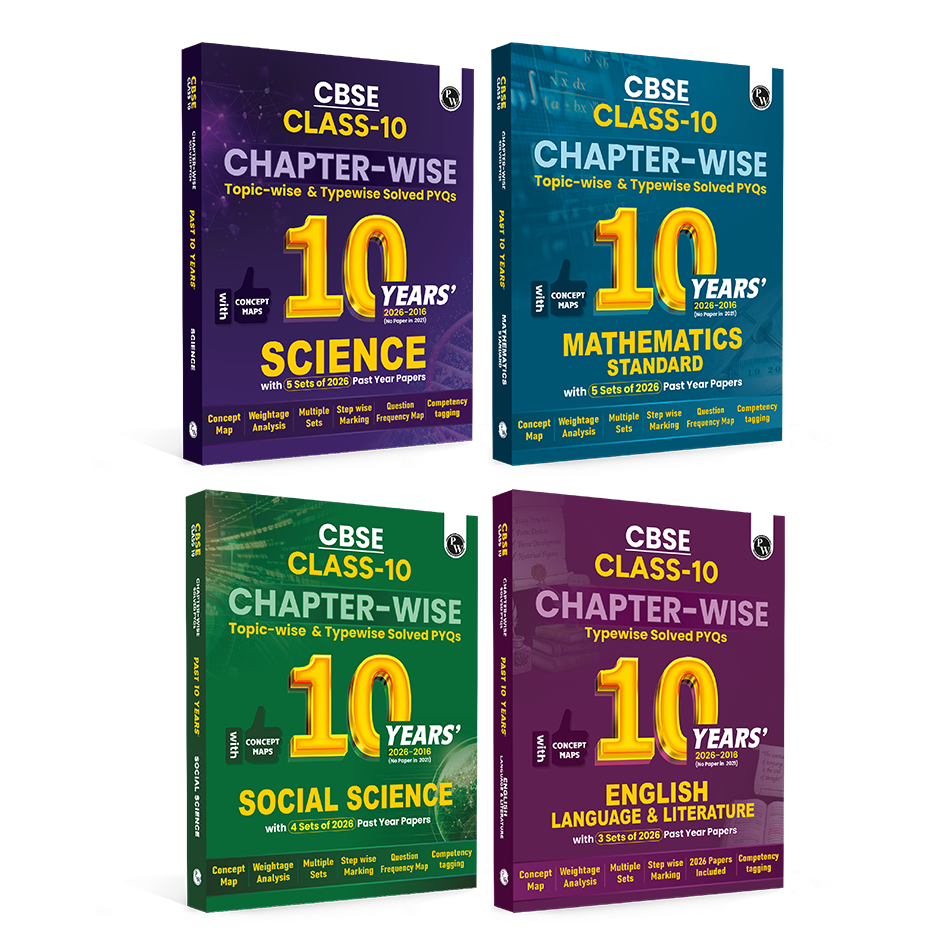
This study resource comes packed with several score-boosting elements designed to make your preparation structural and highly systematic. CBSE Class 10 previous year papers 2026 includes an extensive compilation spanning from 2016 to 2026.
1. Smart Exam Analysis and Trends
The inclusion of a dedicated question frequency map gives you an immediate analytical edge. This feature outlines the evolving trends across a decade of board exams, allowing you to see how the typology of questions has changed over time.
2. Complete Decade-Long Coverage
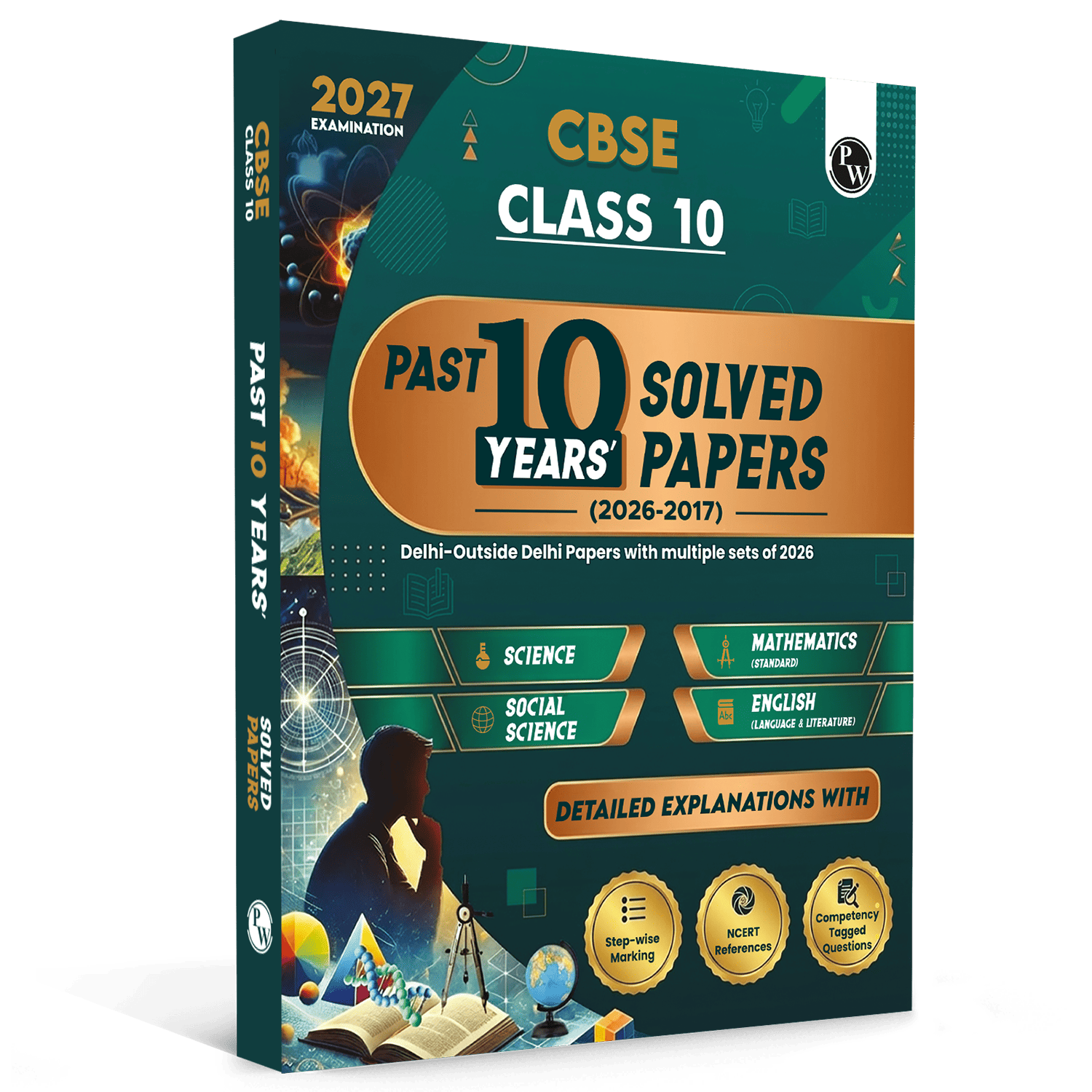
The collection provides 10 years of solved papers covering both the Delhi and Outside Delhi regions. It includes multiple sets from the 2026 exams with complete explanations, ensuring you do not miss any regional variations in the papers.
3. Advanced Learning Architecture
The structural design incorporates several sophisticated pedagogical tools:
-
Bloom's Taxonomy Classification: Questions are systematically categorised across six distinct cognitive learning levels to develop analytical and deep evaluation skills.
-
Type-wise Question Segregation: Every chapter splits questions into objective, short-answer, and long-answer formats based on the latest board patterns.
-
Visual Concept Maps: Highly structured visual maps are provided at the start of chapters to help you recall complex formulas and definitions quickly.
How CBSE Class 10 PYQ Covers All Major Subjects?
A major benefit of this resource is its unified approach. Instead of searching for separate question banks for different subjects, this compilation provides comprehensive coverage of all four core subjects with equal depth and precision. Students looking for a complete practice solution can also refer to the CBSE Class 10 PYQ Combo 2027, which brings together subject-wise previous year questions in one place, making revision more organised and exam-focused.
1. Mathematics (Standard)
Mathematics requires a precise understanding of step-wise marking. The resource breaks down complex algebraic proofs, geometric theorems, and trigonometry problems into clear, sequential steps. This teaches you how to present your calculations neatly to avoid losing trivial marks.
2. Science
The Science section is carefully split into Physics, Chemistry, and Biology:
-
Physics: Focuses heavily on numerical problems, ray diagrams, and circuit calculations.
-
Chemistry: Prioritises balancing chemical equations, identifying compound properties, and practical-based questions.
-
Biology: Provides neat, labelled diagrams alongside precise point-wise explanations for complex physiological processes.
3. Social Science
Social Science papers are historically lengthy and require structured writing. This guide helps you organise your history, geography, civics, and economics answers into concise bullet points, making it easy for external examiners to grade your work.
4. English Language & Literature
For language papers, the book offers clear guidelines on analytical paragraphs, formal letters, grammar rules, and textbook extracts, helping you write crisp, error-free answers.
Benefits of CBSE Class 10 PYQ
Incorporating a dedicated class 10 PYQ book into your daily routine brings immediate improvements to your study output. It changes how you process information and ensures your practice aligns with official standards.
-
Better Conceptual Clarity: Because every single question is linked directly back to NCERT concepts, you can easily revisit your primary textbooks whenever you hit a roadblock.
-
Perfected Answer-Writing Skills: Writing down answers using the official marking scheme helps you learn where to place keywords, diagrams, and final statements to secure full marks.
-
Strategic Time Management: Working through complete papers teaches you how to allocate your three hours perfectly between short objective questions and lengthy descriptive answers.
How to Use CBSE Class 10 PYQ for Subject-Wise Revision?
To get the most out of your CBSE previous year questions, you need a tailored approach for each subject. Simply reading the solutions passively will not produce the best results during the actual exam. Pairing your practice with well-structured CBSE Class 10 Books can further strengthen conceptual understanding and make revision more effective.
- For Calculative Subjects: Hide the solutions completely. Solve the Mathematics or Science numerical on a blank sheet first, then compare your steps with the marking scheme using a red pen to identify mistakes.
- For Theory-Heavy Subjects: Read the question, write down the key points you would include in your answer, and then check whether those points match the detailed solution.
- For Maps and Diagrams: Practise drawing diagrams and marking maps on your own while analysing previous year papers to identify commonly repeated questions and improve presentation skills.
When to Use CBSE Class 10 PYQ?
Timing your preparation correctly is just as crucial as the material you use. Introducing Class 10 PYQs at the right moments in your academic cycle will significantly boost your retention.
-
During Weekly Revisions: Do not wait until the entire syllabus is finished. As soon as you complete a chapter in school, open your past yearbook to solve questions related to that specific topic.
-
During Pre-Board Season: Use the comprehensive papers to test your stamina. Sit in a quiet room, set a timer for 180 minutes, and complete a full paper without any external help.
-
In the Final Weeks Before the Exam: Shift your entire focus away from new reference textbooks. Use this period to read through the error analysis and trend reports to reinforce your strengths.
Study Strategy Plan with CBSE Class 10 PYQ
To make your board exam revision highly structured, you can follow this balanced 4-week study plan that integrates all four major subjects seamlessly.
|
Week |
Target Focus |
Daily Revision Action Plan |
|
Week 1 |
High-Weightage Chapters |
Identify top-scoring chapters using the trend analysis maps. Solve topic-wise questions for Mathematics and Science. |
|
Week 2 |
Type-Wise Segregation |
Focus on specific question formats such as case-based questions, assertions, reasons, and long analytical descriptive answers. |
|
Week 3 |
Full-Length Integration |
Solve older papers from 2016 to 2022 under timed conditions. Focus on writing speed and neatness in Social Science and English. |
|
Week 4 |
Latest Trends & Mistakes |
Deeply analyse the 2026 multiple sets and official sample question papers. Review your past mistakes and memorise the marking schemes. |
Tips to Get the Good Results with CBSE Class 10 PYQ
To maximize your performance using previous year papers class 10, follow these actionable strategies during your daily study sessions:
-
Pay Attention to Competency Tags: Modern board exams focus heavily on application-based questions. Use the competency-tagged questions to adapt to this style of testing.
-
Study the Official Step-Marking: If a question carries 5 marks, observe how points are split across definitions, formulas, calculations, and final units.
-
Analyse the Question Frequency Maps: Use these visual aids to avoid wasting time on outdated topics that have not been asked in the last decade.
-
Keep an Error Notebook: Maintain a separate journal where you write down every question you answered incorrectly, along with its correct step-by-step solution.
Read More: CBSE Class 10 Study Timetable 2026-27
CBSE Class 10 PYQ FAQs
How do past papers help in scoring high marks for Class 10 boards?
Past papers reveal the exact questions, difficulty levels, and marking trends used by examiners. Practising them improves your speed, accuracy, and answer presentation skills.
Should I solve past papers if my regular textbook syllabus is incomplete?
Yes. You can use a chapter-wise and topic-wise layout to solve questions only for those chapters you have already completed, keeping your preparation perfectly on track.
Are the questions from old board papers repeated in current exams?
While direct questions might not repeat word-for-word, the core concepts, data structures, and question patterns repeat almost every single year.
What makes a chapter-wise past paper compilation better than a standard book?
A chapter-wise layout allows you to pinpoint your weak areas immediately after finishing a topic, rather than waiting until the end of the year to test your knowledge.
How does a book with a comprehensive CBSE revision book structure save study time?
It saves hours by organizing multiple sets, concept maps, detailed solutions, and marking schemes into a single place, completely removing the need to search online for old files.