How to Score Good Marks in Chemistry with Class 12 Question Bank

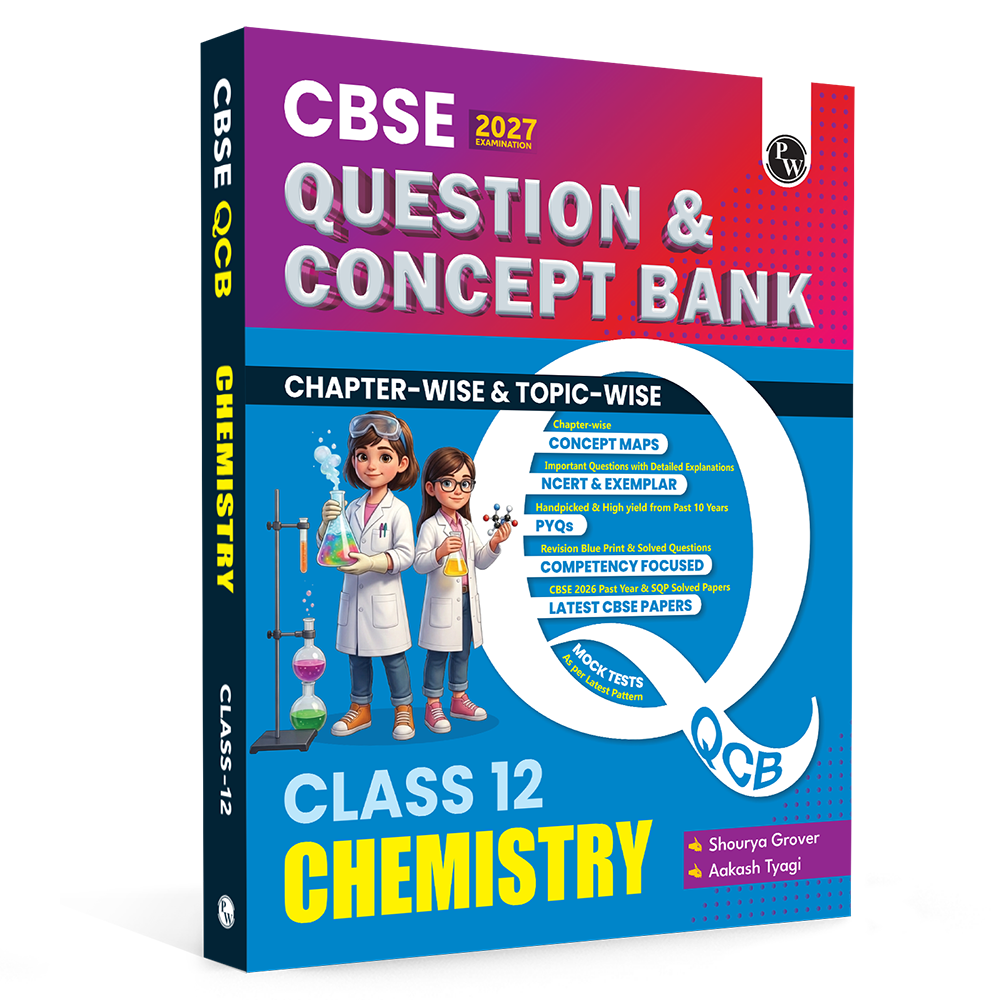
Scoring good marks in Chemistry becomes easier when you study with the right plan. A CBSE class 12 question bank chemistry helps students practice important questions, understand the latest paper pattern, and improve answer writing. It also shows which topics come often in exams. If you use it daily with NCERT, you can prepare better and score high marks in board exams.
Check Out: PW CBSE Class 12th Books!
Importance of CBSE Class 12 Question Bank Chemistry
Using a CBSE class 12 chemistry question bank is very helpful for students who want better marks. Textbooks are important for theory, but question banks give practice in exam style questions. They are made according to the latest CBSE syllabus and marking scheme.
Understanding Exam Weightage
To score well, first understand chapter weightage. A good CBSE 12th chemistry question bank gives chapter-wise questions. This helps you know which chapters are more important. Topics like Electrochemistry, Solutions, Coordination Compounds, and Organic Chemistry often carry good marks. When you know weightage, you can divide study time wisely.
Familiarisation with Question Formats
The Chemistry paper has many question types such as MCQs, Assertion-Reason, Case-Based Questions, Short Answers, and Long Answers. A CBSE question bank class 12 chemistry gives enough practice of all formats. This makes students ready for the real exam and reduces fear.
Study Strategies with CBSE Class 12 Question Bank Chemistry
Chemistry needs smart study, not only long study hours. A class 12th chemistry question bank can help you study in the correct way.
Start with Chapter-wise Practice
After finishing any chapter from NCERT, start solving questions from the chem question bank class 12.
-
First solve easy 1-mark and 2-mark questions. This builds basics.
-
Then solve medium and difficult questions.
-
Revise mistakes and learn correct method.
Identify Core Concepts
Many students lose marks because basics are weak. Use the CBSE class 12 question bank to understand formulas, reactions, definitions, and laws. If your concepts are clear, you can answer faster.
Master Numericals
Physical Chemistry has many numericals. Practice questions on molarity, molality, Raoult’s law, electrochemistry, and chemical kinetics. Use the CBSE class 12 chemistry question bank daily for numerical practice. Write each step clearly.
Organic Conversions
Organic Chemistry needs regular practice. Solve conversion questions from the CBSE 12th chemistry question bank. Practice name reactions and reaction steps again and again. This helps in remembering reactions for a long time.
Focus on NCERT Exemplar Problems in CBSE Class 12 Question Bank Chemistry
Many board exam questions come directly or indirectly from NCERT. A good CBSE question bank class 12 chemistry often includes NCERT Exemplar questions too. This saves time because you get everything in one book.
Students who solve exemplar problems usually perform better because these questions test understanding. Use your class 12th chemistry question bank to solve these extra important questions.
Master Organic Chemistry with CBSE Class 12 Question Bank Chemistry
Organic Chemistry gives many marks in Class 12. Many students feel it is hard because there are many reactions. But with the chem question bank class 12, it becomes easier.
Roadmaps and Flowcharts
Make simple charts of reactions. For example, Alcohol to Aldehyde, Aldehyde to Acid, Acid to Ester. A CBSE class 12 question bank chemistry helps you find common conversions. Write them in notebook form.
Mechanism Practice
Some questions ask reaction mechanism. Practice writing steps from the CBSE class 12 chemistry question bank. Examples include dehydration of alcohols and nucleophilic substitution reactions.
Distinction Tests
Questions like difference between Propanal and Propanone are common. Practice these from the CBSE 12th chemistry question bank. Learn reagent name, colour change, and final observation.
Solving Physical and Inorganic Chemistry with CBSE Class 12 Question Bank Chemistry
Physical Chemistry is based on formulas and logic. Inorganic Chemistry needs memory and regular revision. Both can be improved with a CBSE question bank class 12 chemistry.
Physical Chemistry Tips
-
Make one formula sheet.
-
Learn units carefully.
-
Solve numericals daily.
-
Practice graphs and trends.
Use the class 12th chemistry question bank for chapter tests and mixed practice.
Unit Conversions
Many students lose marks because they forget unit changes like mL to L or Joule to kJ. Solve such questions from the chem question bank class 12.
Inorganic Chemistry Tips
Learn periodic trends, properties, colours, ores, compounds, and uses. Revise NCERT lines regularly. Use the CBSE class 12 question bank chemistry for reasoning questions.
Examples:
-
Why are transition metals coloured?
-
Why does Nitrogen show different behaviour?
-
Why is Fluorine most reactive?
Coordination Compounds
This chapter is important. Practice IUPAC naming, ligands, geometry, and magnetic nature from the CBSE class 12 chemistry question bank.
Time Management and Speed Building for CBSE Class 12 Chemistry
Many students know answers but cannot finish paper on time. A CBSE 12th chemistry question bank helps improve speed.
Timed Practice
Set a timer and solve one section daily.
-
MCQ section in 20 minutes
-
Short answers in fixed time
-
Full paper in exam time
Practice with the CBSE question bank class 12 chemistry regularly.
Self-Evaluation
After solving, check answers from solutions. Compare your steps and keywords. A class 12th chemistry question bank with solved answers helps a lot.
Identify Weak Spots
If you make mistakes in one chapter again and again, revise theory first. Then solve more questions from the chem question bank class 12.
CBSE Class 12 Question Bank Chemistry with PYQs
PYQs are one of the best tools for board preparation. A good CBSE 12th chemistry question bank includes previous year board questions.
Spotting Patterns
You may notice some topics come again and again:
-
Faraday’s Law
-
Nernst Equation
-
Aldehydes reactions
-
Potassium Dichromate preparation
-
Coordination compounds naming
Use the CBSE question bank class 12 chemistry to identify repeated topics.
Confidence Building
When you solve real board questions, confidence increases. You understand the exam level. The class 12th chemistry question bank helps you feel ready.
Marking Scheme Awareness
Solved PYQs in the chem question bank class 12 show how to write answers for full marks. Learn to use:
-
Bullet points
-
Balanced equations
-
Proper steps
-
Underlined keywords
-
Neat diagrams
Also Check, Class 12th PYQs
Final Revision Strategy with CBSE Class 12 Question Bank Chemistry
Last weeks before exam are very important. At this time, use the CBSE class 12 question bank chemistry more than anything else.
Filter Questions
Mark difficult questions during first study. During revision, solve only marked questions again. This saves time.
Simulate Exam Conditions
Take one sample paper from the CBSE class 12 chemistry question bank and solve in a quiet room in 3 hours. Do not use phone or notes.
Focus on Presentation
Good presentation can increase marks.
-
Write neat answers
-
Balance equations properly
-
Draw clean diagrams
-
Mention units clearly
-
Leave space between answers
Using the CBSE 12th chemistry question bank helps improve presentation style.
Chemistry is not difficult if you study with the right method. Use NCERT for theory and a chem question bank class 12 for practice. Solve chapter-wise questions, PYQs, numericals, and sample papers. Revise weak chapters again and again. With regular use of the CBSE class 12 question bank chemistry, you can score very good marks in Class 12 board exams.
Read More: CBSE Class 12 Chemistry Chapter-Wise PYQs
Score Good Marks in Chemistry with Class 12 Question Bank FAQs
Q1: Is the CBSE class 12 question bank chemistry enough to score 90+ marks?
Yes, if you study NCERT well and practice daily, the CBSE class 12 question bank chemistry is enough for high marks. It covers important questions, PYQs, and exam pattern.
Q2: When should I start practicing from the CBSE class 12 chemistry question bank?
Start as soon as each chapter is completed in school or coaching. Use the CBSE class 12 chemistry question bank side by side with regular study.
Q3: Does the CBSE 12th chemistry question bank include solved answers?
Most trusted books provide solutions and marking methods. A CBSE 12th chemistry question bank with answers is best for self-checking.
Q4: Are numericals from the CBSE question bank class 12 chemistry repeated in exams?
Exact numbers may change, but question types are often similar. So solving a CBSE question bank class 12 chemistry helps a lot.
Q5: How many hours should I dedicate to the class 12th chemistry question bank?
You should spend at least 1 to 2 hours daily solving from the class 12th chemistry question bank. Regular practice improves speed, confidence, and marks.